
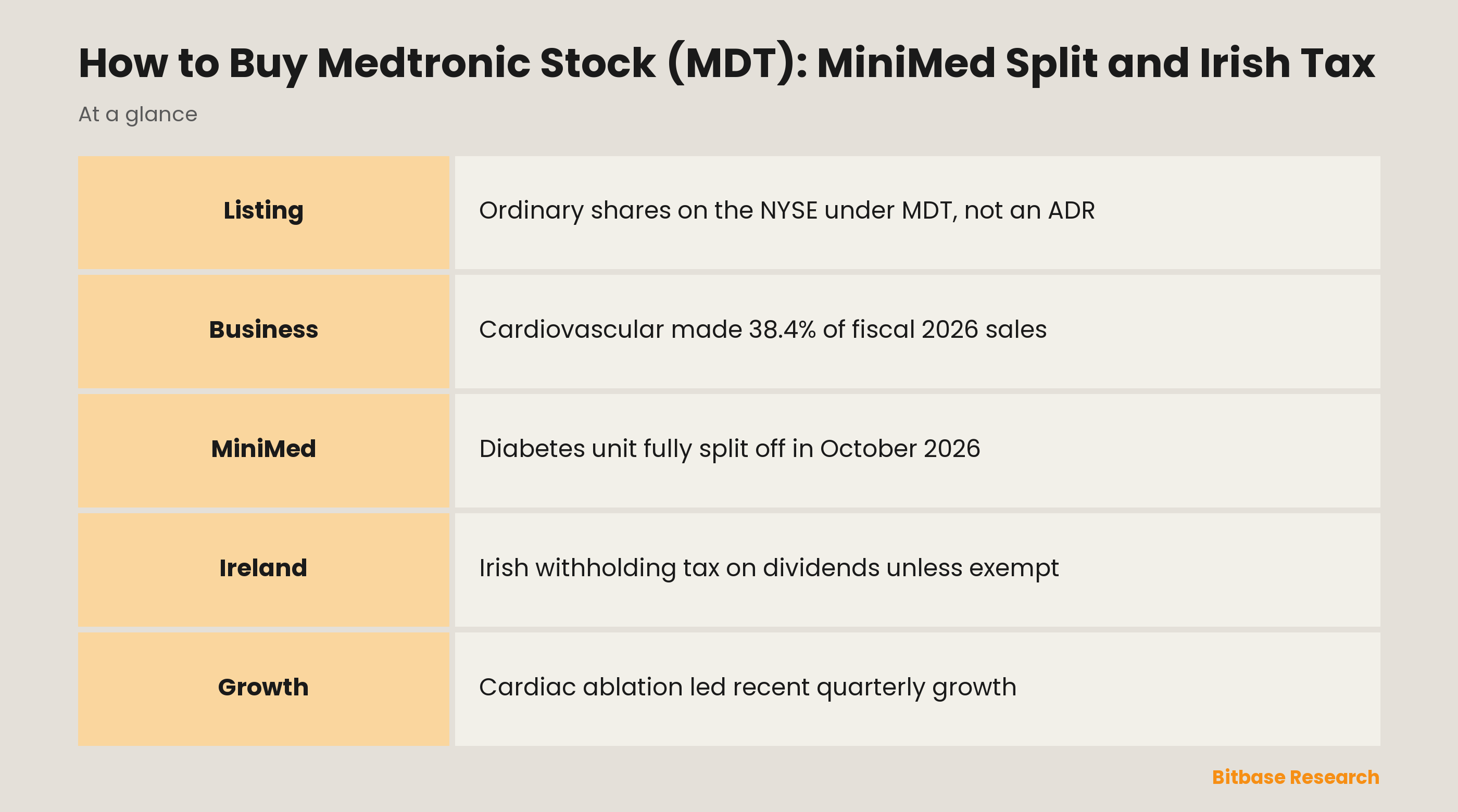
A Medtronic share is bought the way most US-listed stocks are: open an account with a broker that reaches the New York Stock Exchange and order the ticker MDT. What that share holds changed in October 2026, when the company completed the split-off of its diabetes business, now MiniMed, and kept none of its stock. Medtronic plc is incorporated and headquartered in Ireland, and its 10-K says Irish withholding tax applies to dividends unless an exemption does. This guide covers how the heart, neuroscience and surgical portfolios that remain make money, how to buy MDT, and what the filings flag: pulsed field ablation, pricing pressure, product quality and a long-running US tax case.
What Does Medtronic Do?
Medtronic makes medical devices; its 10-K calls them "device-based medical therapies and services." Founded in 1949, it serves more than 150 countries and still quotes its founder's 1960 mission: "to alleviate pain, restore health, and extend life." Hospitals, surgical centers and clinics buy through its sales representatives, distributors and group purchasing contracts.
Three segments make up the company. Cardiovascular covers pacemakers such as the leadless Micra, defibrillators, ablation systems for atrial fibrillation, Evolut transcatheter aortic valves, stents and Symplicity Spyral, a renal denervation system for hypertension. Neuroscience sells spinal implants with the navigation and robotic systems used to place them, stroke devices, ear, nose and throat products and neurostimulators. Medical Surgical makes staplers, LigaSure vessel sealers, the Hugo robotic-assisted surgery system, endoscopy tools and Nellcor pulse oximeters.
Until October 2026 there was a fourth business. Diabetes, which made insulin pumps, continuous glucose monitors and their consumables, listed on Nasdaq in March 2026 as MiniMed Group (MMED), and Medtronic then exchanged all of its remaining MiniMed stock for MDT shares tendered by its own holders. The FAQ below explains how that worked.
The Irish structure dates from 26 January 2015, when Medtronic plc, a newly formed Irish company, acquired Covidien plc and took the Minnesota company Medtronic, Inc. as a subsidiary. Every Medtronic, Inc. share became one Medtronic plc ordinary share, and the ticker on the NYSE stayed MDT. The head office is in Galway.
How Medtronic Makes Money
Net sales rose 8% in fiscal 2026, the year that ended on 24 April 2026, which the results release called Medtronic's highest annual revenue growth in ten years; organic growth, which strips out currency effects and a few other items, was 5.8%. The 10-K's sales table, recast after Diabetes stopped being a reportable segment, divides the year like this:
| Segment | What it sells | Share of fiscal 2026 net sales | Fiscal 2026 sales change |
|---|---|---|---|
| Cardiovascular | Pacemakers and defibrillators, cardiac ablation, heart valves, stents | 38.4% | +12% |
| Neuroscience | Spine implants and surgical navigation, neurovascular, ENT, neuromodulation | 28.3% | +4% |
| Medical Surgical | Staplers, vessel sealing, surgical robotics, endoscopy, patient monitoring | 24.2% | +5% |
| Diabetes (now MiniMed) | Insulin pumps, glucose monitors, consumables | 8.6% | +13% |
Percentages are worked out from the 10-K's fiscal 2026 figures to one decimal place; exited businesses and an Italian accrual adjustment make up the small remainder. Leave Diabetes out and the three remaining portfolios split fiscal 2026 sales roughly 42%, 31% and 27%.
Cardiac Rhythm & Heart Failure is the largest single division, at about 20.6% of fiscal 2026 net sales, and the fastest growing of the reportable divisions, up 17%. The 10-K credits "strong growth in the pulsed ablation portfolio with partially offsetting declines in cryoablation," plus Micra. Elsewhere, Cranial & Spinal Technologies rose 5%, Neuromodulation 7%, Surgical & Endoscopy 4% and Specialty Therapies 2%, held back by Pelvic Health and a recall of the Pipeline Vantage embolization device.
About 50% of sales came from the United States, where they grew 5%, against 12% growth internationally. Medtronic says it is "not dependent on any single customer for more than 10 percent of our total net sales." Payment usually comes from third parties: the 10-K names Medicare and Medicaid, private insurers and volume-based procurement tenders in China among those working to hold down costs.
MDT Stock at a Glance
| Feature | MDT |
|---|---|
| Listing venue | New York Stock Exchange (NYSE) |
| Symbol | MDT |
| What you buy | Ordinary shares, the one equity line on the 10-K cover, not depositary receipts |
| Bonds on the same exchange | Medtronic senior notes under suffixed symbols, for example MDT/27 and MDT/53 |
| Identifier | ISIN IE00BTN1Y115, which starts with Ireland's country code |
| Industry | Healthcare: medical devices |
| Index | S&P 500 |
| Legal home | Ireland, as a public limited company, since January 2015 |
| Head office | Galway, Ireland |
| Financial year | 52 or 53 weeks, closing on the last Friday in April |
| Dividends | Paid quarterly; the June 2026 increase was the 49th consecutive yearly rise |
| Tax on dividends | Irish dividend withholding tax, unless an exemption applies |
| SEC filer number | CIK 1613103 (annual 10-K, quarterly 10-Q, event-driven 8-K) |
Price, market capitalization and yield are left out because they move all day; for those, open the Medtronic stock page on Bitbase.
How to Buy Medtronic Stock
Irish registration does not change how MDT trades. It is the ordinary share itself, quoted on the NYSE in US dollars, so the steps match those for a US company:
1. Pick a broker that offers NYSE stocks. Outside the US, that can be a domestic firm offering US markets or a global one; confirm which legal entity holds your assets and who regulates it.
2. Complete the account and its tax paperwork. A non-US individual is typically asked for IRS Form W-8BEN, the "Certificate of Foreign Status of Beneficial Owner for United States Tax Withholding." Ask as well how Irish withholding on Medtronic dividends will be handled.
3. Fund the account. If your money is in another currency, the conversion spread is a cost to compare next to commissions.
4. Check the line before ordering. The result should read Medtronic plc ordinary shares on the NYSE, with ISIN IE00BTN1Y115. A suffixed symbol such as MDT/27 is a Medtronic bond; on a stock exchange each symbol is reserved for one security, which is why the suffix matters.
5. Set the order type. FINRA notes that a market order "generally will execute at or near the current bid or ask prices," while a limit order executes only "at or better than a specified price," with "a chance your order doesn't get executed at all."
6. Choose the amount. Where fractional shares are offered, a fixed cash sum buys part of a share, with possible limits on votes, dividends and transfers.
7. File what the broker sends. Trade confirmations and statements show your cost, every dividend and any tax taken from it.
Irish withholding on dividends. Under the heading "Irish Taxes Applicable to U.S. Holders," Item 5 says dividends "will generally be subject to Irish dividend withholding tax," at a current rate of 25%, "unless an exemption applies." US residents are exempt if their shares sit in the Depository Trust Company (DTC) with a US address in the broker's records, or, for registered holders, if a US Certification of Residence (Form 6166) or an Irish Non-Resident Form V2 is on file with the transfer agent. The risk factors add that residents of other specified treaty countries "may be entitled to exemptions," while other shareholders may be taxed. Your own country may tax the dividend too.
Irish stamp duty. Book-entry transfers within DTC are exempt, the 10-K says, but a transfer of shares held directly "could be subject to Irish stamp duty," currently 1% of the higher of the price paid or market value, usually owed by the buyer.
Index funds give indirect exposure. Medtronic PLC is listed in the SPDR S&P 500 ETF Trust's SEC holdings report for 30 June 2026, so a fund replicating the S&P 500 carries MDT as one small position among hundreds.
What Moves MDT Stock
Cardiac ablation. Of the businesses named in the latest results releases, ablation for atrial fibrillation grew fastest. Cardiac Ablation Solutions sales rose 78% in the fourth quarter of fiscal 2026 and 88% in the first quarter of fiscal 2027, the results releases say, while the 10-K records partly offsetting declines in cryoablation. The range keeps widening: the Affera mapping and ablation system and Sphere-9 catheter received FDA approval in late October 2024, and the Sphere-360 single-shot catheter received a CE Mark in January 2026. Cardiovascular as a whole grew 20% in the first quarter of fiscal 2027.
Approvals and coverage. Newer products depend on regulators and payers. Hugo received FDA clearance for urologic procedures in December 2025, and in June 2026 Medtronic said it had filed for general surgery and gynecologic indications. For Symplicity Spyral, CMS, which runs Medicare, finalized a National Coverage Determination in October 2025. The Stealth AXiS surgical system received FDA approval for spine in February 2026 and for cranial and ENT procedures in March 2026.
Prices and tariffs. Payers press on device prices, with the 10-K naming tender pricing in China next to US programs. Tariffs add a newer cost: cost of products sold rose as a share of fiscal 2026 net sales, mainly because of higher tariffs and duties on imported goods, along with asset write-offs.
Drugs and robots as competition. No rival is named in the 10-K. It describes competitors from large multi-line manufacturers to small specialists, and adds pharmaceutical companies "including those producing glucagon-like peptide-1s (GLP-1s)." In surgery it links weaker Advanced Stapling sales to "shifts to robotic surgery and bariatric procedure declines." For another large healthcare group that sells heart devices and glucose monitors, see the Abbott stock guide.
Deals. Smaller acquisitions keep arriving: CathWorks in April 2026, Scientia Vascular in June 2026 and SPR Therapeutics, a peripheral nerve stimulation company focused on chronic pain, in July 2026.
Life after MiniMed. Since mid-October 2026 an MDT share carries none of the diabetes business, and the chief executive said the company could now put "the full weight of our organization behind advancing innovation and fueling growth across our Cardiovascular, Neuroscience and Surgical portfolios."
Risks Medtronic Flags in Its 10-K
Item 1A is long; these headings matter most for an MDT holder:
Competition. "We operate in a highly competitive industry and we may be unable to compete effectively." New technologies, the filing adds, "may disrupt existing procedures or reduce demand for device-based therapies, including in markets where we currently have leading positions."
Quality and recalls. "Quality problems have in the past and could in the future lead to recalls or safety alerts, product liability claims, reputational harm, adverse verdicts or costly settlements." One serious event could hurt demand for "all products within that brand," and the Pipeline Vantage recall weighed on fiscal 2026.
Cost containment and supply. "Healthcare industry cost-containment measures could result in reduced sales of our medical devices and medical device components." On the supply side, some components come from a single supplier, and FDA manufacturing rules make replacements slow to qualify.
The Puerto Rico tax case. Medtronic, Inc. and the IRS still disagree on how income for fiscal 2005 and 2006 should be split between it and its Puerto Rico subsidiary, which runs a key manufacturing site. The Tax Court ruled in August 2022, the IRS appealed in September 2023, Medtronic cross-appealed, and in September 2025 the appeals court sent the case back to the Tax Court. An adverse result, the 10-K says, "could materially and adversely affect" the business.
Irish law. "Our shareholders may have more difficulty protecting their interests than would shareholders of a corporation incorporated in a jurisdiction of the United States."
Two general points apply too. A single stock concentrates your outcome in one business, and a long dividend record is no promise: the board decides each payment, weighing "the statutory requirements of Irish law, the Company's earnings and financial condition" among other things. Investors outside the dollar also carry currency risk.
How to Research Medtronic Yourself
EDGAR holds everything under CIK 1613103. Expect a 10-K after each fiscal year, 10-Qs for the first three quarters, and 8-Ks for results, the June 2026 dividend increase and the October 2026 completion of the MiniMed separation. The exchange offer papers, including MiniMed's Form S-4, are there too.
Inside the 10-K, Item 1 covers the portfolios, Item 1A the risks and Item 5 the listing, dividends and Irish taxes; the MD&A lists the launches and approvals management expects to affect each portfolio's sales.
Three cautions apply to any comparison. Fiscal 2026 and the first quarter of fiscal 2027 still consolidate Diabetes, and the 10-K warns that such metrics "may not be directly comparable to future periods." Fiscal 2027 runs 53 weeks, with the extra week in the first quarter, which helped that quarter's sales rise 13.7%. And from fiscal 2027 the Cardiovascular divisions carry new names, Electrophysiology Therapies among them, so older division figures need the recast tables. Quotes are on the MDT page above; to look up other companies, browse US stock pages on Bitbase.
Medtronic Stock FAQ
Does Medtronic pay a dividend?
Yes, quarterly. Raising it in June 2026, the company called that the 49th consecutive year of an increase. Each future payment is the board's decision, and Irish withholding tax applies unless an exemption does; the latest dividend announcement gives the amount and dates.
Can I buy Medtronic stock with crypto?
Not directly. MDT is bought through a brokerage account and settles in US dollars, so any crypto must first be sold and the proceeds sent to the broker; whether that sale is taxed depends on where you live. Treat the two steps as separate decisions, because an ordinary share comes with dividend and voting rights and a share bundles rights that a crypto asset does not.
What happened to Medtronic's diabetes business?
It became MiniMed Group, a separate company listed on Nasdaq as MMED. Medtronic owned about 90% after the March 2026 IPO and then offered its shareholders MiniMed stock in exchange for MDT shares, at 4.5939 MiniMed shares for each MDT share accepted. Demand exceeded the shares on offer, so tenders were accepted pro rata, Medtronic exchanged everything it still held, and it declared the separation complete on 15 October 2026. Taking part was voluntary; holders who did not tender kept their MDT shares.
Is Medtronic an Irish company?
Legally, yes: Medtronic plc is an Irish public limited company with its head office in Galway, a structure set up with the Covidien acquisition in January 2015, and the Minnesota company Medtronic, Inc. is now its subsidiary. Even so, it reports in US dollars and files 10-K reports with the SEC.
Has Medtronic stock ever split?
Yes. Medtronic, Inc. recorded a two-for-one split effective 24 September 1999, paid as a 100% stock dividend. Because each Medtronic, Inc. share later became one Medtronic plc share, per-share data from before September 1999 must be adjusted before any comparison.
Is MDT in the S&P 500?
Yes. Medtronic PLC appears in the SPDR S&P 500 ETF Trust's SEC holdings report for 30 June 2026, and the performance graph in Item 5 of the 10-K measures MDT against the S&P 500 and the S&P 500 Health Care Equipment Index. Its index weight changes daily.
Conclusion
Buying MDT takes an NYSE-capable broker, the ordinary share line rather than a note symbol, and an order type that suits you. What needs more thought surrounds the order: Irish tax on dividends, a company that since October 2026 owns none of its former diabetes business, and recent growth led by cardiac ablation. Read the latest 10-K, the newest 10-Q and the MiniMed separation filings before deciding how much of a portfolio one medical device company should take up.
Related reading
Other Bitbase articles on this topic:
- How to Buy Cigna Stock (CI): Express Scripts and Rebate Reform
- How to Buy CVS Health Stock (CVS): Insurer, PBM and Drugstores
- How to Buy Edwards Lifesciences Stock (EW): TAVR, No Dividend
Disclaimer: This article is educational content from Bitbase Academy, provided for information only. It explains what a company or fund does and how the instruments referenced here differ from one another; it does not constitute investment, trading, tax, or financial advice, and it is neither a recommendation nor an endorsement of any security, token, or trading strategy. A tokenized stock is issued by a third party and is designed to give economic exposure to an underlying asset: it is not a share, it carries no shareholder rights, and it depends on the issuer's structure, eligibility rules, and redemption terms, which the issuer can change. Perpetual futures are leveraged derivatives that hold no underlying asset and can be liquidated, and trading hours, product availability, and eligibility differ by instrument and by jurisdiction and can change at any time. Written as of October 2026; verify everything yourself through company filings, the issuer's own documentation, and the product pages of the venue you trade on.
References
[1] Medtronic plc Form 10-K, fiscal 2026: business, segments, risk factors, dividends and Irish taxes (SEC EDGAR) www.sec.gov
[2] Medtronic Form 10-Q for the quarter ended 31 July 2026: segment sales, the 53-week year and MiniMed (SEC EDGAR) www.sec.gov
[3] Medtronic fourth-quarter and fiscal 2026 results release, 3 June 2026 (Form 8-K exhibit) www.sec.gov
[4] Medtronic first-quarter fiscal 2027 results release, 1 September 2026 (Form 8-K exhibit) www.sec.gov
[5] Medtronic announcement of the final exchange ratio in the MiniMed split-off, 7 October 2026 (Rule 425 filing) www.sec.gov
[6] Medtronic announcement of the final results of the MiniMed exchange offer, 14 October 2026 (Rule 425 filing) www.sec.gov
[7] Medtronic completes separation of MiniMed Group, 15 October 2026 (Form 8-K exhibit) www.sec.gov
[8] Medtronic plc Form 8-K12B, January 2015: completion of the Covidien acquisition and the share conversion (SEC EDGAR) www.sec.gov
[9] Medtronic, Inc. Form 10-K for fiscal 2000, annual report exhibit: two-for-one stock split effective 24 September 1999 (SEC EDGAR) www.sec.gov
[10] SPDR S&P 500 ETF Trust: Form N-PORT holdings report as of 30 June 2026 (SEC EDGAR) www.sec.gov
[11] FINRA: Order Types www.finra.org
[12] IRS: NRA Withholding www.irs.gov





