
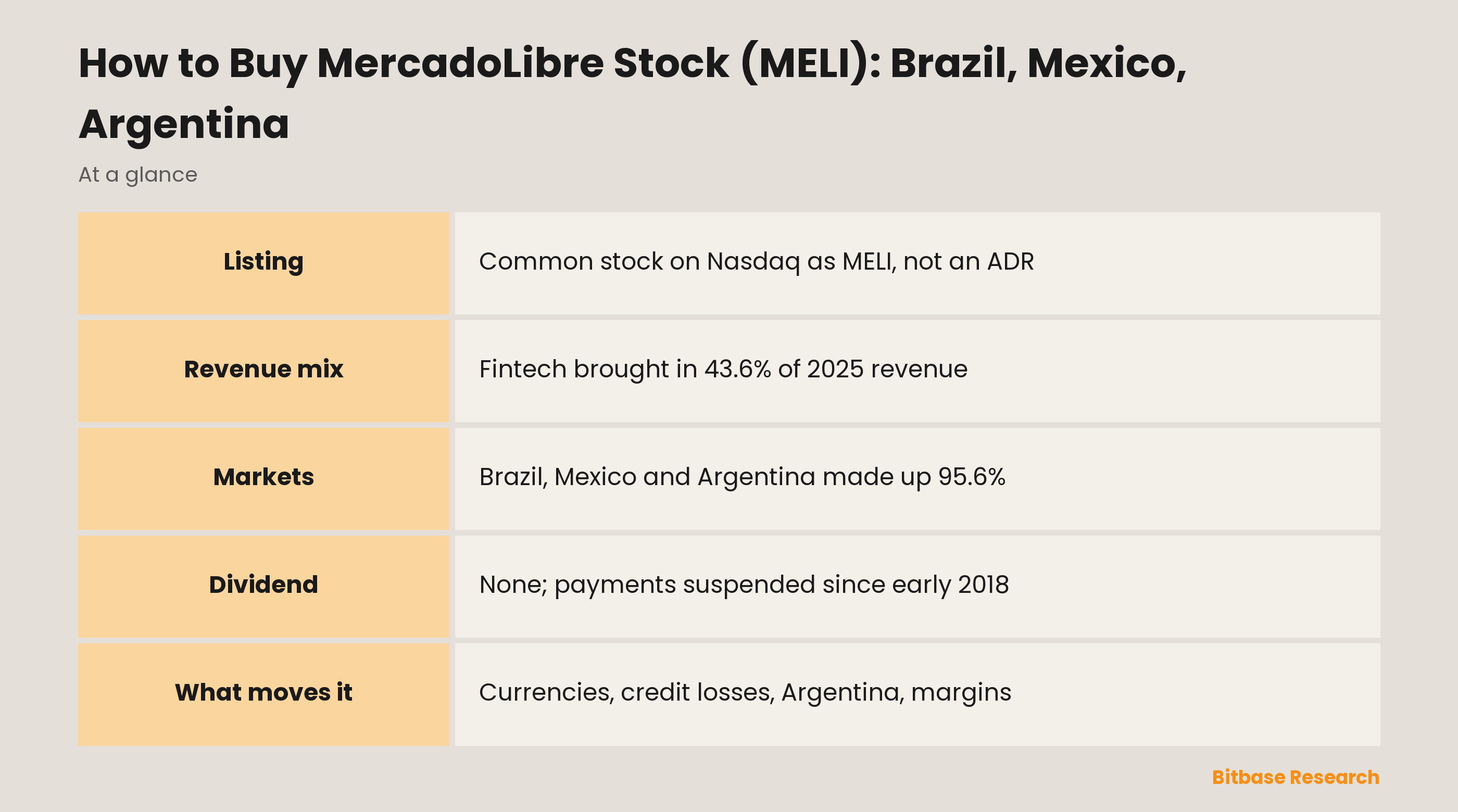
Picking a broker with Nasdaq access is all it takes to buy MercadoLibre stock: the shares trade there under MELI, and they are the common stock of a Delaware corporation, not a depositary receipt. The business behind the ticker is run from Montevideo, Uruguay, and stands on two legs, the Mercado Libre marketplace and the Mercado Pago fintech platform, which brought in 43.6% of 2025 revenue. Brazil, Mexico and Argentina together supplied 95.6%, which puts currencies, credit losses and Argentina's exchange rules close to the centre of any MELI decision.
What Does MercadoLibre Do?
MercadoLibre operates an online marketplace and a set of digital financial services in Latin America. The marketplace, Mercado Libre, is present in 18 countries; the fintech platform, Mercado Pago, in eight. Around them sit Mercado Envios for logistics, Mercado Ads for advertising and Mercado Libre Classifieds for vehicles, property and services.
Co-founder Marcos Galperin wrote the business plan in March 1999 while studying for an MBA at Stanford. Operations began in Argentina that August, the company was incorporated in Delaware in October, and its annual report still recalls "our early days in a garage in Buenos Aires." It went public on Nasdaq in August 2007. On 1 January 2026 Galperin became executive chairman and Ariel Szarfsztejn, until then president of the commerce business, took over as chief executive.
The marketplace mostly sells other people's goods: third-party sellers account for most of its gross merchandise volume (GMV), and MercadoLibre's own inventory for less than 10% of it. The 10-K calls logistics "an integral and crucial part of our value proposition." Fulfilment centres, where sellers keep stock in MercadoLibre's warehouses, handle more than half of shipments, and sellers using Mercado Envios can draw on shipping subsidies to offer free or discounted delivery. Mercado Ads sells sponsored listings and display and video ads, while the Meli+ loyalty programme bundles shipping and cashback benefits.
Mercado Pago began as the marketplace checkout and still processes and settles every marketplace transaction in the countries where it operates. It now also serves merchants off the platform, with online checkout, card readers and QR codes, and offers consumers a digital account with cards, savings, insurance and loans. Lending runs in Argentina, Brazil, Mexico and Chile, and the Mercado Pago credit card launched in Brazil in 2021, Mexico in 2023 and Argentina in 2025. Licences vary by country: Mercado Pago has been an authorised electronic money issuer in Brazil since 2018, while a Mexican subsidiary's application to operate as a bank, filed in September 2024, and a banking licence application in Argentina, filed in June 2025, were both pending when the fiscal 2025 10-K was filed.
The app has a crypto side too. Users in Brazil, Mexico and Chile can buy, hold and sell selected cryptocurrencies inside Mercado Pago, with a partner acting as custodian, and the company issues Meli Dólar, a stablecoin pegged to the US dollar that loyalty members receive as cashback.
How MercadoLibre Makes Money
MercadoLibre reports two revenue lines, Commerce and Fintech, across four geographic segments. Its top line, "net revenues and financial income," grew 39.1% in fiscal 2025; Commerce made up 56.4% of it and Fintech 43.6%. By stream:
| Stream | What it includes | Share of 2025 revenue |
|---|---|---|
| Commerce services | Marketplace fees, shipping, storage, advertising, classifieds, Meli+ | 44.1% |
| Commerce product sales | Goods sold from MercadoLibre's own inventory | 12.3% |
| Fintech services | Off-platform payment fees, instalment fees, asset management, card commissions | 23.1% |
| Credit revenues | Interest and fees on merchant and consumer loans and the credit card | 20.3% |
| Fintech product sales | Point-of-sale devices | 0.2% |
Shares are calculated from the fiscal 2025 segment note and rounded to one decimal.
Credit revenues grew 62.7% in 2025 on higher loan originations, and fintech now makes up most of the business in Argentina:
| Segment | Share of 2025 revenue | Growth in US dollars | Fintech share of the segment |
|---|---|---|---|
| Brazil | 52.6% | 33.3% | 39.6% |
| Mexico | 22.4% | 38.8% | 35.4% |
| Argentina | 20.6% | 56.2% | 65.9% |
| Other countries | 4.4% | 41.2% | 29.0% |
Revenue shares and growth rates are from the 10-K; fintech shares are calculated from the segment note.
The segment note measures each country by direct contribution, what remains after local operating costs and depreciation, and in 2025 Argentina's equalled 41.6% of its revenue against 13.7% in Brazil, making it the largest contributor of the four segments. Brazil's direct contribution fell from 2024 even as its revenue grew.
At the end of 2025 Mercado Pago had 78 million monthly active users, 121 million users bought on the marketplace during the year, GMV rose 26.4% and total payment volume 41.3%. No single customer accounted for more than 5.0% of revenue.
MELI Stock at a Glance
| Item | Detail |
|---|---|
| Exchange | Nasdaq Global Select Market |
| Ticker | MELI |
| Security | Common stock of MercadoLibre, Inc.; no depositary receipt |
| Other listed securities | Two series of notes, MELI31 and MELI33, also on Nasdaq |
| Listed since | August 2007 initial public offering |
| Sector | E-commerce and fintech in Latin America |
| Index membership | Nasdaq-100; not in the S&P 500 (fund holdings, October 2026) |
| Incorporated | Delaware, October 1999 |
| Principal executive offices | Montevideo, Uruguay |
| Fiscal year | Calendar year, ending 31 December |
| Dividend policy | No dividend; payments suspended from the first quarter of 2018 |
| Leadership | Ariel Szarfsztejn, CEO since January 2026; Marcos Galperin, executive chairman |
| SEC identifier | CIK 1099590 |
For price, market value and trading volume, which change by the second, open the MercadoLibre stock page on Bitbase.
How to Buy MercadoLibre Stock
Because MercadoLibre is incorporated in the United States, the share quoted on Nasdaq is the registered common stock itself. That differs from Alibaba, whose New York listing is an American depositary share standing for eight ordinary shares. Buying MELI follows the usual path for a US stock:
1. Choose a broker with Nasdaq access. Outside the US, either a local firm that can reach US markets or an international broker will do; check who regulates it.
2. Open and verify the account. Non-US individuals document their foreign status on IRS Form W-8BEN.
3. Fund it. Depositing reais, pesos or another currency means a conversion, so compare the conversion rate and the commission.
4. Search MELI and check the line. It should read MercadoLibre common stock on Nasdaq; MELI31 and MELI33 are debt securities, not shares.
5. Pick an order type. FINRA explains that a market order "provides the most certainty that your order will be executed," though "you might not get the price you saw or were originally quoted," while "a buy limit order can be executed only at or below the limit price" and may not fill at all.
6. Decide on the size. Where a broker offers fractional shares you can invest a cash amount; FINRA cautions that "you might not have shareholder voting rights" on a fraction and that, for now, "you can't transfer fractional shares to another brokerage firm."
7. Keep the records. Confirmations and statements establish your cost basis later.
Tax for non-US holders is simpler than usual here. The IRS says that "most types of U.S. source income received by a foreign person are subject to U.S. tax of 30%," reduced where a tax treaty applies; for shares, that usually means dividends, and MELI pays none.
Through an index fund, you hold MercadoLibre as one company among many. Invesco's QQQ, which tracks the Nasdaq-100, listed MELI among its 106 holdings on 29 October 2026, while State Street's S&P 500 fund, SPY, did not include it in its holdings file for that date.
What Moves MELI Stock
Exchange rates. MercadoLibre receives almost all its revenue in currencies other than the US dollar, mainly reais and Mexican and Argentine pesos, and reports in dollars. In 2025 revenue grew 39.1% in dollars but 52.4% at constant exchange rates, and the Argentine segment grew 111.7% in local currency.
Argentina's economy and rules. Since 1 July 2018 the company has treated Argentina as highly inflationary for accounting, so its Argentine subsidiaries report in dollars. Inflation there was 211.4% in 2023, 117.8% in 2024 and 31.5% in 2025, and the official exchange rate against the dollar rose 41.0% in 2025. In April 2025 the government loosened controls, introducing a floating band for the dollar, lifting restrictions for individuals and letting companies pay dividends abroad from profits of fiscal years starting in 2025. The 10-K adds that there "can be no assurance" controls will not be tightened again.
Credit growth and credit losses. Loan originations grew 61% in 2025. The provision for doubtful accounts rose 66.4% to 10.7% of revenue, and net interest margin after losses, which the company calls NIMAL, fell from 28.2% to 22.4%. The 10-K also states that "a rise in interest rates may negatively affect our lending business and results of operations."
Margins and free shipping. Operating margin slipped from 12.7% in 2024 to 11.1% in 2025, mainly, the company says, because it lowered the free-shipping threshold in Brazil and set aside more for its growing credit card book. The pattern continued: in the six months to June 2026, revenue rose 49.4% while operating margin fell to 6.8% from 12.5% a year earlier.
Competition. According to the 10-K, in 2025 "several new global and regional entrants, including rapidly expanding Asian e-commerce platforms, gained significant market share in Latin America through low-price strategies," and they "may exert additional pressure on pricing, marketing expenditures and logistics capabilities across the region."
Results without guidance. MercadoLibre does not provide earnings guidance "in the traditional sense," so quarterly reports arrive without a company forecast to compare against. The fourth quarter is usually the strongest and the first the slowest, partly because January to March is summer holiday time in Argentina, Brazil, Chile, Peru and Uruguay.
How Currency, Credit and Rivals Can Hurt MELI
Of the many risk factors in the 10-K, these sit closest to a MELI holding:
Currencies and controls. "Local currencies used in the conduct of our business are subject to depreciation, volatility and exchange controls." Tighter Argentine controls, the filing notes, could affect "our ability to receive cash from our Argentine subsidiaries."
Government intervention. "Latin American governments have exercised and continue to exercise significant influence over the economies of the countries where we operate," including through price and capital controls.
Credit risk. "Our lending solution exposes us to the credit risk of our merchants and consumers, among other risks," and the internal risk model behind the loans "may not accurately predict their creditworthiness."
Competition. "We operate in a highly competitive and evolving environment," one where "barriers to entry are relatively low."
Crypto services. "There are potential risks related to our cryptocurrency buy, hold and sell feature." Third-party providers run that service and hold the private keys to customers' assets.
Two points concern the share itself. The certificate of incorporation limits any stockholder's ability to own or vote more than 20% of the common stock, and the board is staggered; the 10-K says such provisions could "inhibit others from acquiring us." And with no dividend, whatever a holder earns comes through the price of a single stock.
How to Research MELI Yourself
MercadoLibre reports to the SEC as a US domestic filer under CIK 1099590: an annual 10-K, quarterly 10-Qs and 8-Ks for events such as earnings releases. In the 10-K, Item 1 describes the businesses and lists Mercado Pago's licences country by country, Item 1A sets out the risks, the MD&A gives revenue by country and stream plus growth in local currencies, and the segment note gives direct contribution. The latest 10-Q adds a "Fintech Regulation Updates" section.
Two habits help. Compare Argentina's dollar figures with its local-currency growth, since the highly inflationary treatment can make them look very different. And mind metric changes: the fintech user count replaced an older measure in 2024, and food delivery joined GMV and the buyer count from the second quarter of 2025. The stock page linked above carries live quotes, and more US stock pages on Bitbase cover other companies.
MercadoLibre Stock FAQ
Does MercadoLibre pay a dividend?
No. The board suspended dividend payments from the first quarter of 2018, concluding that investing in the business could generate greater returns for shareholders than a dividend policy, and the fiscal 2025 10-K states the same position.
Can I buy MercadoLibre stock with crypto?
Not directly. A broker sells you MELI for US dollars, the currency Nasdaq trades settle in, so any crypto would first have to be converted to cash and transferred to the brokerage account, and that sale may be taxable where you live. A share is also a different asset, a registered claim on the company with voting rights, which is how a share differs from a crypto asset.
Is MELI in the S&P 500 or the Nasdaq-100?
It is in the Nasdaq-100 but not the S&P 500, judging by fund holdings on 29 October 2026: Invesco's QQQ held MercadoLibre and State Street's SPY did not list it. Index weights change daily.
Is MercadoLibre an Argentine company?
Not legally. MercadoLibre, Inc. is a Delaware corporation that files the same reports as other US companies, and its principal executive offices are in Montevideo, Uruguay. Its roots are Argentine: it began operating there in 1999, and its offices were in Buenos Aires when it went public in 2007. Brazil is now its largest segment, with 52.6% of 2025 revenue.
What is Meli Dólar?
It is MercadoLibre's own stablecoin, pegged to the US dollar and launched in Brazil, Mexico and Chile in 2024 and 2025. Meli+ members receive cashback in it, and Mercado Pago users can buy, hold and sell it without fees. Since September 2025 it has been issued from Bermuda under licences from the Bermuda Monetary Authority.
Conclusion
Placing a MELI order is routine: a broker with Nasdaq access, the common stock line rather than the notes, and a market or limit order. Understanding the share takes longer: it belongs to a US-registered company that earns its money in Brazil, Mexico and Argentina and runs a fast-growing loan book inside a payments business. The 10-K and the latest 10-Q track how that mix is shifting; read them before deciding how large a MELI position should be.
Related reading
Other Bitbase articles on this topic:
- How to Buy Cloudflare Stock (NET): Share Classes and 24/7 Perps
- How to Buy Datadog Stock (DDOG): Usage Pricing, Nevada and Perps
- How to Buy DoorDash Stock (DASH): Dashers, Deliveroo, Instacart
Disclaimer: This article is educational content from Bitbase Academy, provided for information only. It explains what a company or fund does and how the instruments referenced here differ from one another; it does not constitute investment, trading, tax, or financial advice, and it is neither a recommendation nor an endorsement of any security, token, or trading strategy. A tokenized stock is issued by a third party and is designed to give economic exposure to an underlying asset: it is not a share, it carries no shareholder rights, and it depends on the issuer's structure, eligibility rules, and redemption terms, which the issuer can change. Perpetual futures are leveraged derivatives that hold no underlying asset and can be liquidated, and trading hours, product availability, and eligibility differ by instrument and by jurisdiction and can change at any time. Written as of October 2026; verify everything yourself through company filings, the issuer's own documentation, and the product pages of the venue you trade on.
References
[1] MercadoLibre Form 10-K, fiscal 2025 (SEC EDGAR) www.sec.gov
[2] MercadoLibre Form 10-Q, quarter ended 30 June 2026 (SEC EDGAR) www.sec.gov
[3] MercadoLibre Form 8-K, 21 May 2025: CEO transition (SEC EDGAR) www.sec.gov
[4] MercadoLibre initial public offering prospectus, August 2007 (SEC EDGAR) www.sec.gov
[5] Invesco: QQQ, which tracks the Nasdaq-100 (holdings as of 29 October 2026) www.invesco.com
[6] State Street: SPY daily holdings, 29 October 2026 www.ssga.com
[7] FINRA: Order Types www.finra.org
[8] FINRA: Investing in Fractional Shares www.finra.org
[9] IRS: NRA Withholding www.irs.gov





