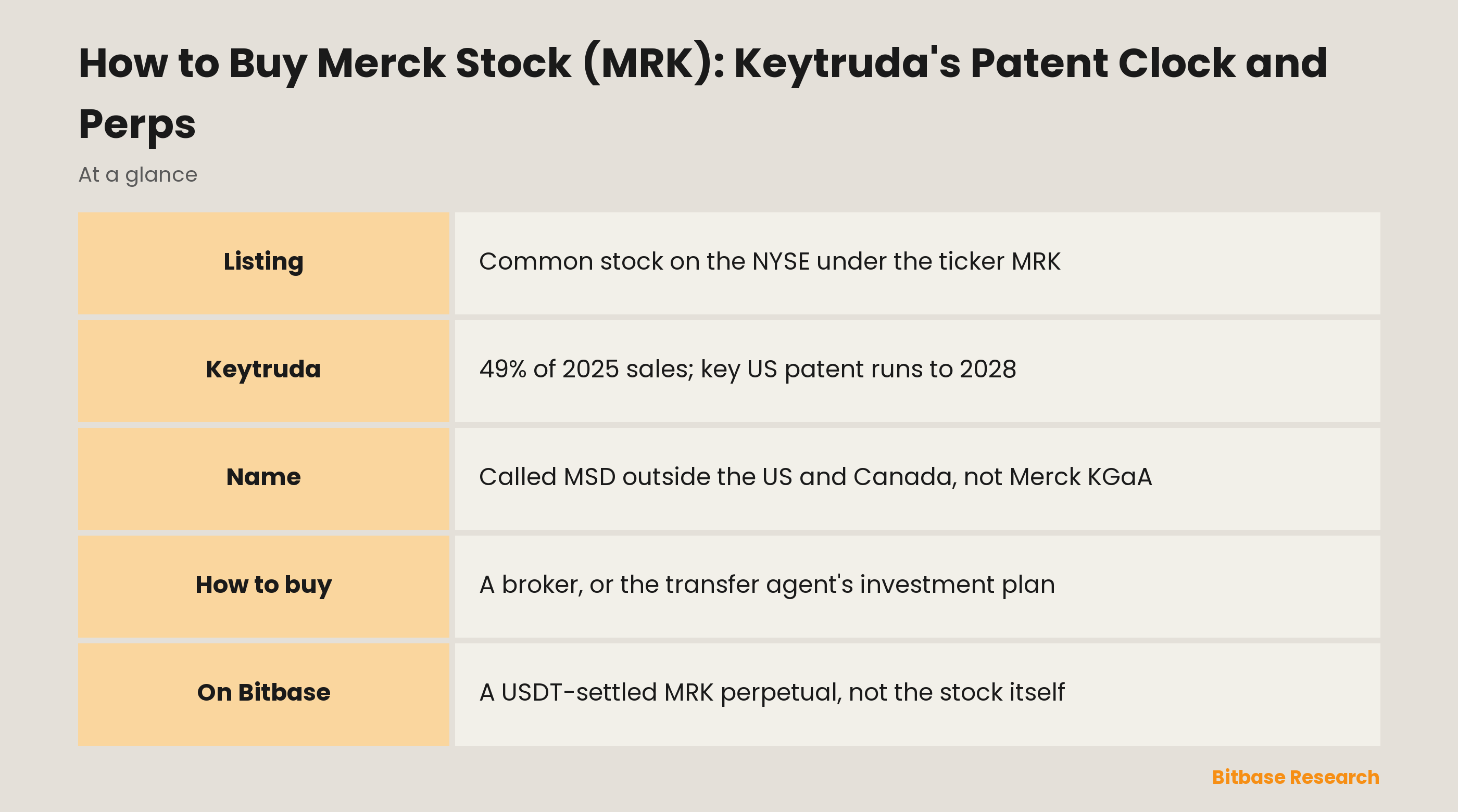
If your broker gives you access to the New York Stock Exchange, you can buy Merck stock under the ticker MRK; outside the United States and Canada the same company calls itself MSD. One medicine dominates the picture: the cancer immunotherapy Keytruda made up 49% of Merck's 2025 sales, and the annual report expects biosimilar competition to cut into it between 2028 and 2029. On Bitbase there are no Merck shares to buy; what it lists is a USDT-margined MRK perpetual, a contract on the price with nothing underneath it.
What Does Merck Do?
Merck & Co., Inc. describes itself as "a global health care company that delivers innovative health solutions through its prescription medicines, including biologic therapies, vaccines and animal health products." It is incorporated in New Jersey, has its head office in Rahway in the same state, and goes by MSD outside the United States and Canada; the company and the share are the same under both names.
The business reports two segments. Pharmaceutical covers human medicines and vaccines, grouped into franchises. Oncology is led by Keytruda, an anti-PD-1 therapy given by intravenous infusion, alongside two partnered drugs: Lynparza, developed with AstraZeneca, and Lenvima, with Eisai. Vaccines include the HPV vaccines Gardasil and Gardasil 9, the pneumococcal vaccines Capvaxive and Vaxneuvance, and Enflonsia, an antibody that helps protect infants against RSV. Hospital acute care has Bridion, which reverses muscle relaxants used during surgery. Winrevair treats pulmonary arterial hypertension, Ohtuvayre chronic obstructive pulmonary disease, and Januvia and Janumet type 2 diabetes.
Animal Health develops and sells veterinary medicines and vaccines for livestock and companion animals. Its best-known line is Bravecto, a family of parasite-control products for dogs and cats, and it also sells digitally connected identification, traceability and monitoring products.
Merck sells human medicines "primarily to drug wholesalers and retailers, hospitals, government agencies, and managed health care providers," and vaccines mainly to physicians, wholesalers, distributors and governments. At the end of 2025, its three largest accounts receivable balances belonged to McKesson, Cencora and Cardinal Health. The 10-K names its competitors only by type: other research-based drugmakers, smaller specialist research companies, generic manufacturers and animal health companies.
The portfolio keeps changing shape. On 2 June 2021 Merck spun off its women's health, biosimilars and established brands businesses as Organon & Co., distributing the new company's shares to its own shareholders. More recently it has added companies: Verona Pharma in October 2025, which brought Ohtuvayre; Cidara Therapeutics, a flu-prevention developer, in January 2026; and the clinical-stage oncology company Terns Pharmaceuticals in May 2026.
How Merck Makes Money
Medicines pay for almost everything. In 2025 the Pharmaceutical segment brought in about 89% of sales and Animal Health about 10%, with the remainder coming from miscellaneous corporate revenue, including hedging, and third-party manufacturing. Total sales rose 1%, a small number that hides two large movements.
The first is concentration. Merck's risk factors state that "in 2025, sales of Keytruda represented 49% of the Company's total sales." In 2021 the same drug made up about 35%. Combined sales of Keytruda and its newer under-the-skin version, Keytruda Qlex, grew 7% in 2025, with the filing crediting wider use in earlier-stage cancers. From Lynparza and Lenvima, Merck books only its share of partnership profits, as alliance revenue.
The second is a vaccine reversal. Worldwide Gardasil sales fell 39% in 2025, which the company attributes mainly to lower demand in China, where Chongqing Zhifei Biological Products is its distributor and commercialisation partner, and to the closing of a catch-up vaccination window in Japan in March 2025. Gardasil accounted for about 8% of 2025 sales.
Geography moved with it. The United States produced about 56% of 2025 sales after US sales grew 13%, while international sales fell 11%. In the 10-K's own words, "International sales represented 44% and 50% of total sales in 2025 and 2024, respectively." Because "virtually all sales are denominated in currencies of the local jurisdiction," exchange rates change what those foreign sales are worth once converted into dollars.
Animal Health grew faster than the company as a whole in 2025, and it has its own concentration: the Bravecto family made up 18% of the segment's sales. On the cost side, research and development spending came to about 24% of sales, a line that also absorbs charges for licensing deals and acquisitions, which is one reason it swings from year to year.
MRK Stock at a Glance
| Item | Detail |
|---|---|
| Exchange | New York Stock Exchange |
| Ticker | MRK |
| Share class | Common stock, the only equity line on the 10-K cover, which also lists seven series of notes |
| Legal name | Merck & Co., Inc., known as MSD outside the US and Canada |
| Industry | Prescription medicines, vaccines and animal health |
| Index membership | S&P 500 and Dow Jones Industrial Average, based on SPY and DIA holdings dated 16 October 2026 |
| Headquarters | Rahway, New Jersey |
| State of incorporation | New Jersey |
| Fiscal year end | 31 December |
| Dividend policy | Quarterly cash dividend, each declared by the board |
| Share buybacks | Authorisation approved in January 2025, with no time limit |
| SEC identifier | CIK 310158 |
How to Buy Merck Stock
MRK is Merck's own common stock, listed in New York rather than issued as a depositary receipt, so the purchase is an ordinary US share trade. Through a broker, it runs like this:
1. Choose a broker with NYSE access. If you live outside the US, confirm the broker accepts residents of your country and find out which legal entity will hold your account.
2. Open and verify the account. A non-US individual is normally asked for IRS Form W-8BEN, which the IRS says to give "to the withholding agent or payer if you are a foreign person."
3. Fund it. Depositing in a currency other than dollars means a conversion, and the exchange rate is part of what the shares cost you.
4. Search MRK and read the name. The listing should say Merck & Co., Inc. common stock on the NYSE. A German company, Merck KGaA, shares the name but not the business, and the notes on Merck's cover trade under symbols of their own.
5. Pick an order type. A market order "guarantees that the order will be executed, but does not guarantee the execution price"; a limit order fills only "at a specific price or better."
6. Decide the size. Buy whole shares, or a cash amount split into part of a share where the broker supports it.
Directly through the transfer agent. Merck's investor site gives a second route: "Shares can be purchased through a stockbroker of your choice or by contacting our transfer agent, EQ Shareowner Services." That agent runs the Merck Stock Investment Program, which offers share purchases, optional cash investments and automatic dividend reinvestment. Fees and eligibility, including whether the program accepts investors in your country, are set in its own documents, so read those before counting on it.
Outside the United States, the instrument stays the same and the tax changes. The IRS states that "Most types of U.S. source income received by a foreign person are subject to U.S. tax of 30%," and that a lower rate or an exemption may apply under a tax treaty. Treat this as a general outline rather than tax advice for your situation.
Through an index fund, you own Merck without choosing it. On 16 October 2026, State Street's SPY, which tracks the S&P 500, and DIA, which tracks the Dow Jones Industrial Average, both held MRK among their constituents, and each fund's slice of Merck changes every day.
Trading MRK on Bitbase
What Bitbase offers is an MRK perpetual futures contract, with margin and settlement in USDT. It follows Merck's share price but gives you no part of the company: no share, no dividend, no vote at the annual meeting. What it offers instead is a position that can be long or short, can use leverage, and keeps trading on nights and weekends while the NYSE is shut.
Two mechanisms do the work. A periodic funding payment changes hands between longs and shorts, with the more crowded side paying, which keeps the contract close to the share price; how that adds up over a holding period is set out in the guide to stock perpetual funding rates. And a position whose margin runs out is liquidated against a mark price, not the last trade. Because the contract trades while the exchange is closed, it can drift from the last close and meet the share somewhere else at the next open.
Bitbase's rules for this contract fix the funding schedule, the margin levels, the leverage cap and the price reference it uses outside NYSE hours; read them before the first order. Other US names, and which instrument each one comes in, are listed on Bitbase's TradFi page.
What Moves MRK Stock
Keytruda's patent dates. The patent table in the 10-K gives Keytruda's key protection as expiring in 2028 in the US and China, 2031 in the major EU markets and 2032 to 2033 in Japan. The compound patent family holds two more US patents running to 2029, which Merck expects to be challenged in court. Its forecast is plain: biosimilar competition "could begin in December 2028 when the primary compound patent expires," and Keytruda sales will be "materially negatively impacted" between 2028 and 2029. A biosimilar launched in Argentina in 2025, and Merck expects the erosion from biosimilars to be immaterial in 2026.
The under-the-skin version. Keytruda Qlex, given by subcutaneous injection rather than infusion, won FDA approval in September 2025 across most of Keytruda's adult solid-tumour uses. The same patent table lists its US protection to 2043. How widely it is adopted matters: the risk factors name "lower than expected utilization of Keytruda Qlex" among the events that could hurt sales.
US drug-price setting. Under the Inflation Reduction Act, the government set a Medicare price for Januvia from 1 January 2026; prices for Janumet follow in 2027 and Lenvima in 2028. Merck also expects Keytruda to be selected in 2027, with a set price from 1 January 2029, after which it expects US sales of Keytruda to "decline materially." The company has challenged the programme in a lawsuit filed in June 2023, and in December 2025 it signed a three-year agreement with the US government under which drugs it launches during the term, with some exceptions, are priced by reference to a group of other countries.
Exclusivity losses already under way. Januvia and Janumet lost US market exclusivity in May 2026 and Janumet XR in July 2026, and Bridion followed that same month; Merck now expects to stop selling Bridion in the US in 2027. The pattern is not unique to Merck: Eli Lilly's annual report describes the same kind of revenue loss after exclusivity ends, as the guide to Eli Lilly stock explains.
Gardasil in China. After the 39% fall in 2025, the company expects that Gardasil sales in China "will not materially increase in 2026." The 10-K ties any recovery to "a favorable environment for innovative pharmaceutical products and vaccines," continued access for its marketed products and the absence of trade barriers or adverse price controls.
Filling the gap. With Keytruda's dates fixed, the share price leans on what replaces it: newer products such as Winrevair, Capvaxive and Ohtuvayre, the acquired pipelines of Verona, Cidara and Terns, and trial readouts and approvals from a research budget equal to about a quarter of sales.
Risks to Weigh
Concentration. Merck's own wording is that "Key products generate a significant amount of the Company's profits and cash flows," and with Keytruda near half of revenue, any setback to one drug reaches the whole income statement.
Exclusivity and price. "As the Company's products lose market exclusivity, the Company generally experiences a significant and rapid loss of sales from those products," and it "faces continued pricing pressure with respect to its products in the public and private sectors."
Manufacturing and safety. Merck says it "may experience difficulties and delays in manufacturing certain of its products, including vaccines," that "Pharmaceutical products can develop unexpected safety or efficacy concerns," and that product liability insurance "may be limited, cost prohibitive or unavailable."
Currency, China and animal health. Sales are earned in local currencies, Chinese demand has already fallen sharply once, and "Negative events in the animal health industry" could hurt that segment.
The name dispute. Merck & Co. has been suing Merck KGaA in the US over the Merck name since January 2016, KGaA has filed suits abroad, and no US trial date had been set when the 10-K was filed.
Price and payout. The share price can fall, and each dividend depends on a fresh board declaration.
Risks specific to the perpetual. Borrowed exposure enlarges every loss, funding keeps accruing while you hold, and when the NYSE opens away from the contract's overnight price, a leveraged position can be liquidated before you can act.
How to Research MRK Yourself
On SEC EDGAR, Merck & Co., Inc. files under CIK 310158; searching by that number avoids picking up a similarly named company by mistake. In the 10-K, Item 1 holds the product list and the patent table, Item 1A the risk factors, and the notes split sales by product and between the US and international markets. Quarterly results arrive on Form 8-K, with 10-Qs updating the patent and pricing picture: over the last four quarters they came on 30 October 2025, 3 February 2026, 30 April 2026 and 4 August 2026. Each spring's DEF 14A sets out the agenda for the annual meeting, which the company usually holds in May.
Merck's investor site carries the dividend history, a shareholder FAQ and the Stock Investment Program. Prices move every trading minute, so the Merck stock page on Bitbase is where to follow the current quote.
Merck Stock FAQ
Is Merck the same company as MSD?
Yes. Merck's investor FAQ says the company "is known as Merck in the United States and Canada and MSD outside the United States and Canada." Under either name there is one listed share: MRK on the NYSE.
Is Merck related to Merck KGaA?
No, they are separate companies. Merck KGaA is based in Darmstadt, Germany, and has historically operated in the US as the EMD Group. In January 2016 Merck & Co. sued it in the US, alleging that KGaA "improperly uses the name" Merck there; KGaA has sued Merck & Co. in several other countries, and the 10-K reports both sets of cases as ongoing. Buying MRK buys Merck & Co., Inc., not KGaA.
Does Merck pay a dividend?
Yes, in cash every quarter, with each payment declared by the board. The dividend table on Merck's investor site begins in 2010 and shows four payments in every full year since, and the board raised the quarterly rate in November 2025. That page also shows what each payment was.
When does Keytruda lose patent protection?
According to the 10-K patent table, Keytruda's key US protection runs to 2028, with two further patents in the family expiring in 2029. Merck expects biosimilar competition could begin in December 2028. Abroad, the table lists 2031 for the major EU markets, 2032 to 2033 for Japan and 2028 for China. Keytruda Qlex has a separate US entry running to 2043.
Can I buy Merck stock with crypto?
Not directly: shares are bought from a broker or the transfer agent and paid for in dollars, which means selling crypto first. A USDT balance on Bitbase can be used for the MRK perpetual instead, a derivative tied to Merck's price rather than a holding of stock: it pays no dividend, carries no vote and can be liquidated. The difference between holding a share and holding a position is covered in buying US stocks with USDT.
Is Merck in the Dow Jones Industrial Average?
Yes. The holdings file of DIA, State Street's fund on the Dow Jones Industrial Average, listed Merck on 16 October 2026, and so did the file for SPY, its S&P 500 fund. Index membership can change, so check the date on any holdings list you rely on.
Conclusion
Buying Merck stock is a routine NYSE trade, through a broker or the company's transfer agent; the real work is reading what the filings say about timing. Keytruda supplied about half of 2025 sales and has published patent dates, US price setting is scheduled drug by drug, and Gardasil has already shown how fast a large product can shrink. For a trader who wants exposure to the price alone, the Bitbase perpetual does that job with funding, leverage and liquidation attached, and without any ownership of Merck.
Related reading
Other Bitbase articles on this topic:
- How to Buy GSK Stock (GSK): Two-Share ADS, HIV and Haleon
- How to Buy Moderna Stock (MRNA): Vaccines, Cancer Trial and Perps
- How to Buy Novo Nordisk Stock (NVO): ADR, Wegovy and Ozempic
Disclaimer: This article is educational content from Bitbase Academy, provided for information only. It explains what a company or fund does and how the instruments referenced here differ from one another; it does not constitute investment, trading, tax, or financial advice, and it is neither a recommendation nor an endorsement of any security, token, or trading strategy. A tokenized stock is issued by a third party and is designed to give economic exposure to an underlying asset: it is not a share, it carries no shareholder rights, and it depends on the issuer's structure, eligibility rules, and redemption terms, which the issuer can change. Perpetual futures are leveraged derivatives that hold no underlying asset and can be liquidated, and trading hours, product availability, and eligibility differ by instrument and by jurisdiction and can change at any time. Written as of October 2026; verify everything yourself through company filings, the issuer's own documentation, and the product pages of the venue you trade on.
References
[1] Merck & Co. 2025 Form 10-K (SEC EDGAR) www.sec.gov
[2] Merck & Co. Form 10-Q, quarter ended 30 June 2026 (SEC EDGAR) www.sec.gov
[3] Merck & Co. 2021 Form 10-K: Organon spin-off and 2021 sales (SEC EDGAR) www.sec.gov
[4] Merck investor resources: shareholder FAQ and Stock Investment Program www.merck.com
[5] Merck stock information: dividend history www.merck.com
[6] State Street: SPY daily holdings, 16 October 2026 www.ssga.com
[7] State Street: DIA daily holdings, 16 October 2026 www.ssga.com
[8] IRS: NRA withholding www.irs.gov
[9] IRS: About Form W-8 BEN www.irs.gov
[10] Investor.gov (SEC): types of orders www.investor.gov





