
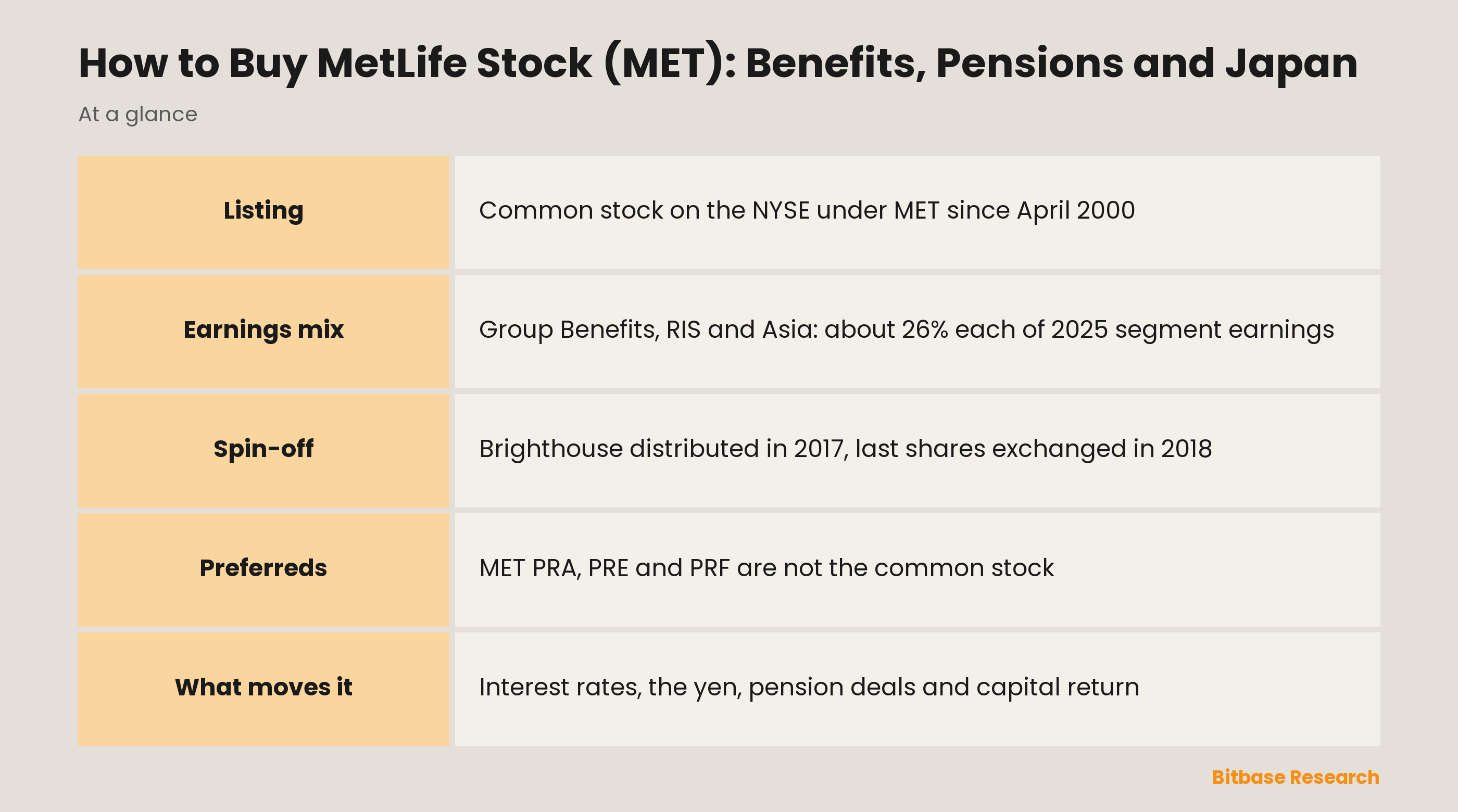
A MetLife share is bought like most New York Stock Exchange stocks: through any brokerage account that reaches US markets, by ordering the common stock under the ticker MET. The company listed in April 2000, when Metropolitan Life Insurance Company gave up mutual ownership, and in 2025 its US group benefits, US retirement products and Asia each produced about a quarter of segment earnings. This guide covers the business, the order and the risks its filings stress.
What Does MetLife Do?
MetLife calls itself "one of the world's leading financial services companies, providing insurance, annuities, employee benefits and asset management." The listed parent, MetLife, Inc., is a Delaware holding company incorporated in 1999. Its oldest insurer, Metropolitan Life Insurance Company, converted from a mutual to a stock company on 7 April 2000 and became wholly owned by MetLife, Inc.
Since a reorganization in late 2025 the company reports six segments. Group Benefits sells US workplace cover, including life, dental, disability, vision and pet insurance. Retirement and Income Solutions (RIS) serves US institutions with pension risk transfers, which take over an employer's pension obligations, plus stable value contracts and UK longevity reinsurance. Asia spans nine jurisdictions, with Japan the largest; Latin America is led by Mexico and Chile; EMEA by the Gulf region, the UK, Turkey and France. MetLife Investment Management (MIM) runs money for outside institutions and for MetLife's own general account, and bought PineBridge Investments on 30 December 2025. The old MetLife Holdings segment was dropped; its run-off books, such as long-term care insurance, now sit mainly in Corporate & Other.
On 4 August 2017 MetLife distributed about 80.8% of Brighthouse Financial, a US life and annuity business, to its shareholders, one Brighthouse share for every 11 MetLife shares, and in June 2018 it swapped its remaining Brighthouse shares for some of its own debt. A MET share carries no Brighthouse stake.
How MetLife Makes Money
An insurer earns twice on the same money: premiums for the risks it takes on, then returns on investing them until claims fall due. In 2025 premiums equalled about 65% of total revenues and net investment income about 29%, while investment and derivative losses were deducted; total revenues rose about 9%. The 10-K uses adjusted earnings as its GAAP measure of segment performance:
| Segment | What it sells | Share of 2025 segment revenues | Share of 2025 segment adjusted earnings |
|---|---|---|---|
| Group Benefits | US workplace life, dental and disability cover | 37% | 26% |
| RIS | Pension risk transfer, stable value, longevity reinsurance | 29% | 26% |
| Asia | Life, health and savings products | 17% | 26% |
| Latin America | Life, health and pension products | 11% | 12% |
| EMEA | Life, health and credit insurance | 4% | 6% |
| MIM | Institutional asset management | 1% | 3% |
Shares of the six segments' combined totals, rounded; Corporate & Other excluded.
Asia turns about 17% of segment revenues into about 26% of segment earnings. RIS shows the opposite: its adjusted premiums, fees and other revenues rose about 43% in 2025, yet its adjusted earnings barely moved, because the premium changes "were more than offset by a corresponding change in policyholder benefits." By location, US operations produced about 72% of 2025 premiums, fees and other revenues, Japan about 8% and other countries about 20%.
MET Stock at a Glance
| Item | Detail |
|---|---|
| Exchange | New York Stock Exchange (NYSE) |
| Ticker | MET, the common stock |
| Other listed securities | MET PRA, MET PRE and MET PRF, all preferred securities |
| Sector | Life insurance, annuities, employee benefits, asset management |
| Index membership | S&P 500 |
| Headquarters | 200 Park Avenue, New York |
| Incorporated | Delaware, 1999 |
| Trading since | 5 April 2000 |
| Fiscal year | Calendar year, ending 31 December |
| Dividend policy | Quarterly cash dividend set by the board |
| SEC identifier | CIK 1099219 |
For live prices and market value, open the MetLife stock page on Bitbase.
How to Buy MetLife Stock
As a US company, MetLife has no depositary receipt: the NYSE line is the common stock itself.
1. Pick a broker that reaches the NYSE. Outside the US, find out which company holds your account and which regulator oversees it.
2. Complete the account checks. Non-US individuals generally give the broker IRS Form W-8BEN, which the IRS says goes "to the withholding agent or payer."
3. Add money. Exchange-rate spreads count as a cost, as commissions do.
4. Select the common stock. Search MET and confirm the result is the common stock, not a preferred line.
5. Choose the order type. FINRA says a market order "provides the most certainty that your order will be executed," but "you might not get the price you saw"; a limit order guarantees "your limit price or a better price if your order is executed," though it may not execute at all.
6. Decide the size. Buying part of a share lets you commit a set amount, but availability "varies by brokerage firm" and a fractional owner "might not have shareholder voting rights."
Before trading early or late, learn how regular-hours and extended-hours stock prices differ.
Investors outside the US pay tax at source on dividends: the IRS says "most types of U.S. source income received by a foreign person are subject to U.S. tax of 30%," unless a treaty lowers it, which the W-8BEN claims. Where you live may add its own tax.
Through an index fund, you can own MetLife as one constituent of several hundred, such as State Street's SPDR S&P 500 ETF Trust (SPY).
What Moves MET Stock
Interest rates. Rates cut both ways for a life insurer. The 10-K warns that "low interest rates and risk asset returns may reduce income from our investment portfolio, increase our liabilities for claims and future benefits." Sharp increases instead push down the value of fixed income holdings.
Japan and the yen. Asia supplied about 26% of 2025 segment earnings and Japan is its largest market. The yen is the first currency the 10-K names as creating exchange-rate risk in its investments and insurance liabilities, Japan's Financial Services Agency "may limit or not permit" profit repatriation that would harm the local unit's solvency, and a new economic value-based solvency regime applies from the fiscal year ending March 2026.
Pension deals and reinsurance. RIS premiums depend on how many employers hand over pension obligations in a year. MetLife also moves risk outward: in 2025 it invested in Chariot, a Bermuda partnership, and ceded pension-related annuities and participating whole life policies to Chariot's subsidiary Chariot Re.
Capital return. The board added a repurchase authorization on 5 August 2026 and raised the quarterly common dividend in the second quarter of both 2025 and 2026.
Third-quarter results. Liability assumptions are updated "generally during the third quarter as part of the Company's annual actuarial assumption review," and income from private equity and real estate funds swings between quarters; MetLife pre-announced an estimate of it on 24 September 2026, ahead of results due on 4 November.
The Bear Case in MetLife's Annual Report
From Item 1A, the entries that matter most:
Claims against estimates. "Our Actual Claims or Other Results May Differ From Our Estimates, Assumptions, or Models," especially where payments "may not occur until well into the future."
Ratings. MetLife "May Lose Business Due to a Downgrade or a Potential Downgrade in Our Financial Strength or Credit Ratings."
The holding company's cash. If subsidiary dividends fall short, "MetLife, Inc. may have to issue debt or equity, or sell assets," and regulatory limits, among other factors, "may preclude us from paying dividends on or repurchasing our common stock."
Governance. Through the MetLife Policyholder Trust the board "may be able to influence stockholder votes."
Brighthouse. MetLife "may not realize any or all of the expected tax or other benefits of the Brighthouse separation."
Above these sits single-stock risk: one company drives your result, and past dividend increases bind no future board.
Which MetLife Filing Answers Which Question
MetLife files under CIK 1099219: the 10-K annually, 10-Qs quarterly and 8-Ks for events, including earnings releases with a quarterly financial supplement attached. In the 10-K, Item 1 covers the segments and regulation, Item 1A the risks, and the segment note gives revenues and adjusted earnings by segment.
Two checks avoid misreadings. The 2025 reorganization recast the segments, so older reports showing MetLife Holdings do not compare like for like. And adjusted earnings "excludes net investment gains (losses), net derivative gains (losses)" and some other items, so it can diverge from net income: in 2025 net income available to common shareholders fell about 25% while adjusted earnings rose about 2%. For other companies, browse more US stock pages on Bitbase.
MetLife Stock FAQ
Does MetLife pay a dividend?
Yes, quarterly on the common stock, and the declared amount rose in the second quarter of 2026, as it had a year earlier. Each payment needs a board decision.
Can I buy MetLife stock with crypto?
Not directly. A broker buys MET for you and NYSE trades settle in US dollars, so any crypto has to be converted to cash and moved to the brokerage first, and that conversion can trigger tax in your country. Owning a share also means holding equity, with the dividends and votes attached, which is where stocks and crypto part ways.
Is MET in the S&P 500?
Yes. MetLife appeared in the 29 October 2026 daily holdings file of SPY, State Street's S&P 500 trust.
Is Brighthouse Financial still part of MetLife?
No. MetLife distributed most of Brighthouse to its shareholders in August 2017 and exchanged its last Brighthouse shares in June 2018. The 10-K still lists the separation's tax treatment among its risks.
What are MET PRA, MET PRE and MET PRF?
MetLife's listed preferred securities: Series A floating rate preferred stock, and depositary shares for Series E and Series F preferred stock. They trade on the NYSE beside the common stock, which is plain MET.
Conclusion
The purchase itself is short: an NYSE-capable broker, the common stock instead of a preferred line, and a market or limit order. Understanding it takes longer: segment earnings split roughly evenly among US group benefits, US retirement products and Asia, and interest rates, the yen and capital rules run through all three. Read the latest 10-K and quarterly supplement before deciding how much room one life insurer deserves.
Related reading
Other Bitbase articles on this topic:
- How to Buy Arthur J. Gallagher Stock (AJG): Broker, Not Insurer
- How to Buy Chubb Stock (CB): Swiss Shares, Dividend, Catastrophes
- How to Buy Manulife Stock (MFC): One Share on Four Exchanges
Disclaimer: This article is educational content from Bitbase Academy, provided for information only. It explains what a company or fund does and how the instruments referenced here differ from one another; it does not constitute investment, trading, tax, or financial advice, and it is neither a recommendation nor an endorsement of any security, token, or trading strategy. A tokenized stock is issued by a third party and is designed to give economic exposure to an underlying asset: it is not a share, it carries no shareholder rights, and it depends on the issuer's structure, eligibility rules, and redemption terms, which the issuer can change. Perpetual futures are leveraged derivatives that hold no underlying asset and can be liquidated, and trading hours, product availability, and eligibility differ by instrument and by jurisdiction and can change at any time. Written as of October 2026; verify everything yourself through company filings, the issuer's own documentation, and the product pages of the venue you trade on.
References
[1] MetLife, Inc. Form 10-K, fiscal 2025: business, segments, risk factors (SEC EDGAR) www.sec.gov
[2] MetLife, Inc. 10-K, fiscal 2025: XBRL cover page with all registered trading symbols www.sec.gov
[3] MetLife, Inc. Form 10-Q, second quarter 2026: dividends declared, Chariot Re www.sec.gov
[4] MetLife, Inc. Form 8-K, 9 August 2017: distribution of Brighthouse Financial shares www.sec.gov
[5] MetLife, Inc. Form 8-K, 19 June 2018: exchange of the remaining Brighthouse shares www.sec.gov
[6] MetLife, Inc. Form 8-K, 5 August 2026: second-quarter results and repurchase authorization www.sec.gov
[7] MetLife, Inc. Form 8-K, 24 September 2026: preliminary variable investment income www.sec.gov
[8] State Street: SPY daily holdings, 29 October 2026 www.ssga.com
[9] FINRA: Order Types www.finra.org
[10] FINRA: Investing in Fractional Shares www.finra.org
[11] IRS: NRA Withholding www.irs.gov
[12] IRS: About Form W-8 BEN www.irs.gov





