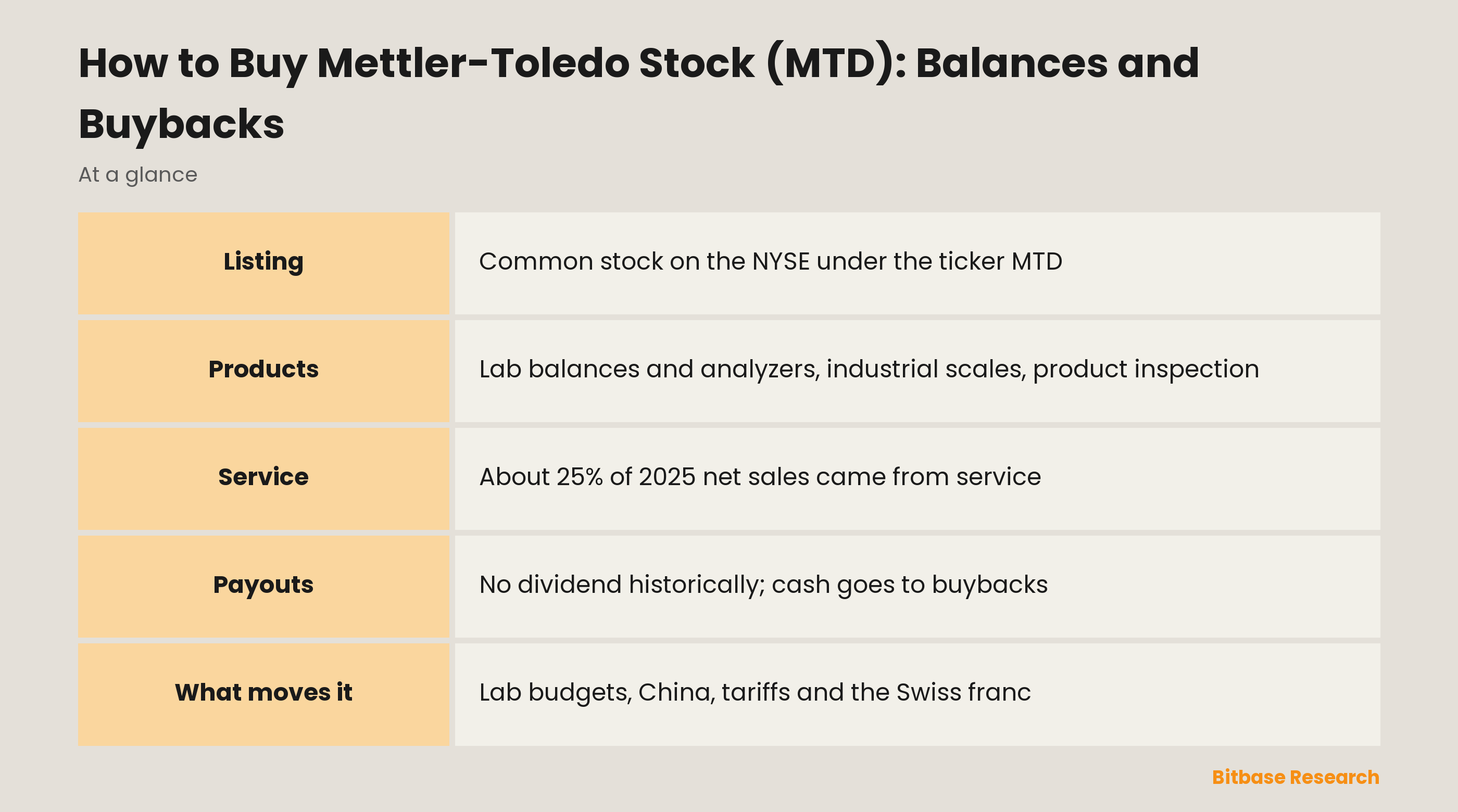
Buying a Mettler-Toledo share takes a brokerage account that can reach the New York Stock Exchange, where the company's common stock, its only registered class of shares, trades as MTD. The company has historically not paid dividends; instead it has repurchased 33.0 million of its own shares since 2004, far more than the 20.3 million it had outstanding in January 2026. This guide covers the instruments behind those shares, how an order works, and the currency, China and tariff exposure that the company's filings describe.
What Does Mettler-Toledo Do?
Mettler-Toledo makes precision instruments and sells the service that keeps them accurate. Its annual report calls it "a leading global supplier of precision instruments and services" and says the company believes it holds "global number-one market positions in most" of its businesses. Mettler-Toledo International Inc. was incorporated in Delaware in 1991 and went public in 1997. It has two principal executive offices, one in Columbus, Ohio, and one in Greifensee, Switzerland, sells in more than 140 countries and has its own presence in about 40 of them.
Laboratory instruments, about 56% of 2025 net sales, begin with the balance. Mettler-Toledo's laboratory balances weigh anything from one ten-millionth of a gram up to 64 kilograms. Around the balances sit pipettes and pipette tips for life science labs, titrators that measure the chemical composition of samples, pH meters, density and refractometry instruments, thermal analysis systems, moisture analyzers, UV/VIS spectrophotometers and cell counters. Automated lab reactors and in-line sensors follow chemical reactions and crystallization in real time while drugs and chemicals are developed and scaled up. LabX, the company's laboratory software, gathers data from these instruments and archives it in line with the FDA's rules for electronic records, known as 21 CFR Part 11.
Industrial instruments, about 39% of sales, cover scales from bench models to floor scales and weigh modules, the terminals that feed their readings into production systems, and vehicle scales for trucks and railcars that can weigh up to 500 tons. Logistics customers use in-motion systems that weigh and measure parcels for billing and load planning. Product inspection is the other large piece: metal detectors, x-ray systems, checkweighers and camera-based vision systems on food, drug and consumer goods packaging lines. X-ray inspection finds contamination that metal detectors miss, "such as glass, calcified bone, stones, and pits."
Retail weighing, about 5% of sales, supplies supermarket scales and labeling systems for fresh food, along with weighing for self-checkout and AI-driven image recognition of fresh goods.
The customer list spreads across pharmaceutical and biotech companies, research organizations and testing labs, food manufacturers, chemical and cosmetics companies, universities, food retailers, transport and logistics firms, metals and electronics. No single end-customer accounted for more than 1% of 2025 net sales. The more technical products are sold by the company's own sales force; in the Americas a significant portion of sales goes through distributors, including Ohaus-branded products aimed at price-conscious buyers such as the education market. The 10-K describes markets that are fragmented by region and application, with "numerous regional or specialized competitors," and it does not name them.
How Mettler-Toledo Makes Money
Most revenue comes from selling instruments, but a growing share comes after the sale. Service, meaning service contracts, on-demand repairs and replacement parts, accounted for about 25% of net sales in 2025, compared with 23% in 2023. The company estimates that it has "the largest installed base of weighing instruments in the world" and works to put more of that base under service contract, including calibration and compliance work for drugmakers that must satisfy FDA rules.
Net sales rose 4% in US dollars in 2025 and 3% in local currencies. The year has a rhythm: fourth-quarter sales have historically made up about 27% to 30% of net sales, and backlog usually covers no more than one to two months of deliveries, so the order book offers little view of the months ahead.
The five reportable segments are drawn by where the company's marketing and producing organizations sit, not by product line:
| Segment | Share of 2025 sales to outside customers | 2025 segment profit as share of the segment's total sales | Role |
|---|---|---|---|
| U.S. Operations | 37% | 23% | US sales, service and production |
| Swiss Operations | 5% | 27% | Research, development and production of weighing and analytical instruments, mostly sold to other segments |
| Western European Operations | 22% | 21% | Western Europe outside Switzerland |
| Chinese Operations | 16% | 36% | Sales in China and a large manufacturing base |
| Other Operations | 20% | 17% | Operations outside the other four segments |
Shares in the first column are calculated from the segment note. Total sales in the second column include sales to other Mettler-Toledo segments, which is where Swiss Operations does most of its business: about 80% of its 2025 sales went to other segments.
China carries more weight than its sales suggest. The 10-K says Chinese Operations accounted for 16% of sales to external customers, 29% of total segment profit and about 29% of global production in 2025. By customer location, 42% of 2025 net sales came from North and South America, 29% from Europe and 29% from Asia and other countries, and emerging markets made up about 33% of the total.
Research and development has run at about 5% of net sales in each of the last three years, and the company holds over 5,600 patents and trademarks. It also returns cash in one main way: buying back its own shares. It repurchased 646,608 shares in 2025, and the board added to the program's authorization in November 2025.
MTD Stock at a Glance
| Feature | MTD |
|---|---|
| Exchange | New York Stock Exchange |
| Ticker | MTD |
| Security | Common stock, the only class registered under Section 12(b) |
| Business | Precision instruments and service for laboratories, industry and food retail |
| Index membership | S&P 500 |
| Incorporated | Delaware, 1991; initial public offering in 1997 |
| Principal executive offices | Columbus, Ohio, and Greifensee, Switzerland |
| Financial year | Ends 31 December |
| Dividend | None historically; cash is returned through share repurchases |
| Shares outstanding | 20,325,250 on 23 January 2026 |
| SEC identifier | CIK 1037646 |
Quotes, market value and trading volume move all day; for live figures, open the Mettler-Toledo stock page on Bitbase.
How to Buy Mettler-Toledo Stock
Although one of its two head offices is in Switzerland, Mettler-Toledo is a Delaware corporation that files 10-K reports with the SEC, and its common stock itself is listed in New York. No depositary receipt is involved, and the 10-K cover lists a single class on a single exchange. The purchase runs in six steps:
1. Find a broker with NYSE access. Outside the US this is either a local firm that offers US shares or an international broker. Check which legal entity holds your account and which regulator supervises it.
2. Complete the account checks. Non-US individuals usually certify their foreign status on IRS Form W-8BEN, which the IRS says to submit "when requested by the withholding agent or payer."
3. Fund the account. If you deposit in a currency other than dollars, the conversion rate is a cost of its own.
4. Search the ticker and confirm the name. MTD should appear as Mettler-Toledo International Inc. common stock on the NYSE, matching the 10-K cover.
5. Choose the order type. FINRA says a market order "provides the most certainty that your order will be executed," while a limit order is an order to buy "at or better than a specified price." A limit order also caps what you pay per share, which matters more the higher that price is.
6. Decide between whole and fractional shares. Some brokers sell a fraction of a share for a fixed sum of money, others do not, and the terms differ: ask whether fractions carry voting rights and whether they can be moved to another broker.
Taxes for investors abroad. According to the IRS, "most types of U.S. source income received by a foreign person are subject to U.S. tax of 30%," and a tax treaty can lower that rate. Because Mettler-Toledo has not paid dividends, there is currently no dividend for that rule to apply to; whatever you earn comes from selling the shares, taxed according to the rules where you live.
Through index funds. As an S&P 500 member, MTD appears in the holdings of funds that track the index, such as State Street's SPY, alongside the other members of the index.
What Moves MTD Stock
Lab budgets at drugmakers and universities. Pharma and biopharma demand was "particularly impacted in 2023 after significant growth during the COVID-19 pandemic," according to the 10-K, and cuts in US government funding for medical and scientific research have hit the academic institutions that received it. In 2025 laboratory sales grew modestly, helped by better bioprocessing conditions while biotech research and academia were softer. In the third quarter of 2026, local currency laboratory sales rose 6%, with strong growth in pipettes.
China. After strong growth in 2021 and 2022, demand in China "declined significantly during the second half of 2023, which continued in 2024." Local currency sales there rose 1% in 2025 and 13% in the third quarter of 2026. Because China makes up a far larger share of profit and production than of sales, swings there pass through to earnings with extra force.
Tariffs. The tariff costs the company reports fall on its US imports from Switzerland, China, Mexico, the European Union and the United Kingdom. At the start of 2026, incremental US tariffs stood at 15% on Swiss imports and 30% on Chinese imports. In February 2026 the US Supreme Court invalidated tariffs imposed under the International Emergency Economic Powers Act; the company received refunds from US Customs and passed part of them on to customers. On 23 July 2026 new Section 301 tariffs took effect, at 12.5% on imports from Switzerland and China and 10% on imports from the European Union, the United Kingdom and non-USMCA goods from Mexico.
The Swiss franc. The company spends more Swiss francs than it earns, because it develops and makes products in Switzerland and runs corporate functions there. When the franc strengthens against the dollar and the euro, earnings fall; when the euro weakens, they fall too, because euro sales exceed euro costs. The renminbi is the largest of the other exposures.
Factory and food lines. Core industrial products are "especially sensitive to changes in economic growth," while product inspection grew strongly in 2025 and stood out again in the first nine months of 2026, which the company ties to food safety, brand protection and productivity. It also expects to benefit from customers moving production closer to home.
A shrinking share count. Repurchases reduce the number of shares, so earnings per share can rise faster than profit. The program runs through open market purchases whose size depends on "business and market conditions, the stock price" and other factors.
Where Mettler-Toledo's Risks Concentrate
The risk factors in the 10-K run long. These bear most directly on an MTD holder:
Developed-market cycles. "Most of our business is derived from companies in developed countries," and an economic downturn in those countries could hurt results.
Customer capital budgets. Instruments are capital purchases, and the company states that "any decrease or delay in capital spending by our customers would cause our revenues to decline and could harm our profitability."
China and geopolitics. "China represents a significant portion of our business and financial results and has an important role in our global supply chain," the 10-K says, listing tariffs, trade restrictions and domestic purchasing requirements among the pressures.
Currency. "When the Swiss franc strengthens against our other trading currencies, particularly the U.S. dollar and euro, our earnings go down." The reported dollar value of its debt also moves with the franc and the euro.
Competition from lower-cost rivals. Some competitors "are domiciled or operate in emerging markets and may have a lower cost structure than ours," and consolidation among instrument makers could create larger rivals.
Debt. The company carries debt and says it "may incur substantially more," and its loan agreements impose restrictions on its business.
Two risks belong to the share itself. With no dividend, your return depends entirely on the price, and buybacks can slow or stop when conditions change. And a single stock, however steady its history, concentrates your money in one company.
How to Research MTD Yourself
Mettler-Toledo files on SEC EDGAR under CIK 1037646. The annual 10-K and three quarterly 10-Qs come with 8-Ks that carry news such as the results releases, which in 2026 came on 5 February, 7 May, 30 July and 5 November. The third-quarter release, for example, announced a conference call with a webcast and presentation on the investor relations site, investor.mt.com.
In the 10-K, the business section explains the product lines, the risk factors section the threats above, and the segment note sets sales to outside customers next to sales between segments and segment profit. The market section reports the buyback table and the comparison of returns against the S&P 500 and a laboratory instruments index. Two other companies that sell into labs, profiled in our Thermo Fisher stock guide and Danaher stock guide, make useful points of comparison.
Two habits help when reading the numbers. Results are reported in dollars, but the company emphasizes local currency growth, so compare both before drawing a conclusion. And 2026 contains one-off tariff items: the nine-month results include a refund from US Customs that lowered cost of sales and refunds to customers that reduced net sales, which the company strips out of its adjusted figures. For the current quote, go back to the MTD page mentioned in the glance section; Bitbase also keeps stock pages for many other US companies.
Mettler-Toledo Stock FAQ
Can I buy Mettler-Toledo stock with crypto?
Not directly. Brokers settle MTD purchases in dollars, which means converting crypto to cash and moving that cash to the broker first, a conversion that may be taxed depending on where you live. What you then hold is a legal stake in a company, with a vote at its annual meeting, and our explainer sets out what separates stocks from crypto.
Does Mettler-Toledo pay a dividend?
No. The 10-K states that "historically, we have not paid dividends on our common stock," adding that the board will evaluate the policy periodically. Cash goes to share repurchases instead.
Is Mettler-Toledo an American or a Swiss company?
Both, in different senses. Legally it is a Delaware corporation that files with the SEC and lists in New York, but it has principal executive offices in both Columbus, Ohio, and Greifensee, Switzerland, and its Swiss Operations segment carries out extensive research and development.
Is MTD in the S&P 500?
Yes. State Street's daily holdings file for SPY, the fund that tracks the S&P 500, listed Mettler-Toledo International under MTD as of 6 November 2026.
Can I buy a fraction of an MTD share?
At some brokers. Whether fractional shares are offered, for which stocks and on what terms depends on the firm, so check before funding the account.
Conclusion
Mettler-Toledo sells the balances, analyzers and inspection systems that labs and factories depend on, and then earns a quarter of its revenue keeping them calibrated and repaired. Owning MTD means owning that installed base along with a Swiss cost base, an outsized dependence on China for profit and production, and a capital return built on buybacks rather than dividends. Before buying, work through the newest annual report and quarterly release, set local currency growth beside dollar growth, and settle on how large a position in a single instrument maker you are comfortable holding.
Related reading
Other Bitbase articles on this topic:
- How to Buy Elbit Systems Stock (ESLT): Nasdaq and Tel Aviv
- How to Buy EMCOR Stock (EME): Wiring and Cooling Data Centers
- How to Buy Ferguson Stock (FERG): From London to NYSE Only
- How to Buy United Airlines Stock (UAL): Unhedged Fuel, No Dividend
Disclaimer: This article is educational content from Bitbase Academy, provided for information only. It explains what a company or fund does and how the instruments referenced here differ from one another; it does not constitute investment, trading, tax, or financial advice, and it is neither a recommendation nor an endorsement of any security, token, or trading strategy. A tokenized stock is issued by a third party and is designed to give economic exposure to an underlying asset: it is not a share, it carries no shareholder rights, and it depends on the issuer's structure, eligibility rules, and redemption terms, which the issuer can change. Perpetual futures are leveraged derivatives that hold no underlying asset and can be liquidated, and trading hours, product availability, and eligibility differ by instrument and by jurisdiction and can change at any time. Written as of November 2026; verify everything yourself through company filings, the issuer's own documentation, and the product pages of the venue you trade on.
References
[1] Mettler-Toledo Form 10-K for 2025 (SEC EDGAR) www.sec.gov
[2] Mettler-Toledo 2025 Form 10-K, XBRL cover page (SEC EDGAR) www.sec.gov
[3] Mettler-Toledo 2025 Form 10-K, XBRL segment data (SEC EDGAR) www.sec.gov
[4] Mettler-Toledo Form 10-Q for the third quarter of 2026 (SEC EDGAR) www.sec.gov
[5] Mettler-Toledo third-quarter 2026 results release, filed with Form 8-K (SEC EDGAR) www.sec.gov
[6] State Street SPDR S&P 500 ETF Trust (SPY): fund page and daily holdings www.ssga.com
[7] FINRA: Order Types www.finra.org
[8] IRS: NRA Withholding www.irs.gov
[9] IRS: About Form W-8 BEN www.irs.gov





