
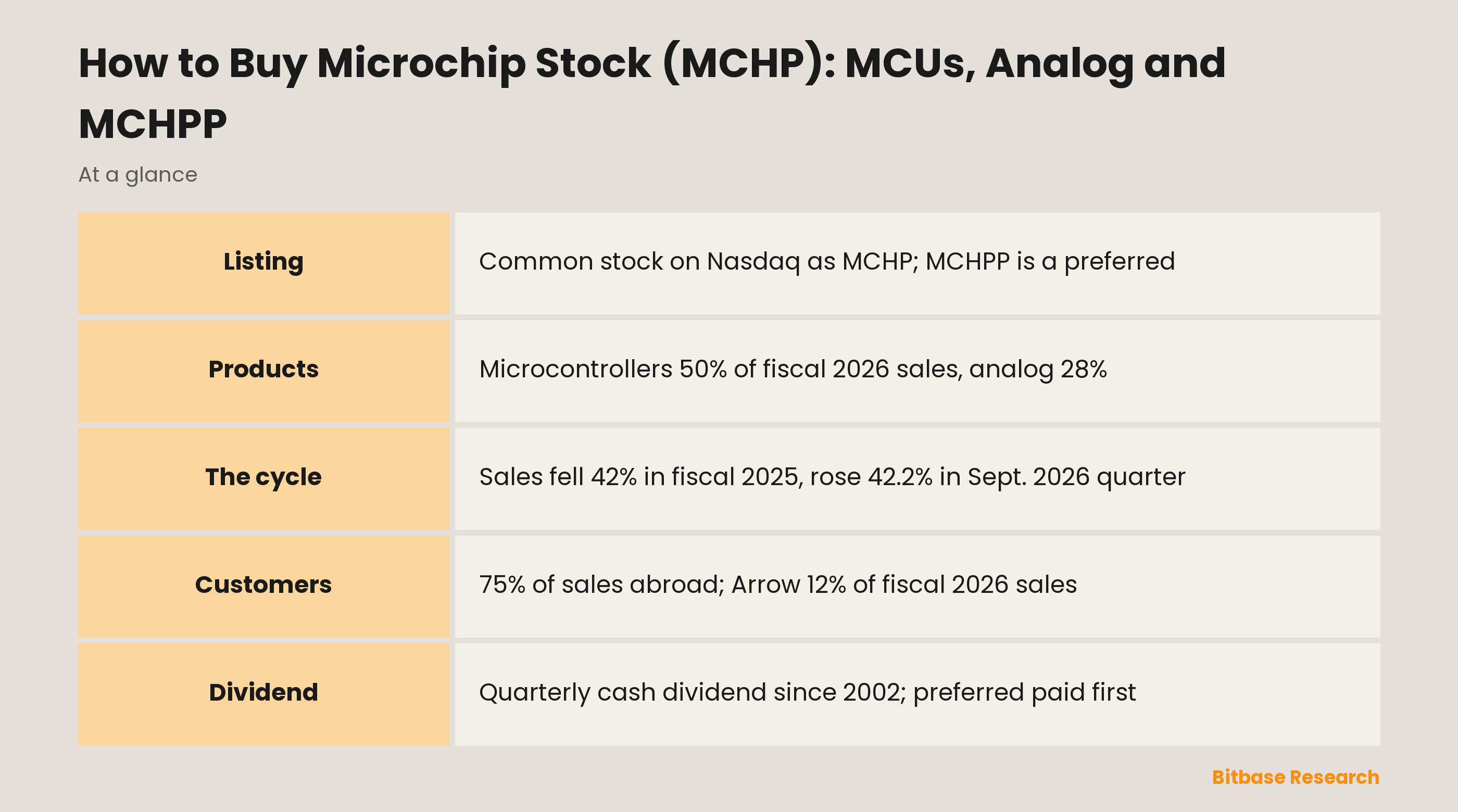
Once you hold a brokerage account that can reach Nasdaq, buying Microchip stock comes down to finding the ticker MCHP and choosing how much to put in. The company makes the controller chips and analog parts inside cars, factory equipment, appliances and data center hardware, and its sales show how sharply that business swings: net sales fell 42% in fiscal 2025 as customers worked off surplus inventory, then the quarter to 30 September 2026 came in 42% above the year before. One more detail trips up first-time buyers: a second Microchip security, MCHPP, trades on the same exchange and is not the common stock.
What Does Microchip Do?
Microchip Technology designs, manufactures and sells what its annual report calls "smart, connected and secure embedded control solutions." Put simply, it supplies the chips that run a product from the inside: a motor drive, car safety electronics, a smart meter, a satellite or a server's storage system. It was incorporated in Delaware in 1989, went public in 1993, and is based in Chandler, Arizona.
The center of the catalog is the mixed-signal microcontroller, which the 10-K describes as "a self-contained computer-on-a-chip," with a processor, memory and analog and digital inputs and outputs on one die. Microchip sells 8-bit, 16-bit and 32-bit families, and it notes that 8-bit parts "remain very cost-effective and easy to use" for high-volume designs. In July 2024 it moved into 64-bit processors with the PIC64 family, built on the open RISC-V architecture for industrial, aerospace, defense and space systems.
Around that core sit three more groups. Analog covers power management, interface, timing, RF, discrete and wireless parts, sold to Microchip's own controller customers and to those who use rival controllers. FPGAs, programmable logic chips that came largely with the May 2018 purchase of Microsemi, are pitched at low power and security for defense, aviation, space and industrial work. A data center line includes Adaptec and Microsemi storage controllers, CXL memory controllers and Switchtec PCIe switches and retimers. Memory chips and the licensing of its SuperFlash embedded-memory technology round out the list.
Much of the portfolio was bought: Atmel in April 2016 and Microsemi in 2018, which the company called "our largest and most complex acquisition ever." In autumn 2026 it added Hailo, a maker of edge AI processors, and Vorago Technologies, a supplier of radiation-hardened microcontrollers.
Unlike many chip designers, Microchip owns a large part of its production. Fab 4 in Gresham, Oregon runs 8-inch wafers and Fab 5 in Colorado Springs makes discrete and specialty products on 6-inch wafers; Fab 2 closed in May 2025. In fiscal 2026 about 35% of sales came from products made in its own US fabs and about 65% from outside foundries, which handle all of its 300mm wafers. It sells to roughly 101,000 customers.
How Microchip Makes Money
Microchip reports two segments, semiconductor products and technology licensing, but the 10-K splits net sales by product line, and that view is more useful:
| Product line | Share of fiscal 2026 net sales | Share of fiscal 2025 net sales | Change in fiscal 2026 |
|---|---|---|---|
| Mixed-signal microcontrollers | 50% | 51% | Up 4.7% |
| Analog | 28% | 26% | Up 14.9% |
| Other (FPGA, licensing, memory, timing and more) | 22% | 23% | Up 3.4% |
Fiscal years end on 31 March, so fiscal 2026 ran from April 2025 to March 2026. Licensing, the only part with no cost of sales, brought in about 3.5% of fiscal 2026 net sales.
The company argues its prices hold up better than the industry's. It says the average selling prices of its microcontrollers "have remained relatively stable in recent periods due to the proprietary nature of these products," and that most of its analog line is proprietary too.
Close to half of sales go through distributors: 47% in fiscal 2026 and 51% in the first half of fiscal 2027. Arrow Electronics, the largest, accounted for 12% of fiscal 2026 net sales, and no other distributor or direct customer passed 10%.
Most sales leave the United States. Foreign customers took about 75% of net sales in fiscal 2026, with Asia at about half, Europe at 21%, China at 18% and Taiwan at 15%. Nearly all of those foreign sales are priced in US dollars.
Profitability follows volume because factories carry fixed costs. Gross margin fell from 65.4% in fiscal 2024 (calculated from the 10-K segment table) to 56.1% in fiscal 2025, recovered to 57.7% in fiscal 2026, and reached 65.9% in the September 2026 quarter. Operating income was 10.4% of fiscal 2026 net sales, up from 6.7%.
MCHP Stock at a Glance
| Feature | MCHP |
|---|---|
| Exchange | Nasdaq (Nasdaq Global Select Market, per the 10-K cover) |
| Ticker | MCHP |
| Security | Common stock |
| Other listed security | MCHPP: depositary shares, each a 1/20th interest in a 7.50% Series A Mandatory Convertible Preferred share |
| Sector | Semiconductors: microcontrollers, analog, FPGA and data center chips |
| Index membership | S&P 500 and Nasdaq-100 |
| Headquarters | Chandler, Arizona |
| Incorporated | Delaware, 1989 |
| Fiscal year | Ends 31 March |
| Payouts | Quarterly cash dividend on the common stock, instituted in 2002 |
| Stock split | Two-for-one, October 2021 |
| SEC identifier | CIK 827054 |
Price, market value and yield move all day; the Microchip stock page on Bitbase shows live figures.
How to Buy Microchip Stock
Microchip is a US company, so no ADR is involved: you buy the common stock itself on Nasdaq. The steps:
1. Find a broker that offers US shares. Abroad, that can be a local broker with US market access or an international platform; check which regulated firm holds your account.
2. Complete the application. Expect identity checks and, for non-US residents, IRS Form W-8BEN. The IRS tells foreign owners to provide it "when requested by the withholding agent or payer."
3. Fund the account. If your money is not in US dollars, the broker converts it, and the exchange rate can cost more than the commission.
4. Search MCHP, not "Microchip". Select the line marked common stock. MCHPP is listed beside it and behaves differently, as the FAQ below explains.
5. Choose the order type. A market order fills at the next available price, which can drift in a fast market. A limit order sets the most you will pay and may not fill at all.
6. Decide the size. Many brokers let you buy a fraction of a share with a fixed amount of money; rules on fractions, and on whether fractional holders can vote, vary by firm.
7. Keep the records. Confirmations show what you paid; statements show dividends and tax withheld.
Tax if you live abroad. Dividends are US-source income. The IRS says "most types of U.S. source income received by a foreign person are subject to U.S. tax of 30%," and that a lower rate or exemption can apply under a tax treaty with your country of residence. Your home country may tax the dividend as well.
Owning it through a fund. MCHP is held by funds that track the S&P 500, such as State Street's SPY, and by Invesco's QQQ, which follows the Nasdaq-100.
What Moves MCHP Stock
The inventory cycle. In fiscal 2025, the 10-K says, the business "was weak as we navigated through a large inventory correction due to our customers holding excess levels of inventory." Net sales fell 42%. The company launched a "business recovery plan" in March 2025 that cut costs, resized manufacturing and reduced headcount. As customers drew down their stock, sales rose 7.1% in fiscal 2026 and 42.2% year on year in the September 2026 quarter, when microcontrollers grew 32.5% and analog 42.8%.
Distributor stock. Because about half of sales run through distributors, their shelves amplify the cycle. At 30 September 2026 distributors held 25 days of Microchip inventory, and over the past ten fiscal years that figure has ranged from about 17 to 43 days. The 10-Q warns that these holding patterns "may have a material impact on our net sales."
Turns orders. Much of each quarter's revenue comes from "turns orders," received and shipped in the same quarter, so visibility is short and customers can change order levels mid-quarter. Historically the first fiscal half has also been stronger than the second.
Pricing. The 10-Q says rising supply chain costs have generally been passed on to customers, and that the latest price increase took effect in the September 2026 quarter with respect to "our very broad range of customers and products."
Data center design wins. Chief executive Steve Sanghi said in the November 2026 earnings release that design wins for the PCIe Gen6 switch and retimer had grown to 24, up from 12 at the end of the June quarter. Design wins become revenue only when customers' products ship.
Trade with China. China took 18% of fiscal 2026 net sales, and the 10-K calls a strong position there "a key component of our global growth strategy," though changes in that market hurt volumes in each of the last three fiscal years. On 13 September 2025 China opened an antidumping investigation into US-origin analog chips; Microchip says it was not a subject.
Where Microchip's Recovery Could Stall
The 10-K lists many risk factors. These are most tied to how Microchip operates:
Factory utilization. "Our operating results will suffer if we ineffectively utilize our manufacturing capacity or fail to maintain manufacturing yields." Owning fabs helps margins in good years and hurts them when volumes drop, which is what the fiscal 2025 gross margin shows. Expansion at Fab 4 and Fab 5 is paused through fiscal 2027.
Reliance on distributors. Most distributors have no long-term agreement and can end the relationship on little notice. A real example sits in the 10-Q: on 8 October 2025 some Arrow subsidiaries were added to the US Commerce Department's Entity List, which stopped certain shipments to them until the department authorized Arrow to continue nine days later. Microchip reported no material impact.
Foreign exposure and foundries. With three quarters of sales abroad, the company names tariffs, export controls, sanctions and geopolitical tension, including in the Middle East, among its risks. And with about 65% of sales made on outside foundries' wafers, their capacity and pricing feed straight into its supply.
The capital structure. Microchip carries debt, convertible notes and the mandatory convertible preferred. The 10-K warns that conversion "will dilute the ownership interest of our existing stockholders," and that common stock "ranks junior" to the preferred: unless accumulated preferred dividends have been paid or set aside, no dividend can be paid on the common stock, with limited exceptions.
Beyond these sit the risks of any single stock: one company's setbacks hit your whole position, and the dividend is a board decision, not an obligation.
How to Research MCHP Yourself
Microchip files with the SEC under CIK 827054. With a March year-end, the 10-K arrives in May and 10-Qs cover the other three quarters. Earnings releases come attached to 8-Ks; recent ones arrived on 5 February, 7 May, 6 August and 5 November 2026. The filings are also free on microchip.com.
In the 10-K, Item 1 describes the products and factories, Item 1A lists the risks, and the MD&A carries the product line and geography tables used above. Item 5 compares Microchip's five-year total return with the S&P 500 and the Philadelphia Semiconductor Index.
When reading the numbers, remember that "fiscal 2027" started on 1 April 2026, and read growth rates next to distributor inventory days in the same 10-Q, since part of a jump in sales can be distributors restocking. For broader comparisons, our Texas Instruments stock guide and NXP stock guide follow the same layout, and Bitbase's list of US stock pages covers other listed companies.
Microchip Stock FAQ
Can I buy Microchip stock with crypto?
Not directly. MCHP shares are bought in US dollars through a brokerage account, so crypto must first be sold for cash and moved to the broker, a sale that may be taxable where you live. A share is a stake in a registered company, with dividend and voting rights; how a share differs from a crypto asset is worth reading before you mix the two.
Does Microchip pay a dividend?
Yes. The board instituted a quarterly cash dividend on the common stock in October 2002. The 10-K says the board "is free to change our dividend practices at any time and to increase or decrease the dividend paid, or not to pay a dividend," and preferred dividends must be paid or set aside first. Check the latest earnings release for the current amount and dates.
What is MCHPP, and is it the same as MCHP stock?
No. MCHPP stands for depositary shares issued in March 2025, each representing a 1/20th interest in a share of 7.50% Series A Mandatory Convertible Preferred Stock. Unless converted earlier, each preferred share converts automatically into common stock on 15 March 2028, at a rate that depends on the common share price at that time. Until then the preferred carries cumulative dividends at 7.50% a year on its liquidation preference. If you want ordinary Microchip shares, buy MCHP.
Is MCHP in the S&P 500 and the Nasdaq-100?
Yes. On 9 November 2026 Microchip Technology appeared in State Street's daily holdings file for SPY, the S&P 500 fund, and MCHP was in Invesco's holdings data for QQQ, which tracks the Nasdaq-100. Index weights change daily.
Has Microchip stock ever split?
Yes. Stockholders approved a two-for-one forward split in August 2021: holders of record at the close on 4 October 2021 received one additional share for each share held, distributed after the close on 12 October 2021. Check that older per-share data you compare has been adjusted for it.
Conclusion
Microchip's results move with its customers' inventories more than with any single product, which is why its sales could fall 42% in one fiscal year and the quarter to September 2026 could come in 42% above the year before. The questions that matter are about that cycle: whether distributor inventory days stay low, whether the September 2026 price increase holds, and whether data center design wins turn into shipments. Read the latest 10-Q next to the 10-K, and decide how much of your portfolio one chipmaker's cycle should carry.
Related reading
Other Bitbase articles on this topic:
- How to Buy Astera Labs Stock (ALAB): Retimers, Switches and Perps
- How to Buy Coherent Stock (COHR): From II-VI to AI Optics
- How to Buy STMicroelectronics Stock (STM): SiC, Sensors and Perps
- How to Buy UMC Stock (UMC): Five-Share ADS and Mature-Node Fabs
Disclaimer: This article is educational content from Bitbase Academy, provided for information only. It explains what a company or fund does and how the instruments referenced here differ from one another; it does not constitute investment, trading, tax, or financial advice, and it is neither a recommendation nor an endorsement of any security, token, or trading strategy. A tokenized stock is issued by a third party and is designed to give economic exposure to an underlying asset: it is not a share, it carries no shareholder rights, and it depends on the issuer's structure, eligibility rules, and redemption terms, which the issuer can change. Perpetual futures are leveraged derivatives that hold no underlying asset and can be liquidated, and trading hours, product availability, and eligibility differ by instrument and by jurisdiction and can change at any time. Written as of November 2026; verify everything yourself through company filings, the issuer's own documentation, and the product pages of the venue you trade on.
References
[1] Microchip Technology Form 10-K for fiscal 2026 (SEC EDGAR) www.sec.gov
[2] Microchip fiscal 2026 Form 10-K, XBRL cover page (SEC EDGAR) www.sec.gov
[3] Microchip fiscal 2026 Form 10-K, XBRL segment net sales and gross profit (SEC EDGAR) www.sec.gov
[4] Microchip fiscal 2026 Form 10-K, XBRL customer and geographic concentration (SEC EDGAR) www.sec.gov
[5] Microchip Form 10-Q for the quarter ended 30 September 2026 (SEC EDGAR) www.sec.gov
[6] Microchip second quarter fiscal 2027 earnings release, filed with Form 8-K (SEC EDGAR) www.sec.gov
[7] Microchip Form 10-K for fiscal 2022: stock split and acquisitions (SEC EDGAR) www.sec.gov
[8] State Street SPDR S&P 500 ETF Trust (SPY): fund page and daily holdings www.ssga.com
[9] Invesco QQQ: fund overview www.invesco.com
[10] IRS: NRA Withholding www.irs.gov
[11] IRS: About Form W-8 BEN www.irs.gov





