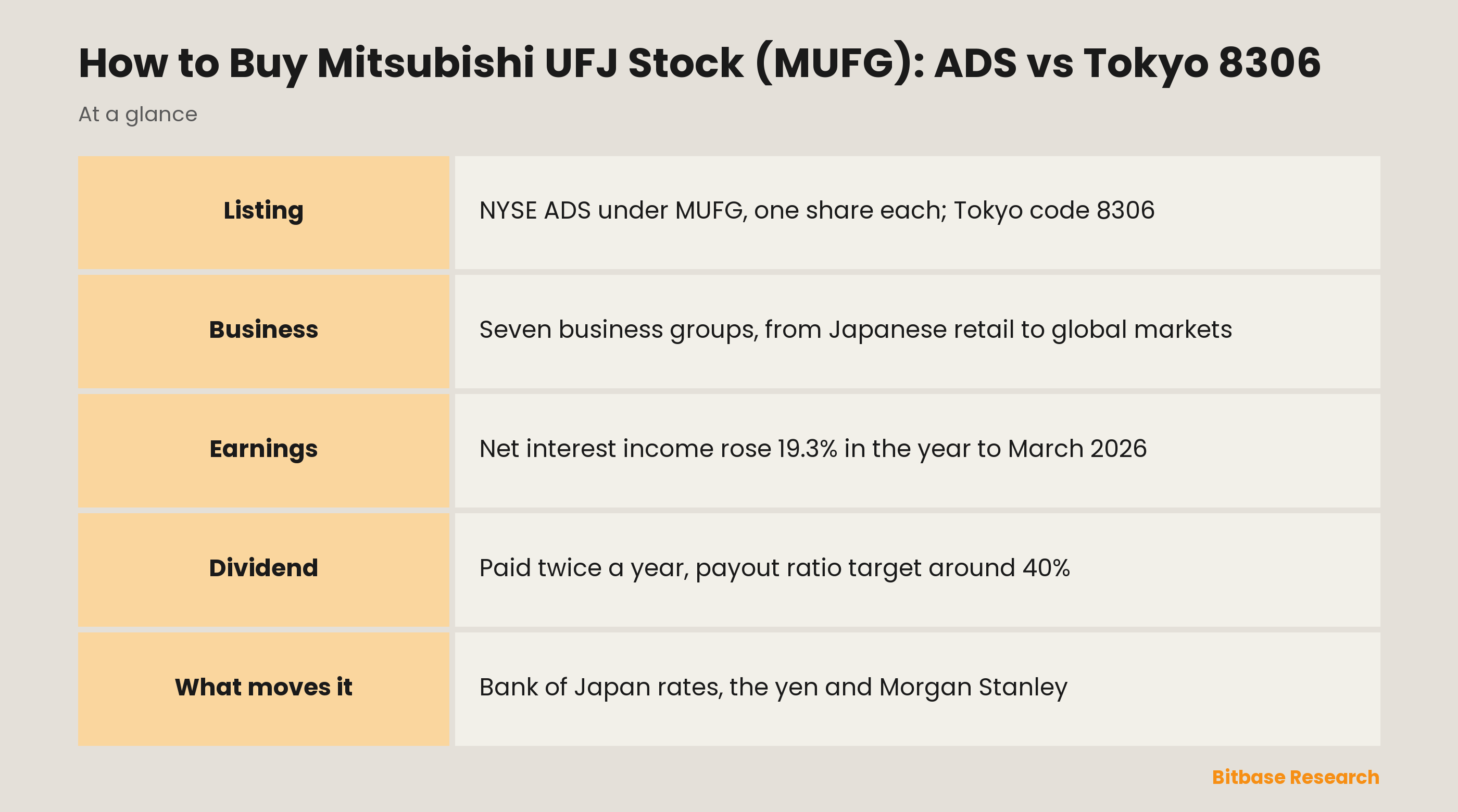
Getting Mitsubishi UFJ Financial Group stock into a portfolio takes a broker with New York Stock Exchange access, where MUFG trades as an American depositary share (ADS) worth exactly one ordinary share, or a broker that reaches Tokyo, where the same shares trade under code 8306 in units of 100. Behind both lines sits a Tokyo holding company that owns MUFG Bank, a trust bank and banks in Southeast Asia, and that also holds about 23.9% of the voting rights in Morgan Stanley. In the year to 31 March 2026, rising Japanese interest rates helped lift its net interest income 19.3%. This guide covers how MUFG makes its money, how to choose between the two lines and what its annual filing flags as the main risks.
What Does Mitsubishi UFJ Do?
Mitsubishi UFJ Financial Group, usually shortened to MUFG, is the holding company of a Japanese banking group. Its annual report describes it as "a bank holding company incorporated as a joint stock company (kabushiki kaisha) under the Companies Act of Japan," and the Financial Stability Board lists it among the global systemically important banks (G-SIBs). The parent sets strategy and its subsidiaries do the business: MUFG Bank, Mitsubishi UFJ Trust and Banking, a securities arm, the card company Mitsubishi UFJ NICOS and an asset manager.
The group took its present shape in two steps. On 2 April 2001, The Bank of Tokyo-Mitsubishi, Mitsubishi Trust and Banking and Nippon Trust and Banking set up Mitsubishi Tokyo Financial Group as their joint holding company through a share exchange. That company merged with UFJ Holdings, and on 1 October 2005 the combined group became Mitsubishi UFJ Financial Group. The commercial bank took the name MUFG Bank in April 2018.
The work is split among seven business groups. Three serve Japan: Retail & Digital for individual customers, cards and consumer finance; Commercial Banking & Wealth Management for smaller companies and wealthy clients, including succession planning for owners and estates; and Japanese Corporate & Investment Banking for large Japanese companies. Asset Management & Investor Services runs pensions, custody, investment trusts and First Sentier Group, a fund manager acquired in 2019. Global Corporate & Investment Banking serves non-Japanese corporations and financial institutions, with project finance among its core businesses, while Global Commercial Banking holds the banks MUFG controls in Southeast Asia. Global Markets trades bonds, currencies and equities for clients and manages the group's own balance sheet.
At 31 March 2026 MUFG owned 76.88% of Krungsri (Bank of Ayudhya) in Thailand and 92.47% of Bank Danamon in Indonesia, and it holds minority stakes in VietinBank in Vietnam and Security Bank in the Philippines; the 20-F calls the four its "Partner Banks." India followed in April 2026, when MUFG Bank bought 20% of Shriram Finance, a lender that mainly finances used commercial and passenger vehicles. In all, the group had about 2,000 business locations in more than 41 countries, Japan included.
The other pillar is Morgan Stanley. MUFG first invested in the US firm in October 2008, and in Japan the two run a pair of securities joint ventures, Mitsubishi UFJ Morgan Stanley Securities and Morgan Stanley MUFG Securities, in each of which MUFG holds a 60% economic interest.
How MUFG Makes Money
MUFG reports in two accounting languages: the audited 20-F statements follow US GAAP, while segment figures follow Japanese rules "as adjusted in accordance with internal management accounting rules and practices," so the two cannot be added together.
On the US GAAP statements, net interest income, what loans and securities earn minus the cost of deposits and borrowing, made up about 53.1% of net interest and non-interest income combined in the year to March 2026. It grew 19.3%. Non-interest income, from fees, trading, investments and affiliates, rose 26.6%, and net income attributable to MUFG increased 36.5%.
The segment note shows where revenue is earned:
| Business group | What it covers | Share of net revenue, year to March 2026 |
|---|---|---|
| Japanese Corporate & Investment Banking | Large Japanese companies | 18.8% |
| Global Corporate & Investment Banking | Non-Japanese corporations and institutions | 18.1% |
| Retail & Digital | Individuals in Japan, cards, consumer finance | 17.8% |
| Global Commercial Banking | Krungsri and Bank Danamon | 15.1% |
| Commercial Banking & Wealth Management | Smaller companies, wealthy clients | 14.5% |
| Asset Management & Investor Services | Pensions, custody, investment trusts | 10.4% |
| Global Markets | Client trading and group treasury | 5.1% |
| Other | Items not allocated to a group | 0.3% |
Shares are of total segment net revenue, on MUFG's internal management basis under Japanese accounting rules.
Profit is spread differently. Japanese Corporate & Investment Banking delivered about 29.9% of segment operating profit, the most of any group, while Global Markets and Other each posted an operating loss. The 20-F partly credits higher yen interest rates for the year's gains in the three domestic customer groups: MUFG's average domestic interest rate spread widened to 0.2% from 0.05% as Japan moved "out of the historical zero-interest rate environment."
Japan remains the anchor. Interest and non-interest income earned in Japan was 37.1% of the group total for the year, and loans in Japan made up 53.6% of all loans at 31 March 2026. Morgan Stanley contributes through equity-method accounting: MUFG's equity in the earnings of its affiliates rose 30.1%, which the filing puts down to "higher earnings of our equity method investees, including Morgan Stanley."
MUFG Stock at a Glance
| Field | MUFG |
|---|---|
| Issuer | Mitsubishi UFJ Financial Group, Inc., incorporated in Japan |
| New York line | ADSs listed on the NYSE under MUFG |
| ADS ratio | One ADS represents one share of common stock |
| Home listing | Tokyo Stock Exchange Prime Market (principal market), code 8306; also Nagoya |
| Trading unit in Japan | 100 shares, one vote per unit |
| Depositary and custodian | The Bank of New York Mellon; MUFG Bank holds the shares |
| Sector | Banking, trust banking, securities, consumer finance |
| Index membership | Nikkei 225 and TOPIX |
| Headquarters | Marunouchi, Tokyo |
| Financial year | Ends 31 March; 20-F in US GAAP, quarterly reports in Japanese GAAP |
| Dividend policy | Interim and year-end dividends; payout ratio target of around 40% |
| SEC filings | CIK 67088; annual report on Form 20-F, interim news on Form 6-K |
Quotes, market value and yield are live numbers, so they belong on the Mitsubishi UFJ stock page on Bitbase rather than in an article.
How to Buy Mitsubishi UFJ Stock
The ADS and the Tokyo share are the same security in two wrappers. The common stock is listed on the NYSE "for technical purposes only and without trading privileges," so in New York the tradable line is the ADS. The steps:
1. Decide where to buy. Any broker with NYSE access can buy the ADS in US dollars; 8306 needs one that reaches Tokyo and settles in yen. Confirm the legal entity behind the account and its regulator.
2. Pass the account checks. Expect to document your identity and tax residence; a treaty rate on Japanese withholding tax depends on forms filed before the dividend is paid.
3. Deposit dollars or yen. Currency conversion carries its own spread, which can outweigh the trading fee.
4. Find the right line. On a US screen, search MUFG and confirm it reads American depositary shares of Mitsubishi UFJ Financial Group; in Tokyo, look for code 8306.
5. Set the order. Market orders execute at the prevailing price; limit orders name a maximum.
6. Size the order. In Tokyo the share trades in units of 100, and a holding below one unit carries no vote. The ADS has no such unit.
7. Save the paperwork. Trade confirmations and dividend vouchers are what you will need at tax time.
ADS or Tokyo shares. ADS holders act through the depositary: they instruct The Bank of New York Mellon how to vote, and it converts yen dividends into US dollars and pays them "after deduction of any applicable withholding taxes." Turning ADSs back into shares works only "in multiples of 100 ADSs," the size of a Tokyo unit. The regular sessions never overlap: Tokyo trades from 9:00 to 11:30 and 12:30 to 15:30 local time, during the New York night, outside the NYSE core session of 9:30 a.m. to 4:00 p.m. ET. Before reading anything into a price gap, convert the currency and check each quote's time stamp, as the guide to regular and extended-hours stock prices explains.
Tax on dividends. Dividends paid to non-residents of Japan are taxed at source. Without a treaty, the 20-F gives the rate as 15.315% for dividends paid on or before 31 December 2047; the Japan–US treaty generally caps it at 10% for US holders, provided the forms go in through the paying agent or, for ADSs, the depositary; if the advance filing is missed, the excess can be reclaimed afterwards. Gains on selling the shares or ADSs are "not, in general, subject to Japanese income or corporation taxes," and MUFG's own view is that it was not a passive foreign investment company, a US tax category, in the year to March 2026. Your home country may tax the same income again.
Through an index fund. Nomura Asset Management's NEXT FUNDS Nikkei 225 ETF and NEXT FUNDS TOPIX ETF each listed code 8306 in their creation baskets for 19 October 2026, so a fund tracking either benchmark holds MUFG as one constituent among many.
What Moves MUFG Stock
The Bank of Japan. The 20-F notes that the central bank "has been gradually raising its policy interest rate since March 2024," and in the year to March 2026 net domestic interest income more than doubled. The filing also spells out the reverse: if the policy rate were lowered, "our interest rate spread on our domestic loan portfolio may narrow, reducing our net interest income." An unexpectedly sharp rise would bring its own costs, through bond prices and borrowers' ability to repay.
The yen. The ADS is priced in dollars, so a dollar-based holder carries two exposures: the Tokyo share price and the yen-dollar rate. In the accounts, the year to March 2026 brought both a weaker yen against the dollar and a net foreign exchange loss. Yen moves also travel through wider markets, because positions funded in a cheap currency can be cut fast when that funding is repriced, the mechanism behind carry-trade unwinds.
Morgan Stanley. In MUFG's words, Morgan Stanley "has contributed to a significant portion of our net income and revenue in recent periods," and a fall in its share price can force MUFG to book losses on the investment. To a degree, an MUFG share is also a position in a US investment bank.
The Tokyo stock market. MUFG still holds strategic stakes in Japanese companies, which its corporate banking group is working to reduce, and unrealised gains and losses on them feed into its capital ratios. In the year to March 2026 higher share prices turned investment securities into a net gain; a falling market would push the other way on earnings and capital alike.
Asia deals. Krungsri's consolidation of Tidlor Holdings in August 2025, the Shriram stake bought in April 2026 and a May 2026 memorandum to explore merging Bank Danamon with MUFG Bank's Jakarta branch all change what an MUFG share owns. That integration, if it proceeds, is expected within 2027 and still needs approval from regulators and Danamon's shareholders.
Credit and capital. Provisions for credit losses rose 85.7% in the year to March 2026, mainly because of one large borrower in the foreign manufacturing sector. The common equity tier 1 (CET1) ratio stood at 12.47% at 31 March 2026 against a requirement of 8.68%, and MUFG lists its capital situation among the factors it weighs when deciding on buybacks.
Risks to Weigh Before Buying MUFG
Of the many risk factors in the 20-F, five touch a shareholder most directly:
Concentration in Japan. "Because a large portion of our assets as well as our business operations are in Japan, we may incur losses if economic conditions in Japan worsen." The filing links that risk to Japan's fiscal health and to Japanese government and agency bonds, which make up more than half of MUFG's investment securities portfolio.
The Morgan Stanley alliance. "If our strategic alliance with Morgan Stanley fails, we could suffer financial or reputational loss." MUFG adds that it has "neither a controlling interest in, nor control over the business operations of, Morgan Stanley."
Capital requirements. MUFG warns that it "may not be able to maintain our capital ratios and other regulatory ratios above minimum required levels," with regulatory action as the consequence. As a G-SIB it must also hold an extra capital surcharge.
Currency. Exchange-rate moves "may result in transaction losses" on foreign-currency assets and liabilities, and in translation losses on foreign subsidiaries and equity-method investees.
Fewer rights as an ADS holder. "As a holder of American Depositary Shares, you have fewer rights than a shareholder of record in our shareholder register since you must act through the depositary to exercise these rights." ADS holders cannot themselves bring a derivative action or examine the books, and the filing warns that it "may not be possible" to enforce US court judgments against MUFG or its directors.
Then come the risks of any single stock: a concentrated position, a confidence risk that banks share with their whole sector, and dividends that are approved each time rather than promised.
How to Research MUFG Yourself
On EDGAR, MUFG appears under CIK 67088. Its annual report is the Form 20-F, filed each July for the year ending 31 March (most recently on 6 July 2026), and Form 6-K carries everything in between, including quarterly results, capital ratios and bond issues. The 20-F is also posted on mufg.jp.
In the 20-F, Item 3.D holds the risk factors, Item 4 the business groups, Item 5 the results and segment analysis, Item 10.E the tax summaries and Item 12.D the depositary fees; Morgan Stanley's own financial statements are attached because Rule 3-09 of the SEC's Regulation S-X requires them.
One trap: the quarterly reports MUFG releases in Japan, and files in English on Form 6-K, follow Japanese GAAP. Results for the three months to June 2026 appeared on 3 August 2026 as a "Consolidated Summary Report" under Japanese GAAP, while the 20-F uses US GAAP, so the profit figures will not match; compare like with like. Live prices are on the MUFG page linked above; for other companies, see Bitbase's full list of US stock pages.
Mitsubishi UFJ Stock FAQ
What is the difference between the MUFG ADS and the Tokyo shares?
The ownership is the same; the wrapper differs. One ADS stands for one MUFG share held by the depositary, The Bank of New York Mellon. It is priced in US dollars on the NYSE, its dividends arrive in dollars after withholding tax, and its votes go through the depositary. Code 8306 is the common stock itself, traded in yen in Tokyo in units of 100. ADSs can be exchanged for shares only in multiples of 100.
Does Mitsubishi UFJ pay a dividend?
Yes, twice a year: an interim dividend for holders of record on 30 September and a year-end dividend approved at the June shareholders' meeting. MUFG's stated policy is a payout ratio of around 40% and "a stable and sustainable increase in dividends per share through profit growth"; the dividend per share for the year to March 2026 was about 34% higher than a year earlier. Each amount is published with MUFG's results.
Can I buy Mitsubishi UFJ stock with crypto?
Not directly. Both the ADS and the Tokyo share are purchased through a broker and settled in US dollars or yen. Crypto would first have to be converted into one of them and moved to the brokerage account, and the sale can carry tax consequences of its own where you live. Keep the two decisions apart: a share is a claim on the company that carries dividends and votes, and the explainer on how stocks and crypto differ sets out why that matters.
Is MUFG in the Nikkei 225?
Yes, and in TOPIX too. Nomura Asset Management's ETFs tracking the two indices both included code 8306 in their creation baskets for 19 October 2026. Index weights change daily.
How much of Morgan Stanley does MUFG own?
About 23.9% of the voting rights at 31 March 2026, according to its 20-F, plus two seats on Morgan Stanley's board. Its share of Morgan Stanley's profit counts in MUFG's earnings, but MUFG does not control the business.
Conclusion
Buying MUFG starts with a choice of line: the NYSE ADS, one share each and priced in dollars, or 8306 in Tokyo, in units of 100 and priced in yen. The order is routine; what deserves the time is what the share owns: a Japanese banking group whose earnings have turned with the end of zero interest rates, with controlling stakes in Southeast Asian banks and a large minority stake in Morgan Stanley. Check that picture against the latest 20-F and any 6-K filed after it before deciding how large a position one bank deserves.
Related reading
Other Bitbase articles on this topic:
- How to Buy Citigroup Stock (C): Five Businesses, Banamex Exit
- How to Buy Deutsche Bank Stock (DB): Same Share as Frankfurt's DBK
- How to Buy HDFC Bank Stock (HDB): Three Shares per ADS, No Vote
Disclaimer: This article is educational content from Bitbase Academy, provided for information only. It explains what a company or fund does and how the instruments referenced here differ from one another; it does not constitute investment, trading, tax, or financial advice, and it is neither a recommendation nor an endorsement of any security, token, or trading strategy. A tokenized stock is issued by a third party and is designed to give economic exposure to an underlying asset: it is not a share, it carries no shareholder rights, and it depends on the issuer's structure, eligibility rules, and redemption terms, which the issuer can change. Perpetual futures are leveraged derivatives that hold no underlying asset and can be liquidated, and trading hours, product availability, and eligibility differ by instrument and by jurisdiction and can change at any time. Written as of October 2026; verify everything yourself through company filings, the issuer's own documentation, and the product pages of the venue you trade on.
References
[1] Mitsubishi UFJ Financial Group, Form 20-F for the year ended 31 March 2026 (SEC EDGAR) www.sec.gov
[2] MUFG, Form 20-F Exhibit 2(c): description of securities www.sec.gov
[3] MUFG, consolidated summary report for the three months to June 2026 (Form 6-K, 3 August 2026) www.sec.gov
[4] MUFG investor relations: Shareholder Return www.mufg.jp
[5] MUFG investor relations: Dividend Information www.mufg.jp
[6] Nomura Asset Management, NEXT FUNDS Nikkei 225 ETF (1321): creation basket, 19 October 2026 nextfunds.jp
[7] Nomura Asset Management, NEXT FUNDS TOPIX ETF (1306): creation basket, 19 October 2026 nextfunds.jp
[8] Japan Exchange Group: trading hours for domestic stocks www.jpx.co.jp
[9] NYSE: hours and calendars www.nyse.com





