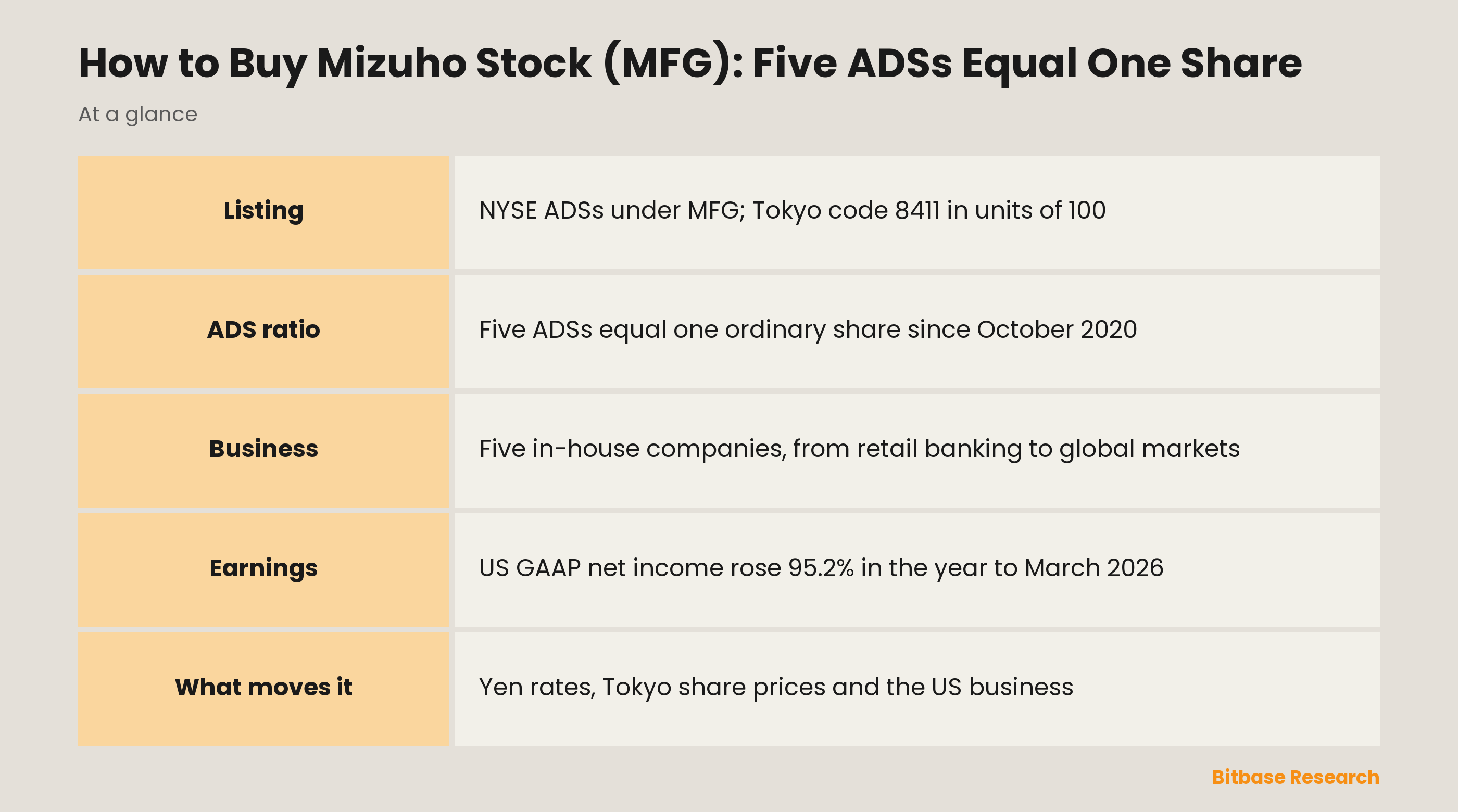
When you buy Mizuho stock through a broker with New York Stock Exchange access, you get American depositary shares (ADSs) under the ticker MFG, each worth one-fifth of an ordinary share; a broker that reaches Tokyo can buy the ordinary shares themselves under code 8411, in lots of 100. Check that ratio against the right document: every Form 20-F cover since 2012, including the one filed in June 2026, still says each ADS represents two shares, which was the ratio before Mizuho consolidated ten shares into one in October 2020. The company behind it owns Mizuho Bank, Mizuho Trust & Banking and Mizuho Securities, and its net income under US accounting rules rose 95.2% in the year to March 2026.
What Does Mizuho Do?
Mizuho Financial Group is a holding company based in Otemachi, in Tokyo's Chiyoda ward. It owns 100% of Mizuho Bank, the trust bank Mizuho Trust & Banking, the broker Mizuho Securities, the card issuer UC Card and Mizuho Americas, the US bank holding company it set up in July 2016. It also owns 70.0% of Asset Management One, created in 2016 when Mizuho and Dai-ichi Life combined their fund managers. Regulators classify the group as a global systemically important bank (G-SIB), which brings an extra capital buffer.
The group dates from 29 September 2000, when Mizuho Holdings became the parent of three banks: Dai-Ichi Kangyo Bank, Fuji Bank and the Industrial Bank of Japan. Mizuho Financial Group was incorporated in January 2003 and took over as parent that March; the retail and wholesale banks merged into today's Mizuho Bank in July 2013.
The business is organised into five in-house companies by type of client. Retail & Business Banking serves individuals, small firms and mid-sized companies with deposits, mortgages, investment accounts and business-succession advice; it even sells lottery tickets issued by Japanese prefectures and large cities. Corporate & Investment Banking covers big Japanese companies, financial institutions and public bodies with loans, bond and equity underwriting, M&A advice and real-estate work. Global Corporate & Investment Banking serves Japanese companies abroad and corporations outside Japan. Its "Global 300 Strategy" targets about 300 blue-chip non-Japanese companies, and the group aims to "rank in the top ten for global Corporate & Investment Banking (CIB)." Global Markets runs sales and trading for clients from individuals to institutions and manages the group's balance sheet and its bond and equity portfolios. Asset Management serves savers and pension funds, including through Asset Management One.
Recent deals show where the group is pushing. Mizuho Bank bought 76.9% of the fintech group Upsider Holdings in September 2025; a month later the group finished handing its custody business outside Japan to State Street. In December 2025 Mizuho Securities agreed to buy more than 60% of Avendus Capital, an Indian financial services firm, subject to regulatory approval. At 31 March 2026 the group held 49.00% of the broker Rakuten Securities, and in May 2026 Mizuho Bank signed a capital and business alliance with the digital bank Rakuten Bank, under which it was scheduled to receive 10.52% of Rakuten Bank's common shares on 1 October 2026 in exchange for its Rakuten Card stake. At home, the 20-F names Mitsubishi UFJ Financial Group and Sumitomo Mitsui Financial Group as the other major banking groups it competes with; both have guides of their own, on buying Mitsubishi UFJ stock and on buying Sumitomo Mitsui stock.
How Mizuho Makes Money
Two rulebooks run through Mizuho's numbers: the 20-F uses US accounting principles (US GAAP), while its Japanese results and in-house company figures use Japanese GAAP. They can describe the same year very differently, so each figure below names its rulebook.
On the US GAAP income statement for the year to 31 March 2026, net interest income (interest earned on loans and securities, less interest paid on deposits and borrowings) rose 33.9% and made up 37.4% of net interest income plus all noninterest income. Fee and commission income, from lending, securities, remittance and trust business, grew 14.0% and supplied 30.5%. Another 23.0% came from gains on equity securities, which swung from a loss the year before as Japanese share prices climbed. Net income attributable to shareholders rose 95.2%.
Two forces lifted the interest line. At home, the average yield on domestic loans rose 0.28 percentage points to 1.51% as the Bank of Japan raised rates, while the average rate paid on domestic deposits rose only 0.18 points, to 0.36%. Abroad, loan yields and funding costs both fell, and the 20-F credits the wider group spread, 0.40% against 0.16% a year earlier, mainly to cheaper funding.
| In-house company | Main clients | Share of gross profit | Share of net business profit |
|---|---|---|---|
| Retail & Business Banking | Individuals, small and mid-sized firms in Japan | 29.7% | 17.2% |
| Corporate & Investment Banking | Large companies and institutions in Japan | 22.3% | 36.1% |
| Global Corporate & Investment Banking | Japanese firms abroad, non-Japanese companies | 25.8% | 26.6% |
| Global Markets | Client trading, balance sheet, securities portfolio | 20.0% | 18.8% |
| Asset Management | Individuals, pension funds | 2.2% | 1.4% |
Share of the five in-house companies' combined figures, other items excluded, for the year to March 2026, on Mizuho's internal management basis under Japanese GAAP, with foreign earnings translated at budgeted exchange rates.
The retail side generates the most gross profit, yet general and administrative expenses took 76.8% of it, compared with 33.9% at Corporate & Investment Banking; the large-company business therefore contributes the biggest share of net business profit. Both domestic companies credited their growth mainly to better deposit income as yen rates rose, and retail net business profit jumped 69.2%. The overseas corporate business lifted gross profit, but rising expenses left its net business profit up just 0.6%.
MFG Stock at a Glance
| Item | Detail |
|---|---|
| Listed company | Mizuho Financial Group, Inc., incorporated in Japan in 2003 |
| US listing | ADSs on the NYSE, ticker MFG, since 8 November 2006; a sponsored Level 2 programme |
| ADS ratio | Five ADSs equal one ordinary share, since 1 October 2020 |
| Tokyo listing | Prime Market of the Tokyo Stock Exchange, code 8411 |
| Tokyo trading unit | 100 shares with one vote, equal to 500 ADSs |
| Depositary | The Bank of New York Mellon, with Mizuho Bank as custodian |
| Index membership | Nikkei 225 and TOPIX |
| Head office | Otemachi, Chiyoda-ku, Tokyo |
| Fiscal year | Ends 31 March; 20-F under US GAAP, Japanese filings under Japanese GAAP |
| Shareholder returns | Two dividends a year, progressive dividend policy, buybacks guided by a total payout ratio of 50% or more |
| SEC filings | CIK 1335730; annual Form 20-F, interim Form 6-K |
For the live share price, market value and dividend yield, which no article can keep current, see Bitbase's MFG quote page.
How to Buy Mizuho Stock
The same company trades on two lines, so the steps are:
1. Pick the market. A broker that trades NYSE stocks can buy the ADSs; code 8411 needs a broker that can trade on the Tokyo Stock Exchange.
2. Open and verify the account. Expect identity and tax-residence checks; treaty forms filed early make a lower Japanese dividend tax easier to get.
3. Fund it. Currency conversion carries its own cost, often hidden in the exchange rate.
4. Check the line. MFG should show as Mizuho Financial Group ADSs; in Tokyo, look up 8411.
5. Choose an order type. Market orders take the going price; limit orders set the most you will pay.
6. Size the order. Tokyo trades in 100-share units, and a full unit equals 500 ADSs.
7. Keep the paperwork. Save trade confirmations and dividend statements; you will need them at tax time.
ADSs or Tokyo shares. The Bank of New York Mellon is the depositary, and Mizuho Bank keeps the underlying shares in custody. In the words of the ADS description: "As an ADS holder, we will not treat you as one of our shareholders and you will not have shareholder rights." You can instruct the depositary how to vote only if Mizuho asks it to collect instructions, and if you send none by the deadline you are treated as having asked it to give a discretionary proxy to a person Mizuho designates, with some exceptions. Dividends arrive in dollars, net of the depositary's fees. Swap ADSs back into shares and you receive only whole 100-share units, with the rest returned as ADSs. Tokyo trades from 9:00 to 11:30 and from 12:30 to 15:30 local time, overnight in New York; NYSE core trading runs 9:30 a.m. to 4:00 p.m. Eastern Time, so the two never overlap.
Why the cover page says two shares. Before 1 October 2020 one ADS represented two shares. On that date Mizuho consolidated every ten shares into one, and it changed the ratio to five ADSs per share "in order to maintain the continuity of the ADRs' price level." The ADS description filed with the July 2021 annual report, which later 20-Fs incorporate by reference, gives each ADS as one-fifth of a share, and Mizuho's investor-relations page lists the conversion ratio as five ADRs to one share. Only the 20-F cover kept the old wording.
Odd lots in Tokyo. A holding below 100 shares brings dividends but no vote. Its owner may ask Mizuho to buy them at the market price, or to sell enough extra shares to make a full unit, if Mizuho has the shares on hand.
Tax on dividends. Japan takes tax at source on dividends paid to holders abroad: 15.315% on listed shares like Mizuho's for payments due by 31 December 2047, according to the 20-F, except for an individual owning 3% or more. Under the US-Japan treaty, qualifying US residents generally pay at most 10%; other treaties set their own rates. For ADSs the depositary files the claim forms, and tax withheld above the treaty rate can be claimed back afterwards. Selling outside Japan normally triggers no Japanese tax for a portfolio investor, but your country of residence may tax the gain. Easy to miss: Japanese inheritance and gift taxes may apply to shares or ADSs passed between individuals even when nobody involved lives in Japan.
Through an index fund. Nomura Asset Management's NEXT FUNDS Nikkei 225 ETF and NEXT FUNDS TOPIX ETF both listed 8411 in their creation baskets for 30 October 2026, so a fund replicating either index holds a small slice of Mizuho. Such funds trade in Tokyo and hold the ordinary shares, not the ADSs.
What Moves Mizuho Shares
Yen interest rates. Japan's central bank scrapped negative rates in March 2024 and lifted its target for the overnight call rate several times afterwards, reaching around 0.75% in December 2025, the last move the 20-F records. Higher rates improve deposit income but cut bond values: after US rates began rising in early 2022, Mizuho booked "significant trading account losses" on foreign bonds in each of the three fiscal years to March 2024.
Tokyo share prices. Under US GAAP, the 20-F explains, Mizuho's equity holdings "are measured at fair value with changes in fair value recognized in earnings," whereas Japanese GAAP routes those changes through other comprehensive income. The Nikkei Stock Average rose 43.4% over the year to 31 March 2026, and equity gains became a big part of the jump in US GAAP profit. The group keeps a cross-shareholding only when it judges it "meaningful" and is selling the rest, but what remains still ties reported profit and capital to Tokyo.
The US business. The 20-F's geographic split, which assigns business by where the customer resides and rests on estimates because the operations are "highly integrated globally," put 21.7% of total assets in the United States at 31 March 2026 and attributed 82.3% of net income in profitable regions to it. Global Markets' growth came mainly from sales and trading in the Americas, so US conditions feed straight into the results.
Deals in progress. The Rakuten Bank stake, Avendus and Upsider all aim to add new income, and the 20-F warns that "our strategic initiatives and measures may not result in the anticipated outcome."
Capital and buybacks. The common equity tier 1 (CET1) ratio, the core measure of bank capital, was 13.16% at 31 March 2026, down from 13.23% a year before. A buyback approved in November 2025 ended in March 2026 with the shares cancelled in April. A second one, approved in May 2026 and enlarged in July, was completed in September, with cancellation set for 23 October 2026. In a June 2026 notice required by Tokyo Stock Exchange rules, Mizuho said it "continues to carefully consider" reducing its investment unit; it set no timetable.
Mizuho's Main Risk Factors
Five of the 20-F's risk headings matter most to a shareholder.
The economy and markets. "We may be adversely affected if the business environment and market conditions in Japan or elsewhere deteriorate." Among current concerns the filing lists inflation, instability in the Middle East, a possible overheating of equity markets "amid expanding AI-related investment" and the build-up of credit risk in private credit.
The equity portfolio. "Significant declines in Japanese stock prices in the future would lead to unrealized losses, losses on impairment and losses from sales of equity securities." Because unrealised gains count toward regulatory capital, a falling market would also weigh on the capital ratios.
Interest rates. Mizuho holds large amounts of Japanese government bonds and US Treasuries, and an increase in rates, "primarily yen interest rates and U.S. dollar interest rates, could lead to unrealized losses of bonds or losses from sales of bonds." Mismatched maturities can also squeeze the spread.
IT systems. "Problems relating to our information technology (IT) systems could significantly disrupt our business operations." Its strategy commits the group to "prevent memories of system failures from fading" and to continue the "prevention of further system failures."
Holding ADSs. "As a holder of ADSs, you have fewer rights than a shareholder and you must act through the depositary to exercise these rights." An ADS holder cannot bring a derivative action, examine the books or exercise appraisal rights except through the depositary, and "market prices for our ADSs may fall if the value of the yen declines against the U.S. dollar."
Add the ordinary hazards of owning one stock: concentration if the position grows, sector-wide selling when markets fear for banks, and dividends that the board sets anew each time.
Where to Check Mizuho's Filings
Mizuho's SEC filings sit on EDGAR under CIK 1335730. The annual 20-F, for the year to 31 March, has come out in late June or early July in recent years, most recently on 26 June 2026. In between, Form 6-K carries the Japanese GAAP results, buyback notices and announcements such as the Rakuten Bank alliance. The investor-relations site, mizuhogroup.com, keeps an ADR outline on its stock information page.
Three traps catch readers. The first is the ADS ratio described above. The second is the year label: Mizuho's Japanese GAAP releases call the year to March 2026 "Fiscal 2025." The third is the accounting basis: under Japanese GAAP, profit attributable to owners of the parent rose 41.0% in that year, far less than the 95.2% rise under US GAAP, partly because the two standards book gains on shareholdings differently; the 20-F reconciles the two figures item by item. The US stock directory on Bitbase lists quote pages for other US-listed companies.
Mizuho Stock FAQ
How many Mizuho shares does one MFG ADS represent?
One-fifth of a share: five ADSs make one ordinary share, a ratio in force since 1 October 2020. The 20-F cover still shows the earlier two-shares wording, so rely on the ADS description and Mizuho's investor-relations page.
Does Mizuho pay a dividend?
Yes, in two payments. Shareholders on the register at 30 September receive the interim dividend and those on the register at 31 March the year-end one; for the year to March 2026 the board set both itself rather than putting them to a shareholder vote. Mizuho follows a progressive dividend policy, and the full-year dividend per share for that year was 3.6% higher than the year before.
Can I buy Mizuho stock with crypto?
Not directly. A broker settles MFG trades in dollars and 8411 trades in yen, so you would first have to sell the crypto for cash and move the proceeds into the brokerage account before placing an order. Selling the crypto may itself be taxable where you live.
Is Mizuho in the Nikkei 225?
Yes. Code 8411 appeared in creation baskets dated 30 October 2026 for Nomura funds tracking both the Nikkei 225 and TOPIX. Its weight in each index changes daily, and the fund pages publish current holdings.
Is Mizuho Financial Group the same as Mizuho Bank?
No. Mizuho Financial Group, set up in 2003, is the listed parent; Mizuho Bank is its wholly owned commercial bank. In either market, what you buy is a stake in the holding company.
Conclusion
Owning Mizuho begins with a choice of line: dollar-priced MFG ADSs in New York, five to each share, or yen-priced 8411 shares in Tokyo, sold by the hundred. Either way, you own a bank that earns more on deposits as yen rates rise and whose US GAAP profit swings with Tokyo share prices. Before buying, work through the newest 20-F and later 6-Ks, take the ADS ratio from the ADS description rather than the cover, and decide how much of your portfolio a single bank deserves.
Related reading
Other Bitbase articles on this topic:
- How to Buy Deutsche Bank Stock (DB): Same Share as Frankfurt's DBK
- How to Buy HDFC Bank Stock (HDB): Three Shares per ADS, No Vote
- How to Buy ICICI Bank Stock (IBN): ADS Voting and Indian GAAP
Disclaimer: This article is educational content from Bitbase Academy, provided for information only. It explains what a company or fund does and how the instruments referenced here differ from one another; it does not constitute investment, trading, tax, or financial advice, and it is neither a recommendation nor an endorsement of any security, token, or trading strategy. A tokenized stock is issued by a third party and is designed to give economic exposure to an underlying asset: it is not a share, it carries no shareholder rights, and it depends on the issuer's structure, eligibility rules, and redemption terms, which the issuer can change. Perpetual futures are leveraged derivatives that hold no underlying asset and can be liquidated, and trading hours, product availability, and eligibility differ by instrument and by jurisdiction and can change at any time. Written as of October 2026; verify everything yourself through company filings, the issuer's own documentation, and the product pages of the venue you trade on.
References
[1] Mizuho Financial Group, Form 20-F for the year to 31 March 2026 (SEC EDGAR) www.sec.gov
[2] Mizuho, change in the ratio of ADRs to common stock (Form 6-K, 9 September 2020) www.sec.gov
[3] Mizuho, description of its ADSs (exhibit to the 20-F filed 2 July 2021) www.sec.gov
[4] Mizuho investor relations: Stock Information (ADR outline) www.mizuhogroup.com
[5] Mizuho, results for Fiscal 2025 under Japanese GAAP (Form 6-K, 15 May 2026) www.sec.gov
[6] Mizuho Bank and Rakuten Bank, capital and business alliance (Form 6-K, 20 May 2026) www.sec.gov
[7] Mizuho, position on reducing investment units (Form 6-K, 12 June 2026) www.sec.gov
[8] Mizuho, completion of share repurchase and planned cancellation (Form 6-K, 24 September 2026) www.sec.gov
[9] Nomura Asset Management, NEXT FUNDS Nikkei 225 ETF (1321): creation basket, 30 October 2026 nextfunds.jp
[10] Nomura Asset Management, NEXT FUNDS TOPIX ETF (1306): creation basket, 30 October 2026 nextfunds.jp
[11] Japan Exchange Group: trading hours for domestic stocks www.jpx.co.jp
[12] NYSE: hours and calendars www.nyse.com





