
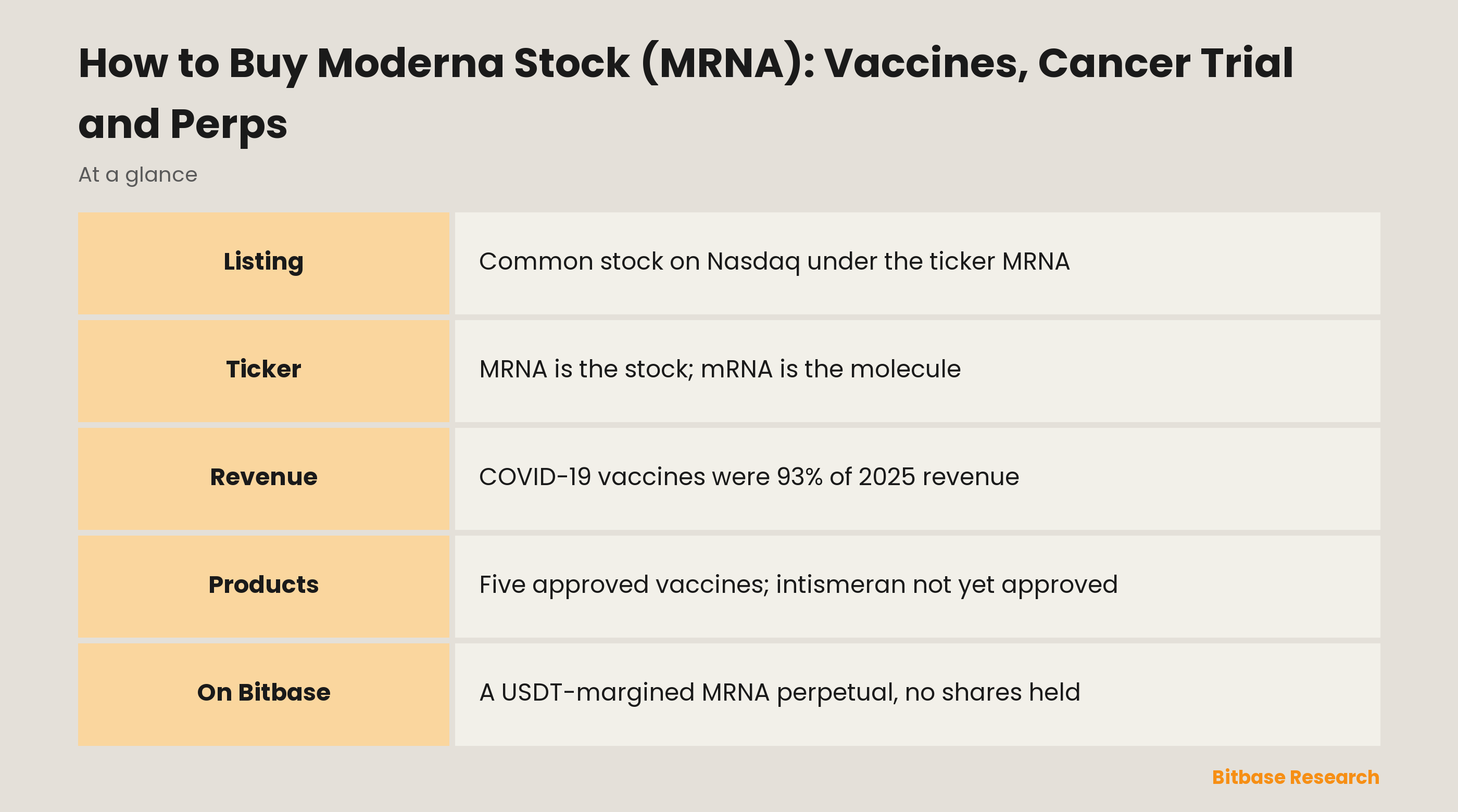
Few stocks share a ticker with the technology they sell, and buying this one is simple: Moderna's common stock trades on the Nasdaq Global Select Market as MRNA, so a brokerage account with Nasdaq access and an ordinary buy order are all it takes. The capitals matter. MRNA is the ticker, while mRNA, short for messenger RNA, is the molecule inside every Moderna vaccine, and the company that makes those vaccines took in about a tenth as much revenue in 2025 as it did in 2022. Bitbase does not sell Moderna shares; it lists an MRNA perpetual contract, settled in USDT, that follows the share price and confers no ownership.
What Does Moderna Do?
Moderna calls itself "a pioneer and leader in the field of mRNA medicine." Its annual report explains that messenger RNA "transfers the information stored in our genes to the cellular machinery that makes all the proteins required for life." Moderna writes that instruction, packs it into lipid nanoparticles so it can enter cells, and lets the body build the protein: a viral fragment that trains the immune system, or an enzyme a patient lacks.
Moderna dates its founding to 2010; its oldest predecessor was incorporated by the venture firm Flagship Pioneering in 2009, and the present Delaware corporation dates from 22 July 2016. Based in Cambridge, Massachusetts, and led by chief executive Stéphane Bancel, it had about 4,700 full-time employees in 18 countries at the end of 2025. Its first commercial product, the COVID-19 vaccine now sold as Spikevax, was authorized in December 2020. By 30 September 2026 the company counted five approved vaccines:
| Vaccine | Protects against | Status in the filings |
|---|---|---|
| Spikevax | COVID-19 | The original COVID-19 vaccine, first authorized in December 2020 |
| mNEXSPIKE | COVID-19 | FDA approval in May 2025, launched in the third quarter of 2025 |
| mRESVIA | RSV | FDA approval in May 2024 for adults 60 and older, widened in June 2025 |
| mCOMBRIAX | Flu and COVID-19 | European Commission authorization in April 2026, ages 50 and older |
| MFLUSIVA | Seasonal flu | US license for people 50 and older; FDA approval letter dated 5 August 2026 |
The pipeline spans infectious disease vaccines, oncology and rare disease, with 36 development programs at the end of June 2026. The most closely followed is intismeran autogene (mRNA-4157), an individualized neoantigen therapy designed from the mutations in a single patient's tumor; Moderna develops it with Merck, and the two share its costs and any profits equally worldwide. In rare disease, mRNA-3927 for propionic acidemia is in a registrational study, with Recordati lined up since January 2026 to commercialize it if approved.
Besides its Massachusetts sites, including a Marlborough plant built for intismeran, Moderna runs plants in the UK, Canada and Australia, each backed by a multi-year government commitment to buy its mRNA products.
How Moderna Makes Money
Vaccine sales provide nearly all of it. The 10-K sets product sales apart from a smaller line of other revenue: grants, collaboration payments, licensing, and stand-ready fees that governments pay to keep manufacturing capacity on call.
| Source | Share of 2025 revenue |
|---|---|
| COVID-19 vaccines (Spikevax and mNEXSPIKE) | 93% |
| RSV vaccine (mRESVIA) | Less than one percent |
| Other revenue | 6% |
| of which stand-ready manufacturing | 4% |
Shares are computed from the 10-K's figures. Moderna was profitable in 2021 and 2022 and has reported a net loss every year since:
| Year | Total revenue as a share of 2022 | Bottom line |
|---|---|---|
| 2022 | 100% | Net income |
| 2023 | 36% | Net loss |
| 2024 | 17% | Net loss |
| 2025 | 10% | Net loss |
Revenue fell 40% in 2025 alone, which the 10-K attributes mainly to lower COVID-19 vaccine volumes "across all regions."
In the United States the vaccines are sold "primarily to wholesalers and distributors"; abroad, the buyers are mostly governments and international organizations. Three customers each passed a tenth of 2025 revenue: the distributor FFF Enterprises with 15%, Public Works and Government Services Canada with 13% and Cardinal Health with 11%. By customer location, product sales swung toward the US:
| Region | Share of 2024 product sales | Share of 2025 product sales |
|---|---|---|
| United States | 56% | 64% |
| Europe | 18% | 3% |
| Rest of world | 26% | 33% |
List price is not what Moderna keeps: in 2025, 45% of gross product sales went on wholesaler chargebacks, discounts, returns, rebates and fees. Timing matters as well, since the 10-K calls these markets "seasonal," with "unpredictability in orders and seasonality of deliveries." In 2026 revenue more than doubled in the first half, up 114% on deliveries under long-term government partnerships, yet rose only 2% in the second quarter.
Research and development spending fell 31% in 2025, and the stated plan is "to invest the cash generated from these products into oncology and rare disease therapeutics."
MRNA Stock at a Glance
| Item | Detail |
|---|---|
| Exchange | Nasdaq Global Select Market |
| Ticker | MRNA, in capitals; lower-case mRNA is the molecule |
| Share class | One class of common stock, as registered on the 10-K cover |
| Depositary receipt | None: MRNA is the common stock itself |
| Industry | Biotechnology: mRNA vaccines and medicines (SIC 2836, biological products) |
| Index membership | S&P 500 and Nasdaq-100, going by SPY and QQQ fund holdings dated 29 October 2026 |
| Headquarters | Cambridge, Massachusetts |
| Incorporation | Delaware, 22 July 2016 |
| Trading since | 7 December 2018 |
| Fiscal year | Calendar year, ending 31 December |
| Dividend policy | No cash dividend has ever been declared or paid |
| Share buybacks | A program authorized in 2022 remains open; no repurchases in 2024 or 2025 |
| SEC identifier | CIK 1682852 |
For the current quote, open the Moderna stock page on Bitbase.
How to Buy Moderna Stock
A first purchase usually comes down to six steps:
1. Pick a broker that reaches Nasdaq and accepts residents of your country.
2. Pass the identity checks. Clients outside the US can expect a request for IRS Form W-8BEN; the IRS tells a foreign person to "Give Form W-8 BEN to the withholding agent or payer."
3. Add funds. Depositing euros, pounds or any other non-dollar currency involves a conversion, and its spread is a cost.
4. Search for MRNA and check that the line reads Moderna, Inc., common stock, on Nasdaq.
5. Decide how to order. A market order fills at the best price available at that moment; a limit order caps what you pay and may not fill at all.
6. Set the size. Brokers that offer fractional shares let you buy a currency amount rather than whole shares.
From outside the United States, MRNA is the company's own common stock, not a depositary receipt, so there is no conversion ratio to track, and with no cash dividend ever paid there is at present nothing for US dividend withholding to reach. None of this is tax advice.
Via index funds, Moderna arrives as one holding among many: SPY, which follows the S&P 500, and QQQ, which follows the Nasdaq-100, both held it on 29 October 2026.
Trading MRNA on Bitbase
What Bitbase offers on Moderna is a derivative, not the share: the MRNA perpetual futures contract, which uses USDT for both margin and settlement. The two compare like this:
| MRNA common stock | MRNA perpetual on Bitbase | |
|---|---|---|
| What you hold | A share of Moderna, Inc. | A contract tracking the share price, with no stock behind it |
| Stockholder rights | Yes, including votes at stockholder meetings | None |
| Positions | Held to own a stake | Long or short, using leverage |
| Expiry | None | None |
| Trading time | Nasdaq sessions | Also while Nasdaq is closed |
| Cost of holding | Broker fees only | Funding payments for as long as the position stays open |
Funding passes periodically between longs and shorts, paid by the more crowded side, and that payment is what anchors the contract to the share price. Once a position's margin can no longer absorb its losses, the exchange liquidates it on the mark price, not on the last traded price, and selling the contract opens a short rather than disposing of shares. When news breaks outside Nasdaq hours, the contract can react at once while the share waits for the next session, so the two may open far apart. The stock perpetual futures guide covers each mechanism.
Bitbase's contract specifications for MRNA fix the funding schedule and formula, the margin brackets, the maximum leverage, and how the mark price and funding behave when Nasdaq is closed; check them before you trade. The TradFi page gathers the exchange's other stock-linked contracts.
What Moves MRNA Stock
Respiratory seasons and vaccination advice. COVID-19 shots still produce most of the revenue, and the 10-K ties that market to "public health authority recommendations and consumer motivation to vaccinate." It adds that changes in FDA policy and in CDC and Advisory Committee on Immunization Practices recommendations "may have affected and may continue to affect demand for our vaccines."
Decisions on new vaccines. In February 2026 the FDA sent a refusal-to-file letter for the flu vaccine mRNA-1010, declining to begin a review. Moderna amended the application, an FDA advisory committee voted unanimously in June that the benefits outweigh the risks, and the FDA now lists the vaccine as MFLUSIVA for people 50 and older. The combination mCOMBRIAX is authorized in the EU, while in the US the company is "awaiting further guidance from the FDA on refiling."
Oncology results. At the ESMO 2026 congress, Merck and Moderna presented the Phase 3 INTerpath-001 trial in completely resected stage IIB–IV melanoma; according to Merck, adding intismeran to KEYTRUDA reduced the risk of recurrence or death by 42% compared with KEYTRUDA alone. The therapy is not approved. Moderna's 30 September 2026 statement spoke of preparing "for the potential launch and scale-up," and the convertible notes it sold in September may fund "the growth of its oncology business."
Pipeline setbacks. The cytomegalovirus vaccine mRNA-1647 missed its Phase 3 primary endpoint in October 2025, and the norovirus study of mRNA-1403 "did not meet statistical criteria for early success" at an interim analysis, though it continues blinded.
Governments and Europe. Long-term partnerships with governments, which the 10-K names as the UK, Canada and Australia, drove the first-half 2026 jump. In many European markets, the 10-K says, a competitor's contract with the European Commission has kept Moderna out of COVID-19 vaccine sales, and it "does not lapse until year-end 2026."
Patent disputes. A March 2026 settlement ended Moderna's worldwide lipid-nanoparticle litigation with Arbutus and Genevant, with a lump sum paid in July and a further payment that hangs on a Federal Circuit appeal over doses sold to the US government. Moderna is pressing its own claims against Pfizer and BioNTech, and defending suits from GSK, BioNTech and Sanofi units, among others.
Cash and financing. The company still loses money and has a "cash breakeven goal." It took a five-year term loan in November 2025, and in September 2026 sold convertible notes due 2032 that bear no regular interest and may be settled partly in shares, with a capped call meant to limit the dilution.
Downside Scenarios in Moderna's Filings
These 10-K risk factors bear most directly on an MRNA share.
Demand it cannot control. The section opens: "Regulatory and market uncertainty have and may continue to impact our business and the markets for our products." In 2025, it notes, "changes at U.S. regulatory agencies impacted policies and priorities related to our industry."
Larger rivals. Moderna competes "against Pfizer and Sanofi for sales of our COVID vaccines and Pfizer and GSK for our RSV vaccine," and its RSV sales "have been minimal to date."
One platform, shared exposure. Because the medicines share mRNA and delivery technology, "new technical challenges may arise that cause an entire modality to fail."
A cancer therapy built per patient. Intismeran is "uniquely manufactured for each patient using a novel, complex manufacturing process," which the company says may cause production difficulties.
No dividend, possible dilution. "Capital appreciation, if any, of our common stock will be your sole source of gain for the foreseeable future," and the 2032 notes may be converted into shares.
On the perpetual. Leverage magnifies losses, funding keeps accruing, and an overnight move after a regulatory decision or trial readout can reach the liquidation price before Nasdaq reopens.
How to Research MRNA Yourself
Moderna's SEC filings sit under CIK 1682852. The 2025 Form 10-K (filed 20 February 2026) contains the products, pipeline, significant-customer table and full risk factors; the second-quarter 10-Q (filed 31 July 2026) updates regional sales and the patent cases. Results and major events arrive on Form 8-K, and attached press releases, such as the 30 September 2026 announcement of a chief operating officer, often carry the latest product count. Merck's filings also report intismeran results, the FDA's product pages carry approval documents, and the investor site is investors.modernatx.com.
Moderna Stock FAQ
Does Moderna pay a dividend?
No. Moderna has "never declared or paid cash dividends on our common stock" and does not expect to "for the foreseeable future," according to the 10-K, and its credit agreement restricts dividends. It repurchased no shares in 2024 or 2025 either.
Can I buy Moderna stock with crypto?
Not directly. Brokers settle MRNA in US dollars, so any crypto must first become cash in the brokerage account. On Bitbase, a USDT balance can margin a position in the MRNA perpetual, a contract that rises and falls with the share price, gives no ownership and can be liquidated. The ways to move from crypto into shares are compared in a separate guide.
Is MRNA the same as mRNA?
No. MRNA, in capitals, is the Nasdaq ticker of Moderna's common stock; mRNA is messenger RNA, the molecule behind Moderna's vaccines. Pfizer and BioNTech also sell an mRNA-based COVID-19 vaccine, so the technology is not exclusive to the ticker; Pfizer's business is set out in the guide to buying Pfizer stock.
Is Moderna in the S&P 500?
Yes, according to the holdings of the funds that track the indexes: State Street's SPY file for 29 October 2026 lists Moderna, and Invesco's QQQ holdings for the same date include MRNA among the Nasdaq-100 stocks. Index rosters change, so both are readings for that date only.
Which Moderna vaccines are approved?
On 30 September 2026 Moderna counted five: Spikevax and mNEXSPIKE against COVID-19, mRESVIA against RSV, MFLUSIVA against seasonal flu in the US and the flu-and-COVID combination mCOMBRIAX in the EU. COVID-19 vaccines still made up 93% of 2025 revenue.
When did Moderna go public?
In December 2018. The common stock began trading on the Nasdaq Global Select Market as MRNA on 7 December 2018, and the offering closed on 11 December.
Conclusion
An MRNA order is routine; what the share stands for has changed. Revenue in 2025 was about a tenth of the 2022 level and still came mostly from COVID-19 vaccines, so the newer flu, combination and RSV shots and the intismeran melanoma results are what later filings will report on. Vaccine sales hinge on approvals and vaccination advice, intismeran still needs regulatory approval, and any income from it would be shared with Merck. The Bitbase perpetual follows the same price for anyone who only wants to trade it, at the cost of funding and liquidation risk and with no stake in the company.
Related reading
Other Bitbase articles on this topic:
- How to Buy GSK Stock (GSK): Two-Share ADS, HIV and Haleon
- How to Buy Novo Nordisk Stock (NVO): ADR, Wegovy and Ozempic
- How to Buy Regeneron Stock (REGN): Dupixent Profits and EYLEA HD
Disclaimer: This article is educational content from Bitbase Academy, provided for information only. It explains what a company or fund does and how the instruments referenced here differ from one another; it does not constitute investment, trading, tax, or financial advice, and it is neither a recommendation nor an endorsement of any security, token, or trading strategy. A tokenized stock is issued by a third party and is designed to give economic exposure to an underlying asset: it is not a share, it carries no shareholder rights, and it depends on the issuer's structure, eligibility rules, and redemption terms, which the issuer can change. Perpetual futures are leveraged derivatives that hold no underlying asset and can be liquidated, and trading hours, product availability, and eligibility differ by instrument and by jurisdiction and can change at any time. Written as of October 2026; verify everything yourself through company filings, the issuer's own documentation, and the product pages of the venue you trade on.
References
[1] Moderna, Inc. Form 10-K for 2025 (SEC EDGAR) www.sec.gov
[2] Moderna, Inc. Form 10-Q, second quarter of 2026 (SEC EDGAR) www.sec.gov
[3] Moderna, Inc. Form 10-K for 2024 (SEC EDGAR) www.sec.gov
[4] Moderna, Inc. Form 10-K for 2018 (SEC EDGAR) www.sec.gov
[5] Moderna Form 8-K, September 2026: convertible notes due 2032 (SEC EDGAR) www.sec.gov
[6] Moderna press release, 30 September 2026, filed with Form 8-K (SEC EDGAR) www.sec.gov
[7] Merck third-quarter 2026 results release, filed with Form 8-K (SEC EDGAR) www.sec.gov
[8] US FDA: MFLUSIVA product page www.fda.gov
[9] State Street: SPY daily holdings, 29 October 2026 www.ssga.com
[10] Invesco QQQ: fund overview and holdings (tracks the Nasdaq-100) www.invesco.com
[11] IRS: About Form W-8 BEN www.irs.gov





