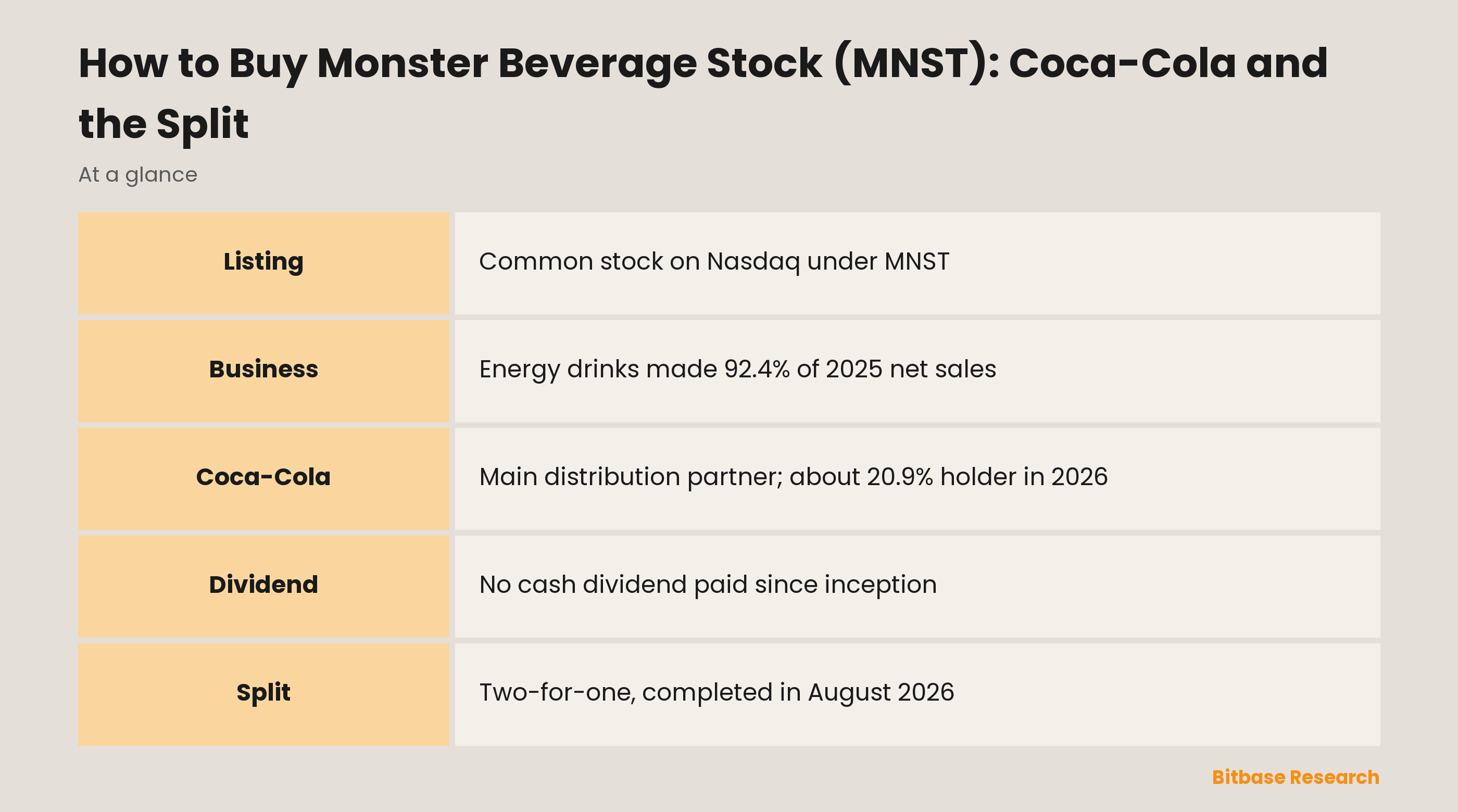
Several kinds of brokerage account can hold Monster Beverage stock: any broker with access to the Nasdaq Global Select Market, where the common shares trade under the ticker MNST, can place the order. Two facts shape that share: Monster has never paid a cash dividend, and The Coca-Cola Company, whose bottlers distribute its energy drinks in the US and almost every other market, owned about 20.9% of it in February 2026. Below: how Monster earns its money, how to buy from abroad, the August 2026 split and the risks named in its filings.
What Does Monster Beverage Do?
Monster Beverage Corporation is a holding company in Corona, California, whose subsidiaries "primarily develop and market energy drinks." It began as Hansen Natural Corporation, a juice and soda business that moved into energy drinks and took the Monster name in 2012. In 2015 it bought a set of energy brands from Coca-Cola and sold off its non-energy drinks; in 2022 it bought Monster Brewing Company, and in July 2023 the assets of Bang Energy.
The 10-K reports four segments. Monster Energy Drinks sells finished Monster, Reign and Bang drinks, mostly to bottlers and distributors. Strategic Brands holds the Coca-Cola brands, such as NOS, Burn and Mother, plus the low-priced Predator and Fury, and mainly sells concentrates that bottlers turn into cans; per case it earns less revenue but a higher gross margin percentage than the Monster line. Alcohol Brands sells craft beer, malt beverages and hard seltzer to US beer distributors. Other is flavors that the subsidiary American Fruits and Flavors (AFF) sells to outside customers.
Most of the cans are filled by someone else: in 2025 Monster outsourced the majority of its finished energy drink production to bottlers and contract packers, making Bang and a few other products in its own plants in Arizona and California.
How Monster Beverage Makes Money
Net sales rose 10.7% in 2025, carried by the flagship line:
| Segment | What it sells | Share of 2025 net sales | Change vs 2024 |
|---|---|---|---|
| Monster Energy Drinks | Finished Monster, Reign and Bang drinks | 92.4% | Up 11.7% |
| Strategic Brands | Concentrates for NOS, Burn, Mother and others | 5.7% | Up 8.4% |
| Alcohol Brands | Craft beer, malt beverages, hard seltzer | 1.6% | Down 21.8% |
| Other | Flavors sold to third parties by AFF | 0.3% | Up 6.2% |
Shares are calculated from fiscal 2025 segment net sales. Alcohol Brands, hit by weaker sales of The Beast lines, ran an operating loss in both 2024 and 2025.
The US and Canada made up 61.2% of 2025 net sales, Europe, the Middle East and Africa (EMEA) 22.9%, Latin America and the Caribbean 8.4% and Asia Pacific 7.5%. Sales outside the United States reached 41% of the total, up from 38% in 2023.
The customers the 10-K names all come from the Coca-Cola system: Coca-Cola Europacific Partners accounted for 15% of 2025 net sales, Coca-Cola Consolidated for 10% and Coca-Cola's own subsidiaries for 3%, and Monster pays Coca-Cola a commission on certain sales in its network. For that system seen from the other side, see how Coca-Cola's bottling partners operate.
Gross profit was 55.8% of net sales in 2025, up from 54.0%, mainly on price increases and supply chain savings, and operating income rose 25.3%.
MNST Stock at a Glance
| Item | MNST |
|---|---|
| Exchange | Nasdaq Global Select Market |
| Security | Common stock, the only class on the 10-K cover |
| Sector | Consumer staples: energy drinks |
| Index membership | S&P 500 and Nasdaq-100 |
| Headquarters and incorporation | Corona, California; Delaware |
| Fiscal year end | 31 December |
| Coca-Cola's stake | About 20.9% of common stock (13 February 2026) |
| Dividend policy | No cash dividend since inception |
| Latest split | Two-for-one, distributed after the close on 10 August 2026 |
| SEC identifier | CIK 865752 |
For the share price and market value, which move with every trade, use the Monster Beverage stock page on Bitbase.
How to Buy Monster Beverage Stock
Monster has one class of listed stock, so there is no depositary receipt or second share line to pick between:
1. Find a broker that offers Nasdaq-listed shares and check who supervises it.
2. Complete the account checks. Brokers normally ask non-US individuals for IRS Form W-8BEN, which documents foreign status.
3. Fund it in dollars, comparing the exchange rate as well as the commission.
4. Search MNST and confirm the result reads Monster Beverage Corporation common stock.
5. Choose how to order. According to FINRA, a market order "provides the most certainty that your order will be executed," while a limit order caps the price but may never fill.
6. Decide on fractions. Fractional trading, FINRA notes, "varies by brokerage firm"; fractional shares can't move to another broker, and their owners "might not have shareholder voting rights."
7. Keep the confirmations. MNST bought before the August 2026 split now shows twice the share count at half the cost per share.
Taxes abroad. The IRS says "most types of U.S. source income received by a foreign person are subject to U.S. tax of 30%," and treaties can lower it. For shareholders the usual case is dividends, and Monster pays none; check how your home country taxes a gain on sale instead. None of this is tax advice.
Via index funds. State Street's SPY (S&P 500) and XLP (consumer staples) both held MNST on 29 October 2026, and Invesco's QQQ (Nasdaq-100) reported it among its holdings at 30 June 2026, in each case as one line among many.
What Moves MNST Stock
The Coca-Cola system. All of Monster's US distribution territories, and substantially all international ones, belong to Coca-Cola network bottlers, many of them independent of Coca-Cola. The international distribution agreement was renewed in February 2025 for five years. With exceptions, agreements keep Coca-Cola out of energy drinks in certain territories and its distributors away from rival brands, yet "disagreements as to the interpretation of the provisions in such agreements have arisen and may arise in the future."
Prices against can costs. US price increases in late 2024 and late 2025 lifted the 2025 margin. In the first half of 2026 net sales rose 23.3%, but the gross margin slipped on regional mix, dearer aluminum cans and freight.
Growth abroad. EMEA sales grew 21.5% in 2025, fastest of the four regions, which also adds currency swings to reported results.
Rules for energy drinks. The 10-K lists age limits in force, with Poland, Latvia, Lithuania and Turkey among the countries banning sales to under-18s; caffeine caps in Canada, the Netherlands and Norway; and sweetened-drink taxes in markets such as Mexico, France and the UK. In the US it points to the administration's concerns about sweetened drinks, food dyes and the GRAS ingredient process.
Rivals and scanner data. The 10-K names Red Bull, Celsius and Keurig Dr Pepper's C4 among direct US rivals and counts PepsiCo in the wider competition. Its recent quarterly results have each come with a presentation of retail scanner data.
Headwinds Named in Monster's 10-K
Item 1A opens with Coca-Cola. The entries closest to an MNST share:
One partner. Monster's "future performance is substantially dependent on the success of its relationship with TCCC."
One category. "We currently derive most of our revenues from energy drinks."
Outsourced production. "We primarily rely on bottlers and other contract packers to manufacture our products."
Perception. "Criticism or negative perceptions of our products (regardless of accuracy) generally could adversely affect us."
Costs. Monster may not always pass on higher costs of "aluminum cans, ingredients, fuel, costs of co-packing, and/or tariffs."
Control. For a period, Coca-Cola must vote shares above 20% of the total in line with other holders on a change of control, but if it opposed a bid, the bidder would need "greater than 62.5%" of the shares Coca-Cola does not own. Directors Rodney Sacks and Hilton Schlosberg could direct about another 8.1% in February 2026.
Add the plain risks of one stock: concentration, and, with no dividend, a return that rests on the dollar share price alone.
How to Research MNST Yourself
Monster files with the SEC under CIK 865752. In the 10-K, Item 1 covers brands, distribution and energy drink regulation, Item 1A the risks, and the segment and related-party notes the figures above. Results 8-Ks carry the scanner data, and the proxy statement covers the board.
Filings from before August 2026, the fiscal 2025 10-K included, show pre-split per-share figures and share counts: halve the first and double the second before comparing. The 10-K's performance graph benchmarks Monster against Coca-Cola, Keurig Dr Pepper, Constellation Brands, Molson Coors and PepsiCo. Bitbase also has stock pages for other US companies.
Monster Beverage Stock FAQ
Does Monster Beverage pay a dividend?
No. The 10-K says Monster has "not paid cash dividends to our stockholders since our inception" and does "not anticipate paying cash dividends in the foreseeable future." Its board authorizes share repurchase programs instead, most recently in May 2026.
Can I buy Monster Beverage stock with crypto?
Not directly. MNST is bought through a broker and settles in US dollars, so crypto must be sold for cash first, possibly with tax due. A share is part-ownership with a vote, which is how a stock differs from a cryptocurrency.
Is MNST in the S&P 500 and the Nasdaq-100?
Yes. SPY listed it on 29 October 2026 and QQQ reported it at 30 June 2026. Membership can change at each rebalancing.
How much of Monster does Coca-Cola own?
About 20.9% of the common stock on 13 February 2026, per the 10-K; the June 2026 quarterly report gave the same figure for voting interests. Coca-Cola has also nominated one director.
Has Monster Beverage stock ever split?
Yes. The latest was a two-for-one split distributed after the close on 10 August 2026, preceded by a two-for-one split in March 2023, a three-for-one in November 2016 and a two-for-one in February 2012.
Conclusion
Buying MNST takes a broker with Nasdaq access, the right ticker and a market or limit order. The share is narrower than the brand list suggests: 92.4% of 2025 net sales came from one segment, sold mostly through Coca-Cola's bottlers, and Coca-Cola owns about a fifth of the company. Read the latest 10-K and 10-Q, adjust older per-share data for the split, and decide how much belongs in one stock that pays no dividend.
Related reading
Other Bitbase articles on this topic:
- How to Buy Altria Stock (MO): Marlboro, Dividend, PMI Spin-Off
- How to Buy British American Tobacco Stock (BTI): ADS and Dividends
- How to Buy Colgate-Palmolive Stock (CL): Toothpaste and Pet Food
Disclaimer: This article is educational content from Bitbase Academy, provided for information only. It explains what a company or fund does and how the instruments referenced here differ from one another; it does not constitute investment, trading, tax, or financial advice, and it is neither a recommendation nor an endorsement of any security, token, or trading strategy. A tokenized stock is issued by a third party and is designed to give economic exposure to an underlying asset: it is not a share, it carries no shareholder rights, and it depends on the issuer's structure, eligibility rules, and redemption terms, which the issuer can change. Perpetual futures are leveraged derivatives that hold no underlying asset and can be liquidated, and trading hours, product availability, and eligibility differ by instrument and by jurisdiction and can change at any time. Written as of October 2026; verify everything yourself through company filings, the issuer's own documentation, and the product pages of the venue you trade on.
References
[1] Monster Beverage Form 10-K, fiscal 2025: business, segments, Coca-Cola agreements and risk factors (SEC EDGAR) www.sec.gov
[2] Monster Beverage Form 10-Q, quarter ended 30 June 2026: sales, margins and Coca-Cola's voting interest (SEC EDGAR) www.sec.gov
[3] Monster Beverage Form 8-K, 8 July 2026: two-for-one stock split declared (SEC EDGAR) www.sec.gov
[4] Form 4 filed 16 September 2026 by Monster Beverage's chief executive: notes the 2-for-1 split of 10 August 2026 (SEC EDGAR) www.sec.gov
[5] Monster Beverage Form 8-K, 28 February 2023: two-for-one stock split declared (SEC EDGAR) www.sec.gov
[6] Monster Beverage press release, 14 October 2016: three-for-one stock split (furnished on Form 8-K, SEC EDGAR) www.sec.gov
[7] Monster Beverage press release, 11 January 2012: two-for-one stock split (furnished on Form 8-K, SEC EDGAR) www.sec.gov
[8] Monster Beverage Form 8-K, 6 August 2026: second-quarter results and scanner-data presentation (SEC EDGAR) www.sec.gov
[9] Monster Beverage Form 8-K, 15 May 2026: annual meeting votes and a new share repurchase program (SEC EDGAR) www.sec.gov
[10] State Street SPDR S&P 500 ETF Trust (SPY): daily holdings file, 29 October 2026 www.ssga.com
[11] State Street Consumer Staples Select Sector SPDR (XLP): daily holdings file, 29 October 2026 www.ssga.com
[12] Invesco QQQ Trust, Series 1 (tracks the Nasdaq-100): Form N-PORT holdings report as of 30 June 2026 (SEC EDGAR) www.sec.gov
[13] FINRA: Order Types www.finra.org
[14] FINRA: Investing in Fractional Shares www.finra.org
[15] IRS: NRA Withholding www.irs.gov
[16] IRS: About Form W-8 BEN www.irs.gov





