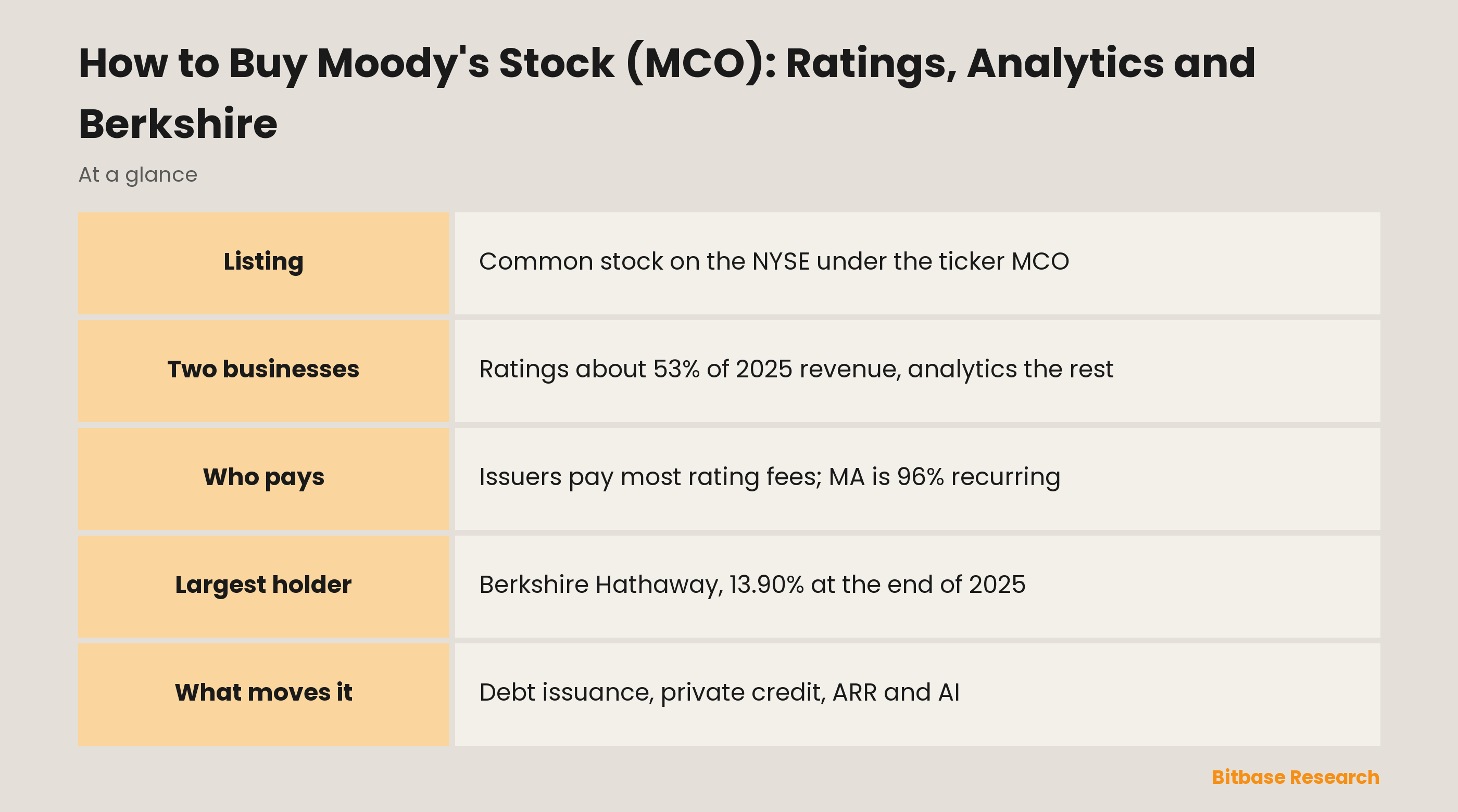
During any New York Stock Exchange session, a brokerage account with access to US shares can buy Moody's Corporation common stock under the ticker MCO. Two businesses sit behind that ticker: Moody's Investors Service, the rating agency that brought in about 53% of 2025 revenue, mostly from fees paid by the issuers it rates, and Moody's Analytics, which sells data, research and risk software on almost entirely recurring contracts. The 2026 proxy statement names Berkshire Hathaway as the largest shareholder, with 13.90% at the end of 2025. This guide covers how each side earns money, how to place the order, and what the filings say can move or hurt the stock.
What Does Moody's Do?
Moody's Corporation is a Delaware company with its head office at 7 World Trade Center in New York. It sells two related things that are paid for in different ways: published opinions on whether borrowers will repay, and the data and software that banks, insurers and companies use to judge risk themselves. The annual report calls them Moody's Investors Service (MIS) and Moody's Analytics (MA).
MIS "publishes credit ratings and provides assessment services on a wide range of debt obligations, programs and facilities, and the entities that issue such obligations": corporate bonds and loans, banks and insurers, governments, public projects and securitisations. The segment also holds local agencies: ICRA in India, Moody's Local in Latin America, which added ICR Chile in 2025, and MERIS in Egypt, acquired in early 2026.
MA "provides curated data, intelligence and analytical tools to help business and financial leaders make confident decisions." Decision Solutions covers cloud-based subscriptions for banking, insurance and know-your-customer (KYC) work, including catastrophe models for insurers. Research and Insights is the fixed income and economic research arm, and Data and Information sells what the company calls "the world's largest database on companies and credit." MA sold its Learning Solutions business in late 2025 and Regulatory Solutions in the second quarter of 2026.
The 2005 annual report dates the business to 1900. Until 30 September 2000 it sat inside The Dun & Bradstreet Corporation; on that date the old D&B distributed the shares of a new D&B to its shareholders, and the ratings business that remained was renamed Moody's Corporation.
How Moody's Makes Money
Revenue grew 9% in 2025. MIS supplied about 53% of revenue from outside customers and MA about 47%, and the revenue note of the 10-K shows how differently each line is paid:
| Line of business | Segment | Share of the segment's 2025 revenue | Recurring part of the line |
|---|---|---|---|
| Corporate finance | MIS | 52.2% | 27% |
| Financial institutions | MIS | 18.6% | 44% |
| Public, project and infrastructure finance | MIS | 15.5% | 31% |
| Structured finance | MIS | 13.7% | 44% |
| Decision Solutions | MA | 47.0% | 93% |
| Research and Insights | MA | 27.6% | 99% |
| Data and Information | MA | 25.3% | 99% |
MIS shares are of ratings revenue and MA shares of external revenue, rounded to one decimal.
Ratings are paid for by the borrower. "Rating fees paid by debt issuers account for most of the revenue of MIS," the 10-K states. In 2025, 67% of MIS revenue was transaction revenue, earned when a new bond, loan or securitisation is rated; the other 33% was recurring, such as monitoring fees and annual fees from frequent issuers.
Analytics is the steadier half. In 2025, 96% of MA revenue was recurring, and in the third quarter of 2026 the share reached 99%. Decision Solutions grew 12%, led by KYC at 19%. The same split between transaction fees and recurring data revenue runs through the reports of stock exchange operators, another kind of financial information business.
Ratings earn the wider margin. Adjusted operating margin, the profit measure Moody's reports for each segment, was 63.6% for MIS in 2025 against 33.1% for MA. About 39% of revenue was in currencies other than the dollar, mainly the pound and the euro.
MCO Stock at a Glance
| Item | Detail |
|---|---|
| Exchange | New York Stock Exchange (NYSE) |
| Ticker | MCO |
| Security | Common stock, the only class of stock registered on the 10-K cover |
| Other listed securities | Two series of senior notes, MCO 27 and MCO 30 |
| Sector | Financial services: credit ratings, data and risk analytics |
| Index membership | S&P 500 |
| Headquarters | New York |
| Incorporated | Delaware |
| Fiscal year | Ends 31 December |
| Dividend policy | Quarterly cash dividend, declared by the board |
| SEC identifier | CIK 1059556 |
Price, market value and yield change with every trade; the Moody's stock page on Bitbase shows them live.
How to Buy Moody's Stock
Moody's common stock is listed directly in New York, so no depositary receipt is involved. The route runs through a broker:
1. Choose a broker with NYSE access, local or international, and check which entity holds your shares and who regulates it.
2. Open the account and file the tax form. Non-US individuals usually complete IRS Form W-8BEN, which goes to the withholding agent "if you are a foreign person and you are the beneficial owner of an amount subject to withholding."
3. Fund it, counting any currency conversion as part of the cost.
4. Search MCO and read the result. You want Moody's Corporation common stock on the NYSE; MCO 27 and MCO 30 are bonds.
5. Pick an order type. FINRA says a market order "provides the most certainty that your order will be executed," but "you might not get the price you saw or were originally quoted"; a buy limit order "can be executed only at or below the limit price."
6. Decide the size. Fractional shares let you invest a cash amount, though FINRA notes that "you can't transfer fractional shares to another brokerage firm."
Living outside the United States, you meet tax first on the dividend. Under IRS rules most US-source income received by a foreign person is taxed at 30%, and a treaty can lower or remove that rate. Your home country may tax it again.
Through an index fund, you get Moody's as one holding among hundreds: State Street's daily file for SPY, its S&P 500 fund, listed MCO on 29 October 2026.
What Moves MCO Stock
Debt issuance. "A majority of Moody's credit-rating-based revenue is transaction-based," the 10-K says, so it depends on "the number and dollar volume of debt securities issued in the capital markets." Rates, spreads, refinancing and mergers feed that volume. Corporate finance revenue rose 9% in 2025 on investment-grade and high-yield bond sales, including jumbo technology deals. The mix can turn fast: in the third quarter of 2026 MIS revenue fell 1% as high-yield revenue dropped 40%, while investment-grade revenue rose 18%, "including issuance associated with AI-related financing and hyperscaler investments."
Private credit. The 10-K counts private credit among its growth trends, yet warns that companies are "increasingly accessing alternative sources of financing, such as loans and debt financing from non-bank lenders that do not involve a CRA-issued credit rating." Whether private lending gets rated cuts both ways.
MA subscriptions. Annualized recurring revenue (ARR), the value of MA's active recurring contracts, grew 8% in 2025 and was 8% higher on 30 September 2026 than a year earlier; each earnings release gives it by line.
Generative AI. Moody's builds AI into its products, but its risk factors warn that cheap information "online and through the use of Gen AI, may reduce the demand for Moody's products and services," and that rivals may use such tools "to deliver solutions at lower prices."
Buybacks and the dollar. The diluted share count averaged 3.5% less in the third quarter of 2026 than a year earlier, so earnings per share can outgrow profit. Exchange rates move reported growth.
Hazards of Owning a Rating Agency
The 10-K's risk factors are long; these are the most specific to Moody's, and the third-quarter 2026 report said none had materially changed.
Regulation. Moody's calls its rules "complex, continually evolving" and says they "have tended to become more stringent over time." MIS is registered with the SEC as a nationally recognized statistical rating organization (NRSRO); its EU subsidiaries are supervised by ESMA and its UK arm by the FCA.
Credibility. "Moody's reputation and the strength of its brand are key competitive strengths," the filing says, and it names threats such as "the appearance of conflicts of interest" and "the performance of securities relative to the ratings assigned to such securities."
Litigation. The company faces "claims and litigation by governmental and private parties that are based on ratings assigned by MIS," and says it often cannot predict the outcome.
Competition. MIS competes with other agencies and with "investment banks and brokerage firms that offer credit opinions and research," and the filing reports price competition.
For the share itself, ratings revenue follows credit markets, so results can swing, and the dividend is not promised: "The continued payment of dividends at this rate, or at all, is subject to the discretion of the Board."
How to Research MCO Yourself
Moody's files with the SEC under CIK 1059556: 10-K annual reports, 10-Q quarterlies and 8-Ks, which carry each earnings release. The investor site named in the 10-K, ir.moodys.com, posts them under "SEC Filings."
Three places answer most questions. The 10-K revenue note splits every line into transaction and recurring revenue. Each earnings release sets MIS revenue against rated issuance and gives ARR by line. The proxy lists holders above 5%, and Berkshire's 13F reports show its side. The 10-K cover lists three registered securities, of which only the common stock trades as plain MCO, and its return graph benchmarks MCO against the S&P 500 and the Russell 3000 Financial Services Index. For other companies, see Bitbase's US stock pages.
Moody's Stock FAQ
Does Moody's pay a dividend?
Yes, quarterly. In February 2026 the board raised the payment about 10% from the 2025 rate, and on 20 October 2026 it declared the next one at that level. The latest 8-K gives amounts and dates.
Can I buy Moody's stock with crypto?
Not directly. MCO is bought with US dollars through a broker, so you would sell the crypto, move the cash, then place the order; that sale may be taxable where you live. The result is a registered share with dividend and voting rights, which is how a share differs from a crypto asset.
How much of Moody's does Berkshire Hathaway own?
The 2026 proxy lists Berkshire Hathaway, with Warren Buffett and Berkshire insurers including GEICO, at 13.90% of the common stock on 31 December 2025, the largest of the holders above 5%, ahead of The Vanguard Group, BlackRock and TCI Fund Management. Berkshire's 13F for 30 June 2026 shows the same number of shares.
Who pays for a Moody's credit rating?
Mostly the issuer. "Rating fees paid by debt issuers account for most of the revenue of MIS," which is why the company lists the appearance of conflicts of interest as a credibility risk. Research and data are sold separately, mostly by MA.
Has Moody's stock ever split?
Yes. The 2005 annual report records a two-for-one split: holders of record on 4 May 2005 received one more share for each share held. Older per-share figures need adjusting.
Conclusion
Buying MCO is simple: a broker with NYSE access, the right line on the order screen and a market or limit order. Knowing what the share holds takes more. A little over half the revenue is ratings fees that follow debt issuance, the rest is analytics on recurring contracts, and Berkshire Hathaway holds a large block. Before sizing a position, read the transaction and recurring split in the latest 10-K and the issuance tables in the newest earnings release.
Related reading
Other Bitbase articles on this topic:
- How to Buy Interactive Brokers Stock (IBKR): Class A, Rates, Split
- How to Buy KKR Stock (KKR): Buyouts, Credit and Global Atlantic
- How to Buy Nasdaq Stock (NDAQ): Its Own Listing, 5% Vote Cap
Disclaimer: This article is educational content from Bitbase Academy, provided for information only. It explains what a company or fund does and how the instruments referenced here differ from one another; it does not constitute investment, trading, tax, or financial advice, and it is neither a recommendation nor an endorsement of any security, token, or trading strategy. A tokenized stock is issued by a third party and is designed to give economic exposure to an underlying asset: it is not a share, it carries no shareholder rights, and it depends on the issuer's structure, eligibility rules, and redemption terms, which the issuer can change. Perpetual futures are leveraged derivatives that hold no underlying asset and can be liquidated, and trading hours, product availability, and eligibility differ by instrument and by jurisdiction and can change at any time. Written as of October 2026; verify everything yourself through company filings, the issuer's own documentation, and the product pages of the venue you trade on.
References
[1] Moody's Corporation Form 10-K, fiscal 2025: business, revenue note, risk factors (SEC EDGAR) www.sec.gov
[2] Moody's Corporation Form 10-Q for the quarter ended 30 September 2026 (SEC EDGAR) www.sec.gov
[3] Moody's release furnished on Form 8-K, 21 October 2026: third quarter 2026 results (SEC EDGAR) www.sec.gov
[4] Moody's Corporation proxy statement for the 2026 annual meeting (SEC EDGAR) www.sec.gov
[5] Berkshire Hathaway Form 13F-HR for the quarter ended 30 June 2026 (SEC EDGAR) www.sec.gov
[6] Moody's Corporation Form 10-K, fiscal 2005: history and 2005 stock split (SEC EDGAR) www.sec.gov
[7] State Street SPDR S&P 500 ETF Trust (SPY): fund page and daily holdings www.ssga.com
[8] FINRA: Order Types www.finra.org
[9] FINRA: Investing in Fractional Shares www.finra.org
[10] IRS: NRA Withholding www.irs.gov
[11] IRS: About Form W-8 BEN www.irs.gov





