
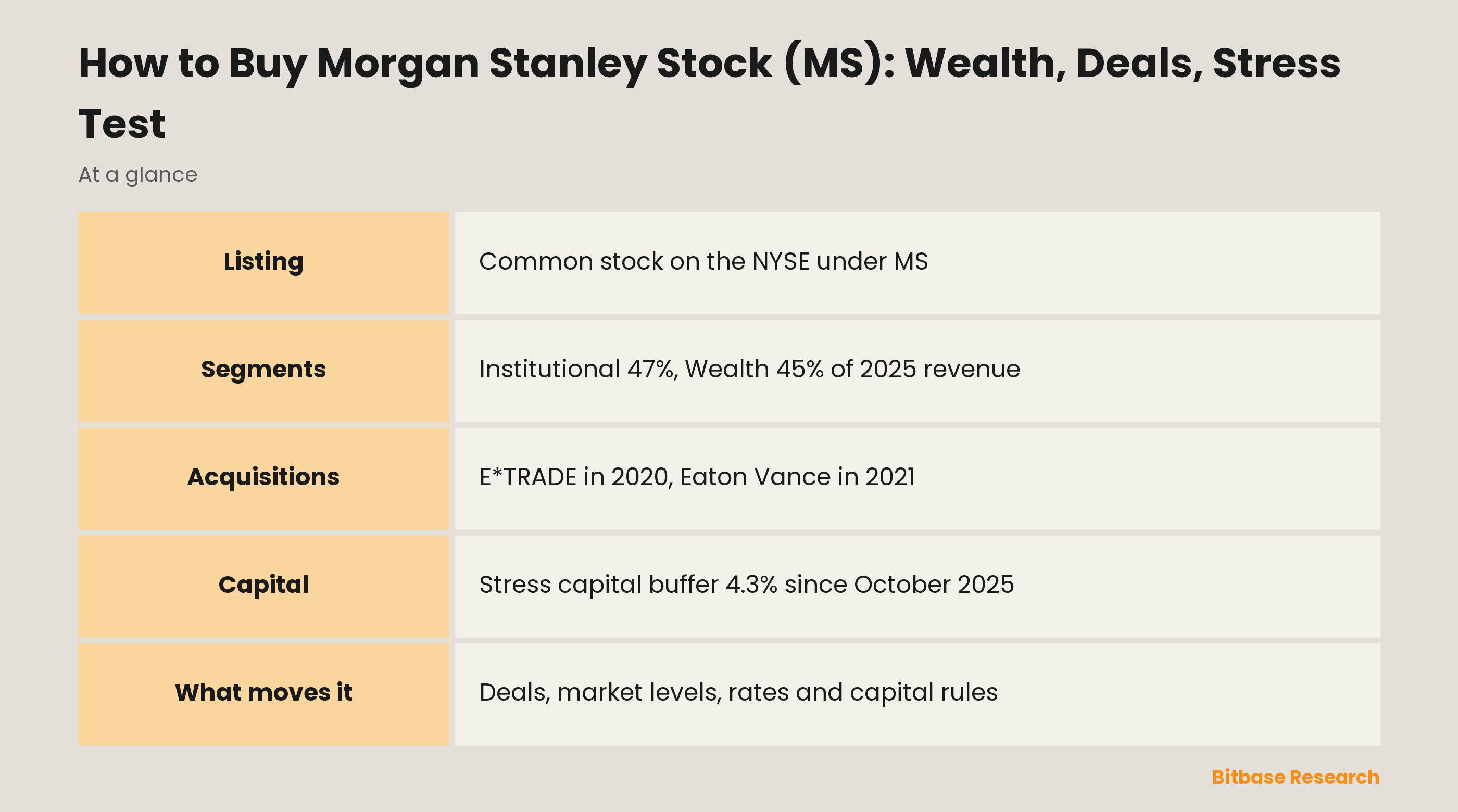
Through a broker that can trade on the New York Stock Exchange, you can buy Morgan Stanley common stock under the ticker MS. Behind the ticker sit two businesses of almost equal weight: in 2025, Institutional Securities produced about 47% of net revenues and Wealth Management about 45%, with Investment Management at about 9%. This guide covers what each segment sells, how an order is placed, and the constraint behind every Morgan Stanley dividend and buyback: as a bank holding company, the firm must hold capital that the Federal Reserve sizes partly through an annual stress test.
What Does Morgan Stanley Do?
Morgan Stanley is a global financial services firm. Its annual report says that, through its subsidiaries and affiliates, it "advises, and originates, trades, manages and distributes capital for governments, institutions and individuals." The company was incorporated in Delaware in 1981, and its predecessor companies date back to 1924. Headquarters are in New York City, with principal offices in London, Frankfurt, Tokyo and Hong Kong.
The business is reported in three segments, and the 10-K calls the whole an "Integrated Firm" that serves clients across all of them.
Institutional Securities works for corporations, governments, financial institutions and ultra-high net worth clients. Its investment bankers underwrite equity and debt and advise on mergers, acquisitions and restructurings. The Markets business, split into Equity and Fixed Income, provides sales, financing, prime brokerage and market-making, and also houses the firm's Asia wealth management services. It also lends, through corporate and commercial real estate loans and secured lending facilities, and publishes research.
Wealth Management serves individual investors, including high and ultra-high net worth individuals, as well as businesses and institutions. The filing names three channels for reaching them: advisor-led, self-directed and workplace. Products run from brokerage and advisory accounts to financial planning, stock plan administration, securities-based lending, mortgages and banking.
Investment Management runs equity, fixed income, alternatives and solutions, and liquidity and overlay strategies. Institutional clients include pension plans, endowments, sovereign wealth funds and insurers; individuals generally reach its funds through intermediaries.
Two acquisitions changed the mix. The merger with E*TRADE Financial closed on 2 October 2020 as a stock-for-stock deal, and E*TRADE's business was reported within Wealth Management from that date. The Eaton Vance merger, paid in Morgan Stanley stock and cash, closed on 1 March 2021 and added scale to Investment Management: in 2021, that segment's asset management and related fees rose 85%, which the 2021 10-K attributes mainly to the acquisition and to higher average assets under management. In Japan the firm works through a joint venture with Mitsubishi UFJ Financial Group (MUFG), in which Morgan Stanley holds a 40% economic interest and MUFG the other 60%.
How Morgan Stanley Makes Money
Net revenues rose 14% in 2025. Every segment grew, and the two largest finished the year close together:
| Segment | Share of 2025 net revenues | Change from 2024 | Largest revenue lines in the 10-K |
|---|---|---|---|
| Institutional Securities | 47% | Up 18% | Equity, Fixed Income, investment banking |
| Wealth Management | 45% | Up 12% | Asset management, net interest, transactional |
| Investment Management | 9% | Up 11% | Asset management and related fees |
Shares are segment net revenues over the firm total, rounded; they sum to slightly more than the whole because intersegment eliminations are deducted only at firm level.
Inside Institutional Securities, Equity was the biggest business in 2025, with net revenues up 28% and close to half of the segment total. It combines client financing, prime brokerage included, with execution services. Investment banking revenues rose 23%, led by underwriting, while advisory revenues increased 21% on more completed mergers and acquisitions. Fixed Income grew 4%, as weaker commodities results offset part of the gains in rates, currencies and credit.
Wealth Management earns most of its money from fees on assets. Asset management revenues, which rise and fall with fee-based client assets, made up about 59% of the segment's 2025 net revenues, and net interest about 25%. At the end of 2025, fee-based assets accounted for 48% of client assets in advisor-led accounts.
Investment Management is the smallest segment. Asset management and related fees provided about 93% of its 2025 net revenues, and the 10-K says those fees depend on "the level, relative mix of AUM and related fee rates." The remainder is reported as performance-based income and other, which includes carried interest.
By region, the Americas generated about 75% of 2025 net revenues and Asia about 13%. Asia was the fastest-growing region, up 23%, on higher Equity and investment banking results.
MS Stock at a Glance
| Feature | Detail |
|---|---|
| Exchange | New York Stock Exchange (NYSE) |
| Ticker | MS |
| Security | Common stock |
| Other listed securities | Nine series of preferred depositary shares, such as MS/PA, and two series of notes |
| Sector | Financials: investment banking, markets, wealth and asset management |
| Regulation | Bank holding company and financial holding company supervised by the Federal Reserve |
| Index membership | S&P 500 |
| Headquarters | New York, New York |
| Incorporated | Delaware, 1981 |
| Fiscal year | Calendar year, ending 31 December |
| Dividends | Paid quarterly; an increase was announced on 24 June 2026 |
| SEC identifier | CIK 895421 |
Quotes, market capitalization and yield are live numbers, and the Morgan Stanley stock page on Bitbase shows them.
How to Buy Morgan Stanley Stock
Morgan Stanley's common stock is itself the New York listing, with no depositary receipt in between. The purchase runs through a broker:
1. Choose a broker with NYSE access. Outside the US, that can be a local firm that routes orders to US markets or an international broker; confirm which legal entity holds your account and which authority regulates it.
2. Open the account and pass verification. Non-US individuals complete IRS Form W-8BEN, the certificate of foreign status, which the broker relies on when withholding tax on US dividends.
3. Add money. If your money is not in US dollars, the conversion carries its own cost, so weigh the currency spread alongside the commission.
4. Pick the right line. Search for MS and check that the result reads Morgan Stanley common stock on the NYSE. Symbols such as MS/PA belong to preferred depositary shares, a different security.
5. Set the order type. Investor.gov explains that a market order "guarantees that the order will be executed, but does not guarantee the execution price," whereas a limit order trades only "at a specific price or better."
6. Settle the size. Fractional shares let you invest an amount of money rather than a whole number of shares. Investor.gov cautions that not every brokerage firm offers them, that some firms accept only market orders for fractions, and that a fractional holder "may not have voting rights."
7. Keep the paperwork. Trade confirmations and account statements record your cost basis and the dividends you receive.
If your broker accepts orders outside the regular session, bear in mind that an extended-hours quote can differ from the regular-session price, and use a limit order to cap what you pay.
Tax outside the United States. The US withholds tax on dividends paid to non-residents. According to the IRS, "most types of U.S. source income received by a foreign person are subject to U.S. tax of 30%," while a lower rate or an exemption can apply where a tax treaty exists; the W-8BEN is how a broker applies it. Your country of residence may tax the same dividend again.
Owning it through a fund. Funds that track the S&P 500, such as State Street's SPY, hold Morgan Stanley, and so does State Street's Financial Select Sector SPDR ETF (XLF); in either, MS is one holding among many.
What Moves Morgan Stanley Shares
Deal and trading activity. The 10-K warns that Institutional Securities results are "subject to substantial market fluctuations due to a variety of factors that we cannot control or predict with great certainty." In 2025 those fluctuations worked for the firm, with investment banking up 23% and Equity up 28%. A slower year for deals and client trading would cut the other way. The Goldman Sachs profile covers another New York-listed firm with advisory, underwriting and markets businesses.
Market levels and client assets. Wealth Management's largest revenue line follows the value of the assets it oversees. The 10-K explains the 2025 rise in asset management revenues as "primarily reflecting higher fee-based assets due to higher market levels and the cumulative impact of positive fee-based flows." Read the other way, a lasting fall in markets shrinks the asset base those fees are calculated on, even if no client leaves.
Interest rates and client cash. Net interest, about a quarter of Wealth Management revenues, rose 8% in 2025, "primarily due to the cumulative impact of lending growth and changes in balance sheet mix, partially offset by the net effect of lower interest rates." How client cash is paid is also before the courts: since February 2024, putative class actions have alleged that Morgan Stanley Smith Barney and E*TRADE Securities failed to pay a reasonable rate of interest on cash sweep products. The June 2026 quarterly report still described the cases as pending and noted requests from state securities regulators.
Capital rules and the stress test. The Federal Reserve sets part of Morgan Stanley's capital requirement each year through its supervisory stress test, as a stress capital buffer (SCB) that cannot be lower than 2.5%. On 30 September 2025 the Fed cut the firm's SCB from 5.1% to 4.3%, effective the next day, after Morgan Stanley asked it to reconsider. That left an aggregate standardized common equity tier 1 (CET1) requirement of 11.8%, against an actual ratio of 15.0% at the end of 2025. In February 2026 the Fed said it expected the 4.3% buffer to stay until 1 October 2027. The G-SIB surcharge, 3.0% at the end of 2025, could rise to 3.5% on the firm's own estimate, though not before 1 January 2028.
Capital above those requirements is what gives room for dividends and buybacks, and the 10-K says the ability to take such actions depends on stress test results and on meeting capital rules. After the Fed published its 2026 results on 24 June 2026, which left the SCB unchanged, Morgan Stanley announced a higher quarterly dividend and reauthorized a multi-year share repurchase program with no set expiration.
Fee pressure and new technology. The filing expects electronic trading and new technologies, "including generative artificial intelligence and tokenization," to "continue the pressure on our revenues," and in Investment Management it reports that other managers and distributors "continue to put downward pressure on fees." That segment also saw continued net outflows from its equity strategies in 2025, offset by inflows into alternatives, solutions and fixed income.
Risks Named in Morgan Stanley's 10-K
Of the risk factors in the 2025 annual report, six headings speak most directly to a shareholder:
Market conditions. "Our results of operations may be materially affected by market fluctuations and by global financial market and economic conditions and other factors."
Capital returns. "We may be prevented from paying dividends or taking other capital actions because of regulatory constraints or revised regulatory capital requirements."
Funding. "Liquidity is essential to our businesses and we rely on external sources to finance a significant portion of our operations." The parent company adds a layer: it "has no business operations and depends on dividends, distributions, loans and other payments from its subsidiaries" to pay its own dividends and debts.
Credit. "We are exposed to the risk that third parties that are indebted to us will not perform their obligations." The filing says it incurs significant credit exposure through Institutional Securities, from lending commitments, derivatives and clearing.
Operations and security. The firm warns of "a failure, breach or other disruption of our operations or security systems or those of our third parties," as well as "human error or malfeasance."
Competition. "We face strong competition from financial services firms and others, which could lead to pricing pressures that could materially adversely affect our revenues and profitability."
The share carries its own risks too. One stock ties your result to one company, and each dividend depends on the board and on capital rules. For an investor whose home currency is not the dollar, exchange rates move both the share value and every payout.
Where to Check MS Filings
Morgan Stanley's SEC filings sit under CIK 895421. Annual reports come on Form 10-K, quarterly reports on 10-Q for the first three quarters, and event reports on 8-K. Each quarterly earnings release arrives as an 8-K exhibit; the third-quarter 2026 release was filed on 14 October 2026, and the June 2026 dividend and buyback announcement came the same way.
Item 1 of the 10-K covers the business and Item 1A the risk factors. The segment note ("Selected Financial Information by Business Segment") splits net revenues by segment, the MD&A breaks each segment into business lines and shows the regional split, and the "Regulatory Requirements" section lists the SCB, the G-SIB surcharge and the required ratios. The stock performance graph benchmarks MS against the S&P 500 and the S&P 500 Financials Sector Index.
Two checks prevent mix-ups. The structured cover of the 2025 report, R1.htm, lists twelve registered securities, of which only the common stock uses the bare symbol MS. And because the SCB is normally revised from 1 October each year, a capital ratio means little without its date. Live quotes are on the stock page linked in the at-a-glance section, and the US stock pages on Bitbase list other companies.
Morgan Stanley Stock FAQ
Does Morgan Stanley pay a dividend?
Yes, every quarter. The firm raised it in July 2025 and, on 24 June 2026, announced another increase starting with the dividend expected to be declared in the third quarter of 2026; the October 2026 earnings release confirmed the board had declared it at the higher level. Each payment is declared by the board within the capital plan the firm submits to the Federal Reserve, and the latest 8-K gives the amount and the payment dates.
Can I buy Morgan Stanley stock with crypto?
Not directly. A broker buys MS for you in US dollars on the NYSE, so any crypto you hold has to be converted to cash first and the cash deposited in the brokerage account. Selling the crypto may count as a taxable disposal where you live. The two assets also give you different things: the share is a registered stake in Morgan Stanley that carries dividends and votes, a point covered in how stocks differ from cryptocurrencies.
Is Morgan Stanley a bank?
In legal terms it is a bank holding company and a financial holding company, supervised by the Federal Reserve. Its two US bank subsidiaries are Morgan Stanley Bank, N.A. and Morgan Stanley Private Bank, National Association, and the OCC sets their capital standards. The main US broker-dealers are Morgan Stanley & Co. and Morgan Stanley Smith Barney.
Does Morgan Stanley own E*TRADE?
Yes. The merger closed on 2 October 2020, when E*TRADE shareholders received Morgan Stanley common stock, and its business was reported within Wealth Management from that date.
Is MS in the S&P 500?
Yes. State Street's daily holdings file for SPY, its S&P 500 trust, listed Morgan Stanley as of 16 October 2026, and so did the file for XLF, its financial sector fund. Index weights change every day.
Are Morgan Stanley preferred shares the same as MS stock?
No. Besides the common stock, the 10-K cover registers nine series of depositary shares, each a one-thousandth interest in a share of non-cumulative preferred stock, under symbols from MS/PA to MS/PQ, plus two series of notes issued by Morgan Stanley Finance LLC and guaranteed by the parent. Each has its own terms, so check the symbol and the security name before placing an order.
Conclusion
Placing the order is the easy part: an account at a broker that reaches the NYSE, the common stock rather than a preferred series, and a market or limit order. Knowing what the share holds takes longer. An MS share is a claim on a markets business that moves with deal and trading activity and on a wealth and asset management business that moves with asset values and interest rates, all under capital rules that the Federal Reserve sets and periodically revises. Read the latest 10-K, quarterly release and capital announcement before deciding how much of a portfolio belongs in one financial stock.
Related reading
Other Bitbase articles on this topic:
- How to Buy KKR Stock (KKR): Buyouts, Credit and Global Atlantic
- How to Buy Moody's Stock (MCO): Ratings, Analytics and Berkshire
- How to Buy Nasdaq Stock (NDAQ): Its Own Listing, 5% Vote Cap
Disclaimer: This article is educational content from Bitbase Academy, provided for information only. It explains what a company or fund does and how the instruments referenced here differ from one another; it does not constitute investment, trading, tax, or financial advice, and it is neither a recommendation nor an endorsement of any security, token, or trading strategy. A tokenized stock is issued by a third party and is designed to give economic exposure to an underlying asset: it is not a share, it carries no shareholder rights, and it depends on the issuer's structure, eligibility rules, and redemption terms, which the issuer can change. Perpetual futures are leveraged derivatives that hold no underlying asset and can be liquidated, and trading hours, product availability, and eligibility differ by instrument and by jurisdiction and can change at any time. Written as of October 2026; verify everything yourself through company filings, the issuer's own documentation, and the product pages of the venue you trade on.
References
[1] Morgan Stanley Form 10-K, fiscal 2025: business, segment results, capital requirements and risk factors (SEC EDGAR) www.sec.gov
[2] Morgan Stanley Form 10-Q for the quarter ended 30 June 2026: capital buffers and legal proceedings (SEC EDGAR) www.sec.gov
[3] Morgan Stanley Form 8-K, 24 June 2026: dividend increase and share repurchase reauthorization (SEC EDGAR) www.sec.gov
[4] Morgan Stanley third-quarter 2026 earnings release, 14 October 2026 (Form 8-K, Exhibit 99.1) www.sec.gov
[5] Morgan Stanley Form 8-K, 2 October 2020: completion of the E*TRADE merger (SEC EDGAR) www.sec.gov
[6] Morgan Stanley Form 10-K, fiscal 2020: E*TRADE reported within Wealth Management (SEC EDGAR) www.sec.gov
[7] Morgan Stanley Form 8-K, 1 March 2021: completion of the Eaton Vance merger (SEC EDGAR) www.sec.gov
[8] Morgan Stanley Form 10-K, fiscal 2021: Investment Management results after the Eaton Vance acquisition (SEC EDGAR) www.sec.gov
[9] State Street SPDR S&P 500 ETF Trust (SPY): fund page and daily holdings www.ssga.com
[10] State Street Financial Select Sector SPDR ETF (XLF): fund page and daily holdings www.ssga.com
[11] Investor.gov (SEC): Types of Orders www.investor.gov
[12] Investor.gov (SEC): Investor Bulletin on fractional share investing www.investor.gov
[13] IRS: NRA Withholding www.irs.gov





