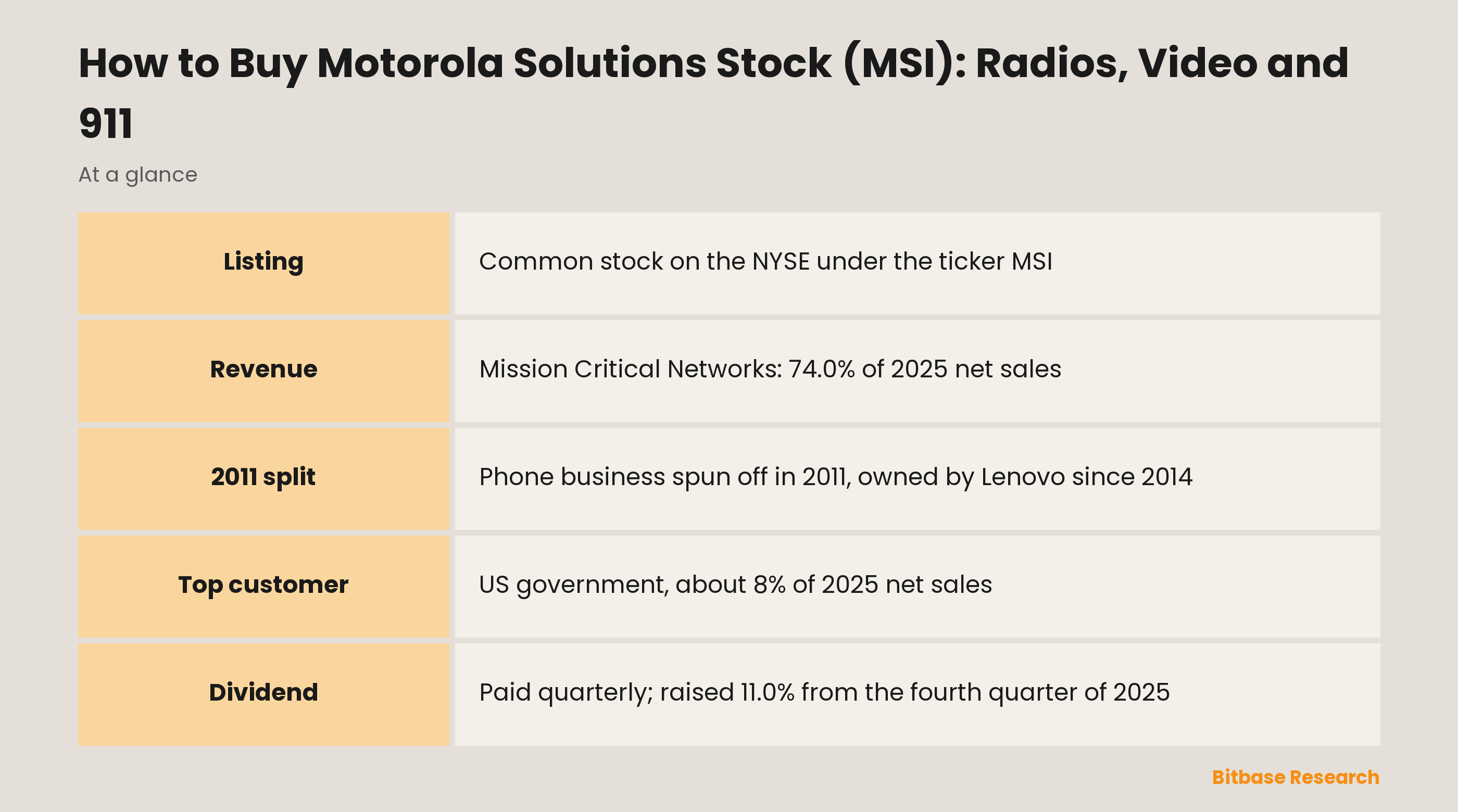
Despite the shared Motorola name, buying MSI does not get you the phone business: Motorola Solutions common stock trades on the New York Stock Exchange under that ticker, and any brokerage account with access to US shares can place the order. What you would own is a supplier of two-way radio networks, video security and 911 command center software to public safety agencies, governments including defense, and enterprises, with Mission Critical Networks alone bringing in 74.0% of 2025 net sales. The handset business left with Motorola Mobility in the 2011 separation and has belonged to Lenovo since 2014.
What Does Motorola Solutions Do?
The company calls itself "a global leader in mission-critical safety and security technologies for public safety, government, including defense, and enterprise customers," and its 10-K counts more than 100,000 customers in over 100 countries. In plain terms, it builds the equipment and software that emergency and security teams use to talk to one another, see what is happening and coordinate a response.
The offering is organized into three technologies. Mission Critical Networks (MCN) covers two-way radio infrastructure and devices built to standards such as P25, TETRA and DMR, broadband devices for public safety LTE, and mobile ad-hoc network (MANET) equipment that links users in the field without fixed towers; the label replaced "Land Mobile Radio Communications" after the company bought Silvus Technologies, a MANET developer, in August 2025. Video Security and Access Control covers fixed, body-worn and in-vehicle cameras, access control, video management software and AI-powered analytics. Command Center is software for a public safety workflow "from the initial 911 call through case closure," used by call takers, dispatchers and first responders.
Buyers range from federal, state and local agencies to schools, hospitals, businesses and stadiums, reached by an in-house sales force for the largest accounts and by independent dealers and distributors for the rest. About 23,000 people worked for the company at the end of 2025, roughly 40% of them in R&D and engineering. Greg Brown has been chairman and chief executive since May 2011.
Motorola Solutions and Motorola Mobility are different companies. The listed entity is the successor to Motorola, Inc., an Illinois corporation organized in 1928, and is now incorporated in Delaware and based in Chicago. On 4 January 2011 Motorola, Inc. completed the separation of Motorola Mobility Holdings, which took the Mobile Devices business, maker of wireless handsets including smartphones, and the Home business, maker of set-top boxes. The remaining company then carried out a one-for-seven reverse stock split, renamed itself Motorola Solutions and began trading on the NYSE as MSI. It kept no shares in Motorola Mobility, which Lenovo acquired in 2014, and even the Motorola brand now sits with Motorola Mobility's trademark unit.
How Motorola Solutions Makes Money
The 10-K reports two segments and, across them, three technologies:
| Segment | What it covers | Share of 2025 net sales | Growth on 2024 |
|---|---|---|---|
| Products and Systems Integration | Radio infrastructure and devices, cameras, installation and integration | 62% | 5.4% |
| Software and Services | Support and managed services, video and command center software | 38% | 12.6% |
| Technology | Share of 2025 net sales | Growth on 2024 |
|---|---|---|
| Mission Critical Networks | 74.0% | 6.8% |
| Video Security and Access Control | 18.1% | 10.4% |
| Command Center | 7.8% | 14.8% |
Segment shares are as stated in the 10-K; technology shares and growth rates are calculated from its revenue note. Total net sales grew 8.0%.
Radio remains the core, and much of it comes back as services. Products and Systems Integration is the upfront sale of devices and communications systems, installed and integrated into the customer's operations, with MCN making up 84% of the segment. Software and Services is the recurring side: repair, monitoring, software upgrades, cybersecurity and managed operation of networks that, the 10-K notes, often have "multi-year or multi-decade lifespans." Video and command center each made up 21% of that segment and MCN services the other 58%.
The largest single customer is the US government, through many branches and agencies including the armed services, at about 8% of 2025 net sales, and all of those contracts can be cancelled at the customer's convenience. North America produced 72% of net sales and international customers 28%.
Part of the contract book is invoiced against milestones such as delivery, installation and system acceptance, which generally take six months to two years to complete. That makes the backlog worth watching: it rose 7.1% during 2025, and Software and Services held 75.8% of the year-end total after its own backlog grew 13.0%. Sales also lean toward the end of the year, with the fourth quarter historically the strongest.
Gross margin reached 51.7% of net sales in 2025, against 51.0% a year earlier, and operating margin 25.6%, against 24.8%, helped in part by gains recovered in the Hytera litigation.
MSI Stock at a Glance
| Item | Detail |
|---|---|
| Exchange | New York Stock Exchange |
| Ticker | MSI, used since 4 January 2011 |
| Security | Common stock; the only class registered on the 10-K cover |
| Sector | Communications equipment and public safety software |
| Index membership | S&P 500 |
| Headquarters | Chicago, Illinois |
| Incorporated | Delaware, successor to Motorola, Inc. (Illinois, 1928) |
| Fiscal year | 52 weeks ending 31 December; quarters close on a Saturday |
| Dividend policy | Regular quarterly cash dividend, at the board's discretion |
| SEC identifier | CIK 68505 |
| CUSIP | 620076307 |
For the live price, market value and yield, which shift through every trading session, open the Motorola Solutions stock page on Bitbase.
How to Buy Motorola Solutions Stock
There is just one listed line to pick: MSI common stock on the NYSE, with no depositary receipt and no second share class. Through a broker, the route looks like this:
1. Pick a broker with NYSE access. Outside the United States that can be a local firm with a gateway to US markets or an international broker; find out which entity holds the shares in custody and who supervises it.
2. Submit a W-8BEN if you are not a US person. The IRS tells a foreign beneficial owner to give Form W-8BEN "to the withholding agent or payer," which usually means the broker.
3. Put dollars in the account. Currency conversion carries a spread, so weigh it alongside the commission.
4. Search for MSI and confirm the issuer. The result should read Motorola Solutions, Inc. common stock on the NYSE; a search for "Motorola" alone may bring up other names.
5. Choose the order type. FINRA notes that brokerage firms "typically enter your order as a market order unless you specify otherwise"; a limit order sets the worst price you will accept, although "there's a chance your order doesn't get executed at all."
6. Settle on whole or fractional shares. Some brokers sell fractions for a fixed cash amount, but FINRA cautions that "you can't transfer fractional shares to another brokerage firm" at present.
7. Save the trade confirmation. It documents your cost basis; dividends and tax withheld appear on later statements.
If you are outside the United States, dividends paid to you face US withholding. The IRS states that "most types of U.S. source income received by a foreign person are subject to U.S. tax of 30%," though a tax treaty may lower or waive it, and the W-8BEN is the form that claims treaty benefits. Your home country may also tax that dividend.
If one company is too narrow a bet, an index fund can hold MSI for you. State Street's SPY holdings file dated 29 October 2026 lists it, which places it in the S&P 500, the benchmark that the Vanguard S&P 500 ETF (VOO) and similar funds set out to track.
What Moves MSI Stock
Public budgets and firm orders. The 10-K names budget uncertainty, government shutdowns and cuts in overall defense spending among the factors that have hurt, or could hurt, its US government business. Large system contracts often receive only partial funding at first, so the backlog in each report shows how much of that money has turned into orders the company believes are firm.
The tilt toward software and services. Software and Services grew 12.6% in 2025 against 5.4% for Products and Systems Integration, and five of the six acquisitions listed since early 2025 belong to the Software and Services segment alone: RapidDeploy, a cloud-native 911 provider, and Theatro in early 2025, the remote video monitoring company Blue Eye in November 2025, then Exacom and Hyper in March 2026.
Defense and Silvus. The August 2025 purchase of Silvus added MANET technology used by defense, government and disaster relief agencies, and the 10-K says the company now meets "increased competition for certain products and services from startups and defense contractors." In the quarter ended 4 July 2026, Products and Systems Integration sales rose 15.4%, international sales 25% and total net sales 13.3%, all including revenue from acquisitions.
Parts and tariffs. Some components, memory among them, come from single-source suppliers, and the latest 10-Q reports "higher costs for memory in our products which is a result of substantial demand in the market driven by AI." US trade actions raised the company's import duties in 2025; then on 20 February 2026 a US Supreme Court ruling invalidated tariffs imposed under the International Emergency Economic Powers Act, and the company booked an adjustment for the refunds it now judges probable.
Hytera recoveries. Money collected from Shenzhen-based Hytera, a radio competitor the company sued for trade secret theft, is recorded as a gain within Other charges. Those gains can lift reported operating earnings in a given year, and further collection depends on court proceedings still under appeal.
The UK Airwave network. The Home Office has extended the Airwave service contract through 31 December 2029. A price control imposed by the Competition and Markets Authority reduced Airwave revenue in 2024, and the 10-K names the contract as a source of political, regulatory or litigation risk.
Dividends, buybacks and debt. The quarterly dividend went up 11.0% for the fourth quarter of 2025 and held at that level through the first half of 2026, and in September 2026 the board enlarged the repurchase authorization under a program with no expiration date. Borrowing rose too: debt issued in 2025 partly funded Silvus, and net interest expense equaled 3.3% of net sales in the second quarter of 2026, compared with 2.0% a year earlier.
Budgets, a Licensed Brand and Other MSI Hazards
Of the risk factors in the 10-K, these bear most directly on an MSI holding:
Government funding. "A portion of our business is dependent upon U.S. government contracts and grants, which have availability of funding, spending levels and priorities that could change." The same entry covers audits, disclosure duties and possible suspension from federal contracting after a compliance failure.
Large multi-year contracts. "We are exposed to risks under large, multi-year system and services contracts that may negatively impact our business." Such contracts may be only partly funded at the outset and cancellable on short notice, and in some the company is not the prime contractor.
A brand it does not own. "Our joint use of the Motorola Marks could result in product and market confusion and negatively impact our ability to expand business under the Motorola brand." The company uses the marks under a worldwide, perpetual and royalty-free license secured in 2010 and limited to agreed fields of use; the license can be lost if its terms are broken, and neither Motorola Mobility nor Lenovo is prohibited from selling the marks.
Rules on AI and biometrics. Laws on facial recognition and other video analytics, the Illinois Biometric Information Privacy Act among them, could make some products harder to sell or costlier to offer.
Supply chains and cyberattacks. The company warns that any disruption to its suppliers or significant increase in their prices "has had, and could continue to have a negative impact on our results of operations or financial condition." A breach could also reach networks it installs and, in some cases, operates for customers.
Beyond these sit the ordinary hazards of a single stock. One company's results set the price, each dividend is a board decision that can change, and an investor who spends a currency other than the dollar sees both the price and the payout pass through an exchange rate.
How to Research MSI Yourself
Motorola Solutions files with the SEC under CIK 68505, and its investor relations section at motorolasolutions.com/investors links the same reports. The fiscal year follows the calendar, but quarters run 13 weeks and close on a Saturday, so the 10-Q for the second quarter of 2026 covers the period to 4 July rather than 30 June.
Inside the 10-K, Item 1 describes the three technologies, the customers and the competitor list; Item 1A holds the risk factors; Item 5 has the dividend record and a performance graph comparing MSI with the S&P 500 and the S&P Communications Equipment Index. The revenue note breaks sales down by segment, region, technology and customer type, and Note 12 follows the Hytera litigation.
Between annual reports, read the segment tables in each 10-Q and the 8-Ks that carry earnings releases and board actions such as buyback increases. For another communications equipment company to compare, see how to buy Cisco stock; quotes for other US companies sit on Bitbase's US stock list.
Motorola Solutions Stock FAQ
Is Motorola Solutions the same company as Motorola phones?
No. Motorola, Inc. split in two on 4 January 2011: shareholders received one Motorola Mobility Holdings share for every eight Motorola, Inc. shares, and the handset and set-top box businesses went with it. Lenovo acquired Motorola Mobility in 2014. The rest of the company became Motorola Solutions, trading as MSI after a one-for-seven reverse split, and it licenses the Motorola brand for its own fields of use. Holding MSI gives you no stake in Motorola Mobility or Lenovo.
Can I buy Motorola Solutions stock with crypto?
Not directly. A brokerage account is the only route to MSI shares, and trades settle in US dollars: you would sell the crypto, move the cash to your broker and then buy, and depending on your country the sale itself can trigger tax. Both steps are laid out in this guide to buying stocks with crypto. The account then holds ordinary MSI common stock.
Does Motorola Solutions pay a dividend?
Yes, every quarter. The board raised the quarterly amount by 11.0% for the fourth quarter of 2025 and declared the same amount in each of the first two quarters of 2026. The 10-K says the company expects to keep paying comparable regular quarterly dividends in 2026, while every payment stays at the board's discretion.
Is MSI in the S&P 500?
Yes. State Street's SPY holdings file for 29 October 2026 includes Motorola Solutions under the ticker MSI. Its weight in the index changes daily.
What is the Hytera case?
In 2017 the company sued Hytera, a Shenzhen-based radio maker, in federal court in Illinois for trade secret theft and copyright infringement; a jury found in its favor in 2020, an appeals court upheld the trade secret damages in 2024, and the US Supreme Court declined Hytera's appeal in February 2025. Hytera also pleaded guilty in January 2025 to a federal charge of conspiring to steal the company's trade secrets and in March 2026 was sentenced to five years of probation, with yearly payments toward the civil judgment. Motorola Solutions has appealed that sentencing order, so the matter is still open.
Conclusion
Getting MSI into a brokerage account is the easy part: one NYSE ticker, a W-8BEN if you live abroad, and a market or limit order. The harder question is what you are buying, which is not a phone brand but a supplier of radio networks, video and dispatch software whose single largest customer is the US government. Read the latest risk factors and the next 10-Q's backlog and segment figures before deciding how much of a portfolio belongs in one public safety technology stock.
Related reading
Other Bitbase articles on this topic:
- How to Buy Lumentum Stock (LITE): Lasers, NVIDIA Stake and Perps
- How to Buy Sony Stock (SONY): PlayStation, Sensors and 24/7 Perps
- How to Buy TE Connectivity Stock (TEL): Cars, AI and Irish Tax
Disclaimer: This article is educational content from Bitbase Academy, provided for information only. It explains what a company or fund does and how the instruments referenced here differ from one another; it does not constitute investment, trading, tax, or financial advice, and it is neither a recommendation nor an endorsement of any security, token, or trading strategy. A tokenized stock is issued by a third party and is designed to give economic exposure to an underlying asset: it is not a share, it carries no shareholder rights, and it depends on the issuer's structure, eligibility rules, and redemption terms, which the issuer can change. Perpetual futures are leveraged derivatives that hold no underlying asset and can be liquidated, and trading hours, product availability, and eligibility differ by instrument and by jurisdiction and can change at any time. Written as of October 2026; verify everything yourself through company filings, the issuer's own documentation, and the product pages of the venue you trade on.
References
[1] Motorola Solutions Form 10-K for 2025 (SEC EDGAR) www.sec.gov
[2] Motorola Solutions Form 10-Q for the quarter ended 4 July 2026 (SEC EDGAR) www.sec.gov
[3] Motorola Solutions Form 8-K, 10 January 2011: separation completed (SEC EDGAR) www.sec.gov
[4] Motorola Solutions Form 10-K for 2010 (SEC EDGAR) www.sec.gov
[5] Motorola Solutions Form 8-K, 9 September 2026: larger buyback authorization (SEC EDGAR) www.sec.gov
[6] State Street: SPY daily holdings, 29 October 2026 www.ssga.com
[7] FINRA: Order Types www.finra.org
[8] FINRA: Investing in Fractional Shares www.finra.org
[9] IRS: NRA Withholding www.irs.gov
[10] IRS: About Form W-8 BEN www.irs.gov





