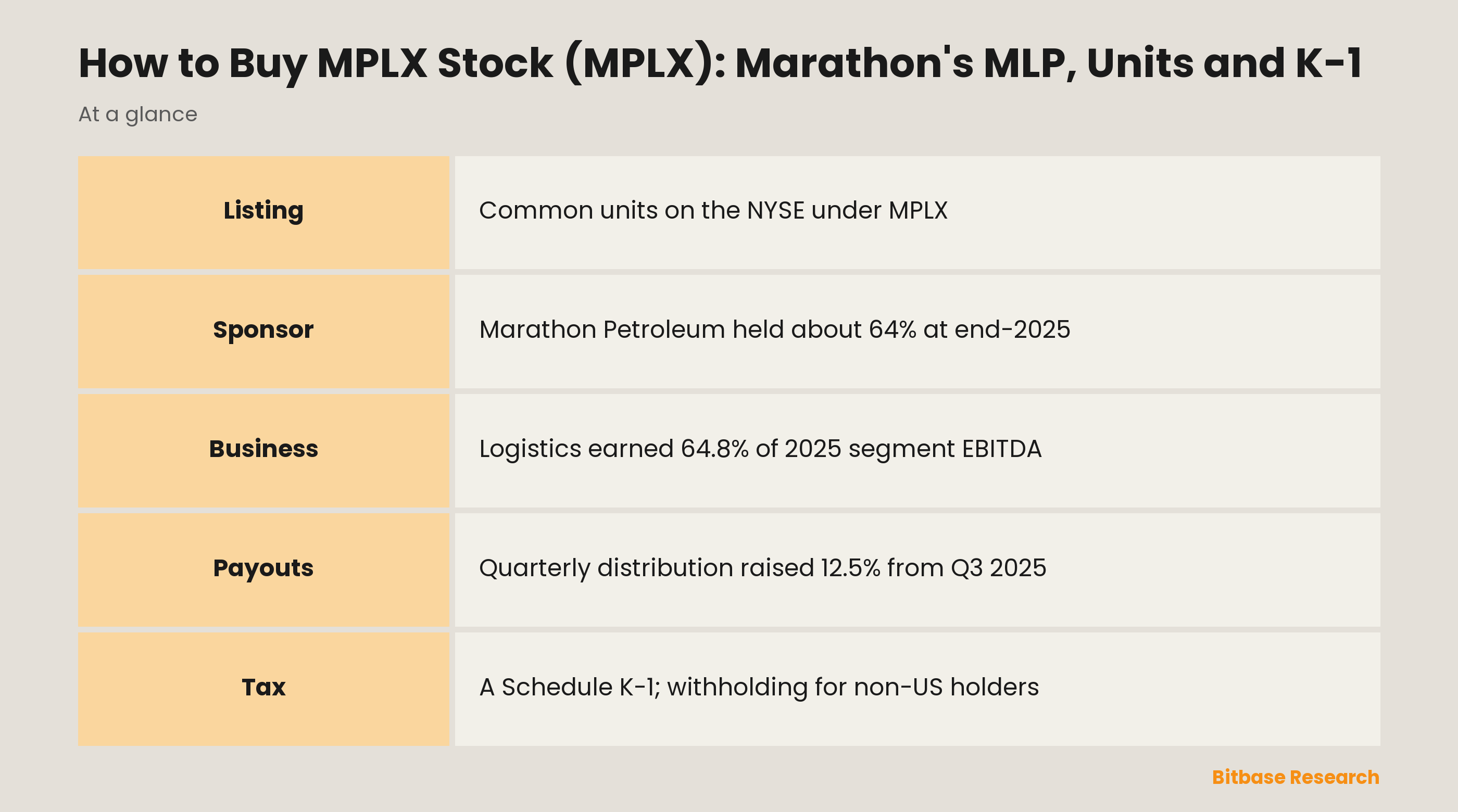
This is a partnership you buy the way you buy a stock: MPLX LP lists its common units on the NYSE as MPLX, so an ordinary brokerage account that reaches New York can buy them. Each unit is a slice of a limited partnership rather than a share of a company; the cash it pays every quarter is a distribution, not a dividend, and the tax paperwork comes on Schedule K-1. Marathon Petroleum created MPLX in 2012, owns its general partner and still held about 64% of its common units on 31 December 2025.
What Does MPLX Do?
MPLX moves, stores and processes oil and gas that other companies produce and refine. Its annual report calls it "a diversified, large-cap master limited partnership formed by MPC in 2012" that "owns and operates midstream energy infrastructure and logistics assets, and provides fuels distribution services." An integrated producer does both jobs itself, as our profile of Exxon Mobil shows; MPLX works the stretch in between.
There are two segments. Crude Oil and Products Logistics moves and stores crude oil, refined products and renewables through pipelines, terminals, caverns and barges, and runs refining logistics at 13 refineries. Natural Gas and NGL Services provides "wellhead to market services": it gathers and treats natural gas, extracts natural gas liquids (NGLs) such as ethane and propane, then fractionates, stores and markets them.
MPLX is a Delaware limited partnership based in Findlay, Ohio. Its units began trading on the NYSE on 26 October 2012. Marathon Petroleum (MPC) is the sponsor: the general partner, MPLX GP LLC, is a wholly owned MPC subsidiary, and the people who run the business are employed by MPC and its affiliates. MPLX bought MarkWest Energy Partners in December 2015; in 2025 it added Northwind Midstream and the rest of BANGL and sold its Rockies gathering and processing operations.
How MPLX Makes Money
The larger segment charges for use rather than selling product. Logistics earns pipeline and barge-dock tariffs and storage fees; the marine business works under "a fee-for-capacity contract with MPC," and fuels distribution is paid on the volume of MPC's products sold each month. These are "long-term, fee-based agreements," most with minimum volumes: if MPC ships less than its commitment on a pipeline, it owes a deficiency payment.
The gas segment mixes "fee-based, percent-of-proceeds, keep-whole and purchase arrangements," and the 10-K notes that "MPLX's contract mix and exposure to natural gas and NGL prices may change." Its producer customers work the Marcellus, Permian, Utica, STACK and Bakken plays, among others; one customer, mainly through NGL transactions, accounted for about 20% of the segment's 2025 revenues.
Management judges both by Segment Adjusted EBITDA:
| Segment | Share of 2025 segment Adjusted EBITDA | Change vs 2024 | Revenue and other income from MPC, 2025 | Share of 2025 capital expenditures |
|---|---|---|---|---|
| Crude Oil and Products Logistics | 64.8% | up 3.9% | 88% | 27.5% |
| Natural Gas and NGL Services | 35.2% | up 3.4% | 2% | 72.5% |
Percentages and changes come from the segment note of the fiscal 2025 10-K, rounded to one decimal; the MPC figures are as reported.
MPC accounted for 48% of total 2025 revenues and other income, primarily in logistics, while the gas segment, where MPC is a minor customer, absorbed most of the capital spending.
MPLX Stock at a Glance
| Feature | MPLX |
|---|---|
| Listing venue | NYSE (New York Stock Exchange) |
| Ticker | MPLX |
| Security | Common units representing limited partnership interests, the sole security registered under 12(b) on the 10-K cover |
| General partner | MPLX GP LLC, wholly owned by Marathon Petroleum |
| Sponsor's stake | About 64% of the common units, held by MPC at 31 December 2025 |
| Sector | Midstream energy: crude oil, refined products, natural gas and NGLs |
| S&P 500 | Absent from State Street's SPY holdings file of 29 October 2026; owned by MLP funds such as AMLP |
| Headquarters | Findlay, Ohio |
| Fiscal year | Calendar year |
| Payouts | Quarterly cash distributions, set by the board of MPLX GP |
| Tax reporting | Schedule K-1 |
| SEC identifier | CIK 1552000 |
Price, market value and yield move all session long; for live figures, see the MPLX market page on Bitbase.
How to Buy MPLX Stock
Because MPLX is American and listed in New York, there is no ADR layer. The trade itself is ordinary; what follows it is not:
1. Pick a broker that reaches the NYSE. Investors abroad should first confirm that their account may hold partnership units and ask how the firm withholds tax on them.
2. Open, verify and fund the account. Tax residence shapes much of what follows, and currency conversion has a price of its own.
3. Find the right line. Search MPLX and check that it reads MPLX LP common units on the NYSE; Marathon Petroleum is a separate listing under MPC.
4. Choose an order type. A market order "generally will execute at or near the current bid or ask prices," FINRA explains, yet "you might not get the price you saw or were originally quoted, especially in fast-moving markets"; a limit order fills only "at or better than a specified price."
5. Decide on the size. Fractional trading depends on the broker, a fractional owner "might not have shareholder voting rights," and for now you "can't transfer fractional shares to another brokerage firm."
Units, not shares. The registered security is "Common Units Representing Limited Partnership Interests," and its holders have only limited voting rights. On tax, the IRS notes that a partnership "generally isn't subject to income tax"; each partner answers for a share of the income instead, and MPLX reports that share on Schedule K-1. Its 10-K even lists auditor fees for "the preparation of IRS Schedule K-1 tax forms for MPLX LP unitholders."
Outside the United States, the gap widens. The 10-K treats a foreign holder's income and gains as generally "effectively connected" with American business, so every distribution paid abroad carries "withholding taxes at the highest applicable effective tax rate," a sale brings withholding "on all proceeds attributable to the sale," and foreign holders "will be required to file U.S. federal tax returns." The partnership agreement adds a second rule: units held by investors who are not both "citizenship-eligible" and "rate-eligible" holders "may be subject to redemption" at the market price three days before the notice is mailed, and citizenship-eligible holders "will generally include individuals and entities who are U.S. citizens." Put both questions to your broker and a tax professional before you buy.
Through a fund, an S&P 500 tracker reaches MPLX only through Marathon Petroleum's stake, while specialist vehicles, the Alerian MLP ETF (AMLP) among them, own the units directly; each fund's prospectus sets out its own tax treatment.
What Moves MPLX Stock
Marathon's refineries. The 10-K's list of MPC risks includes "a material decrease in the refining margins at MPC's refineries" and any MPC decision to "alter, curtail or shut down operations" at a refinery. Minimum volume commitments cushion the downside, but "MPC is not obligated to use our services with respect to volumes in excess of the minimum volume commitments."
The gas build-out. The second-quarter 2026 release says MPLX "plans to invest over 90% of organic growth capital toward opportunities to meet growing natural gas and NGL infrastructure needs." Secretariat I in the Delaware Basin entered service in April 2026; two fractionators near MPC's Galveston Bay refinery are scheduled for 2028 and 2029, alongside a half-owned LPG export terminal at Texas City planned for 2028. The 10-K expects natural gas demand to "accelerate over the next few years" as data centers need more power.
Interest rates. "As with other yield-oriented securities, our unit price will be impacted by our cash distributions and the implied distribution yield," the 10-K says, so "a rising interest rate environment could have an adverse impact on our unit price." Because the partnership agreement "requires that we distribute all of our available cash," expansion also leans on outside financing.
Distribution decisions. The general partner's board declares each payment. The quarterly distribution rose 12.5% from the third quarter of 2025, and MPLX also buys back units held by the public.
Strings Attached to an MPLX Unit
The 10-K sorts its risks under seven headings; four themes bear most directly on a unit.
One dominant customer. "MPC accounts for a substantial portion of our revenues," and anything that hurts MPC's finances "may adversely affect our ability to sustain or increase distributions."
Control. MPLX GP and its affiliates, MPC included, "have conflicts of interest with us and limited duties to us and our unitholders," and "MPC is under no obligation to adopt a business strategy that favors us." Unitholders cannot elect the general partner or its board; removing it takes at least two-thirds of all common units, while MPC's side held about 64% in February 2026. Should that side ever own more than 85% of the common units, the general partner could force a sale of the remainder at a price no lower than their market value at the time.
Who may hold units. The redemption rule is not the only ownership limit: under US maritime laws, vessel-owning entities "must be owned at least 75 percent by U.S. citizens," and too much foreign investment could stop MPLX "operating inland river vessels."
Tax. MPLX believes it is treated as a partnership but has not sought an IRS ruling; being taxed as a corporation "would substantially reduce the amount of cash available for distribution." Holders owe tax on their allocated income whether or not any cash is paid out, and they may have to file returns, and pay tax, in states where they have never lived.
Past increases do not bind future boards, and currency moves add a further layer for investors outside the dollar.
How to Research MPLX on EDGAR
MPLX's filings sit under CIK 1552000: an annual 10-K, quarterly 10-Qs and event-driven 8-Ks, results releases included. In the 10-K, Item 1 tabulates MPC's minimum commitments, Item 1A sets out the risks and the segment note gives Segment Adjusted EBITDA. MPC is "our most significant customer," so Marathon Petroleum's own filings belong alongside. For comparison with other listed companies, Bitbase's US stock market pages carry live data.
MPLX Stock FAQ
Is MPLX an MLP?
Yes. MPLX LP calls itself a master limited partnership, and its NYSE security is common units in a Delaware limited partnership. It trades like a stock, but holders get limited votes, distributions and a Schedule K-1.
Does MPLX pay a dividend?
Not in name. MPLX pays quarterly cash distributions, which do the job a dividend does for a corporation. The quarterly rate was raised 12.5% effective for the third quarter of 2025, and amounts and record dates appear in its 8-K releases. What you are taxed on is your allocated share of income, which can differ from the cash received.
How is MPLX related to Marathon Petroleum?
Marathon Petroleum formed MPLX and remains its sponsor: it owns the general partner, owned roughly 64% of the common units at 2025 year-end, provides the staff and supplied 48% of 2025 revenues and other income. MPC itself is a separately listed corporation.
Is MPLX in the S&P 500?
No. The SPY holdings file State Street published for 29 October 2026 lists Marathon Petroleum among its S&P 500 positions, but not MPLX. The Alerian MLP ETF, by contrast, listed MPLX LP among its pipeline holdings as of 28 February 2026.
Can I buy MPLX stock with crypto?
Not directly. A broker settles the purchase in US dollars, so any crypto has to be converted into cash first, a step that can itself trigger tax in some countries, and the dollars then moved into the brokerage account. What you end up holding is a partnership interest on the register, reported on a K-1, which is part of how a listed security differs from a crypto asset.
Conclusion
Buying MPLX takes a brokerage account, the right ticker and an order. Owning it means units in a partnership Marathon Petroleum controls, distributions instead of dividends and a K-1; outside the US, withholding and a redemption rule too. Before sizing a position, go through the tax and unit-ownership risks in the newest 10-K, and have a tax adviser explain what a K-1 and US withholding would mean in your country.
Related reading
Other Bitbase articles on this topic:
- How to Buy Enbridge Stock (ENB): Pipelines, Dividend, Line 5
- How to Buy Eni Stock (E): Two-Share ADRs, State Stake, Dividends
- How to Buy Enterprise Products Stock (EPD): MLP Units and the K-1
Disclaimer: This article is educational content from Bitbase Academy, provided for information only. It explains what a company or fund does and how the instruments referenced here differ from one another; it does not constitute investment, trading, tax, or financial advice, and it is neither a recommendation nor an endorsement of any security, token, or trading strategy. A tokenized stock is issued by a third party and is designed to give economic exposure to an underlying asset: it is not a share, it carries no shareholder rights, and it depends on the issuer's structure, eligibility rules, and redemption terms, which the issuer can change. Perpetual futures are leveraged derivatives that hold no underlying asset and can be liquidated, and trading hours, product availability, and eligibility differ by instrument and by jurisdiction and can change at any time. Written as of October 2026; verify everything yourself through company filings, the issuer's own documentation, and the product pages of the venue you trade on.
References
[1] MPLX LP Form 10-K, fiscal 2025 (SEC EDGAR) www.sec.gov
[2] MPLX LP 10-K, fiscal 2025: XBRL cover page (SEC EDGAR) www.sec.gov
[3] MPLX LP 10-K, fiscal 2025: segment information (SEC EDGAR) www.sec.gov
[4] MPLX second-quarter 2026 results release (Form 8-K exhibit) www.sec.gov
[5] MPLX LP Form 10-K, fiscal 2012 (SEC EDGAR) www.sec.gov
[6] IRS: Partner's Instructions for Schedule K-1 (Form 1065) www.irs.gov
[7] State Street, SPDR S&P 500 ETF Trust (SPY): daily holdings as of 29 October 2026 www.ssga.com
[8] ALPS ETF Trust: Alerian MLP ETF schedule of investments as of 28 February 2026 www.alpsfunds.com
[9] ALPS: Alerian MLP ETF (AMLP) fund page www.alpsfunds.com
[10] FINRA: Order Types www.finra.org
[11] FINRA: Investing in Fractional Shares www.finra.org





