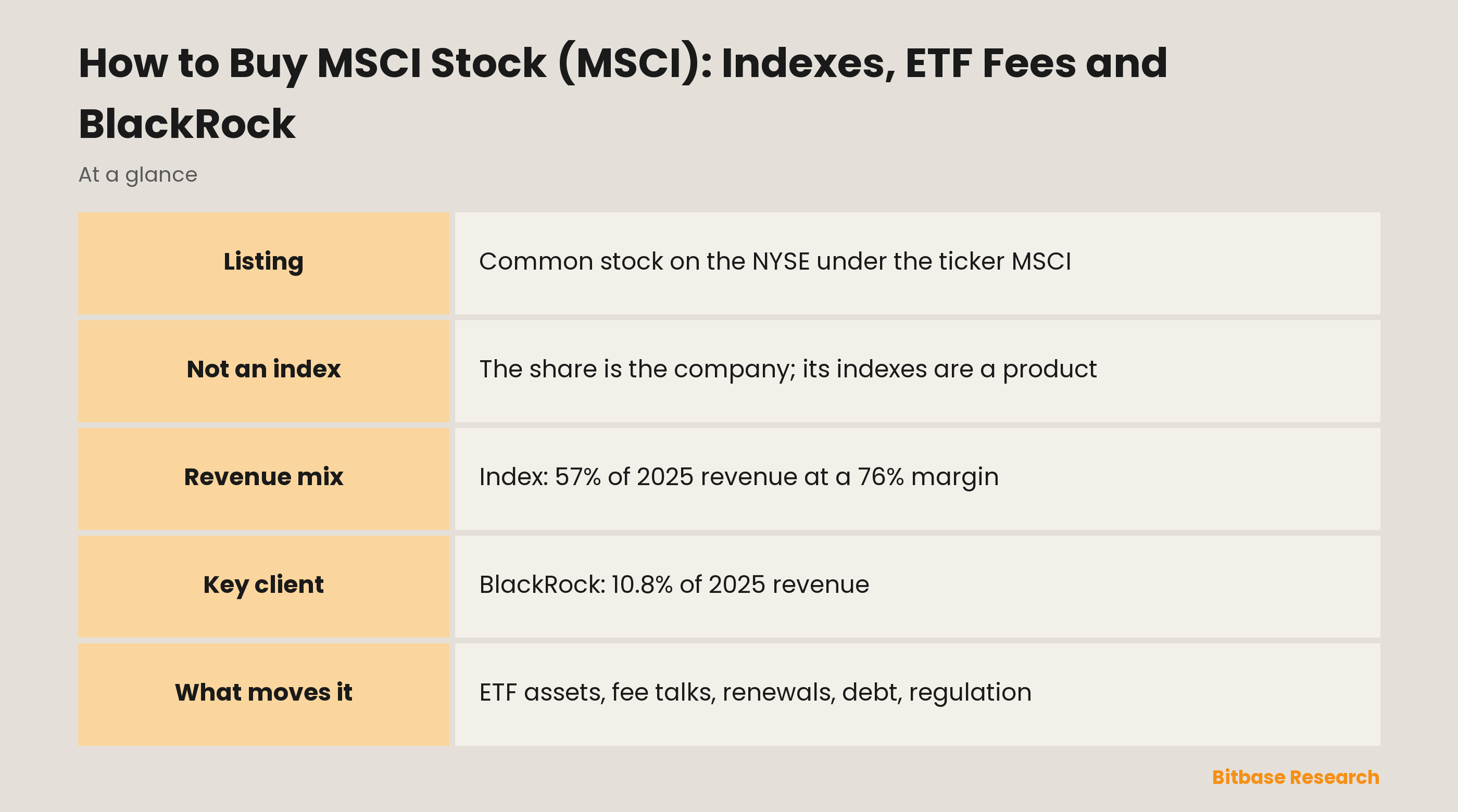
As a stock, MSCI is the common stock of MSCI Inc., listed on the New York Stock Exchange under the ticker MSCI, so any broker that offers US shares can take the order. Buying it does not buy an MSCI index: the company sells those indexes, and in 2025 its Index segment brought in 57% of revenue. Below: how the business earns money, the steps of an order, and why ETF assets and one client, BlackRock, matter to the share.
What Does MSCI Do?
MSCI describes its offering as "research-based data, analytics and indexes" that "set standards for global investors." At the end of 2025 it served about 6,800 clients across the investment industry in more than 100 countries. MSCI was a business unit within Morgan Stanley before its IPO in 2007.
The name covers two different things. MSCI the company is a listed business with revenue, debt and shareholders. An MSCI index is a rules-based list of securities that the company calculates and licenses. You can buy the company's shares; an index can only be followed through a fund or derivative that tracks it, and that fund pays MSCI for the licence.
The work is split into four lines. Index sells the benchmarks: market-cap indexes covering more than 80 equity markets, plus factor, fixed income, climate, thematic and custom indexes, and licences for GICS, the industry classification MSCI maintains jointly with S&P Dow Jones Indices. Analytics sells risk and portfolio tools built on the Barra factor models. Sustainability and Climate sells MSCI ESG Ratings, screening research and climate data. Private Assets, reported under All Other, covers real estate and private capital data, including Burgiss, whose remaining 66.4% MSCI bought on 2 October 2023.
The 10-K names its main index competitors as S&P Dow Jones Indices, FTSE Russell, Nasdaq, Bloomberg and Solactive.
How MSCI Makes Money
Index dominates revenue and profit. Margins below are segment Adjusted EBITDA, MSCI's own profit measure:
| Segment | Share of 2025 revenue | 2025 Adjusted EBITDA margin | What it sells |
|---|---|---|---|
| Index | 57% | 76% | Benchmark data, index licences for funds and derivatives, GICS |
| Analytics | 23% | 48% | Barra and RiskMetrics risk and portfolio tools |
| Sustainability and Climate | 11% | 36% | ESG ratings, screening and climate data |
| Private Assets (All Other) | 9% | 25% | Real estate and private capital data |
By type of fee, about 73% of 2025 revenue came from recurring subscriptions, about 25% from asset-based fees and the rest from one-off sales. Total revenue rose 9.7% from 2024.
Asset-based fees behave differently. The 10-K says they are "primarily based on a client's assets under management ('AUM') or trading volumes," and they made up 43.1% of Index revenue in 2025. Assets in ETFs linked to MSCI equity indexes rose about 36% during 2025, and roughly two-thirds of that increase came from rising markets rather than new money.
The subscription side is steadier. Run Rate, the annualized value of agreements in force, was 13.0% higher at the end of 2025 than a year before, and Retention Rate was 94.4% for the year.
One client stands out. BlackRock accounted for 10.8% of MSCI's 2025 revenue, and 96.5% of that came from fees on BlackRock funds based on MSCI indexes. In the first nine months of 2026 it supplied 11.8% of company revenue and 19.8% of Index revenue.
MSCI Stock at a Glance
| Feature | MSCI |
|---|---|
| Exchange | New York Stock Exchange |
| Ticker | MSCI, the same as the company name |
| Share class | One class of common stock registered under Section 12(b) |
| Sector | Index, analytics and investment data provider |
| Index membership | S&P 500 |
| Headquarters | New York, New York |
| Incorporated | Delaware |
| Listed since | IPO in 2007, after being a Morgan Stanley business unit |
| Fiscal year | Calendar year, ending 31 December |
| Dividend | Regular quarterly cash dividend since October 2014 |
| SEC identifier | CIK 1408198 |
Quotes move all day; the current MSCI share price is on the MSCI stock page on Bitbase.
How to Buy MSCI Stock
No depositary receipt is involved: the common stock itself trades on the NYSE.
1. Find a broker that reaches the NYSE. Outside the US, a domestic firm offering US equities or an international one will do; confirm who supervises it.
2. Complete the account checks. For non-US individuals that usually includes IRS Form W-8BEN, which the IRS says to submit "when requested by the withholding agent or payer."
3. Deposit money. Currency conversion is a cost, so weigh it alongside commissions.
4. Pick the company, not a fund. The line you want is MSCI Inc. common stock on the NYSE. If a search for MSCI also returns funds built on MSCI indexes, those are a different product.
5. Set the order. FINRA says a market order "provides the most certainty that your order will be executed," whereas a limit order fills only "at or better than a specified price."
6. Decide the amount. Not every broker sells fractional shares: some limit them to "large-cap stocks or ETFs" or skip them, and "as a fractional share owner, you might not have shareholder voting rights."
7. Save the paperwork. Statements record your cost and dividends.
Tax outside the US. Under IRS rules, "most types of U.S. source income received by a foreign person are subject to U.S. tax of 30%," unless a treaty sets a lower rate. Your home country may tax the dividends again.
Through index funds. MSCI is in the S&P 500, so funds tracking that index, State Street's SPY among them, hold it as one position among about 500.
What Moves MSCI Stock
Markets and ETF flows. A quarter of revenue is tied to fund assets and trading volumes, so income moves with equity prices and fund flows. In the third quarter of 2026 asset-based fees rose 24.9% from a year earlier, helped by "record ETF AUM linked to MSCI indexes."
Fee pressure. The 10-K warns that clients "may seek for a variety of reasons to negotiate to pay us lower asset-based fee percentages," and that among ETF issuers "low fees are one of the competitive differentiators." With BlackRock near a fifth of Index revenue, the terms with that one client matter.
Subscription renewals. In the third quarter of 2026 Retention Rate was 95.0% and organic recurring subscription Run Rate growth was 8.7%, while Sustainability and Climate retention fell to 91.0% from 93.6%.
Buybacks and debt. The balance sheet showed a shareholders' deficit at the end of 2025, and in the third quarter of 2026 other expense rose 45.2%, "primarily driven by higher interest expense as a result of higher debt levels." Diluted weighted average shares in that quarter were about 6% lower than a year earlier, which lifts earnings per share.
Regulation. Since 1 January 2026 most MSCI indexes "fall outside EU supervision and remain under UK oversight," and the UK has opened a consultation on the scope of its benchmark rules. EU rules also require ESG rating providers to be authorized by or registered with ESMA from 2 July 2026.
Where MSCI's Own Filings See Exposure
The 2025 10-K risk factors, which the latest 10-Q says have not materially changed, include these:
Data and errors. MSCI depends "on third parties to supply data, applications and services," some of them competitors, and its products could contain "undetected errors."
Reputation and self-indexing. "MSCI is exposed to potential reputational and credibility concerns," and some asset managers build their own indexes, so "our clients may become more self-sufficient."
Cancellations. "Cancellations or reductions by our clients could have a material adverse effect."
Leverage. "Our indebtedness could materially adversely affect our cash flows and financial flexibility," and a change in its credit ratings could hurt its financial condition.
Beyond these, holding one company concentrates your risk, and neither payout is assured: future dividends "will be determined by the Board of Directors," and MSCI "cannot provide any guarantee" that buybacks will continue.
How to Research MSCI Yourself
MSCI's filings sit on SEC EDGAR under CIK 1408198. The 2025 10-K was filed on 6 February 2026, and earnings releases arrive as 8-K filings, in 2026 on 28 January, 21 April, 21 July and 20 October. Track the fee split, ETF assets linked to MSCI indexes, Run Rate, Retention Rate and BlackRock's share.
For context, see our S&P Global stock guide on the parent of a major index rival and our BlackRock stock guide on MSCI's largest client. Other US-listed names are on the full list of US stock pages on Bitbase.
MSCI Stock FAQ
Can I buy MSCI stock with crypto?
Not directly. A broker settles MSCI trades in dollars, so you would sell the crypto first, withdraw cash and fund the brokerage account; that sale can create a tax bill at home. Owning the share also brings votes and dividends, one of the points in how a share differs from a crypto asset.
Is buying MSCI stock the same as investing in an MSCI index?
No. MSCI stock is ownership in MSCI Inc., the company that calculates and licenses the indexes. To follow an MSCI index you buy a fund that tracks it, and that fund holds the index's stocks.
Does MSCI pay a dividend?
Yes. MSCI has paid a quarterly cash dividend every quarter since 30 October 2014, and the board declared one for the fourth quarter of 2026. Check the latest earnings release for the amount.
Is MSCI in the S&P 500?
Yes. State Street's SPY, an S&P 500 fund, listed MSCI Inc. in its daily holdings file dated 6 November 2026.
Who is MSCI's biggest client?
BlackRock, which provided 10.8% of MSCI's 2025 revenue, almost all of it from fees on funds built on MSCI indexes.
Conclusion
Placing the trade is the easy part: an account that reaches the NYSE, MSCI Inc. common stock, and a limit or market order. Understanding what you own is harder: index licences earn the highest margins, fees move with fund assets, and one client, buybacks and debt all shape the result. Follow Run Rate, Retention Rate and ETF assets for a few quarters, then size the position to fit the rest of your holdings.
Related reading
Other Bitbase articles on this topic:
- How to Buy Bending Spoons Stock (BSP): Evernote, AOL and Vimeo
- How to Buy Cognizant Stock (CTSH): Banks, Health Care and India
- How to Buy Corpay Stock (CPAY): Fuel Cards to Cross-Border FX
- How to Buy VeriSign Stock (VRSN): .com Registry and Price Caps
Disclaimer: This article is educational content from Bitbase Academy, provided for information only. It explains what a company or fund does and how the instruments referenced here differ from one another; it does not constitute investment, trading, tax, or financial advice, and it is neither a recommendation nor an endorsement of any security, token, or trading strategy. A tokenized stock is issued by a third party and is designed to give economic exposure to an underlying asset: it is not a share, it carries no shareholder rights, and it depends on the issuer's structure, eligibility rules, and redemption terms, which the issuer can change. Perpetual futures are leveraged derivatives that hold no underlying asset and can be liquidated, and trading hours, product availability, and eligibility differ by instrument and by jurisdiction and can change at any time. Written as of November 2026; verify everything yourself through company filings, the issuer's own documentation, and the product pages of the venue you trade on.
References
[1] MSCI Form 10-K for 2025 (SEC EDGAR) www.sec.gov
[2] MSCI 2025 Form 10-K, XBRL cover page (SEC EDGAR) www.sec.gov
[3] MSCI 2025 Form 10-K, XBRL revenue by type and segment (SEC EDGAR) www.sec.gov
[4] MSCI 2025 Form 10-K, XBRL segment profitability (SEC EDGAR) www.sec.gov
[5] MSCI Form 10-Q for the third quarter of 2026 (SEC EDGAR) www.sec.gov
[6] MSCI third-quarter 2026 earnings release, filed with Form 8-K (SEC EDGAR) www.sec.gov
[7] MSCI Inc. filing index (SEC EDGAR) www.sec.gov
[8] State Street SPDR S&P 500 ETF Trust (SPY): fund page and daily holdings www.ssga.com
[9] FINRA: Order Types www.finra.org
[10] FINRA: Investing in Fractional Shares www.finra.org
[11] IRS: NRA Withholding www.irs.gov
[12] IRS: About Form W-8 BEN www.irs.gov





