Upon opening a brokerage account that reaches the Nasdaq Global Select Market, you can buy Natera's common stock under the ticker NTRA, the only security registered on the cover of its annual report. The company sells blood tests built on cell-free DNA; in 2025 its revenue rose 35.9% and its oncology test volume 51.6%, yet it has reported a net loss every year since its founding in 2003 and has never paid a dividend. This guide covers what it sells, who pays, how to order and the risks its filings stress, from reimbursement to a false-advertising judgment under appeal.
What Does Natera Do?
Natera calls itself "a diagnostics company with proprietary molecular and bioinformatics technology that we are applying to change disease management worldwide." Most of its tests analyze cell-free DNA, the fragments of genetic material circulating in a blood sample, to find traces of a tumor, a fetus or a transplanted organ. It works in oncology, women's health and organ health, and reports them as a single segment, unlike a diversified group such as Danaher, where diagnostics is one of three segments.
Founded in California in November 2003 as Gene Security Network, LLC, it is now based in Austin, Texas, and tests mainly in Austin and San Carlos, California. Apart from the Constellation cloud software, every product it sells is a laboratory developed test, or LDT.
Oncology. The flagship is Signatera, "our personalized ctDNA blood test for MRD assessment, early recurrence monitoring, and evaluation of treatment response in patients previously diagnosed with cancer." MRD, molecular residual disease, means traces of cancer that standard imaging often cannot see. Each assay is designed from the patient's own tumor tissue and "is not intended to match patients with any particular therapy." Latitude (a colorectal MRD test that needs no tissue), Altera (genomic profiling for choosing therapy) and the hereditary cancer screen Empower complete the line. On 4 December 2025 Natera bought Foresight Diagnostics, a specialist in MRD detection in B-cell lymphomas, paying in newly issued shares.
Women's health. Panorama, a non-invasive prenatal test launched in 2013, screens a pregnant woman's blood for chromosomal conditions from as early as nine weeks; Natera says it has gone "from being the fourth company to enter the NIPT market to being the market leader by volume in the United States." Horizon, a carrier screening test, "screens for up to 835 inherited conditions" from the same blood draw.
Organ health. Prospera measures donor-derived cell-free DNA to flag rejection of a kidney, heart or lung transplant, and Renasight tests 397 genes linked to chronic kidney disease. Through Constellation, partner labs run the chemistry and use Natera's cloud algorithms, a model that earns less per test than processing in-house.
How Natera Makes Money
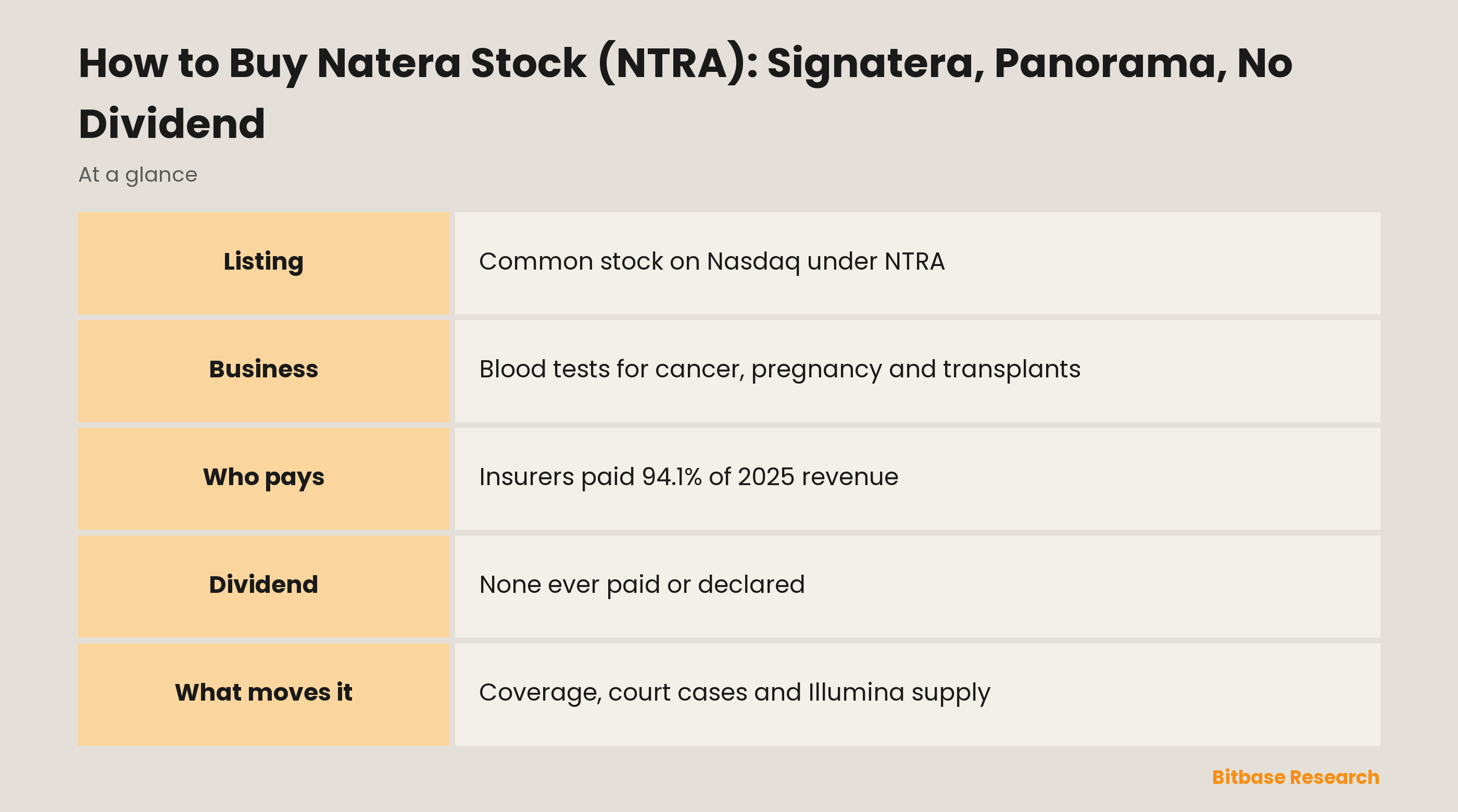
Natera is paid for test results: 99.6% of 2025 revenue came from tests rather than licensing. Who settles the bill matters more than which test was run:
| Who pays | Share of 2025 revenue | What the line covers |
|---|---|---|
| Insurance carriers | 94.1% | Health plans reimbursing tests for their members |
| Laboratory and other partners | 4.5% | Labs that buy tests and bill their own clients |
| Patients | 1.4% | Out-of-pocket costs such as co-pays and deductibles |
The shares are calculated from 2025 revenue by payer type in the 10-K's revenue note and rounded to one decimal place.
Medicare alone accounted for 13.6% of 2025 revenue, up from 12.1% in 2024, and no single customer exceeded 10%. "The majority of our revenue comes from insurers with whom we have in-network contracts," the company says; at the end of 2025 those contracts, its own and its lab partners', covered close to 250 million lives in the US. Coverage matters as much as volume: Panorama's microdeletion screening has drawn "low average reimbursement rates."
Revenue is also an estimate: Natera books a test on delivering the result, at the amount it expects to collect, and about 90% of the cash arrives within nine months. Upward revisions for tests delivered in earlier periods made up about 8.4% of 2025 revenue.
The business is concentrated at home, with 98.2% of 2025 revenue from the United States. Total revenue rose 35.9% that year and product revenue 36.2%, on "increased test volumes as well as average selling price improvements." Tests processed grew 15.0% and oncology units 51.6%, bringing oncology to 22.7% of all tests processed. Gross margin widened from 45.5% in 2023 to 60.3% in 2024 and 64.7% in 2025; revenue grew 38.2% in the first half of 2026.
Revenue is not reported by product; the management discussion still credits Panorama and Horizon with "the majority of our revenues," while the results section lists "Signatera and other oncology testing" beside them.
NTRA Stock at a Glance
| Item | Detail |
|---|---|
| Exchange | Nasdaq Global Select Market |
| Ticker | NTRA |
| Security | Common stock, the only class registered on the 10-K cover |
| Listed since | 2 July 2015, the date of its initial public offering |
| Sector | Healthcare: medical laboratories and molecular diagnostics |
| Reporting segments | One |
| Index membership | Not in the S&P 500; held by State Street's SPDR S&P Biotech ETF (XBI) |
| Headquarters | Austin, Texas |
| Incorporated | Delaware, January 2007 (formed in California in 2003) |
| Fiscal year | Calendar year, ending 31 December |
| Dividend policy | None ever paid or declared; none expected in the foreseeable future |
| SEC identifier | CIK 1604821 |
Live price, market value and volume are on the Natera stock page on Bitbase; the table keeps to facts that do not move daily.
How to Buy Natera Stock
NTRA is a US company's common stock, with no depositary receipt or second share class. Through a broker it takes seven steps:
1. Find a broker with Nasdaq access. Many brokers abroad route orders to US exchanges; check which entity holds your shares and who regulates it.
2. Open the account and complete Form W-8BEN, the IRS form a non-US individual files to document foreign status.
3. Fund it. Converting into dollars has its own cost; check the conversion rate alongside the trading fee.
4. Search NTRA and check the name. It should read Natera, Inc. common stock on Nasdaq, the only security on the company's 12(b) cover listing.
5. Choose an order type. A market order fills at the best available price, which can differ from the last quote. A limit order, in the SEC's words, "is an order to buy or sell a stock at a specific price," so it may not fill.
6. Decide the size. Some brokers sell fractions of a share; check whether a fraction carries voting rights and can be moved to another firm.
7. Keep the records. Trade confirmations establish your cost basis for a later sale.
Outside regular hours, extended-hours quotes can stray from regular-session prices, and setting a limit protects you when few shares change hands.
Withholding without a dividend. The IRS says that "most types of U.S. source income received by a foreign person are subject to U.S. tax of 30%," with treaty rates possibly lower; Form W-8BEN is how the broker applies them. With no Natera dividend there is nothing to withhold for now, though a gain on a sale may be taxed where you live.
Through a fund. NTRA is not in the S&P 500, so funds tracking that index do not hold it. It does appear in the 29 October 2026 holdings file of State Street's SPDR S&P Biotech ETF (XBI).
What Moves NTRA Stock
Oncology volume. Growth is fastest in Signatera's field: oncology units processed rose 51.6% in 2025 and 55.6% in the first half of 2026, against 15.0% for all tests in 2025. The 10-K calls tests processed "a key metric."
Coverage and payment rates. Each new use for a test needs payers willing to reimburse it. Medicare covers Signatera in specified colorectal, bladder, breast, ovarian and lung cancer settings and for immunotherapy monitoring in solid tumors, and CMS has given it Advanced Diagnostic Laboratory Test status, a separate pricing route. Private-payer rate reporting under the Protecting Access to Medicare Act has been delayed until 2027, which so far has meant no cuts to Medicare's clinical laboratory fee schedule.
Collections and estimates. Because revenue is booked on expected collections, faster or slower payment shows up as revisions: in 2025 they lifted revenue by about 8.4% of the total, and if collections fall short, the company reduces revenue instead.
Courtrooms. In Guardant Health's false-advertising suit, a jury found Natera liable in November 2024; the court largely upheld the verdict in July 2025 and entered final judgment in June 2026, which Natera is appealing to the Ninth Circuit. In a Ravgen patent case, a jury found non-willful infringement in January 2024, judgment followed in March 2026, and Natera has appealed certain rulings. Its own patent suits cut both ways: NeoGenomics withdrew its RaDaR test under an injunction, but two Natera patents asserted against an updated version were later ruled invalid.
Rules for laboratory tests. An FDA rule that could have required premarket review for many LDTs was vacated by a federal court in 2025 and rescinded that September, but the agency "has not indicated how it will interpret the court ruling," and Congress re-introduced the VALID Act in June 2025.
Illumina. Natera's tests "are currently only validated to perform on Illumina's sequencing platform," and Illumina is the sole supplier of its sequencers and related reagents under an agreement running to August 2033. The same 10-K lists Illumina, through Verinata, among its prenatal-testing competitors.
Natera Grows Quickly but Has Never Posted an Annual Profit
Item 1A of the 2025 10-K runs long; the points below draw on the parts that matter most for an NTRA holder:
Losses. "We have incurred net losses since our inception and we anticipate that we will continue to incur losses for the near future, which could harm our future business prospects." Equity is part of the cost: non-cash stock-based compensation in 2025 was larger than the net loss itself, and shares outstanding on the filing covers rose 1.7% between 20 February and 31 July 2026.
Reimbursement. The 10-K warns that if Natera cannot "expand, maintain or obtain third-party payer coverage and reimbursement" for its tests, or must refund payments already received, "our revenues and results of operations would be adversely affected." With 94.1% of revenue paid by insurers, that reaches almost every dollar.
Competition. "Competition in our industry is intense." In oncology the 10-K names Guardant Health, Exact Sciences, Tempus Labs, Caris Life Sciences, Personalis, BillionToOne and Quest; in organ health, CareDx is "our primary competitor."
Single suppliers. Natera relies "on a limited number of suppliers or, in some cases, single suppliers"; its sequencers, many reagents and its blood collection tubes are sole sourced.
Legal proceedings. Beyond the cases above, a securities class action filed in Texas in April 2022 has been certified as a class.
The share itself adds two more. With no dividend, any returns "will be limited to changes in the value of our common stock," as the 10-K puts it, and buyers outside the US also carry the dollar's exchange rate.
How to Track NTRA's Test Volumes and Court Cases
Natera files with the SEC under CIK 1604821 and reports on a calendar-year basis. The 10-K comes in late February (the 2025 report was filed on 27 February 2026), 10-Qs follow each quarter, and 8-Ks carry results releases and other events in between.
Three parts of each report repay attention: the management discussion for tests processed and oncology units, the revenue note for payer mix and revised estimates, and the legal proceedings section, which updates the Guardant, CareDx and Ravgen cases each quarter. The June 2026 report, for example, recorded that the Supreme Court had denied CareDx's petition in its false-advertising case.
As a yardstick, the 10-K's performance graph compares NTRA with the Nasdaq Biotechnology Index and the Nasdaq Composite. Quotes are on the stock page linked above, and the US stock directory on Bitbase covers other listed companies.
Natera Stock FAQ
Does Natera pay a dividend?
No. Its 10-K states: "No cash dividends have ever been paid or declared on our common stock." The company does not expect to pay any in the foreseeable future, so a return on NTRA has to come from the share price.
Can I buy Natera stock with crypto?
Not directly. NTRA is bought through a broker and settles in US dollars, so any crypto must first be converted to cash and transferred to the broker; that sale may be taxable where you live. You end up with a registered share carrying voting rights, which marks the difference between a stock and a crypto asset.
Is NTRA in the S&P 500?
No. State Street's holdings file for its S&P 500 trust (SPY), dated 29 October 2026, does not include Natera, while the same day's file for the SPDR S&P Biotech ETF (XBI) does. Index lists change, so confirm against a current file.
Is Natera profitable?
Not on an annual basis so far. The company has "incurred net losses each year since our inception in 2003," including 2025, even as its gross margin rose to 64.7% that year.
What is Signatera?
Natera's tumor-informed blood test for molecular residual disease. Designed from the patient's own tumor tissue, it tracks circulating tumor DNA in later blood samples to show how much cancer remains and to watch for recurrence; it is not meant to choose a therapy.
Conclusion
Placing an NTRA order is routine: a broker with Nasdaq access, the Natera, Inc. common stock line and a market or limit order. Judging the company takes longer: revenue depends on insurers paying for each test, growth leans on oncology, and court cases and a single sequencing supplier sit behind a business yet to post an annual profit. Read the latest 10-Q, especially its volume figures and legal note, before deciding how much of one diagnostics stock to own.
Related reading
Other Bitbase articles on this topic:
- How to Buy Cigna Stock (CI): Express Scripts and Rebate Reform
- How to Buy CVS Health Stock (CVS): Insurer, PBM and Drugstores
- How to Buy Edwards Lifesciences Stock (EW): TAVR, No Dividend
Disclaimer: This article is educational content from Bitbase Academy, provided for information only. It explains what a company or fund does and how the instruments referenced here differ from one another; it does not constitute investment, trading, tax, or financial advice, and it is neither a recommendation nor an endorsement of any security, token, or trading strategy. A tokenized stock is issued by a third party and is designed to give economic exposure to an underlying asset: it is not a share, it carries no shareholder rights, and it depends on the issuer's structure, eligibility rules, and redemption terms, which the issuer can change. Perpetual futures are leveraged derivatives that hold no underlying asset and can be liquidated, and trading hours, product availability, and eligibility differ by instrument and by jurisdiction and can change at any time. Written as of October 2026; verify everything yourself through company filings, the issuer's own documentation, and the product pages of the venue you trade on.
References
[1] Natera Form 10-K, fiscal 2025 (SEC EDGAR) www.sec.gov
[2] Natera Form 10-Q, quarter to 30 June 2026 (SEC EDGAR) www.sec.gov
[3] Natera 8-K on the Foresight Diagnostics acquisition, 5 December 2025 (SEC EDGAR) www.sec.gov
[4] Natera Form 10-K, fiscal 2015: listing since the IPO (SEC EDGAR) www.sec.gov
[5] State Street, SPY daily holdings, 29 October 2026 www.ssga.com
[6] State Street, XBI daily holdings, 29 October 2026 www.ssga.com
[7] SEC, Trade Execution: What Every Investor Should Know www.sec.gov
[8] IRS, NRA Withholding www.irs.gov





