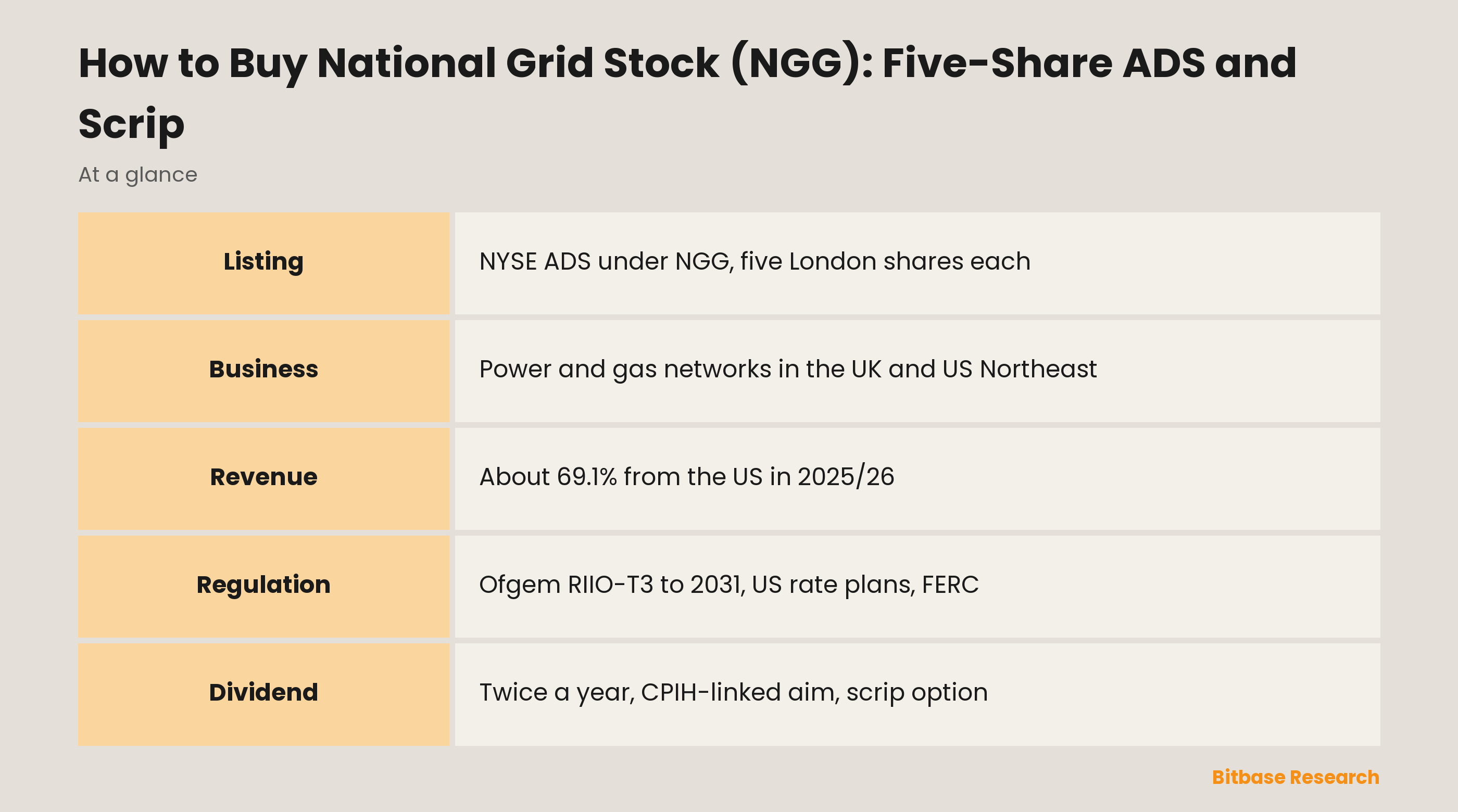
Nothing about buying National Grid stock requires a London account: its American depositary shares trade on the New York Stock Exchange under NGG, so any broker with NYSE access can fill the order in dollars, and each ADS stands for five ordinary shares listed in London under NG. Behind the ticker is a British company whose regulated power and gas networks span the Atlantic, and the United States produced about 69.1% of its revenue in the year to 31 March 2026. This guide covers how those networks earn money, the order steps, what the ADS changes and the risks named in the annual report on Form 20-F.
What Does National Grid Do?
National Grid owns and runs the wires and pipes that carry electricity and natural gas to homes and businesses. Its 20-F reports five business units.
UK Electricity Transmission owns and operates the high-voltage network in England and Wales, which links generators, storage and large customers with the local networks.
UK Electricity Distribution is the former Western Power Distribution, bought on 14 June 2021. It runs the local networks of the East Midlands, West Midlands, South West of England and South Wales, which the company describes as the UK's largest, serving a population of 20 million.
New York covers electricity transmission and distribution and gas distribution upstate and downstate, with 4.2 million customers, through utilities that include Niagara Mohawk, Brooklyn Union Gas and KeySpan Gas East.
New England distributes electricity and gas to 2.3 million customers in Massachusetts and owns transmission lines in Massachusetts, New Hampshire and Vermont.
National Grid Ventures holds six subsea interconnectors linking Britain with France, Belgium, the Netherlands, Denmark and Norway, power stations on Long Island that sell capacity to the Long Island Power Authority under long-term agreements, and an LNG plant in Providence, Rhode Island.
National Grid plc was incorporated in England and Wales on 11 July 2000. Its present shape comes from what it called a strategic pivot towards electricity. It sold its final 20% interest in National Gas Transmission in 2024/25, and the Electricity System Operator left on 1 October 2024 to become the government-owned NESO. In 2025/26 it sold National Grid Renewables to Brookfield Asset Management on 29 May 2025 and Grain LNG to Centrica and Energy Capital Partners on 28 November 2025. Zoë Yujnovich became chief executive on 17 November 2025, a day after John Pettigrew retired from the board.
How National Grid Makes Money
Regulators decide how much revenue each network may collect. In Britain that is Ofgem, through price controls under its RIIO framework ("Revenue = Incentives + Innovation + Outputs"). In the US, state commissions set retail rates in rate cases, and the Federal Energy Regulatory Commission (FERC) regulates interstate transmission, where National Grid's companies use formula rates trued up each year.
| Business unit | What it runs | Share of 2025/26 revenue | Share of group assets |
|---|---|---|---|
| UK Electricity Transmission | High-voltage grid in England and Wales | 15.9% | 34% |
| UK Electricity Distribution | Local networks in the Midlands, South West and South Wales | 11.0% | 18% |
| New York | Electricity and gas utilities | 43.1% | 27% |
| New England | Electricity and gas utilities, regional transmission | 23.6% | 14% |
| National Grid Ventures | Interconnectors, generation, LNG | 6.0% | 4% |
Revenue shares are our calculation from the 20-F segment note; asset shares are the company's figures for regulatory asset value, rate base and other assets.
The columns diverge. The US businesses produced about 69.1% of revenue but about 41.6% of operating profit before exceptional items and remeasurements; the UK produced about 30.9% of revenue and about 58.4% of that profit. One reason is the American bill: "a substantial proportion of our costs, in particular electricity and gas commodity purchases, are pass-through costs," recovered from customers "with no profit."
In Britain, Ofgem sets an allowance for total expenditure, or "totex," and over- or underspending is shared with customers. Part of each year's allowance is recovered at once as "fast money"; the rest is added to the regulatory asset value, which the 20-F calls "effectively the regulatory IOU." Transmission moved onto RIIO-T3 for April 2026 to March 2031; distribution stays on RIIO-ED2 until March 2028.
In 2025/26 capital investment rose by more than 20%, asset growth was 10.9% and underlying earnings per share grew 8% at constant currency, while the dividend rose 3.8%, in line with UK CPIH inflation.
NGG Stock at a Glance
| Item | Detail |
|---|---|
| Exchanges | New York Stock Exchange (ADS); London Stock Exchange (ordinary shares, primary listing) |
| Tickers | NGG in New York; NG in London |
| Security traded in New York | American depositary share; one ADS represents five ordinary shares |
| Depositary | The Bank of New York Mellon |
| Sector | Regulated electricity and gas networks, UK and US Northeast |
| Benchmark index in the 20-F | FTSE 100, for total shareholder return |
| Headquarters | 1-3 Strand, London; incorporated in England and Wales |
| Financial year | Ends 31 March; the year to 31 March 2026 is 2025/26 |
| Reporting | IFRS, in sterling; Form 20-F yearly, results on Form 6-K |
| Dividend policy | Interim and final, aimed to grow in line with UK CPIH; scrip alternative |
| SEC identifiers | CIK 1004315; file number 001-14958 |
Prices and yields are left out; the live quote is on National Grid's stock page on Bitbase.
How to Buy National Grid Stock
The two lines are linked but not interchangeable: London trades single shares in pence, New York trades five-share ADSs in dollars. For the New York route:
1. Choose a broker with NYSE access, or one that also deals in London if you want the ordinary shares.
2. Open and verify the account, including the tax forms a broker needs before paying dividends.
3. Fund it, comparing the currency conversion rate as well as the commission.
4. Find the correct listing. The 20-F cover registers five National Grid securities on the NYSE: the ADS (NGG), three series of notes (NGG28, NGG33, NGG34) and the ordinary shares, footnoted "Not for trading, but only in connection with the registration of American Depositary Shares." Buy NGG.
5. Set the order type. Market orders take the next available price; limit orders cap it but may go unfilled.
6. Size it. Ten ADSs carry the economics of fifty London shares; fractional ADSs depend on the broker.
What the ADS changes. The Bank of New York Mellon is depositary under a deposit agreement amended and restated on 23 May 2013. Ordinary shareholders and ADS holders alike "receive dividends" and "can vote at general meetings." The depositary charges for issuing and cancelling ADSs and may take a fee per ADS from each cash dividend. Ratios vary by company: one Shell ADS represents two shares, while AstraZeneca ended its ADR programme and listed its ordinary shares directly on the NYSE on 2 February 2026.
Dividends and scrip. Dividends are declared in pence per share, and the 20-F also gives the amount per ADS in dollars. Holders can take new shares instead of cash through the scrip scheme, with separate election deadlines for ADR holders; for the 2025/26 final dividend the company announced new ADRs under those terms. Of the dividends paid during 2025/26, about 30.0% by value went out as shares.
Tax and stamp duty. The 20-F's tax summary covers US holders only: "The UK does not currently impose a withholding tax on dividends paid to US Holders." Anyone else should ask a broker or tax adviser. No UK stamp duty is due on acquiring existing ADSs if the transfer papers are signed and kept outside the UK; buying ordinary shares through CREST generally costs 0.5% in stamp duty reserve tax, and depositing shares to create ADSs can trigger 1.5%, which the depositary passes on.
Through a fund. Whether an index or utilities fund holds the shares is stated in its published holdings.
What Moves NGG Stock
British price controls. RIIO-T3 sets transmission revenue until March 2031, and extra funding for connections and reinforcements comes through reopeners, so Ofgem's reopener decisions also shape revenue. Distribution is next: National Grid plans to send Ofgem its final ED3 business plan in December 2026.
US rate cases. New York regulators approved a three-year plan for Niagara Mohawk in August 2025 and one for the downstate gas companies in August 2024. The Massachusetts electric companies have been on a five-year plan since 1 October 2024, and Boston Gas filed a new rate case on 16 January 2026.
FERC. In March 2026 FERC set a lower base return on equity for the New England transmission owners and ordered refunds with interest. National Grid says it will challenge the order; its October 2026 pre-close update cited "the one-off impact of the FERC RoE judgement in the second half of FY26."
Funding and share count. The 20-F lists "retained operating cash flows, use of scrip dividend programme and issuances of senior and hybrid debt securities" as funding, plus the 2024 rights issue. Scrip lifted shares in issue by about 1.3% in 2025/26, and the company bought back none, saying it does not expect to "while delivering strong asset growth."
Data centres. In July 2026 National Grid Ventures agreed to take a 35% interest in Joulent, which develops contracted power and high-voltage infrastructure for large US users. Its first project, in West Texas and owned 50/50 with Chevron, would supply a Microsoft-operated data centre campus under a 20-year contract, targeting first power in 2028. The company says such returns can exceed "National Grid's regulated returns," but they rest on contracts, not a price control.
Sterling and the dollar. National Grid reports in pounds while most revenue is earned in dollars, and NGG trades in dollars on a dividend set in pence. That mix sets it apart from a single-country utility such as NextEra Energy, whose regulated arm, Florida Power & Light, serves Florida.
The Downside Cases in National Grid's 20-F
The Risk Factors section opens with law and regulation; these entries matter most to a shareholder:
Regulation and politics. "Changes in law or regulation, or decisions by governmental bodies or regulators and increased political and economic uncertainty, could adversely affect us in a material way." The filing contrasts US federal "tariffs or its focus on natural gas and pausing of offshore wind leasing" with a UK where the energy transition "remains at the forefront of government policy," and warns that "increasing political focus on issues of affordability could also affect us."
Project delivery. Capital projects depend on "availability of supplies and personnel, cost and scheduling oversight, and regulatory requirements, approvals and consents"; the British ASTI transmission projects "will require an increase in the annual level of capital investment over the next decade."
Networks and cyber. "Cyber or physical security breaches may impact our ability to operate our networks," and major storms are listed among events largely outside its control. In 2025/26 Storm Goretti, one of the worst on record to hit the South West in the company's words, cut power to customers there.
Funding. "An inability to access capital markets on commercially acceptable terms could affect how we maintain and grow our businesses." Regulatory rules can also restrict National Grid plc and some subsidiaries from certain transactions, "including paying dividends."
Currency. US results must be translated "into sterling (our reporting currency)," so dollar moves change reported figures.
For ADS holders, the dividend also passes through a currency conversion and a depositary fee, and each scrip issue leaves cash takers with a slightly smaller share of the company.
Researching NGG Through Its Own Filings
National Grid files with the SEC under CIK 1004315. The 2025/26 Form 20-F was filed on 3 June 2026; results arrive on Form 6-K, with full-year results on 14 May 2026 and half-year results set for 5 November 2026. In the 20-F, the segment and revenue notes give figures by business unit, "The business in detail" explains each price control and rate plan, and "Shareholder information" covers the ADS, scrip, tax and stamp duty. Check whether a figure is "underlying," which excludes exceptional items, timing differences and some other items, or statutory IFRS, and remember that sold businesses count only until their sale dates. Quotes for other US-listed companies are on Bitbase's US stock list.
National Grid Stock FAQ
How many National Grid shares does one NGG ADS represent?
Five. Each NYSE ADS represents five of the ordinary shares that trade under NG in London; it is priced in dollars, with The Bank of New York Mellon as depositary.
Is National Grid a British or an American company?
British: incorporated in England and Wales, based in London, with its primary listing in London and accounts in sterling. Yet about 69.1% of its 2025/26 revenue came from the United States.
Does National Grid pay a dividend?
Yes, twice a year, an interim and a final. The board "aims to grow annual dividend per share (DPS) in line with UK CPIH," and the 2025/26 dividend rose 3.8%. Shareholders and ADR holders can take scrip instead of cash.
Can I buy National Grid stock with crypto?
Not directly. A broker settles NGG in US dollars and the London line in pounds, so any crypto has to be converted into one of those currencies and deposited first. That conversion can itself be a taxable sale.
Does National Grid still run Britain's electricity system operator?
No. The Electricity System Operator separated on 1 October 2024 and became NESO, under government ownership. National Grid still owns the high-voltage network in England and Wales.
What was National Grid's 2024 rights issue?
A share offer to existing holders, announced on 23 May 2024 and completed in June 2024: 7 new shares for every 24 held, "to support the future capital investment plans of the Group," priced at a 33% discount to the ex-dividend closing price on the announcement date.
Conclusion
Buying National Grid takes an account that reaches the NYSE or London, the NGG line rather than a note, and a market or limit order; one ADS equals five shares. The harder part is the business: a British network owner earning most of its revenue in America and most of its profit in Britain, with income set by Ofgem, state commissions and FERC. Read the latest 20-F's regulation section and risk factors before deciding how much weight one utility deserves.
Related reading
Other Bitbase articles on this topic:
- How to Buy American Electric Power Stock (AEP): Nasdaq, 11 States
- How to Buy Constellation Energy Stock (CEG): Nuclear and Calpine
- How to Buy Dominion Energy Stock (D): NextEra Deal, Data Centers
Disclaimer: This article is educational content from Bitbase Academy, provided for information only. It explains what a company or fund does and how the instruments referenced here differ from one another; it does not constitute investment, trading, tax, or financial advice, and it is neither a recommendation nor an endorsement of any security, token, or trading strategy. A tokenized stock is issued by a third party and is designed to give economic exposure to an underlying asset: it is not a share, it carries no shareholder rights, and it depends on the issuer's structure, eligibility rules, and redemption terms, which the issuer can change. Perpetual futures are leveraged derivatives that hold no underlying asset and can be liquidated, and trading hours, product availability, and eligibility differ by instrument and by jurisdiction and can change at any time. Written as of October 2026; verify everything yourself through company filings, the issuer's own documentation, and the product pages of the venue you trade on.
References
[1] National Grid plc Form 20-F for 2025/26: businesses, regulation, risks, ADS and tax (SEC EDGAR) www.sec.gov
[2] National Grid plc Form 20-F for 2025/26, XBRL cover page (SEC EDGAR) www.sec.gov
[3] National Grid plc Form 20-F for 2025/26, XBRL segmental analysis (SEC EDGAR) www.sec.gov
[4] National Grid plc Form 20-F for 2021/22: acquisition of Western Power Distribution (SEC EDGAR) www.sec.gov
[5] National Grid plc Form 6-K, July 2026: investment in Joulent (SEC EDGAR) www.sec.gov
[6] National Grid plc Form 6-K, July 2026: scrip dividend shares and ADRs (SEC EDGAR) www.sec.gov
[7] National Grid plc Form 6-K, October 2026: pre-close update (SEC EDGAR) www.sec.gov





