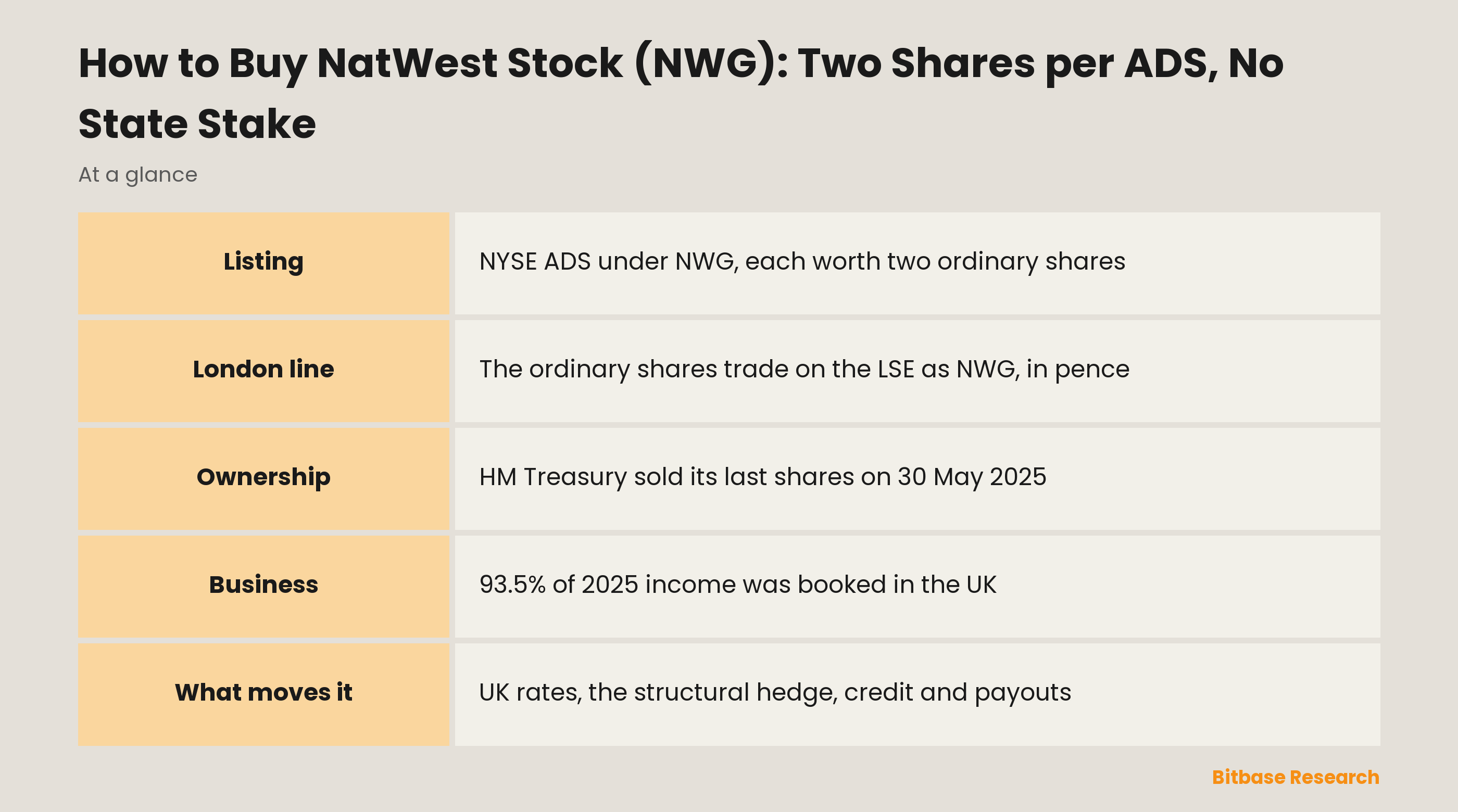
No special account is needed to buy NatWest stock: any broker with access to the New York Stock Exchange can buy NatWest Group plc's American depositary shares (ADSs) under the ticker NWG, each representing two ordinary shares, and the ordinary shares themselves trade on the London Stock Exchange under the same three letters. What has changed is who else is on the register. HM Treasury, which owned about 70.3% of the ordinary share capital after the capital raisings of 2008 and 2009, ceased to be a shareholder on 30 May 2025. Below: how the bank earns its money, which line to buy and what its own filings say could go wrong.
What Does NatWest Do?
NatWest Group is a UK-focused banking group serving more than 20 million customers, from savers and homebuyers to wealthy families and large companies. The listed parent, NatWest Group plc, is registered in Scotland, with its registered office in Edinburgh and its principal executive offices at 250 Bishopsgate in London.
It runs three customer businesses. Retail Banking serves more than 19 million personal customers in the UK with current accounts, savings, mortgages, credit cards and personal loans. Private Banking & Wealth Management serves UK-connected high-net-worth and ultra-high-net-worth clients and includes Coutts. Commercial & Institutional spans Business Banking, Commercial Mid-market and Corporate & Institutions, from start-ups to large corporates and financial institutions; it also runs the markets offering that helps clients manage financial risk, plus full-service banking in the Channel Islands, the Isle of Man, Gibraltar and Luxembourg. Customers know the group as NatWest, Royal Bank of Scotland, Ulster Bank in Northern Ireland and Coutts.
The legal structure follows the UK's ring-fencing rules, which separate everyday banking for individuals and smaller firms from riskier wholesale activity. NatWest Holdings Limited is the parent of the ring-fenced bank, which includes National Westminster Bank Plc and The Royal Bank of Scotland plc. NatWest Markets Plc is the non-ring-fenced bank, and a third subsidiary owns the Jersey-based Royal Bank of Scotland International.
The annual report puts figures on its weight at home: a 16.5% share of UK current account balances on November 2025 CACI data, and on December 2025 Bank of England data a 12.5% share of UK mortgage balances and roughly a fifth of lending to UK small and large businesses. Its business model page bills the commercial franchise as the "Biggest business bank in the UK."
The holding company dates from 1968, when it was incorporated in Scotland as National and Commercial Banking Group Limited. It took the name The Royal Bank of Scotland Group in 1979 and became NatWest Group plc on 22 July 2020. After its 2008 and 2009 investment, the government sold down in stages between 2015 and 2025 through market sales, a trading plan and five off-market purchases by the company itself; its stake went from 9.99% at the end of 2024 to 0% on 30 May 2025.
The map has been redrawn too. NatWest has been withdrawing from the Republic of Ireland in phases, and Ulster Bank Ireland DAC gave up its banking licence in June 2025, continuing as Ulydien DAC. During 2025 the group integrated around one million Sainsbury's Bank customer accounts. On 30 June 2026 it completed the purchase of Evelyn Partners, a wealth manager with more than 180 years of history and owner of the Bestinvest platform, and in the second quarter of 2026 it sold its majority stake in Cushon, a workplace pensions business.
How NatWest Makes Money
Interest dominates. In 2025, net interest income, what the bank earns on loans and bonds minus what it pays on deposits and other funding, made up 77.1% of total income. Net fees and commissions contributed 15.1% and trading income 6.7%; other operating income supplied the small remainder.
That puts the margin at the centre of the story. The 20-F reports a net interest margin of 2.34% for 2025, up from 2.13% in 2024, and credits "deposit margin expansion, as a result of higher customer balances and strong hedge income," together with more lending, growth in managed assets and higher foreign exchange trading revenue. Total income rose 13.2% in 2025, and profit attributable to ordinary shareholders 21.2%.
By business, 2025 looked like this:
| Business | Main customers and products | Share of 2025 total income | Share of 2025 operating profit |
|---|---|---|---|
| Commercial & Institutional | Business banking, mid-market and corporate lending, payments, markets, international banking | 52.9% | 52.7% |
| Retail Banking | Current accounts, savings, mortgages, cards and loans for UK households | 39.0% | 40.5% |
| Private Banking & Wealth Management | Coutts and other private banking, investment management, financial planning | 6.8% | 5.1% |
Shares are of group totals; Central items & other make up the small remainder.
Geography is even more one-sided. The segment note allocates 93.5% of 2025 total income to the UK, 4.5% to Europe and 1.5% to the United States. An NWG ADS is therefore a dollar-priced claim on a British bank with little American business behind it.
The mix is tilting towards fees. On completing the Evelyn Partners deal, NatWest said it would raise group fee income by about 20% before any revenue synergies. By 30 September 2026, assets under management and administration in Private Banking & Wealth Management were 126.3% above their end-2025 level, a jump the half-year report attributes primarily to the acquisition. For the group, total income in the first nine months of 2026 was 9.6% higher than a year earlier, and return on tangible equity for the year to date was 20.2%.
NWG Stock at a Glance
| Field | NatWest Group |
|---|---|
| Issuer | NatWest Group plc, registered in Scotland |
| US security | American depositary shares on the NYSE, ticker NWG |
| ADS ratio | One ADS represents two ordinary shares |
| Ordinary share listing | London Stock Exchange, symbol NWG |
| ADS depositary | The Bank of New York Mellon |
| Former name | The Royal Bank of Scotland Group plc, renamed on 22 July 2020 |
| Sector | Banking: retail, private and commercial |
| Index membership | FTSE 100 |
| Government stake | None since 30 May 2025 |
| Financial year | Calendar year, reported in pounds sterling under IFRS |
| Dividend policy | Interim and final ordinary dividends; guided payout of around 50% of attributable profit, with buybacks on top |
| SEC identifier | CIK 844150; Form 20-F annually, Form 6-K for other announcements |
These fields stay put; the share price, market value and yield do not. For a live quote and chart, open the NatWest stock page on Bitbase.
How to Buy NatWest Stock
Two lines carry the same three letters. On the NYSE, NWG is an ADS priced in US dollars; in London, NWG is the ordinary share, priced in pence. Either way you end up owning part of the same company. The steps:
1. Pick a broker that reaches the market you want. NYSE access covers the ADS; the ordinary shares need a broker trading on the London Stock Exchange. Find out which legal entity keeps your assets and who regulates it.
2. Complete identity and tax checks. For US holders, the 20-F notes that payments can face backup withholding without a correct taxpayer identification number.
3. Fund the account in the trading currency. A conversion spread can cost more than the commission.
4. Confirm the instrument. On a US screen, the description should read American depositary shares of NatWest Group plc. The 20-F cover also registers 19 series of NatWest notes on the NYSE, with symbols such as NWG26 and NWG30A; those are bonds.
5. Choose the order type. A market order fills at the best price on offer; a limit order caps what you pay, which helps when spreads are wide.
6. Size the position. One ADS costs roughly as much as two London shares once pence are converted to dollars. Ask whether your broker offers fractional ADSs.
7. Save the paperwork. Trade confirmations and dividend records support your tax return.
ADS or ordinary shares. The ratio has changed twice since the ADSs were listed in October 2007 at one share each: to 20 shares in November 2008, then to two shares after a sub-division and one-for-ten consolidation in June 2012. A further consolidation in August 2022 kept the ratio but turned every 14 ADSs into 13. Other banks use other ratios: one HSBC ADS stands for five ordinary shares and one Santander ADS for a single share, so multiply before comparing prices. ADS holders are paid dividends in US dollars, minus small per-ADS depositary fees that can be taken from cash distributions. Votes go through the depositary: "You may instruct the depositary to vote the number of deposited shares your ordinary share ADSs represent," the deposit terms say, but only by its deadline.
Stamp duty. According to the 20-F, a transfer of an ADS "executed and retained in the United States" does not create a stamp duty charge, and transfers through DTC do not trigger stamp duty reserve tax. Transfers of the ordinary shares normally attract one of the two.
Tax on dividends. "The company is not required to withhold UK tax at source from dividend payments it makes," the 20-F says; your own country may still tax them. For US holders, NatWest does not believe it was a passive foreign investment company for 2025, and dividends paid to certain non-corporate US holders "may be taxable at the favourable rates" that apply to long-term capital gains.
Through a fund. NatWest is a FTSE 100 member, so UK large-cap index funds generally own it. One example: the holdings file of the iShares MSCI United Kingdom ETF dated 29 October 2026 includes NatWest Group, held via the London line.
What Moves NWG Stock
UK interest rates and the structural hedge. With interest at 77.1% of income, sterling rates run straight into earnings. In 2025 the Bank of England base rate fell from 4.75% to 3.75%, yet NatWest's margin widened. The reason is its structural hedge, interest rate swaps against stable current account and savings balances and against its own equity: as maturing hedges were replaced at higher swap rates, the hedge yield rose to 2.40% in 2025 from 1.77% in 2024. Falling benchmark rates, the 20-F warns, "may adversely affect NatWest Group's net interest margin."
British credit quality. With 93.5% of income booked in the UK, the domestic economy is the main credit risk. Impairments rose in 2025, partly because of the Sainsbury's Bank balances, and the loan impairment rate for the first nine months of 2026 was 21 basis points. Unemployment and house prices are among the inputs to its credit loss models.
Capital and payouts. NatWest targets a common equity tier 1 (CET1) ratio of around 13.0% and guides to ordinary dividends of around 50% of attributable profit. Its third-quarter 2026 statement put the CET1 ratio at 13.5% on 30 September 2026, against a maximum distributable amount (MDA) threshold of 10.3%, the level below which automatic limits on payouts apply. The same statement expects the CET1 part of its Pillar 2A requirement to drop to 1.2% from 1 January 2027, the date on which the final Basel reforms are expected to raise risk-weighted assets. A buy-back run under instructions given on 16 February 2026 was still buying shares in late October 2026; the next buy-back announcement is expected with the full-year 2026 results.
The wealth bet. NatWest estimated that buying Evelyn Partners would cost about 130 basis points of CET1, in return for more fee income and planned cost savings.
A register without a forced seller. Until May 2025, the state was a steady source of supply, selling through its trading plan and to the company directly. Now there is no state seller, and buybacks take place in the open market; the company intends to cancel the shares it repurchases.
Five Things That Could Hurt NWG Shareholders
The 20-F's risk factors fill more than 20 pages. These five bear most directly on someone holding the shares:
Concentration in one economy. "As a principally UK-focused banking group, NatWest Group is affected by global economic and market conditions and is particularly exposed to those conditions in the UK." Uncertain and volatile conditions, it adds, "can create a challenging operating environment for financial services companies such as NatWest Group."
Rates and deposit competition. Beyond margin pressure from lower rates, the filing notes that "customers may make deposit choices that provide them with higher returns than those being offered by NatWest Group," and that the bank may be slow to answer a rate change with competitive products, which could reduce net interest income.
Resolution powers. UK authorities have five stabilisation options for a failing bank, and their use "may result in, for example, the cancellation, transfer or dilution of ordinary shares."
Payouts are not guaranteed. "NatWest Group plc is a non-operating holding company," so its dividends depend on cash from subsidiaries and on capital rules. Any breach of the combined buffer requirement "may necessitate NatWest Group plc reducing or ceasing discretionary payments to shareholders (including payments of dividends) and buybacks."
Deals that disappoint. NatWest "may not fully realise the expected benefits and value" from acquisitions and other transactions "in the time, or to the degree, anticipated, or at all," the 20-F says. Evelyn Partners is the test case.
Beyond the company itself, owning a single bank stock adds two more layers. Lenders are exposed to swings in confidence, and banking stress and liquidity squeezes tend to travel across the whole sector. And because NatWest reports in pounds and declares dividends in pence, a dollar-based holder of the ADS carries sterling exchange-rate risk on both price and payout.
How to Research NWG Yourself
NatWest files with the SEC under CIK 844150; EDGAR still shows the old name, Royal Bank of Scotland Group plc, on filings made before 22 July 2020. The annual report comes on Form 20-F, filed for 2025 on 17 February 2026. Everything else arrives on Form 6-K: results, weekly buy-back reports, monthly voting-rights totals, quarterly Pillar 3 capital disclosures and bond redemption notices.
In 2026, full-year 2025 results came on 13 February, first-quarter results on 1 May, interim results on 31 July and the third-quarter interim management statement on 30 October. Each set is also posted at natwestgroup.com/results.
Inside the 20-F, the segment performance pages give income and profit by business, the risk factors section the threats, the capital section the requirements and buffers, and the shareholder information pages the ADS ratio history, dividend calendar and tax summary. Two traps: Private Banking was renamed Private Banking & Wealth Management in the second quarter of 2025, and Evelyn Partners is consolidated only from 30 June 2026, so 2026 wealth figures do not compare cleanly with earlier years.
The NWG page linked above carries live prices, and Bitbase's US stock pages cover other US-listed companies.
NatWest Stock FAQ
Is NatWest still owned by the UK government?
No. Sales under HM Treasury's trading plan cut its holding from 9.99% at the end of 2024 to 0%, and the 20-F records that it "ceased to be a shareholder of the company on 30 May 2025."
How many NatWest shares does one NWG ADS represent?
Two. Each ADS on the NYSE represents two ordinary shares held by The Bank of New York Mellon as depositary. In London the ordinary shares trade one by one under the same symbol, NWG, in pence.
Does NatWest pay a dividend?
Yes, twice a year: an interim dividend announced with the half-year results and a final dividend approved at the annual general meeting. Total dividends for 2025 were up 51% on 2024, and the company guides to paying out around 50% of attributable profit. ADS holders are paid in US dollars.
Can I buy NatWest stock with crypto?
Not directly. NatWest ADSs and ordinary shares are bought through a broker and settle in US dollars or pounds sterling. Crypto would first have to be sold for one of those currencies and the cash moved to the brokerage account, and in many countries that sale is itself a taxable event.
Is NatWest the same company as Royal Bank of Scotland?
As a listed company, yes: The Royal Bank of Scotland Group plc was renamed NatWest Group plc on 22 July 2020. The Royal Bank of Scotland plc lives on as one of the group's banks, inside the ring-fenced bank next to National Westminster Bank Plc.
Conclusion
The mechanics are short: buy the dollar-priced NYSE ADS, worth two ordinary shares, or the pence-priced London share, both under NWG. The bank behind them takes longer to judge, being almost wholly British, tied to UK rates and credit, free of its state shareholder and in the middle of absorbing a large wealth manager. Check the latest 20-F and the 6-Ks filed since before deciding how much of a single bank belongs in your portfolio.
Related reading
Other Bitbase articles on this topic:
- How to Buy Deutsche Bank Stock (DB): Same Share as Frankfurt's DBK
- How to Buy HDFC Bank Stock (HDB): Three Shares per ADS, No Vote
- How to Buy ICICI Bank Stock (IBN): ADS Voting and Indian GAAP
Disclaimer: This article is educational content from Bitbase Academy, provided for information only. It explains what a company or fund does and how the instruments referenced here differ from one another; it does not constitute investment, trading, tax, or financial advice, and it is neither a recommendation nor an endorsement of any security, token, or trading strategy. A tokenized stock is issued by a third party and is designed to give economic exposure to an underlying asset: it is not a share, it carries no shareholder rights, and it depends on the issuer's structure, eligibility rules, and redemption terms, which the issuer can change. Perpetual futures are leveraged derivatives that hold no underlying asset and can be liquidated, and trading hours, product availability, and eligibility differ by instrument and by jurisdiction and can change at any time. Written as of October 2026; verify everything yourself through company filings, the issuer's own documentation, and the product pages of the venue you trade on.
References
[1] NatWest Group plc, Form 20-F for 2025 (SEC EDGAR) www.sec.gov
[2] NatWest Group, 2025 Annual Report and Accounts, filed with the 20-F www.sec.gov
[3] NatWest Group, description of registered securities (2025 20-F) www.sec.gov
[4] NatWest Group, Q3 2026 interim management statement, 30 October 2026 (Form 6-K) www.sec.gov
[5] NatWest Group, interim results 2026, 31 July 2026 (Form 6-K) www.sec.gov
[6] NatWest Group, agreement to acquire Evelyn Partners, 9 February 2026 (Form 6-K) www.sec.gov
[7] NatWest Group, completion of the Evelyn Partners acquisition, 1 July 2026 (Form 6-K) www.sec.gov
[8] NatWest Group, transaction in own shares, 30 October 2026 (Form 6-K) www.sec.gov
[9] iShares MSCI United Kingdom ETF, holdings as of 29 October 2026 www.ishares.com





