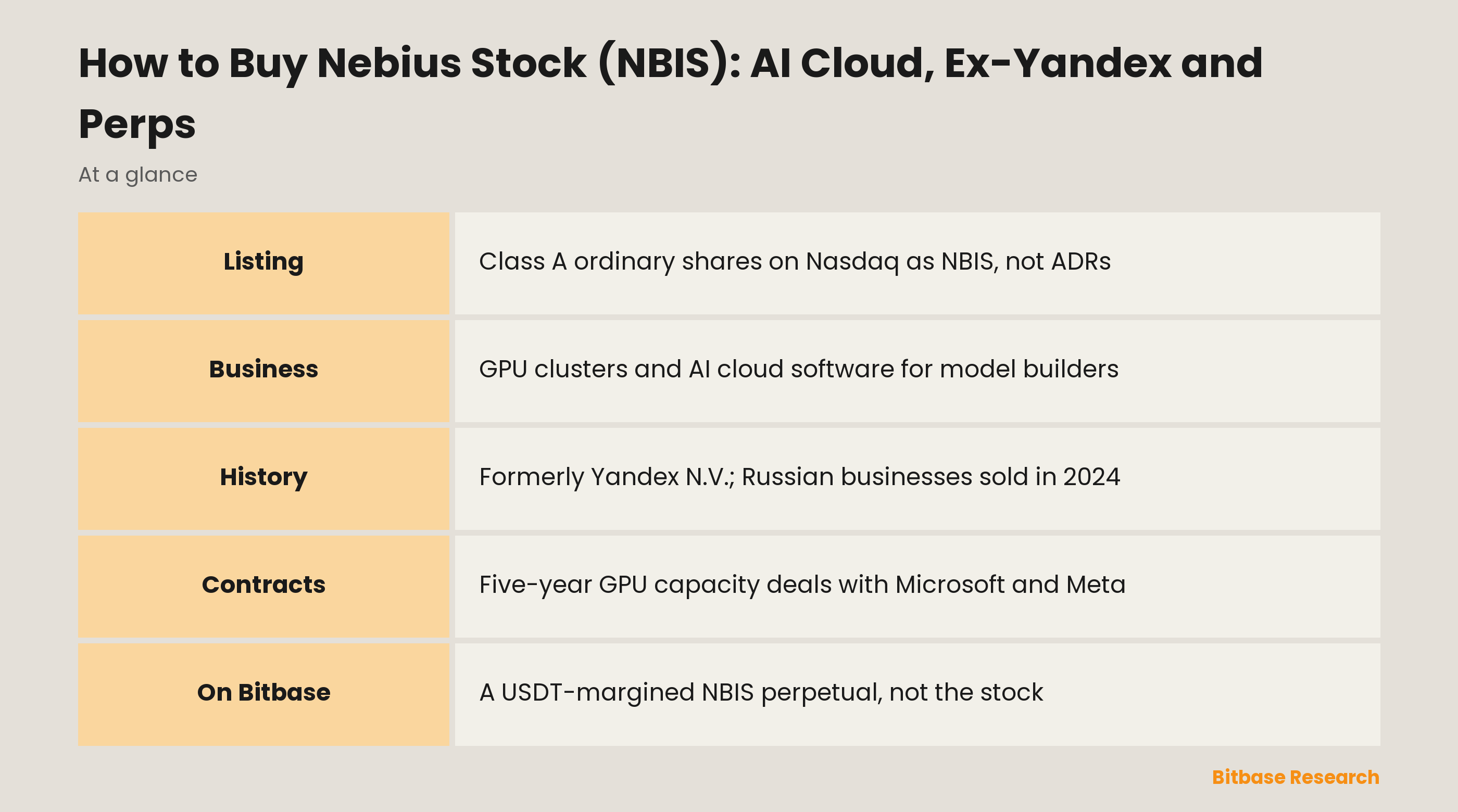
One class of Nebius Group shares is listed in the United States: the Class A ordinary shares, quoted on the Nasdaq Global Select Market as NBIS, so a broker that sells US-listed stocks can fill your order. The Amsterdam company used to be Yandex N.V.; after selling every one of its Russian businesses in 2024, it now rents GPU clusters and AI software to model builders and has five-year capacity contracts with Microsoft and Meta. Bitbase also lists an NBIS perpetual margined in USDT, which follows the share price without holding any shares.
What Does Nebius Do?
The annual report opens with a one-line description: "Nebius, a global AI cloud platform, delivers a unified full-stack AI cloud." Customers rent the compute they need to train and serve AI models: clusters of NVIDIA GPUs, storage, networking and managed software on top. Nebius designs its own servers and racks, which the filing says can run at up to 40°C so that air cooling is enough for current chips. Above the hardware sit virtual machines, managed Kubernetes and Nebius Token Factory, an inference service launched in November 2025 and billed per token rather than per GPU hour.
The footprint is growing fast. During 2025 the company owned and operated one data center, in Mäntsälä, Finland, signed a build-to-suit facility in Vineland, New Jersey, and leased co-location space in Kansas City, the UK, Israel, France and Iceland. In February 2026 it announced nine further sites across seven locations in Missouri, Alabama, Oklahoma, Minnesota, France, the UK and Israel, lifting contracted power above 2 gigawatts. Active power, the capacity actually drawn by IT equipment and earning revenue, was about 170 megawatts at the end of 2025.
Two smaller units keep their own brands. Avride builds self-driving cars and sidewalk delivery robots from Austin, Texas, and its autonomous cars began carrying Uber riders in Dallas in December 2025. TripleTen sells online courses that retrain people for technology jobs, mainly in the US and Latin America. Nebius also holds minority stakes in ClickHouse, a database company, and Toloka, an AI data company, both spun out of the group.
The listing is far older than the brand. Class A shares have traded on Nasdaq since 2011, when the company was Yandex N.V. A March 2022 filing records that on 28 February 2022 Nasdaq and the New York Stock Exchange "suspended the trading in securities of a number of companies with material operations in Russia, including Yandex N.V." In February 2024 the company agreed to sell all of the group's businesses in Russia and certain international markets to a purchaser consortium, with the final closing in July 2024. According to the 20-F, those businesses "constituted more than 95% of the group's consolidated revenues, assets and employees at that time." The legal name became Nebius Group N.V. in August 2024, and trading resumed on 21 October 2024 under NBIS. Arkady Volozh, who founded the company and ran it from 2000 to 2022, returned as chief executive in August 2024.
How Nebius Makes Money
The 20-F reports three segments: the Nebius AI cloud, Avride and TripleTen. Total revenue rose 479% in 2025 from a small base. The AI cloud grew 603% and supplied about 90% of segment revenue before intercompany eliminations; TripleTen grew 88% on higher enrollment, and Avride contributed little.
Customers pay for GPU capacity, storage and services, on demand or under longer reservations, and the filing notes that "a substantial portion of the Group's revenue is collected on a prepaid basis." Large contracts have reshaped the mix. Under an agreement effective 7 September 2025, Nebius provides Microsoft with dedicated GPU capacity at Vineland for five years. A Meta agreement dated 1 November 2025 covers dedicated clusters for five years, delivered in November 2025 and February 2026. A second Meta agreement, signed on 13 March 2026, sets up five-year orders with deployments expected in tranches through the first half of 2027; one order obliges Meta to buy capacity on certain clusters that Nebius fails to sell to other customers.
Concentration follows from deals of that size. Two unnamed customers made up 25% and 15% of 2025 revenue, and customers located in the United States contributed about 64%, with the UK at about 26%. Of the contracted revenue not yet recognized at the end of 2025, the company expected 28% to be recognized in the 24 months to December 2027 and 39% in the two years after that.
Profit has not caught up. The 20-F says the core business "is capital-intensive and currently not profitable." Loss from operations widened about 53% in 2025 as total operating costs more than doubled, and net income from continuing operations turned slightly positive only because of a gain on revaluing equity investments.
NBIS Stock at a Glance
| Item | Detail |
|---|---|
| Exchange | Nasdaq Global Select Market |
| Ticker | NBIS |
| Listed class | Class A ordinary shares, one vote each |
| Unlisted class | Class B shares, ten votes each, held mostly by insiders and large early holders |
| Form of listing | Ordinary shares listed directly, not ADRs |
| Incorporated in | The Netherlands, as a public company with limited liability (N.V.) |
| Headquarters | Amsterdam; registered office at Schiphol |
| Annual report | Form 20-F; interim reports on Form 6-K |
| Accounting standard | US GAAP |
| Fiscal year end | 31 December |
| Reportable segments | Three: Nebius AI cloud, Avride, TripleTen |
| Former name | Yandex N.V., until August 2024 |
| On Nasdaq since | 2011 |
| Dividend policy | No dividends intended for the foreseeable future |
Live quotes and charts sit on the Nebius stock page on Bitbase.
How to Buy Nebius Stock
The route through a broker looks like this:
1. Choose a broker with Nasdaq access that takes clients from your country of residence.
2. Open and verify the account. Brokers usually ask non-US clients for a Form W-8BEN.
3. Add money. Funding in a currency other than the US dollar usually costs a conversion spread or fee.
4. Search for NBIS and check that the listing reads Nebius Group N.V. Class A ordinary shares.
5. Set the order. A market order executes at the current price; a limit order names the highest price you accept and might never fill. Many platforms also offer fractional shares.
A Dutch company on Nasdaq is often assumed to trade as an ADR, but NBIS does not. The Class A ordinary shares themselves are registered on Nasdaq and priced in dollars, so there is no depositary bank and no conversion ratio. Nebius files as a foreign private issuer, hence a 20-F rather than a 10-K. Dividends are not expected, though the 20-F notes that any dividend on Class A shares would generally face Dutch dividend withholding tax at 15%. The company also cannot rule out being classified as a passive foreign investment company in a given year, which carries unfavorable US tax treatment for US holders. Treat this as general information, not tax advice.
Funds offer an indirect path, but do not assume one owns NBIS; open its current holdings file and search for Nebius first.
Trading NBIS on Bitbase
The NBIS perpetual futures contract on Bitbase is collateralized and settled in USDT and tracks the price of Nebius Class A shares. It is a price bet, not ownership: no share is bought in your name and you cannot vote the stock. The contract has no expiry. You can open a long, or sell first to go short, decide whether to use leverage, and keep trading overnight and at weekends while Nasdaq is shut.
Two mechanics set it apart. Periodic funding payments run between long and short holders, paid by the side with more open demand, and they keep the perpetual anchored to the stock; the longer a position stays open, the more those payments add up. A position whose margin is used up gets liquidated, with the mark price, not the latest trade, deciding when. Nebius tends to announce contracts, financings and acquisitions by press release, and news released after the Nasdaq close can move the perpetual before the shares reopen. The guide to stock perpetuals covers this at greater length.
Left out on purpose: the funding interval and formula, margin tiers, maximum leverage, and how mark price and funding are treated while the stock market is closed. Those live in the NBIS contract rules. More contracts on listed companies are collected on the TradFi page.
What Moves NBIS Stock
Delivering hyperscaler capacity on schedule. The Microsoft and Meta agreements give those customers service credits or the right to terminate individual tranches if delivery slips or availability falls short.
Power and sites. The distance between more than 2 gigawatts contracted and roughly 170 megawatts active is the build-out still to come. Grid connections and construction at owned sites such as Missouri and Alabama decide how quickly it closes.
GPU supply. Nebius depends on a limited number of suppliers for advanced hardware, and the 20-F reports that its 2025 capital spending was concentrated with two suppliers. Its pitch rests on being early with each new NVIDIA generation, so allocation and delivery timing matter.
Financing and dilution. Convertible notes issued in June and September 2025 and March 2026 can convert into roughly 66 million Class A shares, and a public equity offering was completed in September 2025. NVIDIA bought a pre-funded share warrant in March 2026. Later in 2026 came a secured loan facility with MUFG in July, convertible notes due 2030 and 2034 in August, and a secured bridge loan from Citibank in October. Each raise changes the dilution and interest picture.
AI demand and rivals. The 20-F names CoreWeave, Crusoe and Lambda as AI-focused competitors, and AWS, Google Cloud, Microsoft Azure and Oracle as general clouds scaling their own AI offerings; the CoreWeave guide covers the closest listed comparison.
Avride and the stakes. Uber and Nebius agreed in October 2025 to invest in Avride, and the company is exploring further outside investment, "including transactions in which we may cede control." Revaluing the ClickHouse or Toloka stakes can also swing net income.
Weak Spots in the Nebius Growth Plan
Spending ahead of demand. If customers do not use the compute being built, the company "would not realize the expected returns on our expansion efforts," the filing warns.
Large contracts, little track record. Nebius acknowledges "limited experience in delivering, implementing and managing such contracts at scale," while two customers already account for a large slice of revenue.
Cheaper models. AI models needing "less computation power than earlier models" could reduce or change demand for what it sells.
Control sits with insiders. At 31 March 2026, the CEO, directors, employees and other pre-IPO holders controlled about 59% of the votes, and a family trust established by the CEO held about 52% of the votes with an economic interest of about 11%. Nebius is a controlled company under Nasdaq rules, so outside shareholders have limited influence.
The Yandex legacy. The 20-F states that the company does not "have any customers, suppliers or business partners in Russia," yet warns that its history could still mean "more protracted client on-boarding and 'know-your-customer' processes."
Leverage in the perpetual. Borrowed exposure enlarges losses, funding keeps accruing, and a sharp opening move on Nasdaq can carry the price past your liquidation level.
Following Nebius Through Its 20-F and 6-K Filings
Nebius files under CIK 1513845, the same SEC number that holds the Yandex-era filings. The 20-F for 2025 was filed on 30 April 2026; an amendment on 22 May 2026 only added the company's clawback policy. Quarterly figures arrive on Form 6-K: second-quarter 2026 results and the CEO's letter to shareholders were furnished on 12 August 2026. Financings, acquisitions and partnerships, such as the Palantir partnership announced on 8 September 2026, also appear as 6-K reports.
Inside the 20-F, Item 4 lists the data center sites and the four ways Nebius builds or leases them, the operating review gives revenue by segment, and the "Material Contracts" section summarizes the Microsoft, Meta and NVIDIA agreements. The notes show revenue by customer location and the customer concentration table. As a foreign private issuer, Nebius reports less often than a US company and follows Dutch practice for proxy statements at general meetings.
Nebius Stock FAQ
Is Nebius the same company as Yandex?
It is the same legal entity under a new name, not the same business. Yandex N.V. sold all of its businesses in Russia and certain international markets in 2024, renamed itself Nebius Group N.V. in August 2024, and resumed trading on Nasdaq as NBIS on 21 October 2024.
Is NBIS an ADR?
No. NBIS represents Class A ordinary shares of a Dutch N.V., listed directly on Nasdaq, and the company reports on Forms 20-F and 6-K instead of 10-K and 10-Q.
What is the difference between Nebius Class A and Class B shares?
Class A shares carry one vote each and are the only class listed. Class B shares carry ten votes each and are not listed. Each Class B share can be converted into one Class A share and one Class C share, and the company intends to repurchase Class C shares promptly after they are issued.
Does Nebius pay a dividend?
No. The 20-F says the company intends to retain funds and future earnings for the business and does not anticipate paying dividends on Class A shares in the foreseeable future.
Can I buy Nebius stock with crypto?
Not directly. Brokers take cash, so coins must be sold for dollars or another currency before you can buy NBIS shares. On Bitbase, USDT can be used to trade the NBIS perpetual, which gives price exposure only: no share behind it, no vote, and the position can be liquidated. For ways to move from crypto to actual shares, see buying stocks with crypto.
Conclusion
Nebius is a young AI cloud business inside an older listed shell: a Nasdaq listing from 2011, a Dutch legal home, and a founder whose trust holds most of the votes through unlisted Class B shares. Its value hinges on turning hyperscaler contracts and gigawatts of contracted power into delivered, paid-for capacity without too much dilution along the way. NBIS Class A shares can be bought like any Nasdaq stock, and the Bitbase perpetual follows the same price with funding costs and liquidation risk in place of ownership.
Related reading
Other Bitbase articles on this topic:
- How to Buy Cognizant Stock (CTSH): Banks, Health Care and India
- How to Buy Corpay Stock (CPAY): Fuel Cards to Cross-Border FX
- How to Buy Fiserv Stock (FISV): Clover, Bank Tech and a New Ticker
- How to Buy Verisk Stock (VRSK): Insurance Data and AccuLynx
Disclaimer: This article is educational content from Bitbase Academy, provided for information only. It explains what a company or fund does and how the instruments referenced here differ from one another; it does not constitute investment, trading, tax, or financial advice, and it is neither a recommendation nor an endorsement of any security, token, or trading strategy. A tokenized stock is issued by a third party and is designed to give economic exposure to an underlying asset: it is not a share, it carries no shareholder rights, and it depends on the issuer's structure, eligibility rules, and redemption terms, which the issuer can change. Perpetual futures are leveraged derivatives that hold no underlying asset and can be liquidated, and trading hours, product availability, and eligibility differ by instrument and by jurisdiction and can change at any time. Written as of November 2026; verify everything yourself through company filings, the issuer's own documentation, and the product pages of the venue you trade on.
References
[1] Nebius Group Form 20-F for 2025 (SEC EDGAR) www.sec.gov
[2] Yandex N.V. Form 6-K, March 2022: trading suspension (SEC EDGAR) www.sec.gov
[3] Yandex N.V. Form 6-K, July 2024: divestment completed (SEC EDGAR) www.sec.gov
[4] Nebius Group Form 6-K, October 2024: Nasdaq trading resumes (SEC EDGAR) www.sec.gov
[5] Nebius Group Form 6-K, August 2026: second-quarter results (SEC EDGAR) www.sec.gov
[6] Nebius Group Form 6-K, October 2026: Citibank bridge facility (SEC EDGAR) www.sec.gov





