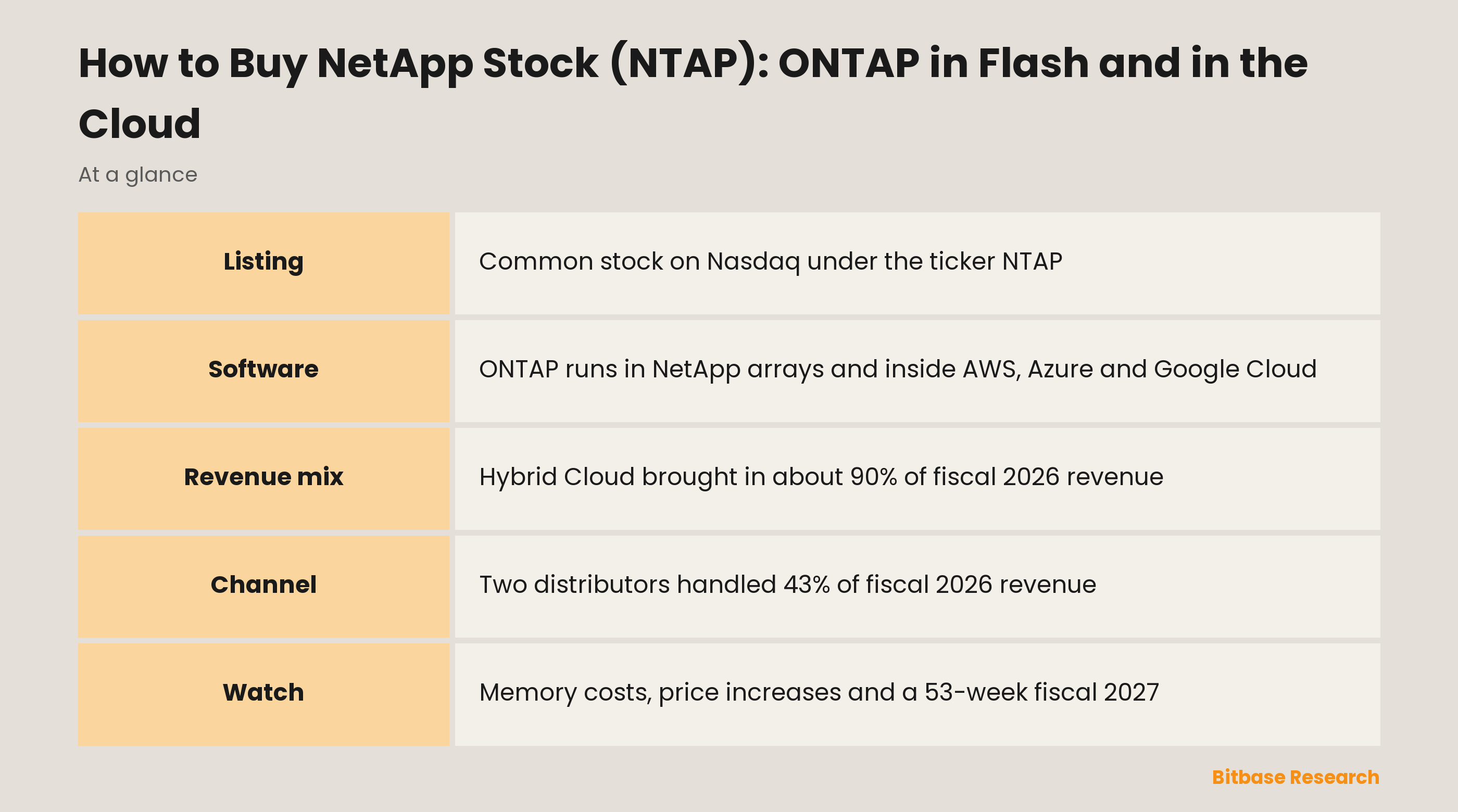
From almost any brokerage account that reaches US exchanges, NetApp stock can be bought on Nasdaq under the ticker NTAP, as the common stock itself rather than a depositary receipt. The company sells one storage operating system, ONTAP, in two forms: inside its own all-flash arrays, and as a native service on AWS, Microsoft Azure and Google Cloud. Two distributors handled 43% of its fiscal 2026 revenue. What follows covers the business, the steps of a purchase and the pressures its filings describe, from memory chip costs to a 53-week fiscal year.
What Does NetApp Do?
NetApp builds the systems and software that companies use to store, protect and move their data. The 10-K sums up its history in one line: "Since our founding in 1992, we have transformed from a pioneering storage hardware provider into a software-driven, cloud-centric data infrastructure company." EDGAR still records its earlier name, Network Appliance, used until 2008.
The common thread is ONTAP, which the annual report calls "our foundational technology." It handles file, block and object storage and carries Snapshot copies, SnapMirror replication and an Autonomous Ransomware Protection feature that runs in the storage layer itself.
The hardware comes in several families. AFF A-Series and C-Series are all-flash systems, tuned for low latency and for capacity respectively; ASA arrays are all-flash systems for block storage; AFX is a disaggregated design aimed at AI workloads; FAS covers hybrid flash and disk; and StorageGRID is object storage that speaks the Amazon S3 interface.
The cloud side is what sets NetApp apart from most storage vendors. Its storage runs as first-party services inside the largest public clouds: Azure NetApp Files on Microsoft Azure, Amazon FSx for NetApp ONTAP on AWS and Google Cloud NetApp Volumes on Google Cloud. Cloud Volumes ONTAP lets customers run the software themselves, and Keystone delivers NetApp storage as a subscription.
NetApp sold Spot by NetApp, its cloud cost-optimization business, to Flexera in fiscal 2025, and on 16 July 2026 it acquired DataPelago, which the 10-Q describes as a company working to "eliminate data processing bottlenecks for AI and analytics workloads." The NetApp AI Data Engine prepares stored data for AI pipelines, with NVIDIA among the reference-architecture partners.
NetApp does not run its own factories: contract manufacturers in the United States, Mexico, Europe and Asia assemble its systems.
How NetApp Makes Money
Fiscal 2026 ran to 24 April 2026. Net revenues rose about 5% that year, and the split below comes from the income statement and the segment note:
| Revenue line | Share of fiscal 2026 net revenues | Change from fiscal 2025 | What it covers |
|---|---|---|---|
| Product | 46% | +5% | All-flash and hybrid systems sold with ONTAP, plus add-on software |
| Support | 38% | +5% | Hardware and software support contracts on installed systems |
| Professional and other services | 6% | +15% | Deployment work, training and Keystone subscriptions |
| Public cloud | 10% | +3% | Cloud storage, data services and operational services |
The first three lines make up the Hybrid Cloud segment, about 90% of revenue; the fourth is the Public Cloud segment, about 10%. Within Hybrid Cloud, all-flash systems and their services brought in 67% of segment revenue, up 11% on the year, while hybrid-flash and other revenue slipped 4%. The 10-K says the slower cloud growth in fiscal 2026 reflects "the loss of revenue from our Spot by NetApp business which we sold in the fourth quarter of fiscal 2025."
The two segments earn very different margins. Segment gross profit came to about 84% of Public Cloud revenue against about 70% for Hybrid Cloud, before costs NetApp does not allocate to either. For the company as a whole, gross profit was about 71% of revenue, income from operations about 24%, and research and development absorbed about 14%. Net income grew about 8%.
Most sales do not go straight from NetApp to the end customer. "During fiscal 2026, sales through our indirect channels represented the majority of our net revenues," the 10-K says, and two distributors, identified only as Customer A and Customer B, accounted for 22% and 21% of revenue. Customers in the Americas produced about 51% of revenue, Europe, the Middle East and Africa about 34% and Asia Pacific about 15%; sales to customers inside the United States alone were about 48%.
The company also reports "a sequential decline in revenues in the first quarter of our fiscal year," as the sales force rebuilds its pipeline and European orders slow in summer.
NTAP Stock at a Glance
| Feature | NTAP |
|---|---|
| Exchange | Nasdaq (The NASDAQ Stock Market LLC) |
| Ticker | NTAP |
| Security | Common stock, the only class registered under Section 12(b) |
| Sector | Enterprise data storage and data management |
| Segments | Hybrid Cloud and Public Cloud |
| Index membership | S&P 500 |
| Headquarters | San Jose, California |
| Incorporated | Delaware |
| Fiscal year | 52 or 53 weeks, ending on the last Friday in April |
| Shareholder returns | Quarterly cash dividend and an open-ended share repurchase program |
| SEC identifier | CIK 1002047 |
None of this tells you the current price, which moves all day; quotes, charts and market value sit on the NetApp stock page on Bitbase.
How to Buy NetApp Stock
NetApp files a 10-K as a US company, so no ADR is involved: the shares on Nasdaq are the ones the company issued. At a broker, the steps are:
1. Find a broker that lists Nasdaq stocks. Investors outside the United States can use a local firm with US market access or an international broker; check which legal entity holds your account and who supervises it.
2. Fill in the tax paperwork. The IRS tells foreign investors to give Form W-8 BEN "to the withholding agent or payer if you are a foreign person and you are the beneficial owner of an amount subject to withholding." Brokers usually collect it while opening the account.
3. Deposit funds. The shares are priced in US dollars, so other currencies are converted on the way in, at a rate worth comparing.
4. Search for NTAP. The result should read NetApp, Inc. common stock on Nasdaq. The 10-K cover lists that single class and nothing under Section 12(g).
5. Choose the order type. FINRA notes that brokerage firms "typically enter your order as a market order unless you specify otherwise," and that "a buy limit order can be executed only at or below the limit price." Regular trading on US exchanges runs from 9:30 a.m. to 4 p.m. Eastern Time.
6. Decide between whole and fractional shares. Some brokers let you buy US shares in dollar amounts. FINRA warns that "you can't transfer fractional shares to another brokerage firm," so a fractional position has to be sold before the account moves.
Withholding on dividends. For most US-source income paid to foreign persons, the IRS withholding rate is 30%, and a tax treaty between your country and the United States can lower it. That is why the W-8 BEN matters: NetApp pays a quarterly dividend, and your home country may tax the same payment again.
Owning it through a fund. State Street's holdings file for SPY, the S&P 500 tracker, listed NetApp Inc on 9 November 2026, so S&P 500 index funds hold NTAP as one small slice of the index.
What Moves NTAP Stock
Memory and component prices. Third-party components make up "a significant portion of our product costs," and the 10-K names NAND flash among the parts that are hard to manage when supply tightens. It also reports "inflationary pressure and supply chain constraints beginning in the second half of fiscal 2026, resulting in increased costs for memory and other components, which have affected our gross margins." The 10-Q for the quarter ended 31 July 2026 says NetApp raised prices in the fourth quarter of fiscal 2026 and again at the start of the second quarter of fiscal 2027, and that it expects costs to "remain elevated, or continue to increase, in the near term."
How fast flash replaces disk. All-flash systems rose to 72% of Hybrid Cloud revenue in that July quarter, from 64% a year earlier, and product revenue grew 51%. The company credits higher all-flash sales, "supported by the price increases we implemented in the fourth quarter of fiscal 2026."
An extra week in fiscal 2027. Fiscal 2027 ends on 30 April 2027 and has 53 weeks, with 14 of them in the first quarter. Total revenue in that quarter rose 30%, and part of the gain came from the extra week, which the 10-Q says added services revenue. Later quarters compare 13 weeks with 13 weeks again, so slower headline growth then does not by itself mean the business cooled.
Two distributors. With 43% of fiscal 2026 revenue flowing through two distributors, a change in their ordering can show up quickly in NetApp's results. Purchase orders, the 10-K notes, are mostly "cancelable prior to shipment without penalty."
The cloud providers. Public Cloud revenue grew 28% in the July quarter, helped by the extra week. The same providers are also rivals: "We both partner with and compete against cloud service providers through our cloud-based software and services offerings," the 10-K says.
AI spending. NetApp markets AFX and the AI Data Engine for AI pipelines, and its risk factors warn about results if "the pace of AI infrastructure investment shifts in ways we do not anticipate."
NetApp's Exposure to Suppliers, Distributors and Rivals
These passages from Item 1A of the fiscal 2026 10-K sit closest to the share price:
Suppliers. "We depend on a limited number of suppliers for drives and other components used in assembling our products, including some single-source suppliers." In tight markets, the 10-K adds, suppliers "may allocate volumes away from us and to others, including our competitors."
Gross margin. "An increase in component or design costs relative to our product prices could continue to harm our gross margins."
Concentrated sales. "A significant portion of our net revenues rely on sales to a limited number of customers and distributors," and reseller agreements "generally do not require minimum purchases."
Competition. NetApp lists rivals by type rather than by name: "established public companies, newer public companies focused on flash storage, and new market entrants targeting the AI opportunity," as well as cloud services that offer storage "on demand without requiring capital expenditure."
Technology and trade. The filing ties demand to technology transitions and "increased storage efficiency," recalling lower revenue "as seen in fiscal 2024," and flags tariffs on imports "from countries where we source and/or manufacture products."
At the shareholder level, a single stock ties your result to one company, and the dividend is not guaranteed: "Decisions regarding future dividends are within the discretion of our Board of Directors."
How to Research NTAP Yourself
NetApp's filings sit on EDGAR under CIK 1002047. With the fiscal year ending in late April, the 10-K arrives in early summer, and each quarter's results appear first in an 8-K; in 2026 they came on 26 February, 28 May and 2 September.
In the 10-K, Item 1 lists products and partners, Item 1A the risks, and the MD&A splits Hybrid Cloud revenue into all-flash and hybrid-flash, a direct gauge of the flash transition. Note 14 holds segment margins, regional revenue and the two distributor percentages. Item 5 covers dividends and buybacks and plots NetApp's five-year shareholder return against the S&P 500, the S&P 500 Information Technology Index and the S&P 1500 Technology Hardware & Equipment Index.
Two checks help. First, line up the weeks: the quarter ended 31 July 2026 had 14 weeks, the one a year earlier had 13. Second, read the distributor percentages across the three years the 10-K shows side by side. Other enterprise hardware makers are covered in our guides to Hewlett Packard Enterprise stock and Dell stock. All US stock pages on Bitbase are listed in one place.
NetApp Stock FAQ
Can I buy NetApp stock with crypto?
No, not as a direct swap. NTAP shares are bought in US dollars through a brokerage account, so any crypto has to be sold first and the cash moved to the broker, and in many countries that sale is a taxable event. A share and a token are different kinds of asset, as our guide on how stocks differ from crypto explains.
Does NetApp pay a dividend?
Yes, quarterly. The 10-K shows a cash dividend paid in every quarter of fiscal 2024, 2025 and 2026, and the board declared another in May 2026. The board can change or stop it, so check the latest earnings release for the current amount.
Is NTAP in the S&P 500?
Yes. NetApp Inc appeared in State Street's daily holdings file for SPY, which tracks the S&P 500, on 9 November 2026. Its weight in the index changes every day.
When does NetApp's fiscal year end?
On the last Friday in April. Most years have 52 weeks, but about every six years NetApp adds a week to its first quarter. Fiscal 2026 ended on 24 April 2026; fiscal 2027 has 53 weeks and ends on 30 April 2027.
How much of NetApp's revenue comes from the cloud?
About 10% in fiscal 2026, counting the Public Cloud segment. The rest came from Hybrid Cloud: systems, software, support and services for customers' own data centers.
Conclusion
NetApp is a software company whose revenue still rises and falls with flash hardware: in fiscal 2026 two-thirds of its Hybrid Cloud sales were all-flash, most of its revenue passes through partners, and its newest growth runs through the same cloud providers it competes with. Memory costs and the price increases meant to offset them are what the next few quarterly reports will measure, and the 53-week fiscal 2027 complicates comparisons until the year closes. Read the latest 10-Q next to the 10-K, keep the all-flash share and the distributor percentages in view, and weigh one storage company against the rest of your portfolio.
Related reading
Other Bitbase articles on this topic:
- How to Buy Celestica Stock (CLS): From IBM Unit to AI Racks
- How to Buy Ciena Stock (CIEN): Optics, Cloud Buyers, No Dividend
- How to Buy Ericsson Stock (ERIC): B Shares, ADS and 5G Gear
- How to Buy Vertiv (VRT) Stock: Trading Methods, Costs and Risks
Disclaimer: This article is educational content from Bitbase Academy, provided for information only. It explains what a company or fund does and how the instruments referenced here differ from one another; it does not constitute investment, trading, tax, or financial advice, and it is neither a recommendation nor an endorsement of any security, token, or trading strategy. A tokenized stock is issued by a third party and is designed to give economic exposure to an underlying asset: it is not a share, it carries no shareholder rights, and it depends on the issuer's structure, eligibility rules, and redemption terms, which the issuer can change. Perpetual futures are leveraged derivatives that hold no underlying asset and can be liquidated, and trading hours, product availability, and eligibility differ by instrument and by jurisdiction and can change at any time. Written as of November 2026; verify everything yourself through company filings, the issuer's own documentation, and the product pages of the venue you trade on.
References
[1] NetApp Form 10-K for fiscal 2026 (SEC EDGAR) www.sec.gov
[2] NetApp 10-K cover page data, fiscal 2026 (XBRL) www.sec.gov
[3] NetApp 10-K Note 14: segment, geographic and significant customer information (XBRL) www.sec.gov
[4] NetApp Form 10-Q, quarter ended 31 July 2026 (SEC EDGAR) www.sec.gov
[5] NetApp filings on SEC EDGAR (CIK 1002047) www.sec.gov
[6] State Street: SPDR S&P 500 ETF Trust (SPY) holdings www.ssga.com
[7] FINRA: Order Types www.finra.org
[8] FINRA: Investing in Fractional Shares www.finra.org
[9] IRS: NRA Withholding www.irs.gov
[10] IRS: About Form W-8 BEN www.irs.gov





