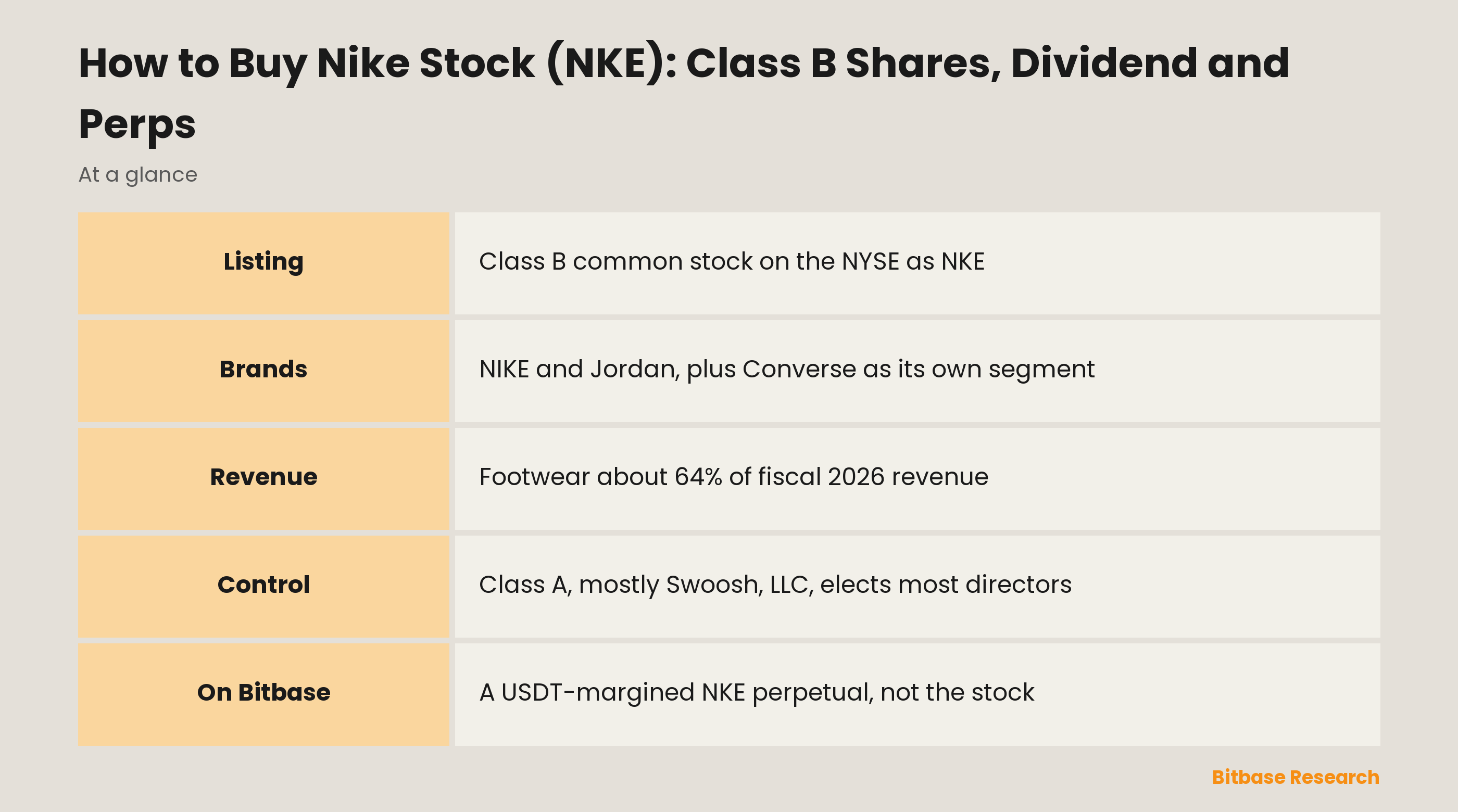
Choosing a broker that can place orders on the New York Stock Exchange is all it takes to buy Nike stock, listed there under the ticker NKE. What you get is Class B common stock: a second, unlisted class, Class A, elects most of the board, and Swoosh, LLC, the entity co-founder Phil Knight set up, holds about 79% of it. On Bitbase, NKE is a USDT-margined perpetual contract that follows the share price and holds no shares.
What Does Nike Do?
Nike designs and markets athletic footwear, apparel, equipment and accessories worldwide; its annual report calls it "the largest seller of athletic footwear and apparel in the world." The NIKE brand covers performance and sportswear, from Air to Dri-FIT. Jordan Brand sells footwear, apparel and accessories under the Jumpman trademark, and its results sit inside Nike's geographic segments. Converse, a wholly owned subsidiary based in Boston, sells casual sneakers such as the Chuck Taylor and reports as a segment of its own.
Production is outsourced. "Nearly all of our products are manufactured by independent contractors," the 10-K says, almost all of them outside the US. In fiscal 2026, factories in Vietnam made about 52% of Nike Brand footwear, Indonesia about 27% and China about 16%, and four contract manufacturers together produced about 60%.
Incorporated in Oregon in 1967 and public since 1980, Nike is based in Beaverton. Elliott Hill, who first joined Nike in 1988, became president and chief executive on 14 October 2024, succeeding John Donahoe. Competitors named in the 10-K include adidas, ASICS, lululemon athletica, New Balance, On, Puma and Under Armour.
How Nike Makes Money
In fiscal 2026, the year to 31 May, revenue was flat on a reported basis and down 2% excluding currency changes, after a 10% fall in fiscal 2025. Nike Brand footwear made up about 64% of total revenue, apparel about 29% and equipment about 5%. Jordan, counted within those lines, came to about 15%, and Converse to about 3% after its revenue fell 31%.
Wholesale customers such as sporting goods chains and department stores accounted for about 61% of Nike Brand revenue and grew 6%. Nike Direct, its own stores and digital platforms, made up about 39% and shrank 6%, with digital sales down 12% excluding currency, mainly on lower traffic. That reflects a change of course: management is "repositioning NIKE Brand Digital as a full-price platform and reinvesting in wholesale distribution."
The United States produced about 44% of fiscal 2026 revenue, and its three largest US customers about 29% of US sales, though no single customer reached 10% of the total. North America grew 5% while Greater China fell 11%. Gross margin was 42.9%, up 20 basis points.
NKE Stock at a Glance
| Item | Detail |
|---|---|
| Exchange | New York Stock Exchange |
| Ticker | NKE |
| Share class | Class B common stock, the only listed class |
| Other class | Class A, unlisted, convertible one-for-one into Class B |
| Industry | Athletic footwear, apparel and equipment |
| Index membership | S&P 500 and Dow Jones Industrial Average (held by SPY and DIA on 29 October 2026) |
| Headquarters | Beaverton, Oregon |
| Public since | 1980 |
| Fiscal year end | 31 May |
| Dividend policy | Cash dividend declared by the board every quarter |
| Share buybacks | Programme approved in June 2022, paused in the first quarter of fiscal 2026 |
For a live NKE quote and chart, open the Nike stock page on Bitbase.
How to Buy Nike Stock
Five steps at a broker:
1. Pick a broker that lists NYSE shares and accepts clients where you live.
2. Complete account opening and identity checks. If you are not a US resident, expect Form W-8BEN.
3. Add funds. Currency conversion into dollars adds cost.
4. Look up NKE. Fund files and quote screens may label it "CL B", the only listed class.
5. Choose the order. A market order fills at the going price; a limit order caps it and may not fill. Fractional shares depend on the broker.
Outside the US, the security is the same Oregon company's Class B stock; no depositary receipt sits in between, so there is no ADR ratio. Withholding on dividends depends on where you live and on any tax treaty; this is not tax advice.
Through a fund, S&P 500 and Dow trackers hold a small, shifting slice of Nike.
Trading NKE on Bitbase
Bitbase lists an NKE perpetual futures contract whose margin and settlement are both in USDT and whose price follows Nike's Class B shares. It carries no share, dividend or vote. In return it offers exposure with no expiry, in either direction and with optional leverage, that keeps trading while the NYSE is shut at night and over weekends.
To keep the contract in line with the stock, funding flows at set intervals from the more crowded side to the other, and once a position's margin is exhausted it is liquidated on the mark price, not on the latest fill. News that lands while New York is closed can move the perpetual before the shares. The stock perpetual futures guide goes through the mechanics.
How often funding is paid and how it is calculated, the margin tiers, the leverage cap and what happens to mark price and funding outside NYSE hours are all in the NKE contract rules. More stock-linked contracts are on the TradFi page.
What Moves NKE Stock
The marketplace reset. Nike is cutting the supply of some footwear styles, clearing stock with heavier markdowns and spending more on brand marketing. The 10-K expected this to be done by the end of December 2026, but the October 2026 10-Q says further work on NIKE Sportswear and Jordan Brand will run beyond fiscal 2027.
Greater China and Converse. Nike reports "declining store traffic, elevated promotional activity and higher levels of inventory" in Greater China, while Converse "is in the midst of a strategic reset of the brand and marketplace." Both are expected to weigh on results through fiscal 2027.
Tariffs. US trade policy feeds straight into cost of sales. After the US Supreme Court ruled on 20 February 2026 that the tariffs levied under the International Emergency Economic Powers Act (IEEPA) were unauthorised, Nike booked expected refunds, "largely offsetting the impact of the IEEPA tariffs recognized during fiscal 2026."
Restructuring. On 1 October 2026 Nike announced Pace, a multi-year cost programme that adds a campus in India and regroups the company into three geographies in fiscal 2028: the Americas, Asia Pacific and Greater China, and EMEA.
People and sport calendars. David Denton, who came from Pfizer, became CFO in August 2026. Events such as the NBA Finals, the Olympics and the World Cup shift the product mix and the timing of sales.
Uncertainties Hanging Over Nike's Reset
Inventory. Excess stock "may in the future result in inventory write-downs," the 10-K says, and selling it cheaply "could significantly impair our brand image."
Concentrated production. Nike relies on "a concentrated amount of contract manufacturers, which we do not own or operate, to manufacture all of the footwear products we sell."
Endorsement costs. Competition for athletes has sharpened, partly "due to the growing influence of athletes' personal brands."
Control and the share price. Class A holders elect most of the board, and a large sale by Swoosh, LLC "could have an adverse effect on the market price of our common stock." Nike also faces several securities class actions over a fall in its share price, and S&P and Moody's both cut its credit rating in 2025, keeping it investment grade.
The perpetual's added layer. Leverage magnifies losses, funding builds up over time, and a price gap when the NYSE opens can jump straight through a liquidation level, as the guide to margin and liquidation on stock perpetuals explains.
Tracking Nike Through a June-to-May Fiscal Year
Nike files with the SEC under CIK 320187. The 10-K for the year to 31 May arrives in July with the proxy statement, which explains the two-class vote, and the first three quarters each get a 10-Q. Read the segment tables, not just the total: North America, Greater China and Converse have been moving in different directions. Nike's investor site, investors.nike.com, posts the same filings.
Nike Stock FAQ
Does Nike pay a dividend?
Yes. The board declares a cash dividend every quarter, and Class A and Class B carry the same dividend rights. Amounts change, so check the latest declaration. Buybacks were paused in the first quarter of fiscal 2026, and none were made in the quarter to 31 August 2026.
What is the difference between Nike Class A and Class B stock?
Only Class B trades publicly; Class A converts into it one-for-one at the holder's request. Economic rights are the same, but the classes vote separately on directors: while Class B is between 25% and 87.5% of the outstanding shares, as now, it elects 25% of the board and Class A the rest. At the September 2026 annual meeting that meant three of 11 directors for Class B. Swoosh, LLC, formed by Phil Knight in 2015, holds about 79% of Class A, or about 16% of Class B if converted.
Is Nike stock part of the S&P 500 and the Dow Jones?
Both, going by fund holdings: State Street's SPY, which tracks the S&P 500, and DIA, which tracks the Dow Jones Industrial Average, each held Nike's Class B shares on 29 October 2026. Index lists change, so the date matters.
When does Nike report earnings?
Four times a year: for fiscal 2026 on 30 September 2025, 18 December 2025, 31 March 2026 and, for the full year, 30 June 2026. First-quarter fiscal 2027 results came on 1 October 2026.
Can I buy Nike stock with crypto?
Not the shares themselves. Brokers take money, so crypto has to be sold first. What USDT can reach on Bitbase is the NKE perpetual: a price-linked derivative with no shares behind it, no dividend and a liquidation price. Buying stocks with crypto sets the options side by side.
Conclusion
Buying Nike stock means buying Class B shares through an NYSE broker, while Class A, held mainly by Swoosh, LLC, elects most of the board. The business is mid-reset, with wholesale growing and digital sales, Converse and Greater China shrinking. The Bitbase perpetual offers a view on the price without the shares, at its own cost and liquidation risk.
Related reading
Other Bitbase articles on this topic:
- How to Buy General Motors Stock (GM): Nasdaq Move, Trucks and EVs
- How to Buy Hilton Stock (HLT): Fees, Honors and the Nasdaq Move
- How to Buy Lowe's Stock (LOW): FBM, Pro Customers and Dividend
Disclaimer: This article is educational content from Bitbase Academy, provided for information only. It explains what a company or fund does and how the instruments referenced here differ from one another; it does not constitute investment, trading, tax, or financial advice, and it is neither a recommendation nor an endorsement of any security, token, or trading strategy. A tokenized stock is issued by a third party and is designed to give economic exposure to an underlying asset: it is not a share, it carries no shareholder rights, and it depends on the issuer's structure, eligibility rules, and redemption terms, which the issuer can change. Perpetual futures are leveraged derivatives that hold no underlying asset and can be liquidated, and trading hours, product availability, and eligibility differ by instrument and by jurisdiction and can change at any time. Written as of October 2026; verify everything yourself through company filings, the issuer's own documentation, and the product pages of the venue you trade on.
References
[1] Nike Form 10-K for fiscal 2026 (SEC EDGAR) www.sec.gov
[2] Nike proxy statement for the 2026 annual meeting (SEC EDGAR) www.sec.gov
[3] Nike Form 10-Q, first quarter of fiscal 2027 (SEC EDGAR) www.sec.gov
[4] Nike Form 8-K, September 2024: new chief executive (SEC EDGAR) www.sec.gov
[5] Nike Form 8-K, June 2026: new chief financial officer (SEC EDGAR) www.sec.gov
[6] State Street: SPY daily holdings, 29 October 2026 www.ssga.com
[7] State Street: DIA daily holdings, 29 October 2026 www.ssga.com





