
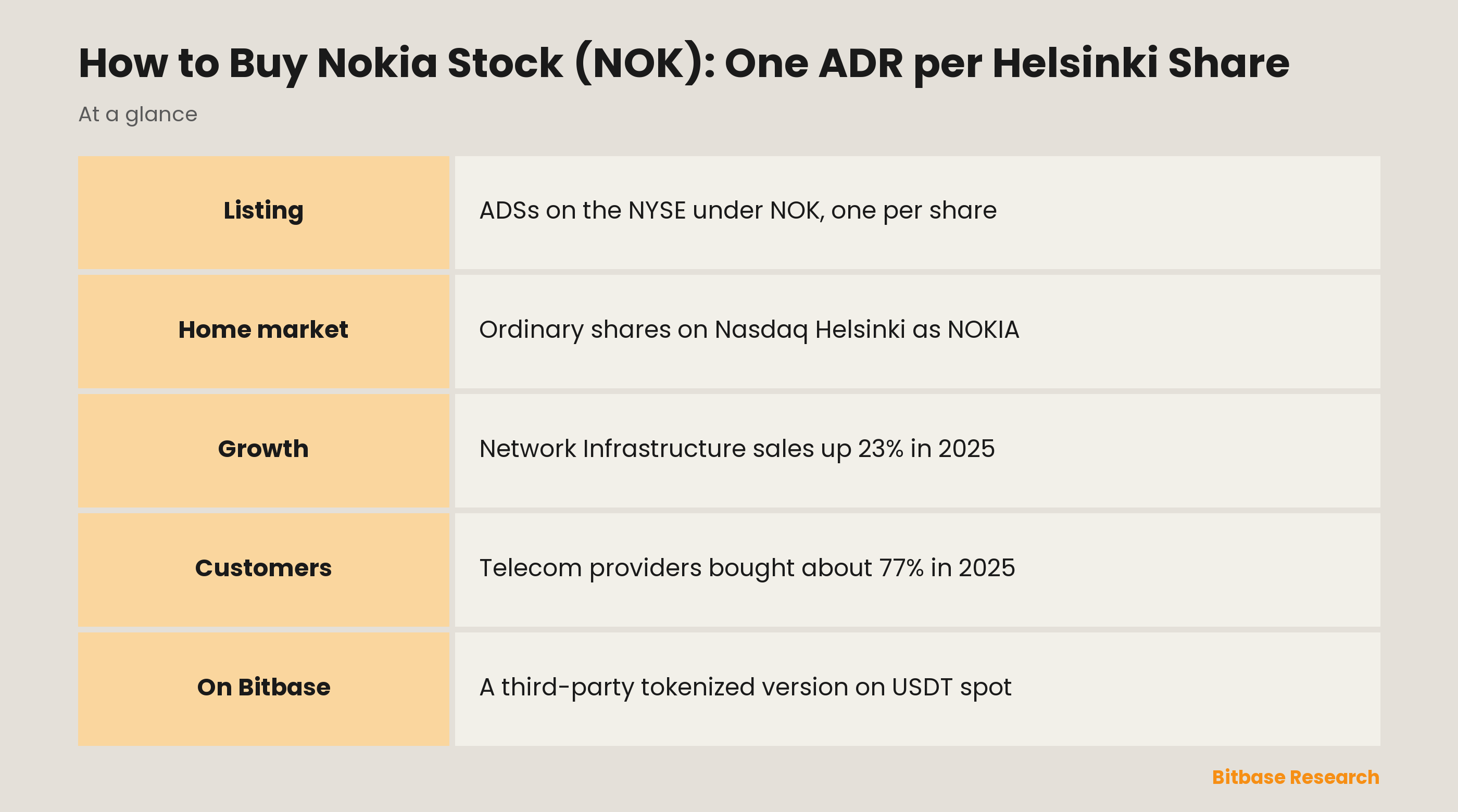
Nokia trades on the New York Stock Exchange as American depositary shares under NOK, so any broker with NYSE access can buy them, and each one stands for a single ordinary share listed in Helsinki. The phones are long gone: Nokia now sells the networks that carry mobile, internet and data-centre traffic, and in 2025 it absorbed the optical specialist Infinera. On Bitbase, a tokenized version of Nokia issued by a third party trades on spot against USDT, under that issuer's terms.
What Does Nokia Do?
Nokia Corporation, based in Espoo, Finland, builds the equipment and software that telecom operators, cloud companies and large enterprises use to move data: radio and core networks for mobile operators, optical transport and IP routing for long-haul and data-centre links, and fixed access such as fibre to the home. It also licenses a large patent portfolio, and its research arm, Nokia Bell Labs, marked its centenary in 2025, the year Nokia itself turned 160.
Nokia's annual report calls the turn to telecoms in the 1990s the most consequential of its many transformations. The handset business that made the name famous was sold to Microsoft, and in 2016 Nokia gave HMD Global an exclusive licence to make Nokia-branded phones and tablets in return for royalties. A 2023 amendment set that exclusivity to end by March 2026, and in October 2025 the two extended the licence for Nokia-branded feature phones in a limited number of countries until March 2029.
In 2025 Nokia reported through four business groups. Network Infrastructure sold optical, IP and fixed networks. Mobile Networks covered radio access across every 3GPP generation, from 2G to 5G. Cloud and Network Services provided core software and automation. Nokia Technologies ran patent and brand licensing.
Two changes reshaped the company. In February 2025 Nokia closed its acquisition of Infinera, a US maker of optical networking gear and optical semiconductors. Then, with a new strategy announced in November 2025, it folded the four groups into two operating segments from 1 January 2026: Network Infrastructure keeps optical, IP and fixed networks, while Mobile Infrastructure combines the core and radio portfolios with Technology Standards, the new name for Nokia Technologies. A separate Portfolio Businesses group holds units that are "not core to our strategy," such as microwave radio, while Nokia explores "strategic alternatives." Justin Hotard, who arrived with a background in AI and data-centre markets, has been President and CEO since 1 April 2025.
The 20-F is blunt about the market: competition for new infrastructure "is particularly intense and focused on the favorability of price and agreement terms."
How Nokia Makes Money
Nokia reports in euros under IFRS. Group net sales rose 3% in 2025, after foreign exchange took about 4% off the reported figure as the dollar weakened. Under the 2025 structure, the four groups contributed roughly:
| Business group (2025) | Share of group net sales | Change from 2024 |
|---|---|---|
| Network Infrastructure | about 40% | up 23% |
| Mobile Networks | about 39% | down 4% |
| Cloud and Network Services | about 13% | up 1% |
| Nokia Technologies | about 8% | down 22% |
The growth sat in optical. Optical Networks sales rose 85%, mostly because Infinera joined at the end of February, and Nokia says all three Network Infrastructure units also grew organically. Nokia Technologies fell because 2024 had included a large one-off catch-up from licence deals; the 20-F still says Nokia's inventions sit in "more than a billion new devices worldwide each year."
By customer, telecom providers bought about 77% of what Nokia sold in 2025. AI and cloud customers together with mission-critical enterprise and defence grew fastest, up 42% to about 16% of the total. No single customer exceeded 10% of net sales in 2025, 2024 or 2023.
By region, Europe, the Middle East and Africa produced about 42% of 2025 net sales, the Americas about 35% and Asia-Pacific about 23%. North America grew 15%, while Greater China fell 19%. All patent licensing income is booked to Finland, which inflates the Finnish line in the country table.
NOK Stock at a Glance
| Item | Detail |
|---|---|
| US listing | American depositary shares (ADSs) on the New York Stock Exchange, ticker NOK, traded in US dollars, since 1994 |
| ADS ratio | One ADS represents one Nokia ordinary share |
| Depositary | Citibank, N.A., which issues the American depositary receipts |
| Home market | Ordinary shares on Nasdaq Helsinki under NOKIA, in euros, since 1915; the Euronext Paris listing ended on 30 December 2025 |
| Legal form | Nokia Corporation (Nokia Oyj), a Finnish public company |
| Headquarters | Espoo, Finland |
| Industry | Network equipment, network software and technology licensing |
| Index membership | Not in the S&P 500 (absent from SPY holdings on 6 November 2026); held by SPDR Portfolio Developed World ex-US ETF (SPDW) that day |
| Fiscal year | Calendar year, ending 31 December |
| Accounting | IFRS, reported in euros |
| Dividend policy | Recurring, stable and over time growing ordinary dividends, paid in quarterly instalments |
| SEC filings | Form 20-F (annual) and Form 6-K (interim reports and other releases), CIK 924613 |
For the live NYSE quote and chart, open the Nokia stock page on Bitbase.
How to Buy Nokia Stock
Most buyers outside Finland use the NYSE line:
1. Pick a broker that reaches the NYSE and accepts residents of your country; for the Helsinki share you need Nasdaq Helsinki access instead.
2. Open and verify the account, stating your tax residence accurately, since it decides how Finnish withholding tax applies.
3. Fund the account. Converting into dollars is part of the cost.
4. Search for NOK and confirm the result is Nokia Corporation's American depositary shares.
5. Choose the order type. A market order fills at the best price available, while a limit order caps the price and may not fill.
6. Decide the size. Whether you can buy a fraction of an ADS is your broker's policy.
The ADS and the Helsinki share. The SEC describes an ADR as "a security that represents shares of non-U.S. companies that are held by a U.S. depositary bank outside the United States," adding that ADRs "trade in U.S. dollars and clear through U.S. settlement systems." With Nokia's one-to-one ratio, the NYSE price should track the Helsinki price converted into dollars. What differs is the wrapper: the depositary may charge fees for issuing or cancelling ADSs and for passing on cash distributions, which arrive in dollars.
Distributions and Finnish tax. For 2025 the Board sought authority to pay out of retained earnings or the reserve for invested unrestricted equity in four instalments, normally alongside quarterly results. Finland generally withholds 30% on dividends paid to non-residents, and 35% on nominee-registered shares unless the custodian meets strict conditions. Treaties can lower the rate, and the 20-F says US holders are generally taxed at reduced rates, but relief depends on the paperwork your broker and the depositary chain provide. This is general information, not tax advice.
Through funds. As a Finnish company, Nokia sits outside the S&P 500, but developed-market ex-US funds can hold it; on 6 November 2026 State Street's SPDW listed Nokia Oyj among its holdings.
Trading NOK on Bitbase
The NOK ADS itself is bought through a broker. On Bitbase, a tokenized version of Nokia trades on the tokenized stock spot market, priced in USDT. A third party named on that market's page issues it, and the issuer's terms decide what each token represents and whether it can be redeemed, so read them before buying. The guide to what tokenized stocks are explains the category in general, and the Bitbase TradFi page lists the other stock-linked markets.
What Moves NOK Stock
Optical and data-centre demand. Nokia has cast Network Infrastructure as its growth segment and ties it to what it calls the "AI supercycle," which it says is driving "an unprecedented demand for network capacity." Orders from AI and cloud customers are therefore a line to watch in each interim report.
Operator budgets. Telecom providers still buy most of what Nokia sells, and the 20-F warns that consolidation could leave "an even greater portion of our net sales" with "a smaller number of large telecommunication providers," so one tender can matter.
Licence deals. Licensing revenue jumps when large agreements are signed or renewed and drops when a catch-up payment falls out of the comparison, as in 2025. Much of it comes from a smartphone market with "a limited number of large vendors."
The NVIDIA partnership. In October 2025 Nokia announced a strategic partnership with NVIDIA on AI-native mobile networks, adding NVIDIA-powered AI-RAN products to its radio portfolio, and NVIDIA subscribed for new Nokia shares in a directed issue. Operator uptake of those products is a visible test of the strategy.
The euro-dollar rate. Nokia reports in euros while the ADS trades in dollars, and the weaker dollar reduced reported 2025 sales. A dollar investor carries the exchange rate as well as the business.
Where Nokia's Annual Report Sees Pressure
Executing the strategy. The 20-F says Nokia may be unable to "successfully implement our strategic plans," with the reorganisation, the Infinera integration and the AI-driven network bet among the moving parts.
Price competition. Contracts are fought on price and terms, and approaches such as Open RAN can bring in new competitors.
Operator health. Demand depends on telecom providers growing revenue, continuing to invest and seeing traffic keep rising.
Trade and geopolitics. The 20-F flags export controls and tariffs, which "could impact raw material prices, the cost of component parts and transportation," and a presence in emerging markets with less predictable legal systems.
The Bitbase token. The tokenized version adds dependence on its issuer and on terms the issuer sets and can change.
How to Research NOK Yourself
Nokia files with the SEC as a foreign private issuer under CIK 924613. The Form 20-F holds the business review, segment results, risk factors, the ADS fee table and the Finnish and US tax sections. Interim reports arrive on Form 6-K, enclosing the Helsinki stock exchange release. Reports for 2026 use the two-segment structure, so their segment lines will not match the 2025 table above.
Nokia Stock FAQ
Is the NOK ADR the same as a Nokia share in Helsinki?
Economically, nearly. Each NOK ADS represents one ordinary share held through Citibank as depositary, so the NYSE price should follow Helsinki converted into dollars. The differences are currency, depositary fees and how distributions and tax relief reach you.
Does Nokia pay a dividend?
Yes, as a policy. Nokia targets "recurring, stable and over time growing ordinary dividend payments," and for 2025 the Board proposed paying in four instalments tied to quarterly results. Finland taxes distributions from the equity reserve as dividends too.
Does Nokia still make phones?
No. It sold its Devices & Services business to Microsoft and licensed the brand to HMD Global instead. HMD's exclusive licence for Nokia-branded devices was set to end by March 2026, while the licence for Nokia-branded feature phones runs to March 2029 in a limited number of countries.
Is Nokia in the S&P 500?
No. SPY, State Street's S&P 500 fund, did not hold it on 6 November 2026; developed-market ex-US funds such as SPDW did.
Can I buy Nokia stock with crypto?
Not the shares directly: brokers sell NOK ADSs for money, so crypto has to be sold first. On Bitbase, USDT can buy the tokenized version of Nokia on spot; a third party issues it under its own terms, and it is not the ADS itself. How to buy stocks with crypto compares the routes.
Conclusion
Buying Nokia stock takes one NYSE order for an ADS that mirrors a Helsinki share. Judging it means watching optical demand from data centres, operator budgets and the euro-dollar rate. On Bitbase, the tokenized version is a USDT route governed by its issuer's terms rather than by Nokia's deposit agreement.
Related reading
Other Bitbase articles on this topic:
- How to Buy Everpure Stock (P): Formerly Pure Storage, PSTG
- How to Buy Flex Stock (FLEX): Singapore Shares, Axiom Spin-Off
- How to Buy HP Stock (HPQ): PCs, Ink and the 2015 Split
- How to Buy Western Digital Stock (WDC): Hard Drives After Sandisk
Disclaimer: This article is educational content from Bitbase Academy, provided for information only. It explains what a company or fund does and how the instruments referenced here differ from one another; it does not constitute investment, trading, tax, or financial advice, and it is neither a recommendation nor an endorsement of any security, token, or trading strategy. A tokenized stock is issued by a third party and is designed to give economic exposure to an underlying asset: it is not a share, it carries no shareholder rights, and it depends on the issuer's structure, eligibility rules, and redemption terms, which the issuer can change. Perpetual futures are leveraged derivatives that hold no underlying asset and can be liquidated, and trading hours, product availability, and eligibility differ by instrument and by jurisdiction and can change at any time. Written as of November 2026; verify everything yourself through company filings, the issuer's own documentation, and the product pages of the venue you trade on.
References
[1] Nokia Form 20-F for 2025 (SEC EDGAR) www.sec.gov
[2] Nokia 2025 Form 20-F, XBRL cover page (SEC EDGAR) www.sec.gov
[3] Nokia Form 6-K, October 2026: interim report for Q3 2026 (SEC EDGAR) www.sec.gov
[4] SEC Investor Bulletin: American Depositary Receipts (2012) www.sec.gov
[5] State Street: SPY daily holdings, 6 November 2026 www.ssga.com
[6] State Street: SPDW daily holdings, 6 November 2026 www.ssga.com





