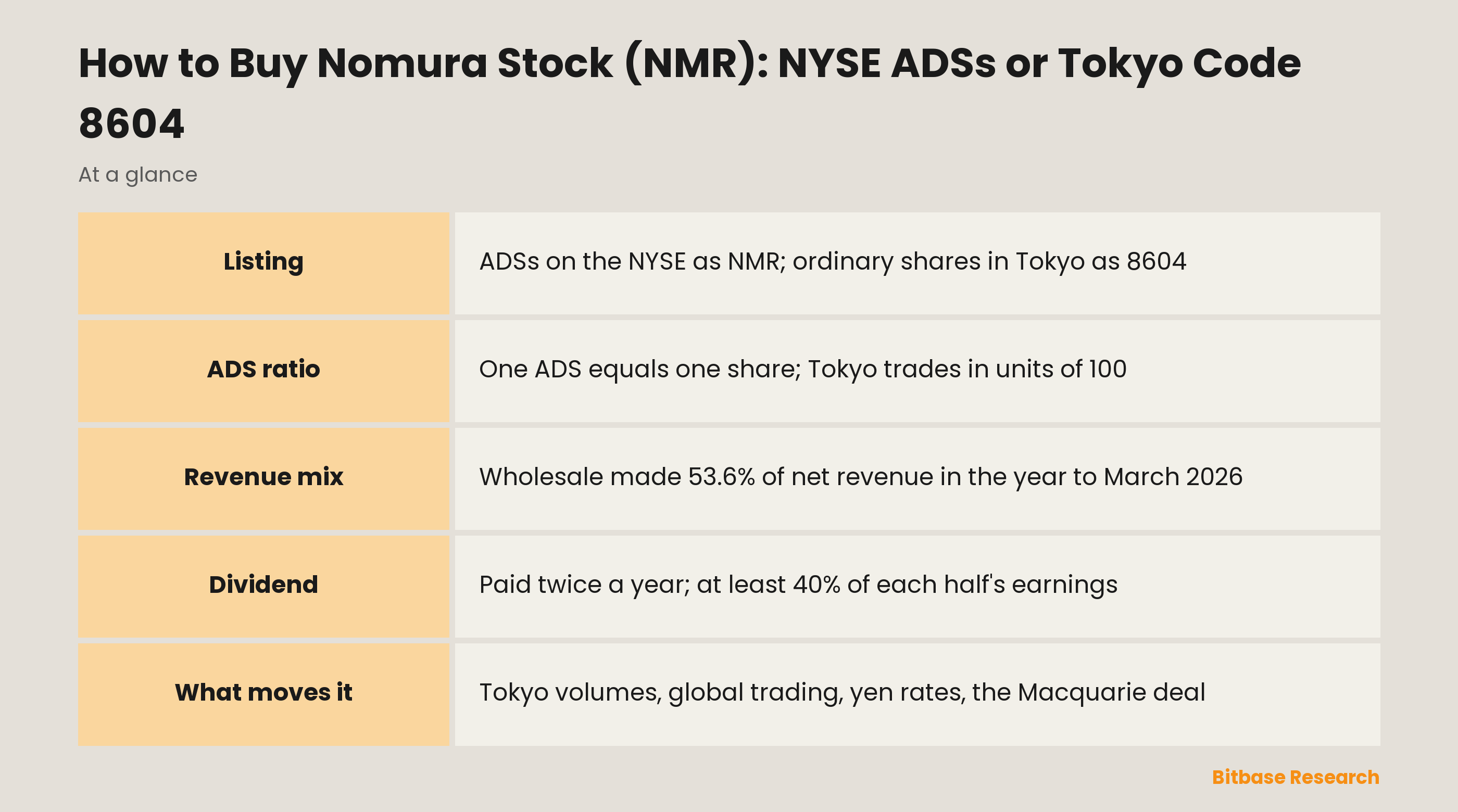
Whether you buy it in New York or in Tokyo, Nomura stock is the same share: on the New York Stock Exchange it trades as the American depositary share (ADS) NMR, each standing for exactly one ordinary share of Nomura Holdings, while a broker with Tokyo access can buy the ordinary shares under code 8604, in blocks of 100. The one-for-one ratio keeps the arithmetic simple, but only 2.8% of Nomura's shares sat in ADS form at the end of March 2026, and the 20-F names Tokyo as the principal trading market. Behind the ticker is a 100-year-old broker that now earns more than half its net revenue from global trading and deal work.
What Does Nomura Do?
Nomura Holdings is the parent company of Nomura Securities, the Tokyo brokerage at the centre of the group. Its roots go back to 25 December 1925, when the securities arm of The Osaka Nomura Bank was split off to trade and distribute Japanese bonds. Two years later it opened a representative office in New York, which the company calls the first international move by any Japanese securities firm. It began trading equities in 1938 and set up Japan's first investment trust in 1941. On 1 October 2001 the old Nomura Securities Co., Ltd. became a holding company and took the name Nomura Holdings, Inc.; the brokerage business moved into a wholly owned subsidiary that kept the Nomura Securities name.
Today the group runs four business divisions.
Wealth Management is the retail franchise at home. It serves individuals and companies in Japan through Nomura Securities' branch network, 104 offices including head office at the end of March 2026, and through online services. Its advisers sell stocks, bonds and investment trusts and, increasingly, charge fees on assets they look after rather than commissions on each trade.
Investment Management builds and runs funds. It sells investment trusts to Japanese savers through banks and brokers and offers public- and private-market strategies to pension funds and institutions worldwide. Most of its revenue is a fixed annual fee on the assets it manages, with occasional performance fees on top. On 1 December 2025 Nomura completed its purchase of Macquarie's US and European public asset management business, Delaware Management Company included, a deal the 20-F calls "a significant step towards our 2030 management vision."
Wholesale is the institutional side, made up of two parts. Global Markets trades, sells and structures fixed income, equity and currency products for institutions around the world; the filing claims "an industry leading market share on the Tokyo Stock Exchange." Investment Banking advises on mergers and arranges financing.
Banking is the newest division, created in April 2025. It brings together The Nomura Trust and Banking Co., which lends and provides trust services in Japan, and Nomura Bank (Luxembourg), which administers investment funds.
Two more pieces help explain the group. Nomura owns 100% of Laser Digital Group Holdings, a Swiss company, and the 20-F says the group is exploring "the digital asset business." It also holds minority stakes in two separately listed Japanese companies that share its name: 23.1% of Nomura Research Institute, an IT and consulting firm that counts Nomura among its major clients, and 37.6% of Nomura Real Estate Holdings. For the big Japanese banking groups also listed in New York, see our guides on buying Mizuho stock and buying Mitsubishi UFJ stock.
How Nomura Makes Money
Nomura's 20-F is prepared in yen under US accounting rules (US GAAP), and its fiscal year ends on 31 March. In the year to March 2026, net revenue rose 14.5%, net income attributable to shareholders reached a record, and return on equity was 10.1%.
| Division | Share of group net revenue, year to March 2026 | Change from prior year |
|---|---|---|
| Wholesale | 53.6% | +9.9% |
| of which Global Markets | 44.7% | +10.7% |
| Wealth Management | 22.5% | +12.5% |
| Investment Management | 11.9% | +34.3% |
| Banking | 2.5% | +14.3% |
Shares are calculated from the 20-F's divisional net revenue against consolidated net revenue; the four divisions do not add up to 100% because of other items and reconciling entries.
Trading drives the business. Global Markets alone produced close to half of group net revenue, and it rises and falls with client activity in bonds, equities and currencies; Investment Banking was a much smaller slice.
Wealth Management had what the 20-F calls its best year since the division was formed in fiscal 2002. Higher sales of stocks and investment trusts lifted transaction revenue, while growing client assets lifted the recurring fees that management is trying to build up, and the division's pre-tax income rose 22.8%.
Investment Management grew fastest, helped by the Macquarie business from December, but its non-interest expenses rose 65.5%, so pre-tax income slipped 1.4%.
Geography matters too. Japan supplied 50.2% of net revenue and the Americas 30.9%. Europe was the weak spot: net revenue there fell 30.4% and the region posted a pre-tax loss, while Asia and Oceania more than doubled. Roughly half of Nomura's net revenue therefore comes from outside Japan.
NMR Stock at a Glance
| Item | Detail |
|---|---|
| Company | Nomura Holdings, Inc., incorporated in Japan |
| US listing | ADSs on the NYSE under NMR since December 2001 |
| ADS ratio | One ADS represents one share of common stock |
| Home listing | Tokyo and Nagoya stock exchanges since 1961, code 8604; Singapore since 1994, code N33 |
| Trading unit in Tokyo | 100 shares |
| Depositary | The Bank of New York Mellon |
| Index membership | Nikkei 225 and TOPIX |
| Head office | Nihonbashi, Chuo-ku, Tokyo |
| Fiscal year | Ends 31 March; annual report on Form 20-F under US GAAP |
| Shareholder returns | Two dividends a year, payout of at least 40% of each half-year's earnings, total payout including buybacks of at least 50% |
| SEC filer number | CIK 1163653 |
Prices, market value and yield move every day, so check them on Bitbase's NMR stock page instead of in an article.
How to Buy Nomura Stock
Since an ADS and an ordinary share are the same slice of the company, the choice comes down to where your broker trades and which currency you want.
1. Decide on the market. NMR trades in US dollars on the NYSE. Code 8604 trades in yen in Tokyo and requires a broker with Japanese market access.
2. Open the account. The broker will check your identity and tax residence; filing the right tax-treaty form early can lower the Japanese tax taken from dividends.
3. Fund it in the right currency. Converting money costs something, and the cost often sits in the exchange rate rather than in a visible fee.
4. Find the right line. Search for NMR and confirm the name reads Nomura Holdings ADS; in Tokyo, enter 8604.
5. Pick an order type. A market order fills at the going price, while a limit order caps what you pay.
6. Size it. A Tokyo order comes in 100-share units, which equals 100 ADSs. Some US brokers also let you buy part of an ADS.
What an ADS gives you. The Bank of New York Mellon holds the underlying shares through a custodian and is the shareholder of record. Nomura's own risk factor puts it plainly: "As a holder of ADRs, you will have fewer rights than a shareholder has and you will have to act through the depositary to exercise these rights." The depositary will try to vote as you instruct and passes on dividends, converted to dollars, but you cannot bring a derivative action, inspect the books or exercise appraisal rights except through it.
The Tokyo shares. Holders of fewer than 100 shares get no vote. They can ask Nomura to buy the odd lot back, or to sell them enough extra shares to complete a unit when Nomura has shares to spare. Tokyo also limits how far a stock may move in a single day, and the 20-F warns that you "may not be able to sell your shares of NHI Shares at a particular price on any particular trading day, or at all." Trading runs from 9:00 to 11:30 and 12:30 to 15:30 Tokyo time, which is overnight in New York.
Dividend tax. Japan withholds tax on dividends paid to foreign holders of listed shares: 15.315% under domestic law, or 20% before surtax for an individual holding 3% or more. Under the US-Japan treaty the rate for qualifying US portfolio investors is 10%, and qualifying US pension funds are exempt. Other treaties set their own rates. Your home country may then tax the dividend or any gain again.
Through a fund. Nomura is in both of Japan's main indexes: the 12 November 2026 creation baskets of the NEXT FUNDS Nikkei 225 ETF and the NEXT FUNDS TOPIX ETF both include 8604. Those two ETFs are run by Nomura Asset Management, part of Nomura's own Investment Management division. Any fund tracking either index holds a small slice of the company, in Tokyo shares rather than ADSs.
What Moves NMR Stock
Tokyo trading volumes. When Japanese investors buy more stocks and investment trusts, Wealth Management's transaction revenue rises, and Nomura's dealers earn more on the Tokyo exchange where they lead. A quiet market cuts both at once.
The global trading cycle. With Global Markets near half of net revenue, results swing with volatility and client hedging in bonds, rates and equities abroad. The year to March 2026 showed the split: the Americas and Asia grew while Europe lost money, so regional figures in each quarterly release say more than the group total.
Yen interest rates. The Bank of Japan raised its policy rate again in December 2025, and the 20-F records Japan's 10-year yield rising above 2% that month. Higher yen rates help the new Banking division earn more on loans and trust business; they also change the value of bond inventories and the cost of funding.
The Macquarie integration. The asset management purchase moves Nomura further toward fee income, which the 20-F describes as part of an effort to "expand our stable earnings base." The test is whether revenue from the acquired business grows faster than the expense that came with it.
Payouts. The board aims to pay at least 40% of each half-year's earnings as dividends and to return at least 50% including buybacks. Because payouts follow earnings, dividends can rise and fall: the total for the year to March 2025 included a one-off payment for the company's centenary, so the lower total a year later still meant the ordinary dividend rose 8.5%. For the half to September 2026 the interim dividend was 30% higher than a year earlier. A buyback approved in January 2026 used its full yen limit by 15 April 2026.
The exchange rate. NMR is priced in dollars but the business reports in yen, so a weaker yen can lower the ADS price even if the Tokyo price holds steady.
Trading Losses, Goodwill and Phishing: Nomura's Risk List
The annual report lists 28 risk headings. These five bear most directly on someone holding the stock.
Markets and geopolitics. The first risk is broad: "Our business may be materially affected by financial markets, economic conditions and market fluctuations in Japan and elsewhere around the world, including the ones caused by geopolitical events."
Trading losses. "We may incur significant losses from our trading and investment activities," the 20-F warns, adding that concentrated positions and hedges that do not work can make losses larger.
Goodwill after acquisitions. Nomura may "have to recognize impairment losses with regard to the amount of goodwill, tangible assets and intangible assets" on its balance sheet. After the Macquarie deal, that line covers a sizable new asset.
Misconduct and fraud. The company names the risk that an employee, executive or outside party could act improperly. It also discloses that Nomura Securities is handling losses caused since January 2025 by third parties who broke into client accounts through phishing, and that it will at most restore an account to its state before the unauthorised trades. The 20-F says such incidents have become less frequent but "may occur again in the future."
Holding through an ADS. Beyond the depositary point above, the company notes that it "does not announce any dividend forecasts" and that holders on a record date "may not receive the dividends they anticipate."
Owning a single stock also concentrates risk: one company can fall much further than the market.
Following Nomura Between Annual Reports
Nomura files with the SEC under CIK 1163653. The annual Form 20-F covers the year to 31 March; the most recent was filed on 22 June 2026. Quarterly results arrive as Form 6-K, usually a press release plus a longer financial supplement, and the same form carries dividend declarations, monthly buyback reports and capital ratio updates.
Watch the year labels. Nomura's own releases call the year ending March 2027 "FY2026/27," while the 20-F speaks of "the year ended March 31, 2026." In the October 2026 release, the first half of FY2026/27 showed net revenue up 25%, pre-tax income up 21%, net income up 27% and a first-half return on equity of 13.3%, with Investment Banking net revenue in the second quarter up 26% from a year earlier.
For quotes on other companies, browse the Bitbase US stock directory.
Nomura Stock FAQ
How many Nomura shares does one NMR ADS represent?
One. Each ADS represents one share of Nomura Holdings common stock, so 100 ADSs equal one Tokyo trading unit. The Bank of New York Mellon is the depositary.
Does Nomura pay a dividend?
Yes, twice a year, to holders on the register at 30 September and 31 March. The board aims for a payout of at least 40% of each half-year's consolidated earnings and does not publish forecasts, so the amount changes with profit. ADS holders receive the dividend in dollars from the depositary, after Japanese withholding tax and fees.
Can I buy Nomura stock with crypto?
Not directly. NMR settles in US dollars and 8604 in yen, so crypto must first be sold for cash and the money moved into a brokerage account before you can place an order. Selling crypto can itself be a taxable event; our guide on how crypto differs from stocks explains why the two are held so differently.
Is Nomura in the Nikkei 225?
Yes. Code 8604 appears in the 12 November 2026 creation baskets of Nomura Asset Management's Nikkei 225 and TOPIX ETFs. Its index weight changes every day.
Is Nomura Holdings the same company as Nomura Research Institute?
No. Nomura Research Institute is a separately listed IT and consulting company in which Nomura held 23.1% at 31 March 2026, accounted for under the equity method. Nomura Real Estate Holdings is likewise a separate listed company, 37.6% owned.
Conclusion
Nomura is a trading house with a retail network attached, and its results follow market activity more than interest margins. The Macquarie purchase and the new Banking division are meant to add steadier fee and interest income, so the numbers to watch are recurring revenue in Wealth Management, assets and costs in Investment Management, and how much of Wholesale's profit comes from Europe and the Americas. Whether you hold NMR in New York or 8604 in Tokyo, you own the same share at a one-to-one ratio; what differs is the currency, the trading hours and how you exercise your rights.
Related reading
Other Bitbase articles on this topic:
- How to Buy Ameriprise Stock (AMP): Advisors, Funds and Annuities
- How to Buy Ares Management Stock (ARES): Private Credit and Votes
- How to Buy ORIX Stock (IX): One-Share ADS and a PFIC Warning
- How to Buy Rocket Companies Stock (RKT): Redfin and Mr. Cooper
Disclaimer: This article is educational content from Bitbase Academy, provided for information only. It explains what a company or fund does and how the instruments referenced here differ from one another; it does not constitute investment, trading, tax, or financial advice, and it is neither a recommendation nor an endorsement of any security, token, or trading strategy. A tokenized stock is issued by a third party and is designed to give economic exposure to an underlying asset: it is not a share, it carries no shareholder rights, and it depends on the issuer's structure, eligibility rules, and redemption terms, which the issuer can change. Perpetual futures are leveraged derivatives that hold no underlying asset and can be liquidated, and trading hours, product availability, and eligibility differ by instrument and by jurisdiction and can change at any time. Written as of November 2026; verify everything yourself through company filings, the issuer's own documentation, and the product pages of the venue you trade on.
References
[1] Nomura Holdings, Form 20-F for the year to 31 March 2026 (SEC EDGAR) www.sec.gov
[2] Nomura, second-quarter results and half-year dividend (Form 6-K, 28 October 2026) www.sec.gov
[3] Nomura, share buyback report for September 2026 (Form 6-K, 14 October 2026) www.sec.gov
[4] Nomura Asset Management, NEXT FUNDS Nikkei 225 ETF (1321): creation basket, 12 November 2026 nextfunds.jp
[5] Nomura Asset Management, NEXT FUNDS TOPIX ETF (1306): creation basket, 12 November 2026 nextfunds.jp
[6] Japan Exchange Group: trading hours for domestic stocks www.jpx.co.jp





