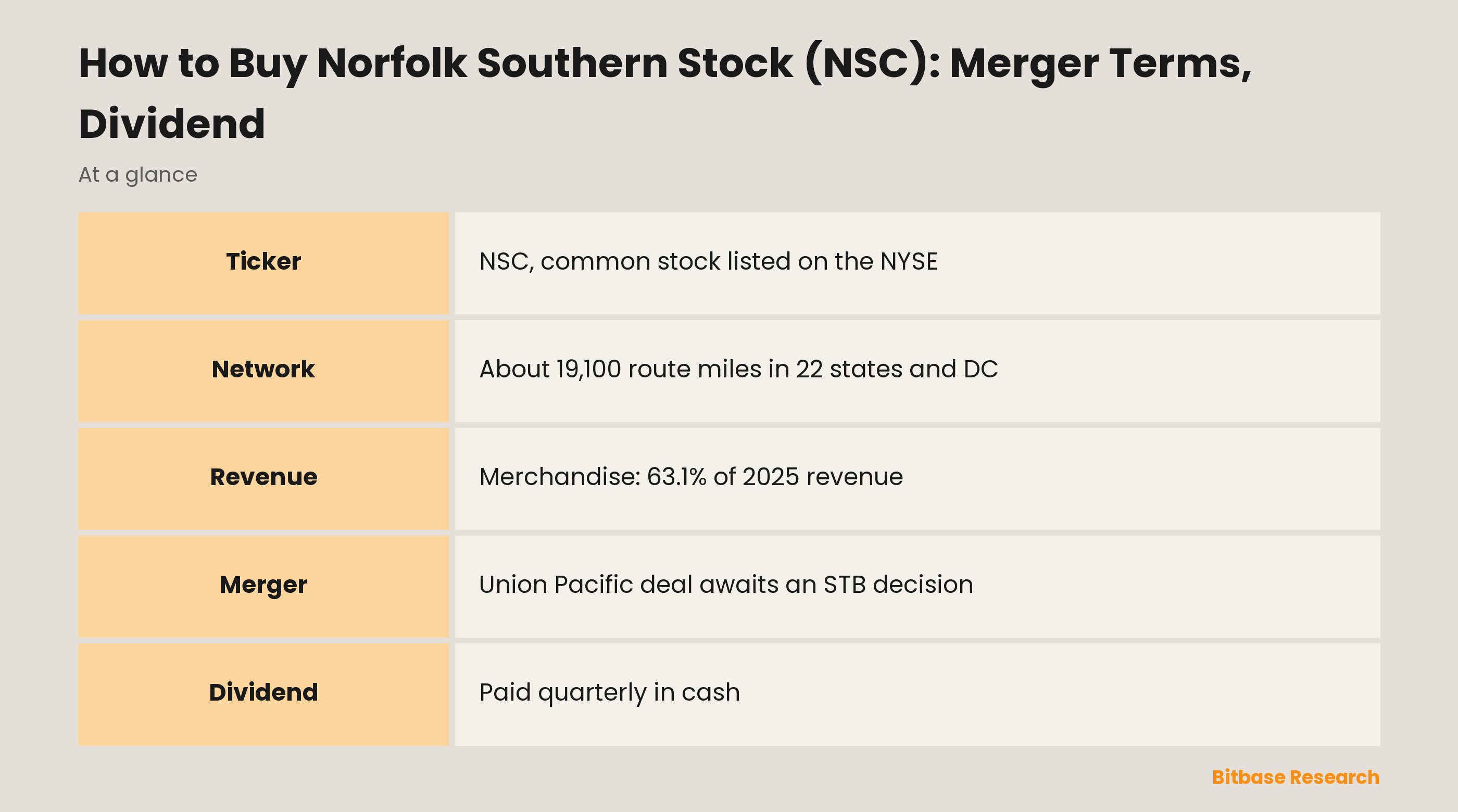
Twenty-two states and the District of Columbia lie on the rail network behind NSC, and you can buy the stock through any broker that offers NYSE-listed shares, because Norfolk Southern's common stock trades on the New York Stock Exchange under that ticker. The company has also agreed to be acquired: under a July 2025 agreement, each NSC share would be exchanged for one Union Pacific share plus cash, a deal that still awaits a decision by the Surface Transportation Board (STB).
What Does Norfolk Southern Do?
Norfolk Southern Corporation is an Atlanta-based company that owns a major freight railroad, Norfolk Southern Railway Company. It was incorporated in Virginia on 23 July 1980, and its 10-K traces the business through predecessor companies back to 1827. At the end of 2025 it operated approximately 19,100 route miles in 22 states and the District of Columbia, mostly in the Southeast, East and Midwest. In March 2024 it bought the 337-mile line from Cincinnati to Chattanooga that it had previously leased.
Traffic falls into three groups. Merchandise covers agriculture, forest and consumer products, chemicals, metals and construction materials, and vehicles. Intermodal hauls containers and trailers; the company calls this "the most extensive intermodal network in the eastern half of the U.S." Coal serves power plants, steelmakers and export customers, partly through terminals such as Lamberts Point in Norfolk, Virginia.
Norfolk Southern and CSX, which the 10-K names as its primary rail competitor, jointly own Conrail; Norfolk Southern holds a 58% economic interest and 50% of the votes.
How Norfolk Southern Makes Money
Revenue barely changed in 2025. Shares are computed from the 10-K's commodity tables; changes are as filed.
| Traffic | 2025 revenue share | 2025 unit share | Revenue vs 2024 |
|---|---|---|---|
| Agriculture, forest and consumer products | 20.8% | 10.4% | Up 1% |
| Chemicals | 18.1% | 7.8% | Up 4% |
| Metals and construction | 14.2% | 9.0% | Up 2% |
| Automotive | 10.0% | 5.5% | Up 6% |
| Intermodal | 24.7% | 57.4% | Down 1% |
| Coal | 12.2% | 9.8% | Down 8% |
The first four rows make up merchandise, which earned 63.1% of revenue. The gap between the two share columns comes down to price: in 2025 an average merchandise carload brought in about 4.5 times the revenue of an average intermodal unit. Coal revenue fell even though tonnage rose 2%, on lower pricing, adverse mix and smaller fuel surcharges.
About 95% of the revenue base sits under contracts with negotiated fuel surcharges, which equaled 6.8% of 2025 revenue. Efficiency is tracked through the railway operating ratio, "a measure of the amount of operating revenues consumed by operating expenses," where lower is better: 64.2% in 2025 against 66.4% in 2024, helped partly by net recoveries related to the 2023 derailment in East Palestine, Ohio.
NSC Stock at a Glance
| Feature | NSC |
|---|---|
| Exchange | NYSE (New York Stock Exchange) |
| Security | Common stock, the only class registered on the 10-K cover |
| Index membership | S&P 500 |
| Headquarters | Atlanta, Georgia |
| Incorporated | Virginia, 23 July 1980 |
| Fiscal year | Ends 31 December |
| Dividends | Quarterly, in cash |
| Share buybacks | Suspended since the merger agreement |
| Pending deal | Acquisition by Union Pacific, subject to STB approval |
Live price, market value and dividend yield are on the Norfolk Southern stock page on Bitbase.
How to Buy Norfolk Southern Stock
Norfolk Southern is a US company with one class of common stock on the NYSE, so you buy the same shares US investors hold, with no depositary receipt in between.
1. Pick a broker with NYSE access, local or international, and find out which regulator oversees it.
2. Open the account and complete verification. Non-US residents normally submit IRS Form W-8BEN to document foreign status for dividend withholding.
3. Add funds, counting the currency conversion spread as part of the cost.
4. Look up NSC and confirm it is Norfolk Southern common stock, not Union Pacific, which trades separately as UNP.
5. Choose an order type. FINRA defines a limit order as one "to buy or sell a security at or better than a specified price," while a market order "provides the most certainty that your order will be executed."
6. Set the duration. Day orders, per FINRA, "expire at the end of the trading day if they aren't executed"; good-'til-canceled orders stay open until filled or canceled.
7. Consider a fraction. Some brokers sell fractions; FINRA notes they often cannot be traded outside regular market hours.
8. Keep the confirmation, which records your purchase price.
Non-US holders face withholding on dividends: the IRS says tax on US-source income paid to a foreign person "is generally withheld (NRA withholding) from the payment," at 30% unless a tax treaty sets a lower rate.
Index funds give indirect exposure: State Street's daily holdings files for SPY and for its Industrial Select Sector SPDR ETF (XLI) both listed Norfolk Southern on 29 October 2026.
What Moves NSC Stock
The merger terms. Under the agreement signed on 28 July 2025, each Norfolk Southern share would convert into one Union Pacific share and a fixed amount of cash. The joint proxy statement says the exchange ratio "is fixed and will not be adjusted to reflect stock price changes," so part of what an NSC holder stands to receive rises and falls with Union Pacific's share price. It also estimated that former Norfolk Southern shareholders would own approximately 27% of the combined company; our guide to buying Union Pacific stock covers the buyer's side.
The STB review. Shareholders of both companies approved the deal on 14 November 2025. The STB rejected the first application, filed on 19 December 2025, as incomplete on 16 January 2026, stressing that this did not signal how it would judge a revised one. It accepted a revised application for consideration on 28 May 2026, adopted a procedural schedule on 18 August and denied motions seeking summary denial on 18 September. The 10-Q of 22 October 2026 still lists STB approval as a closing condition, and either side may terminate if the deal has not closed by 28 January 2028, with an automatic extension possible in some circumstances.
Customers hedging. The 10-K attributes part of the 2025 fall in intermodal revenue to "distribution network diversification by certain of our customers in connection with the Merger."
Diesel. Surcharges make reported revenue swing with fuel prices. In the third quarter of 2026 revenue rose 14% year over year while fuel expense jumped 77%, and the operating ratio weakened to 67.4%.
Coal and containers. In that quarter export coal tonnage climbed 10% on higher metallurgical coal production, and domestic intermodal volume also grew 10% with truck capacity constrained, while international volume fell 8% as ocean carriers shifted capacity to West Coast ports.
What NSC Shareholders Take On
The 10-K's risk factors open with the merger and the derailment:
A deal that might not close. If it fails, "the market price of the Company's Common Stock could decline," and a substantial termination fee could be owed in certain circumstances. Meanwhile the agreement limits debt, capital spending and dividend decisions.
Conditions on approval. The terms of any approval "may impose requirements, concessions, limitations, or costs" on the combined company.
The derailment's long tail. Related costs "have been significant to date, may exceed expected or accrued amounts." In September 2026 a federal court certified a class in a shareholder securities suit; the company is seeking permission to appeal.
Hazardous materials. "As a common carrier by rail, we must offer to transport hazardous materials, which exposes us to significant costs and claims."
Labor and technology. Approximately 80% of railroad employees are covered by collective bargaining agreements, and the company has "previously experienced technology outages and cybersecurity events that have impacted our systems and service."
One stock also means one company's results decide your outcome; non-dollar investors add currency risk.
Primary Sources for NSC: EDGAR and the STB Docket
Norfolk Southern's filings are on SEC EDGAR (CIK 702165): the 10-K each year (the fiscal 2025 report was filed on 9 February 2026), 10-Qs quarterly and 8-Ks for earnings and events such as the November 2025 vote. Each 10-Q's commitments and contingencies note updates the East Palestine litigation. The merger terms are in the joint proxy statement of 1 October 2025, and the STB posts its decisions and the parties' filings under docket FD 36873.
Norfolk Southern Stock FAQ
Does Norfolk Southern pay a dividend?
Yes. It pays cash every quarter, and the third-quarter 2026 10-Q refers to "regular quarterly dividends paid on Common Stock." The merger agreement permits ordinary-course quarterly cash dividends up to a cap while the deal is pending, and the board declares each one.
Can I buy Norfolk Southern stock with crypto?
Not directly. NSC trades in US dollars, so any crypto has to be sold for dollars before the order, and that sale may be a taxable disposal in your country. The share itself carries voting and dividend rights; how owning a stock differs from owning crypto is covered separately.
What happens to NSC shares if the Union Pacific merger closes?
Each share would become one Union Pacific share plus cash, Norfolk Southern would become a wholly owned Union Pacific subsidiary, and NSC would be delisted from the NYSE. Until then it trades as a separate stock, and the agreement can still be terminated.
Is NSC in the S&P 500?
Yes, judging by fund holdings: SPY, State Street's S&P 500 tracker, listed Norfolk Southern on 29 October 2026.
Is the East Palestine derailment still affecting Norfolk Southern?
Yes, through litigation and costs. On 3 February 2023 a Norfolk Southern train carrying hazardous materials derailed in East Palestine, Ohio; three days later five tank cars of vinyl chloride were vented and burned. The October 2026 10-Q shows the class action settlement fully paid, the federal consent decree still awaiting court approval and the Ohio attorney general's lawsuit ongoing.
Conclusion
The order itself is the easy part. What you own is less simple: a railroad in the eastern US whose revenue comes mostly from merchandise and, while the merger is pending, a claim on Union Pacific stock and cash if the STB clears the deal. Read the latest 10-Q, the merger proxy and the STB docket before you place the order.
Related reading
Other Bitbase articles on this topic:
- How to Buy Fastenal Stock (FAST): Vending, Onsites and Splits
- How to Buy FedEx Stock (FDX): After the Freight Spin-Off
- How to Buy Garmin Stock (GRMN): Wearables, Taiwan, Swiss Dividend
Disclaimer: This article is educational content from Bitbase Academy, provided for information only. It explains what a company or fund does and how the instruments referenced here differ from one another; it does not constitute investment, trading, tax, or financial advice, and it is neither a recommendation nor an endorsement of any security, token, or trading strategy. A tokenized stock is issued by a third party and is designed to give economic exposure to an underlying asset: it is not a share, it carries no shareholder rights, and it depends on the issuer's structure, eligibility rules, and redemption terms, which the issuer can change. Perpetual futures are leveraged derivatives that hold no underlying asset and can be liquidated, and trading hours, product availability, and eligibility differ by instrument and by jurisdiction and can change at any time. Written as of October 2026; verify everything yourself through company filings, the issuer's own documentation, and the product pages of the venue you trade on.
References
[1] Norfolk Southern Corporation Form 10-K, fiscal 2025: business, revenue by commodity group, risk factors and merger agreement (SEC EDGAR) www.sec.gov
[2] Norfolk Southern Corporation Form 10-Q for the quarter ended 30 September 2026: third-quarter results, merger status and litigation (SEC EDGAR) www.sec.gov
[3] Union Pacific and Norfolk Southern joint proxy statement/prospectus, 1 October 2025: merger terms and exchange ratio (SEC EDGAR) www.sec.gov
[4] Norfolk Southern Corporation Form 8-K: results of the 14 November 2025 special meeting of shareholders (SEC EDGAR) www.sec.gov
[5] Norfolk Southern Corporation Form 8-K, 19 December 2025: merger application filed with the Surface Transportation Board (SEC EDGAR) www.sec.gov
[6] Surface Transportation Board: UP-NS merger resources, docket FD 36873 (decisions and filings) www.stb.gov
[7] State Street SPDR S&P 500 ETF Trust (SPY): fund page and daily holdings www.ssga.com
[8] State Street Industrial Select Sector SPDR ETF (XLI): fund page and daily holdings www.ssga.com
[9] FINRA: Order Types www.finra.org
[10] FINRA: Investing in Fractional Shares www.finra.org
[11] IRS: NRA Withholding www.irs.gov
[12] IRS: About Form W-8 BEN www.irs.gov





