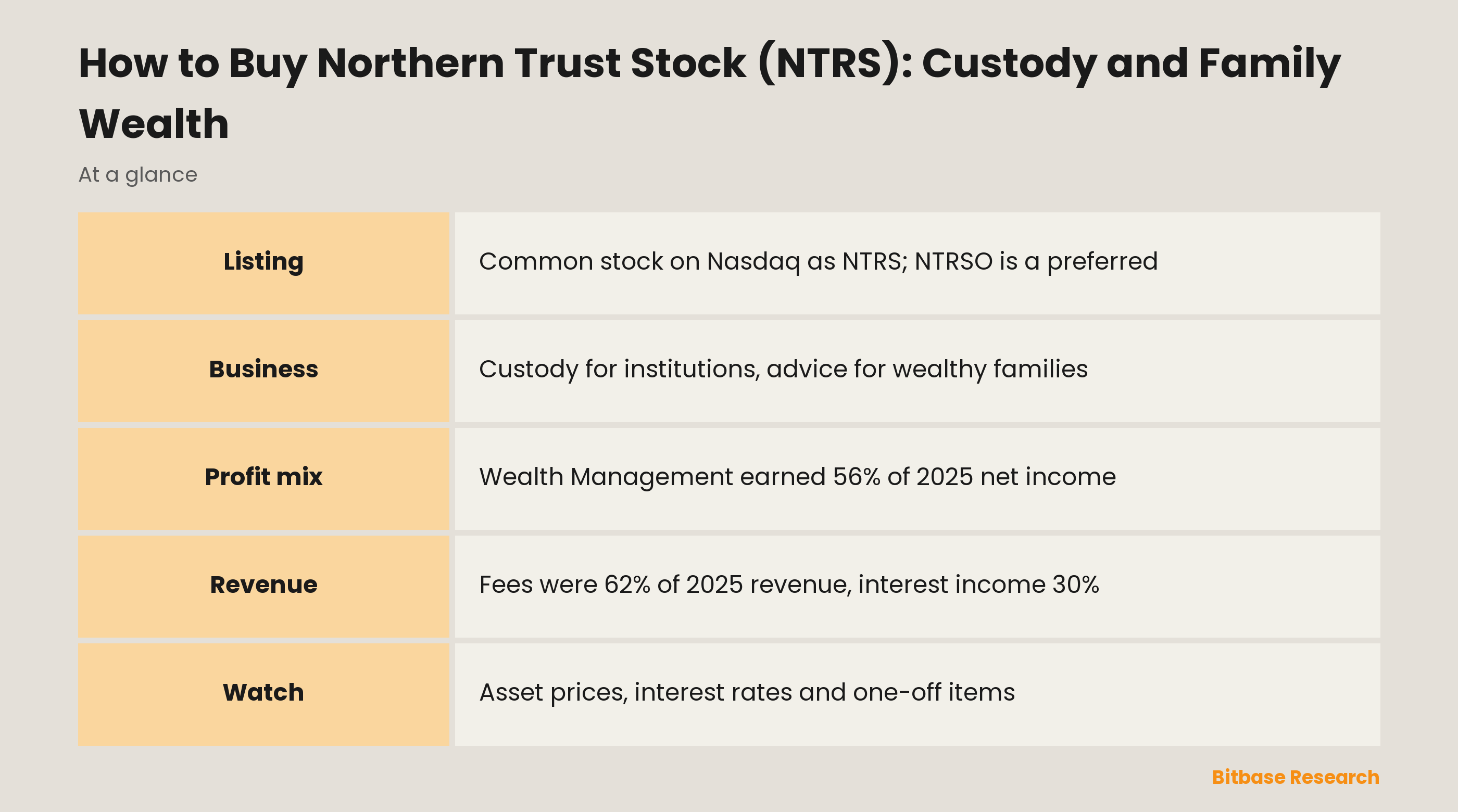
You will need a brokerage account with Nasdaq access to buy Northern Trust shares, because the Chicago bank's common stock trades there as NTRS. Behind the ticker sit two very different businesses: Asset Servicing keeps the securities and books of pension funds, sovereign wealth funds and fund managers, while Wealth Management advises rich families, and in 2025 the smaller wealth side earned 56% of net income from about 42% of revenue.
What Does Northern Trust Do?
Northern Trust holds, administers and invests money for institutions and wealthy households. Its 10-K describes the group as "a leading provider of wealth management, asset servicing, asset management and banking solutions to corporations, institutions, families and individuals." The operating company, The Northern Trust Company, is an Illinois bank founded in 1889; the Delaware holding company above it dates from 1971 and is supervised by the Federal Reserve as a financial holding company. Michael O'Grady has been chief executive since 2018 and chairman since 2019.
The reach goes well beyond Chicago: offices in 24 US states and Washington, D.C., plus 22 locations in Canada, Europe, the Middle East and Asia-Pacific. Of about 23,800 full-time equivalent staff at the end of 2025, more worked in Asia-Pacific (42%) than in North America (41%).
Asset Servicing works for corporate and public retirement funds, foundations, endowments, fund managers, insurers and sovereign wealth funds. Its core is custody and fund administration: safekeeping securities, settling trades and producing the accounts that trustees and regulators rely on. Around it sit outsourced investment operations, securities lending, foreign exchange, risk analytics and cash management. Assets under custody or administration in the segment grew 11% during 2025.
Wealth Management serves high-net-worth families, business owners, executives and retirees as trustee, estate administrator, portfolio manager, custodian and private banker. Its Global Family Office unit handles the investment, custody and reporting needs of family offices worldwide. The 10-K calls the segment "one of the largest providers of advisory services in the United States," with teams in 19 states and Washington, D.C., and offices in London, Guernsey, Singapore and Abu Dhabi.
Asset Management runs active and passive equity, fixed income, cash, multi-asset and alternative strategies through managed accounts, collective funds and ETFs. It has no reporting line of its own; its revenue and costs are allocated in full to the two segments.
The 10-K names rivals only by type, from other custodial banks and trust companies to asset managers and financial technology firms. The 2026 proxy statement is more concrete: the compensation peer group includes BNY, State Street, BlackRock, Charles Schwab and T. Rowe Price, though the proxy says the group is "not necessarily representing primary business competitors."
How Northern Trust Makes Money
Most income is fees for looking after and managing assets; the rest is interest earned on deposits clients leave with the bank.
| Revenue line | Share of 2025 revenue | Change from 2024 |
|---|---|---|
| Trust, investment and other servicing fees | 62% | +6% |
| Net interest income | 30% | +11% |
| Foreign exchange trading income | 3% | +4% |
| Treasury management, security commissions and other income | 5% | Lower; 2024 included a one-off Visa gain |
Shares are calculated from the 10-K revenue table and rounded.
Total revenue slipped 2% in 2025 and net income fell 14%, but only because 2024 carried a large gain from Northern Trust's participation in a Visa exchange offer. Servicing fees rose "primarily due to favorable markets, net new business, and favorable currency movements," and net interest income grew on higher deposits and lower funding costs.
Fees follow markets with a delay. Custody and administration fees depend on client asset values, transaction volumes and account numbers, and the 10-K says the asset values used "are based on a one-month or one-quarter lag." At the end of 2025 assets in custody were 50% equities, 30% fixed income, 19% cash and other assets and 1% securities lending collateral.
The two segments differ sharply in profitability:
| Segment | Share of 2025 revenue | Share of 2025 net income | Pre-tax margin |
|---|---|---|---|
| Asset Servicing | 59% | 51% | 24% |
| Wealth Management | 42% | 56% | 38% |
Revenue shares and margins are calculated from the 10-K segment table; net income shares are the 10-K's own. Unallocated items in Other make up the rest (−1% of revenue, −7% of net income).
The balance sheet splits the same way. In 2025 Wealth Management held 86% of average loans, while Asset Servicing brought in 77% of average deposits. Net interest margin, the spread between what the bank earns on assets and pays for funding, widened to 1.70% from 1.62%, and offices outside the United States held 66% of average interest-bearing deposits.
NTRS Stock at a Glance
| Feature | NTRS |
|---|---|
| Exchange | Nasdaq (The NASDAQ Stock Market LLC) |
| Ticker | NTRS (common stock) |
| Second listed line | NTRSO: depositary shares, each a 1/1,000th interest in Series E non-cumulative perpetual preferred stock |
| Issuer | Northern Trust Corporation, a financial holding company |
| Sector | Custody and fund administration, wealth management, asset management |
| Index membership | S&P 500 and KBW Bank Index, according to the 10-K |
| Headquarters | 50 South LaSalle Street, Chicago, Illinois |
| Incorporated | Delaware; holding company formed in 1971, bank founded in 1889 |
| Fiscal year | Calendar year, ending 31 December |
| Payouts | Quarterly cash dividend on the common stock, plus share buybacks |
| SEC identifier | CIK 73124 |
Prices, market value and yield change with every trade; live figures are on the Northern Trust stock page on Bitbase.
How to Buy Northern Trust Stock
Northern Trust is a US company listed in the US, so no depositary receipt stands between you and the share. The purchase takes six steps:
1. Pick a broker that can reach Nasdaq. Outside the United States, use a local broker offering US shares or an international platform, and check which legal entity holds your account and who regulates it.
2. Pass the account checks. Non-US individuals usually certify their status on IRS Form W-8BEN when the broker asks; the broker uses it to apply any treaty rate on dividends.
3. Fund the account. NTRS is priced in dollars, so other currencies are converted, and the exchange spread can cost more than the commission.
4. Search for NTRS, not NTRSO. Both symbols belong to Northern Trust and trade on Nasdaq, but NTRSO is a preferred security with its own dividend. Confirm the result reads Northern Trust Corporation common stock.
5. Choose the order type. A market order fills at the prevailing price; a limit order caps what you pay and may not fill, which helps around the quarterly earnings release.
6. Decide on whole or fractional shares. Some brokers sell slices of a share for a fixed sum, and fractional holders may not be able to vote.
Withholding tax. The IRS says "most types of U.S. source income received by a foreign person are subject to U.S. tax of 30%," usually withheld at payment, unless a tax treaty lowers the rate. Your home country may tax the dividend again.
Through funds. NTRS is in the S&P 500 and the KBW Bank Index, so funds tracking either index hold it as one position among many.
What Moves NTRS Stock
Asset prices. Fees track what clients own, so rising stock and bond markets lift revenue and falling ones cut it, with the lag described above. The S&P 500's daily average rose 15% in 2025, the backdrop to that year's 6% fee growth. The 10-K also warns that a shift in client preference "to lower fee products" could hurt earnings.
Interest rates. With net interest income at 30% of revenue, rates matter more than the custodian label suggests. "The direction and level of interest rates are important factors in our earnings," the 10-K says, adding that the rapid increases of 2022 and 2023 cut the value of some investment securities. In the third quarter of 2026 net interest margin on a fully taxable equivalent basis was 1.83%, against 1.70% a year earlier.
Notable items. Releases list one-off gains and charges first. In 2026 they included a gain from a second Visa exchange offer, booked mostly in the second quarter, severance and software charges, and a gain on selling the guardianship services business in the third quarter. Excluding such items, Michael O'Grady said third-quarter "revenues grew 11%," pre-tax income 21% and earnings per share 40%.
Costs. Management frames progress around its One Northern Trust strategy, and the CEO credited the third quarter with "more than 600 basis points of positive operating leverage." Since the 10-K lists failure to "control our costs and expenses adequately" as a risk, the gap between revenue and expense growth is worth tracking every quarter.
Capital rules. As a Category II banking organization, Northern Trust can pay dividends and buy back stock only within Federal Reserve capital plan rules and its stress capital buffer. Its July 2025 buyback authorization has no expiration date, and the quarterly dividend was raised in the third quarter of 2026.
People and policy. Chief financial officer Dave Fox will retire and is expected to stay through the first quarter of 2027 while a successor is sought. The 10-K adds that stablecoin legislation, the enacted GENIUS Act and the proposed CLARITY Act, "may affect our clients' needs and expectations for products and services."
Pressure Points in Northern Trust's 10-K Item 1A
These passages bear most directly on an NTRS holder:
Fee dependence. The first market risk reads: "We are dependent on fee-based business for a majority of our revenues, which may be affected adversely by market volatility, a downturn in economic conditions, underperformance and/or negative trends in investment preferences."
Errors at volume. "Given the high volume of transactions we process, errors that affect earnings may be repeated or compounded before they are discovered and corrected." Much of the technology runs on third-party systems, and cyber-attacks are a separate risk.
Fiduciary claims. Clients may sue over duties they believe were missed, and "our trust, custody and investment management businesses are particularly subject to this risk," especially when markets fall.
Trapped cash. Cash tied to Russian securities held for some Asset Servicing clients sits with subcustodians and clearing agencies under restrictions, and the 10-K expects it to "increase significantly over time." If one of those institutions failed, the loss could fall on Northern Trust.
Funding the parent. "The Corporation relies in large part on dividends paid to it by the Bank to meet its obligations and to pay dividends to stockholders," and banking law limits those payments.
New competitors. Nontraditional providers often face "fewer regulatory constraints," helped by technology "such as the use of generative AI."
Two risks belong to the stock itself. One bank share concentrates your money in one company. And returns are not assured: on the 10-K's five-year chart, with 100 invested at the end of 2020 and dividends reinvested, NTRS reached 176 by the end of 2025, while the S&P 500 and the KBW Bank Index both reached 196.
How to Research NTRS Yourself
Filings sit on EDGAR under CIK 73124: the 10-K each February, 10-Qs for the first three quarters and 8-Ks for events. In 2026 the earnings 8-Ks came on 22 January, 21 April, 22 July and 21 October, each with a release, a presentation and a trend report setting several quarters side by side.
In the 10-K, laid out as the annual report, Item 1 explains the segments and regulation, Item 1A the risks, and the MD&A the fee lines and the segment table used above. Two habits help: read the notable items before the headline earnings, and watch for restated categories, since from the second quarter of 2026 the regional Wealth Management fee lines were merged into one Private Wealth line, with earlier periods revised. The spring proxy statement names the peer groups used for pay and performance. For other listed companies, see all US stock pages on Bitbase.
Northern Trust Stock FAQ
Can I buy Northern Trust stock with crypto?
Not directly. NTRS is bought in US dollars through a brokerage account, so crypto must first be sold for cash, which may be taxable where you live. The result is a share in a regulated bank holding company, with dividends and a vote, which is how a share differs from a crypto asset.
Does Northern Trust pay a dividend?
Yes, a quarterly cash dividend on the common stock, raised in the third quarter of 2026; in 2025 dividends took 35.5% of earnings. Payments depend on Federal Reserve capital rules and on dividends from the bank to the parent, so check each release for the current amount.
Is NTRS in the S&P 500?
Yes. The 2025 10-K states that the company "is included in the S&P 500 Index and the KBW Bank Index."
What is NTRSO?
The second Northern Trust security on Nasdaq: depositary shares, each a 1/1,000th interest in a share of Series E non-cumulative perpetual preferred stock. It pays preferred dividends, has no maturity date and can be redeemed by the company under its terms. It is not the common stock.
Does Northern Trust hold cryptocurrency for clients?
Not according to its 2025 10-K, which says "we do not hold, invest in, or custody cryptocurrency assets." It still lists crypto volatility as a risk, because it can spill into markets for the assets the bank does hold.
Conclusion
Northern Trust is two businesses under one ticker: an institutional servicing operation that brings in most of the revenue, and a private wealth business that in 2025 earned most of the profit. Both are paid largely on asset values and both lean on client deposits, so the stock answers to markets and to interest rates at once. Read the latest 10-K and quarterly release, set the notable items aside, judge whether fees are growing faster than costs, and decide how much one custody bank should weigh in your portfolio.
Related reading
Other Bitbase articles on this topic:
- How to Buy Fifth Third Stock (FITB): Comerica Deal and NYSE Move
- How to Buy Huntington Bancshares Stock (HBAN): Cadence and Veritex
- How to Buy KB Financial Stock (KB): One ADS Equals One Seoul Share
- How to Buy State Street Stock (STT): Custody, SPDR ETFs and Fees
Disclaimer: This article is educational content from Bitbase Academy, provided for information only. It explains what a company or fund does and how the instruments referenced here differ from one another; it does not constitute investment, trading, tax, or financial advice, and it is neither a recommendation nor an endorsement of any security, token, or trading strategy. A tokenized stock is issued by a third party and is designed to give economic exposure to an underlying asset: it is not a share, it carries no shareholder rights, and it depends on the issuer's structure, eligibility rules, and redemption terms, which the issuer can change. Perpetual futures are leveraged derivatives that hold no underlying asset and can be liquidated, and trading hours, product availability, and eligibility differ by instrument and by jurisdiction and can change at any time. Written as of November 2026; verify everything yourself through company filings, the issuer's own documentation, and the product pages of the venue you trade on.
References
[1] Northern Trust Form 10-K for 2025 (SEC EDGAR) www.sec.gov
[2] Northern Trust Form 10-Q, third quarter of 2026 (SEC EDGAR) www.sec.gov
[3] Northern Trust third-quarter 2026 earnings release, Form 8-K Exhibit 99.1 (SEC EDGAR) www.sec.gov
[4] Northern Trust 2026 proxy statement (SEC EDGAR) www.sec.gov
[5] Northern Trust Form 8-K, September 2026: CFO transition (SEC EDGAR) www.sec.gov
[6] IRS: NRA Withholding www.irs.gov
[7] IRS: About Form W-8 BEN www.irs.gov





