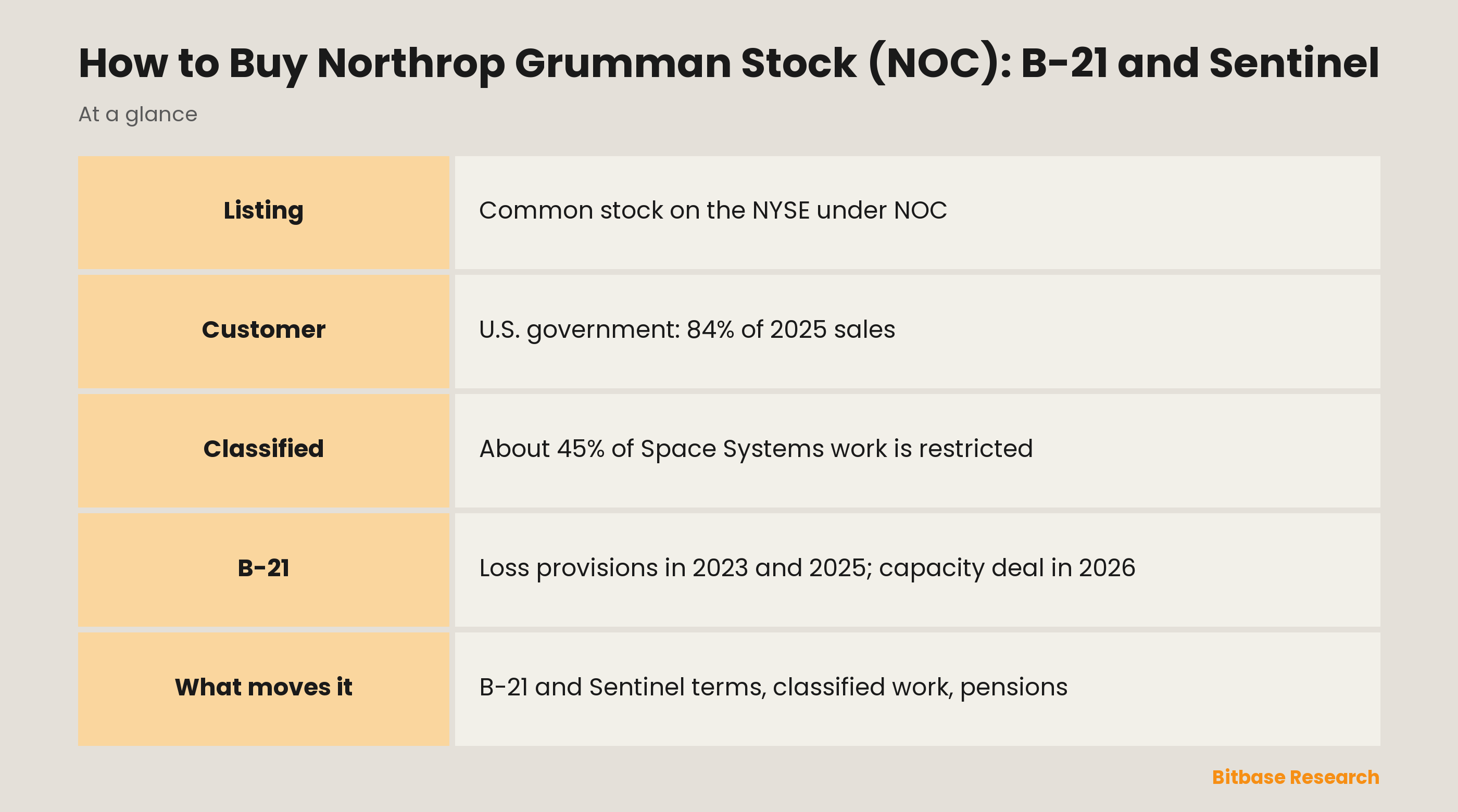
Weighing all the routes into Northrop Grumman stock brings you back to one: a brokerage account that can reach the New York Stock Exchange, where the common shares trade under the ticker NOC. Two facts shape what that share buys into: the U.S. government accounted for 84% of 2025 sales, and about 45% of the space business runs through restricted programs the company may not discuss in detail. What follows walks through the four segments, the purchase, and the two programs its filings treat in subsections of their own, the B-21 Raider bomber and the Sentinel missile.
What Does Northrop Grumman Do?
Northrop Grumman calls itself "a leading global aerospace and defense technology company" and sells "principally to the U.S. Department of War ('DoW') and intelligence community." It is incorporated in Delaware and based in Falls Church, Virginia.
Its roots are Northrop Aircraft Incorporated, formed in 1939 in Hawthorne, California; as Northrop Corporation, reincorporated in Delaware in 1985, it was a principal developer of flying-wing technology, including the B-2 Spirit bomber. Buying Grumman in 1994 produced the present name; TRW followed in 2002 and Orbital ATK in 2018. The portfolio has also been pruned: shipbuilding left with the 2011 spin-off of Huntington Ingalls Industries, IT services were sold to Veritas Capital in 2021, and a training services unit went in May 2025.
The company reports four segments:
Aeronautics Systems builds, sustains and upgrades military aircraft: the B-21 Raider long-range strike bomber, support for the B-2, the E-130J Phoenix II for the U.S. Navy's TACAMO nuclear command mission, fuselage production for the F-35 and F/A-18, the E-2D Advanced Hawkeye, and the Triton and Global Hawk uncrewed surveillance aircraft.
Defense Systems covers strategic deterrence, tactical weapons and missile defense. It runs the development phase of Sentinel, the modernization of the intercontinental ballistic missile system that will serve as the land-based leg of the U.S. nuclear triad, and builds the IBCS command-and-control system for the U.S. Army and Poland, ammunition, the AARGM-ER missile and rocket motors for the Precision Strike Missile.
Mission Systems makes sensors and electronics: the F-35's fire-control radar and Distributed Aperture System, electronic warfare and cyber systems, navigation equipment, and the power and propulsion systems for Virginia- and Columbia-class submarines.
Space Systems builds satellites, interceptors and launch propulsion, including GEM 63 boosters for the Atlas V and Vulcan rockets, satellites for the Space Development Agency, the Cygnus spacecraft that resupplies the International Space Station for NASA, and rocket motors for NASA's Space Launch System and the Navy's Trident II missile.
Much of this work stays out of public view. The company is "prohibited by the U.S. government from publicly discussing the details of classified programs," which its filings call restricted; their results are in the financial statements, their details are not.
The 10-K names Boeing, General Dynamics, L3Harris, Lockheed Martin and RTX as competitors, "as well as, increasingly, new entrants and startups," and calls it "not unusual" to bid against a peer on one contract while acting as its supplier or customer on another.
How Northrop Grumman Makes Money
Revenue comes almost entirely from long-term government contracts, recognized "primarily over time on a cost-to-cost basis" as the company incurs costs. The 2025 segment picture:
| Segment | Main programs | Share of 2025 sales | Sales growth in 2025 | Business in restricted programs |
|---|---|---|---|---|
| Aeronautics Systems | B-21, E-130J, F-35 fuselages, E-2D | 30.6% | 4.8% | About 40% |
| Mission Systems | F-35 radar and sensors, electronic warfare, submarine power | 26.4% | 9.7% | About 30% |
| Space Systems | Satellites, GEM 63 boosters, Cygnus, interceptors | 24.5% | −8.2% | About 45% |
| Defense Systems | Sentinel, IBCS, ammunition, rocket motors | 18.6% | 8.1% | Under 5% |
Shares exclude sales between segments; growth uses each segment's own sales line in the 10-K, which includes them. Restricted shares are the 10-K's own approximations.
Sales to the U.S. government made up 84% of the 2025 total, after 87% in 2024 and 86% in 2023, counting work done as a subcontractor when Washington is the end customer. International customers supplied 14%, including foreign military sales arranged through the U.S. government, and their purchases grew 19.8% in 2025. In the first nine months of 2026, the U.S. government's share was 85%.
In 2025, 50% of sales came from cost-type contracts, which reimburse allowable costs plus a fee, and the rest from fixed-price contracts. Cost-type contracts, the 10-K explains, "have less financial risk associated with unanticipated cost growth but generally provide lower profit margins than fixed-price contracts." International work leans on fixed prices: 86.7% of 2025 international sales were fixed-price.
Total sales rose 2.2% in 2025. Space Systems shrank as work on restricted space programs and a program the filing calls NGI wound down, while Mission Systems grew on restricted airborne radar. Aeronautics' operating margin fell to 6.3% from 10.0%, mainly because of a B-21 loss provision in the first quarter. In the first nine months of 2026, sales were 5.4% higher than a year earlier, with all four segments growing and Aeronautics up 14.4%.
Backlog, the sales expected from firm orders, rose 4.6% during 2025 and a further 14.5% in the first nine months of 2026, with Defense Systems up 31.2% as Sentinel's backlog grew. At 30 September 2026, 45.7% of it was funded, meaning authorized and appropriated; the rest depends on future appropriations.
NOC Stock at a Glance
| Item | Detail |
|---|---|
| Exchange | New York Stock Exchange (NYSE) |
| Ticker | NOC |
| Security | Common stock, the only security registered on the 10-K cover |
| CUSIP | 666807102 |
| Sector | Aerospace and defense |
| Index membership | S&P 500; not in the Dow Jones Industrial Average |
| Headquarters | Falls Church, Virginia |
| Incorporated | Delaware |
| Fiscal year | Calendar year, ending 31 December |
| Dividend policy | Quarterly cash dividend, raised by 7% in May 2026 |
| SEC identifier | CIK 1133421 |
Price, market value and yield change through every session, so they are left out here; the Northrop Grumman stock page on Bitbase carries them.
How to Buy Northrop Grumman Stock
Northrop Grumman's own common stock is listed in New York, so no depositary receipt sits in between. The purchase runs through a broker:
1. Choose a broker with NYSE access. Abroad, the choice is between a domestic firm with a US-markets service and an international broker; check which entity holds your account and who supervises it.
2. Complete the account checks. Brokers document a non-US individual's status with IRS Form W-8BEN, the "Certificate of Foreign Status of Beneficial Owner for United States Tax Withholding," and use it to apply any treaty rate to dividends.
3. Fund the account. A currency conversion has its own cost; compare it alongside the commission.
4. Confirm the line. Search for NOC and check that the result reads Northrop Grumman common stock on the NYSE, CUSIP 666807102. The 10-K cover registers no other exchange-listed security, so there are no listed bonds to mistake for the shares.
5. Choose the order type. The SEC's investor bulletin on trading basics defines a market order as one "at the best available price," adding that "the price at which a market order will be executed is not guaranteed." A limit order fills only "at a specific price or better," but "a limit order is not guaranteed to execute."
6. Set the size and keep records. Some brokers sell fractional shares, so you can invest a fixed sum; whether yours does, and on what terms, is in its own documentation. Confirmations and statements record your cost and dividends for tax time.
From outside the United States, dividends are taxed at source. The IRS explains that a foreign person is generally subject to US tax on US-source income, collected by withholding, and that a tax treaty can lower the rate or remove it; Form W-8BEN is how you claim that. Your own country may tax the dividend again.
Through index funds, you can hold Northrop Grumman without choosing it: State Street's holdings files dated 29 October 2026 list it in SPY, an S&P 500 fund, and XLI, an industrial sector fund, as one holding among many.
What Moves NOC Shares
The B-21's production economics. The Air Force awarded the B-21 contract in 2015: a development phase that is largely cost-type, plus five low-rate initial production (LRIP) options for a baseline of 21 aircraft that are largely fixed-price and expected to run to about the end of the decade. When a contract is expected to lose money, the whole estimated loss is charged at once, and that has happened twice on the LRIP options, in the fourth quarter of 2023 and the first quarter of 2025. Two later lots carry not-to-exceed pricing whose average sits above the LRIP average unit price, though final terms are not negotiated. In the first quarter of 2026 the company agreed with the Air Force to expand capacity and raise the production rate, investing its own money over several years for "the opportunity to earn improved returns." Its third-quarter 2026 review made "no significant changes" to the loss already recognized. Aeronautics' operating margin was 10.1% in the first nine months of 2026, against 4.9% a year earlier, which the 10-Q puts down mainly to the absence of the prior-year provision.
Sentinel's restructuring. In January 2024 the Air Force told Congress that Sentinel was under a Nunn-McCurdy breach review, required when program cost estimates exceed set thresholds; the increase came mainly from estimates for the later production and deployment phases. In July 2024 the program was certified to continue and ordered restructured, including the plans for command and launch infrastructure, the main driver of the higher estimates. Northrop Grumman performs the development work under a cost-type contract, while the production and deployment phases "are yet to be priced and negotiated," and the restructuring includes the work needed to "re-accomplish Milestone B approval."
Classified work. With so much of the business restricted, sizeable changes can arrive with little explanation. The 10-K puts Space Systems' 2025 decline down primarily to the wind-down of "the restricted space and NGI programs" and says no more. Ramps the 10-K does name, such as GEM 63 boosters and the HALO module for NASA's Lunar Gateway, are easier to follow from outside.
Pension accounting. Gains and losses from marking the pension and retiree plans to market are "generally only recognized during the fourth quarter," so fourth-quarter earnings can carry an item the other quarters lack; it was a benefit in 2024 and 2025 and an expense in 2023. The company also reports MTM-adjusted earnings per share, a non-GAAP measure that leaves it out. Separately, a FAS/CAS operating adjustment reconciles the pension cost charged to government contracts with the cost under accounting standards.
Key Risks for a NOC Shareholder
Of the risk factors in Item 1A of the 10-K, five speak most directly to what a shareholder owns:
One customer. The first reads: "We depend heavily on a single customer, the U.S. government, for a substantial portion of our business." That customer "has the ability to delay, modify or cancel ongoing competitions, procurements and programs," and if it ends a contract for convenience, contractors generally recover costs and profit on them "but not the anticipated profit that would have been earned."
Funding and its timing. "Significant delays or reductions in appropriations," including "a prolonged continuing resolution, government shutdown or breach of the debt ceiling," can hurt its programs, and programs "are often partially funded initially, with additional funds committed incrementally over time as Congress makes further appropriations."
Fixed-price development. Customers "have sought, and may in the future seek, fixed-price contracts for development programs, combined development and production programs, or low-rate initial production programs, where the risks are greater." The B-21's LRIP options are that kind of contract.
Limits on buybacks and dividends. If government contracts include terms tied to underperformance, insufficient investment or insufficient production speed, and the company triggers them, it "may be prohibited from engaging in share repurchases or dividends for a period of time." The 10-K also cites "the recent executive order applicable to government defense contractors," which seeks, among other things, to "limit share repurchases and dividends by government defense contractors."
New competitors. Customers "are increasingly working with commercial contractors as well as newer entrants and startups," which "may have lower cost, more agile operating structures and access to capital and talent."
Two further risks come with any single stock, this one included. Your result rides on one company's contracts, however many programs it runs. And past dividend increases do not bind the board, which declares each payment; for a holder whose home currency is not the dollar, exchange rates move both the share price and the payout received.
How to Research NOC Yourself
Northrop Grumman files with the SEC under CIK 1133421: a 10-K each year, 10-Qs each quarter and 8-Ks in between, including each earnings release. The third-quarter 2026 10-Q and its release both came out on 20 October 2026.
In the 10-K, Item 1 describes the segments and their restricted shares, Item 1A the risks, and the MD&A has separate subsections on the B-21 and Sentinel, both updated in that 10-Q. Note 15 breaks sales down by customer, contract type and region; Note 10 covers investigations and litigation.
Two checks help with the numbers. Segment sales include sales to other segments, eliminated in the total; at Mission Systems they were 11.5% of 2025 segment sales, so the four segments add up to more than the company. And the performance graph sets the company's own benchmarks: the S&P 500 and the S&P Aerospace & Defense Index, whose members include General Dynamics, Lockheed Martin, RTX and General Electric. For quotes on the peers, Bitbase's US stock pages list them alongside NOC.
Northrop Grumman Stock FAQ
Can I buy Northrop Grumman stock with crypto?
Not directly. NOC shares are bought through a brokerage account and paid for in US dollars, so you would sell the crypto first and send the cash to the broker, and that sale may be taxable where you live. Keep the two decisions apart: a share is a registered stake with dividend and voting rights, what sets a share apart from a crypto asset.
Does Northrop Grumman pay a dividend?
Yes, quarterly. The board raised it by 7% in May 2026, after 12% in May 2025 and 10% in May 2024, and declares each payment; amounts and dates are in the filings. Buybacks under a program authorized in December 2024 began in September 2025, and the third-quarter 2026 10-Q reports none in that quarter. Both are exposed to the limits described above.
Is NOC in the S&P 500 or the Dow?
It is in the S&P 500 but not the Dow Jones Industrial Average: State Street's holdings file for DIA, its Dow fund, dated 29 October 2026, does not list it.
Has Northrop Grumman stock ever split?
Yes. In May 2004 the board declared a two-for-one split, paid as a stock dividend on 21 June 2004. The 2004 annual report adjusted per-share data for earlier periods, so older figures need the same treatment.
What happened to Northrop Grumman's shipbuilding business?
It became Huntington Ingalls Industries. Northrop Grumman acquired Newport News Shipbuilding and Litton Industries, a shipbuilder among other things, in 2001, then spun the shipyards off as Huntington Ingalls in 2011. It still supplies submarine programs: Mission Systems makes power and propulsion systems for Virginia- and Columbia-class boats.
Conclusion
Buying NOC takes a broker with NYSE access, the right common stock line and an order type you understand. Knowing what you own takes longer: a company that sells mostly to one government, under contracts split between cost reimbursement and fixed prices, with much of its work classified. The B-21 and Sentinel subsections and the backlog table in each new filing show how the two programs it discusses at length are developing; read them before deciding how much of a portfolio belongs in one defense contractor.
Related reading
Other Bitbase articles on this topic:
- How to Buy FedEx Stock (FDX): After the Freight Spin-Off
- How to Buy Garmin Stock (GRMN): Wearables, Taiwan, Swiss Dividend
- How to Buy General Dynamics Stock (GD): Gulfstream and Submarines
Disclaimer: This article is educational content from Bitbase Academy, provided for information only. It explains what a company or fund does and how the instruments referenced here differ from one another; it does not constitute investment, trading, tax, or financial advice, and it is neither a recommendation nor an endorsement of any security, token, or trading strategy. A tokenized stock is issued by a third party and is designed to give economic exposure to an underlying asset: it is not a share, it carries no shareholder rights, and it depends on the issuer's structure, eligibility rules, and redemption terms, which the issuer can change. Perpetual futures are leveraged derivatives that hold no underlying asset and can be liquidated, and trading hours, product availability, and eligibility differ by instrument and by jurisdiction and can change at any time. Written as of October 2026; verify everything yourself through company filings, the issuer's own documentation, and the product pages of the venue you trade on.
References
[1] Northrop Grumman Form 10-K, fiscal 2025: segments, customers, B-21, Sentinel and risk factors (SEC EDGAR) www.sec.gov
[2] Northrop Grumman Form 10-Q for the quarter ended 30 September 2026 (SEC EDGAR) www.sec.gov
[3] Northrop Grumman press release, 12 May 2004: dividend increase and two-for-one split (Form 8-K exhibit, SEC EDGAR) www.sec.gov
[4] Northrop Grumman Form 10-K, fiscal 2004: per-share data adjusted for the 2004 split (SEC EDGAR) www.sec.gov
[5] State Street SPDR S&P 500 ETF Trust (SPY): fund page and daily holdings www.ssga.com
[6] State Street Industrial Select Sector SPDR ETF (XLI): fund page and daily holdings www.ssga.com
[7] State Street SPDR Dow Jones Industrial Average ETF Trust (DIA): fund page and daily holdings www.ssga.com
[8] SEC Investor Bulletin: Trading Basics, the different ways to buy and sell stock www.sec.gov
[9] IRS: NRA Withholding www.irs.gov





