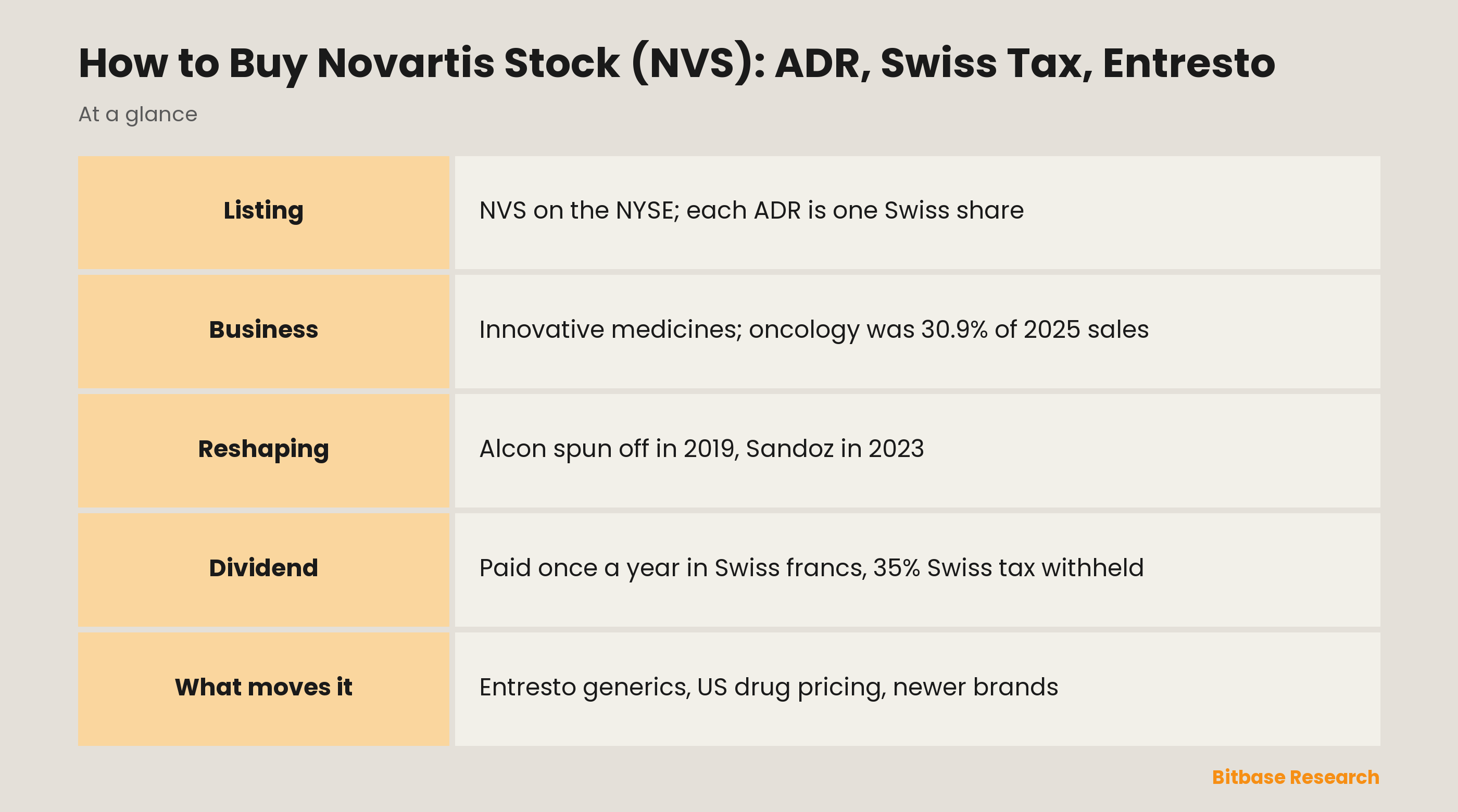
Your order for Novartis stock can go through any broker that reaches the New York Stock Exchange, and there the ticker NVS is an American depositary share standing for exactly one Novartis AG share listed in Zurich. Behind that receipt sits a narrower company than many investors remember: Alcon left in 2019, Sandoz in 2023, and what remains is, in its own words, a "pure-play" innovative medicines company. This guide covers where the revenue comes from, how to place the order, what the ADR means for dividends and Swiss tax, and the pressures the annual report flags, led by US generics of Entresto.
What Does Novartis Do?
The annual report on Form 20-F puts the business in one sentence: "Novartis is an innovative medicines company, engaged in the research, development, manufacturing, distribution, marketing and sale of a broad range of pharmaceutical products." The parent, Novartis AG, was incorporated under Swiss law on 29 February 1996, and on 20 December that year its two predecessors, Ciba-Geigy and Sandoz, merged into it. It is headquartered in Basel and sells its products in about 120 countries.
Most of its effort goes to four therapeutic areas: cardiovascular, renal and metabolic; immunology; neuroscience; and oncology. The key products described in the 20-F map onto them. Entresto is an oral heart-failure drug. Leqvio, a small interfering RNA injected twice a year after the first year, lowers LDL cholesterol. Cosentyx blocks the inflammatory protein IL-17A in psoriasis and several other immune-mediated diseases. Kesimpta treats relapsing multiple sclerosis. Kisqali, a CDK4/6 inhibitor, treats hormone receptor-positive, HER2-negative breast cancer, and Pluvicto is a radioligand therapy: a targeting molecule that carries a radioactive particle to PSMA-positive cells, including prostate cancer cells. Older medicines such as Sandostatin, Diovan and Lucentis are grouped as Established Brands.
For accounting purposes it reports a single global operating segment. Beyond its established chemistry and biotherapeutics platforms, its mid-2026 report names three emerging platforms it is prioritizing: gene and cell therapy, radioligand therapy and xRNA. Zolgensma, a one-time gene therapy for spinal muscular atrophy, is an example of the first.
That shape is the result of two spin-offs. On 9 April 2019 Novartis completed the separation of its Alcon eye care business, giving holders one Alcon share for every five Novartis shares or ADRs; Alcon then listed on the SIX Swiss Exchange and the NYSE as ALC. On 3 October 2023 the generics business, Sandoz, followed on the same one-for-five basis, with ADR holders receiving Sandoz ADRs, and Sandoz has traded on SIX as SDZ since the next day. An NVS share bought now carries neither business.
How Novartis Makes Money
Net sales rose 8% in 2025, in dollars and in constant currencies alike. The annual report splits that growth into volume, which added 15 percentage points, generic competition, which took away 6, and pricing, which took away 1. By therapeutic area:
| Therapeutic area | Share of 2025 net sales | Products named in the revenue note |
|---|---|---|
| Oncology | 30.9% | Kisqali, Pluvicto, Tafinlar + Mekinist, Jakavi, Scemblix |
| Immunology | 18.9% | Cosentyx, Ilaris, Xolair |
| Cardiovascular, renal and metabolic | 16.4% | Entresto, Leqvio |
| Neuroscience | 11.0% | Kesimpta, Zolgensma |
| Established Brands | 22.8% | Sandostatin, Exforge, Lucentis, Diovan, Galvus, contract manufacturing |
Shares are calculated from the 2025 net sales the 20-F reports for each area and rounded to one decimal.
Revenue leans on a short list of brands. Entresto was still the largest product in 2025 at 14.2% of net sales, followed by Cosentyx at 12.2%, Kisqali at 8.8% and Kesimpta at 8.1%; the 20 largest products together made up 81.6%. Growth came from the newer launches: Kisqali sales rose 58%, Pluvicto 43%, Kesimpta 37% and the leukemia drug Scemblix 87%, while Entresto edged down once US generics arrived in the second half of the year.
By region, the United States brought in 42.8% of 2025 net sales, Europe 30.7%, Asia, Africa and Australasia 19.8%, and Canada and Latin America 6.7%. The buyers are concentrated: "A significant portion of our global sales is to a small number of drug wholesalers, retail chains, governments, and other purchasing organizations," and the three largest customers accounted for about 18%, 13% and 7% of net sales. Research and development absorbed 20.5% of net sales in 2025.
NVS Stock at a Glance
| Field | NVS |
|---|---|
| US listing | NVS on the New York Stock Exchange (NYSE) |
| What NVS is | American depositary share (ADS); each represents one Novartis AG ordinary share |
| Home listing | SIX Swiss Exchange, ticker NOVN (ISIN CH0012005267) |
| Depositary bank | JPMorgan Chase Bank, N.A. |
| Sector | Pharmaceuticals: patented, innovative medicines |
| Headquarters | Basel, Switzerland |
| Incorporated | Switzerland, 1996, as a stock corporation (Aktiengesellschaft) |
| Fiscal year | Calendar year, ending 31 December |
| Reporting | IFRS, in US dollars |
| Dividend policy | One annual dividend set in Swiss francs and approved at the general meeting; the 2025 dividend was the 29th consecutive increase |
| SEC filings | Form 20-F (annual) and Form 6-K (quarterly reports and other news); CIK 1114448 |
Anything that changes by the minute is left out of the table; the live NVS quote and chart are on the Novartis stock page on Bitbase.
How to Buy Novartis Stock
Novartis has two listings: NVS on the NYSE, which trades in US dollars and clears through US settlement systems, and NOVN on SIX, which trades in Swiss francs. The steps below follow the NYSE line:
1. Pick a broker with NYSE access. Find out which company actually holds your account and which regulator supervises it. To hold the ordinary share itself, you need a broker that reaches SIX instead.
2. Open and verify the account. Declare your tax residence accurately, because the Swiss withholding tax relief described below depends on it.
3. Fund it. If you convert from another currency, look at the conversion rate, not only the commission.
4. Locate the listing. Type NVS and confirm the result reads Novartis AG American depositary shares on the NYSE.
5. Set the order. A market order "guarantees that the order will be executed, but does not guarantee the execution price"; a limit order executes only "at a specific price or better."
6. Size the position. With fractional shares you can put in a fixed sum, but "not every brokerage firm offers fractional share investing," some restrict fractional orders to market orders, and you "may not have voting rights" on a fraction.
NVS trades in New York and NOVN in Zurich, so the two quotes cover different hours of the day. If your broker lets you trade outside the NYSE session, remember that a price printed outside regular hours comes from a thinner market and can sit some distance from the next open; a limit order puts a ceiling on the price.
What the ADR changes. The SEC describes an ADR as "a security that represents shares of non-U.S. companies that are held by a U.S. depositary bank outside the United States." For Novartis that bank is JPMorgan, and the 20-F spells out the consequence: "An ADR is not a share, and an ADR holder is not a Novartis AG shareholder." ADR holders have the rights set out in the deposit agreement, such as receiving dividends and instructing the depositary how to vote. The depositary may charge fees per ADS, listed in Item 12.D of the 20-F, and the SEC notes that such fees are commonly subtracted from the gross dividends paid to ADR holders.
Dividends and Swiss tax. Dividends on both shares and ADRs are subject to a Swiss federal withholding tax "at a current rate of 35%." Residents of countries with a Swiss tax treaty may reclaim part of it, by procedures that differ from country to country. For a qualifying US-resident individual the treaty rate is 15%, and JPMorgan handles the Swiss paperwork for US-resident ADR holders and pays out the net amount. A sale of the Swiss share through a Swiss bank or securities dealer may also attract a federal stamp duty of 0.15%. Your home country may tax the income again.
Through an index fund. Novartis is not in the S&P 500: the daily holdings file of SPY, State Street's SPDR S&P 500 ETF Trust, dated 16 October 2026, does not list it. The same day's files for State Street's Portfolio Developed World ex-US ETF (SPDW) and MSCI ACWI ex-US ETF (CWI) do include the Swiss-registered share, NOVN, among their many holdings.
What Moves NVS Stock
Entresto's loss of exclusivity. The 20-F states that Novartis "lost market exclusivity for Entresto in the US in July 2025, and thereafter experienced a substantial decline in Entresto sales in that market during the second half of 2025." Europe is next: "Our regulatory data protection for Entresto in Europe expires in November 2026, and revenues will decline substantially thereafter unless we are successful in appropriately asserting our intellectual property rights that expire later." The 2026 interim figures show the effect. First-half net sales fell 2% in constant currencies, and in the second quarter 18 percentage points of volume growth were offset by 14 points of generic competition. Eli Lilly's annual report describes the same loss-of-exclusivity pattern for its own medicines; for Novartis the question is how fast the newer brands fill the gap.
The growth brands and their patent dates. The 20-F credits Kisqali, Kesimpta, Pluvicto, Scemblix and Cosentyx with most of the 2025 growth, and it dates the patents behind them: in the US, Cosentyx is listed at 2029, Kesimpta and Kisqali at 2031, Pluvicto and Leqvio at 2034 with term extensions applied for, and Scemblix at 2035. In mid-2026 the FDA granted Kisqali pediatric exclusivity, adding six months to all of its patents listed in the Orange Book. The company cautions that "the listing of any date in the table below should not be regarded as the date after which Novartis expects generic or biosimilar competition": litigation and other protections can move the real date either way.
US drug pricing. Under the Inflation Reduction Act, Entresto was among the first ten drugs selected for Medicare price negotiation in August 2023, and in August 2024 Novartis acceded to a "maximum fair price" for it for 2026. The Centers for Medicare and Medicaid Services has since selected Cosentyx, Kisqali and Xolair for the 2028 round. In December 2025 Novartis also announced a voluntary agreement with the US administration that includes "launching future medicines with comparable prices across high-income countries." After the US administration proposed tariffs on imported pharmaceuticals in 2025, the company said it expects "a three-year relief from any such tariffs" in recognition of planned US research and manufacturing investment.
Deals and the pipeline. Novartis bought Anthos Therapeutics, Regulus Therapeutics and Tourmaline Bio in 2025, and by its first-quarter 2026 report had completed the purchase of Avidity Biosciences, adding three late-stage medicines for neuromuscular disease. Deals, trial results and approvals decide whether each fading product has a successor.
Currency. Novartis reports in US dollars, sells in many currencies and pays its dividend in Swiss francs. The 20-F points to "expenditures in Swiss francs that are significantly higher than our revenue in Swiss francs," so a stronger franc raises costs relative to sales and also changes the dollar value of each dividend.
Risks to Weigh Before Buying NVS
The 20-F's risk factors run for pages; the headings closest to an NVS holding are these:
Intellectual property. "Expiry, assertion or loss of intellectual property protection." Losing protection and meeting generic or biosimilar competition, the filing adds, "typically result in a significant reduction in net sales and operating income for the branded product."
Pricing. "Pricing and reimbursement pressure, including pricing transparency and access to healthcare."
Launches and deals. "Failure to deliver key commercial priorities and successfully launch new products ahead of competitors," and "failure to identify, execute or realize the expected benefits from our external business opportunities."
Customers and currency. "Concentration among our key customers," and a "negative effect on financial results due to foreign currency exchange rate fluctuations."
Two more sit above the business. Owning one stock ties your result to one company, however broad its portfolio, and the ADR adds a layer: the depositary stands between you and the share, and fees can come out of dividends. The dividend itself is a policy "to pay a growing annual dividend in Swiss francs per share," subject to the company's financial condition and results.
How to Research NVS Yourself
Novartis's SEC filer number (CIK) is 1114448, and as a foreign private issuer it reports on different forms from a US company: the annual report is Form 20-F, and quarterly financial reports and other announcements arrive on Form 6-K. The SEC reminds investors that, "except for the annual report on Form 20-F, non-U.S. companies are generally only required to disclose what is required in their home country."
Within the 20-F, Item 3.D holds the risk factors, Item 4.B the business and the patent expiry table, Item 10.E the tax treatment of dividends and Item 12.D the depositary fees; the revenue note gives net sales by product and region. Two checks avoid misreadings. "Core" figures are non-IFRS measures, and growth is quoted both in dollars and in constant currencies, so compare like with like. And the structured cover of the 2025 filing registers both NVS and NOVN, but marks the NOVN line "not for trading but only in connection with the registration of American Depositary Shares."
The general meeting normally takes place in late February or early March, after the results release that carries the dividend proposal. For other companies, browse the Bitbase stock pages.
Novartis Stock FAQ
Is NVS the same as a Novartis share?
Not exactly. NVS is an American depositary share: JPMorgan holds one Novartis AG ordinary share for every ADR it issues, and you hold the ADR. You get the economic exposure and the rights in the deposit agreement, but "an ADR holder is not a Novartis AG shareholder." The ordinary share trades on SIX as NOVN.
Does Novartis pay a dividend?
Yes, once a year. Shareholders approve a dividend in Swiss francs at the general meeting and payment follows shortly after; the 2025 dividend, paid in March 2026, was the 29th consecutive increase since the company's creation in December 1996. ADR holders receive dollars after Swiss withholding tax, so the amount moves with the exchange rate.
Can I buy Novartis stock with crypto?
Not directly. NVS has to be bought through a broker, and an NYSE trade settles in US dollars, while NOVN trades in Swiss francs. You would first sell the crypto for fiat money and transfer that money to the brokerage account, and in many countries that sale is a taxable event in its own right. Treat it as two decisions: selling the crypto, then buying the shares.
Is Novartis in the S&P 500?
No. Novartis AG is incorporated in Switzerland, and SPY's holdings file dated 16 October 2026 did not list it. International funds such as SPDW and CWI hold the Swiss-listed share instead.
What happened to Alcon and Sandoz?
Both were spun off to shareholders at one new share for every five Novartis shares or ADRs: Alcon, the eye care business, in April 2019, and Sandoz, the generics business, in October 2023, when ADR holders received Sandoz ADRs. Both now trade as separate companies.
Conclusion
Buying NVS takes a broker with NYSE access and a clear idea of what the ticker is: a depositary receipt for one Swiss share, with dividends set in francs and taxed in Switzerland before they reach you. The company behind it now concentrates on innovative medicines, and its 2025 figures show the tension in that model, with Entresto losing exclusivity just as Kisqali, Kesimpta and Pluvicto grow. Read the latest 20-F and 6-K reports, and decide how much one drugmaker should weigh in your portfolio.
Related reading
Other Bitbase articles on this topic:
- How to Buy GSK Stock (GSK): Two-Share ADS, HIV and Haleon
- How to Buy Moderna Stock (MRNA): Vaccines, Cancer Trial and Perps
- How to Buy Novo Nordisk Stock (NVO): ADR, Wegovy and Ozempic
Disclaimer: This article is educational content from Bitbase Academy, provided for information only. It explains what a company or fund does and how the instruments referenced here differ from one another; it does not constitute investment, trading, tax, or financial advice, and it is neither a recommendation nor an endorsement of any security, token, or trading strategy. A tokenized stock is issued by a third party and is designed to give economic exposure to an underlying asset: it is not a share, it carries no shareholder rights, and it depends on the issuer's structure, eligibility rules, and redemption terms, which the issuer can change. Perpetual futures are leveraged derivatives that hold no underlying asset and can be liquidated, and trading hours, product availability, and eligibility differ by instrument and by jurisdiction and can change at any time. Written as of October 2026; verify everything yourself through company filings, the issuer's own documentation, and the product pages of the venue you trade on.
References
[1] Novartis AG Form 20-F, fiscal 2025: business, net sales, patents, risk factors, taxation and ADR fees (SEC EDGAR) www.sec.gov
[2] Novartis Q4 and full-year 2025 results, 4 February 2026: dividend proposal (Form 6-K, Exhibit 99.1) www.sec.gov
[3] Novartis Q1 2026 financial report, 28 April 2026: Avidity acquisition completed (Form 6-K, Exhibit 99.1) www.sec.gov
[4] Novartis Q2 2026 financial report, 21 July 2026: first-half sales, generic competition, Kisqali pediatric exclusivity (Form 6-K, Exhibit 99.1) www.sec.gov
[5] Novartis AG Form 20-F, fiscal 2019: completion of the Alcon spin-off (SEC EDGAR) www.sec.gov
[6] Investor.gov (SEC): Investor Bulletin, American Depositary Receipts www.investor.gov
[7] Investor.gov (SEC): Types of Orders www.investor.gov
[8] Investor.gov (SEC): Investor Bulletin, Fractional Share Investing www.investor.gov
[9] State Street: SPDR S&P 500 ETF Trust (SPY), daily holdings as of 16 October 2026 www.ssga.com
[10] State Street: SPDR Portfolio Developed World ex-US ETF (SPDW), daily holdings as of 16 October 2026 www.ssga.com
[11] State Street: SPDR MSCI ACWI ex-US ETF (CWI), daily holdings as of 16 October 2026 www.ssga.com





