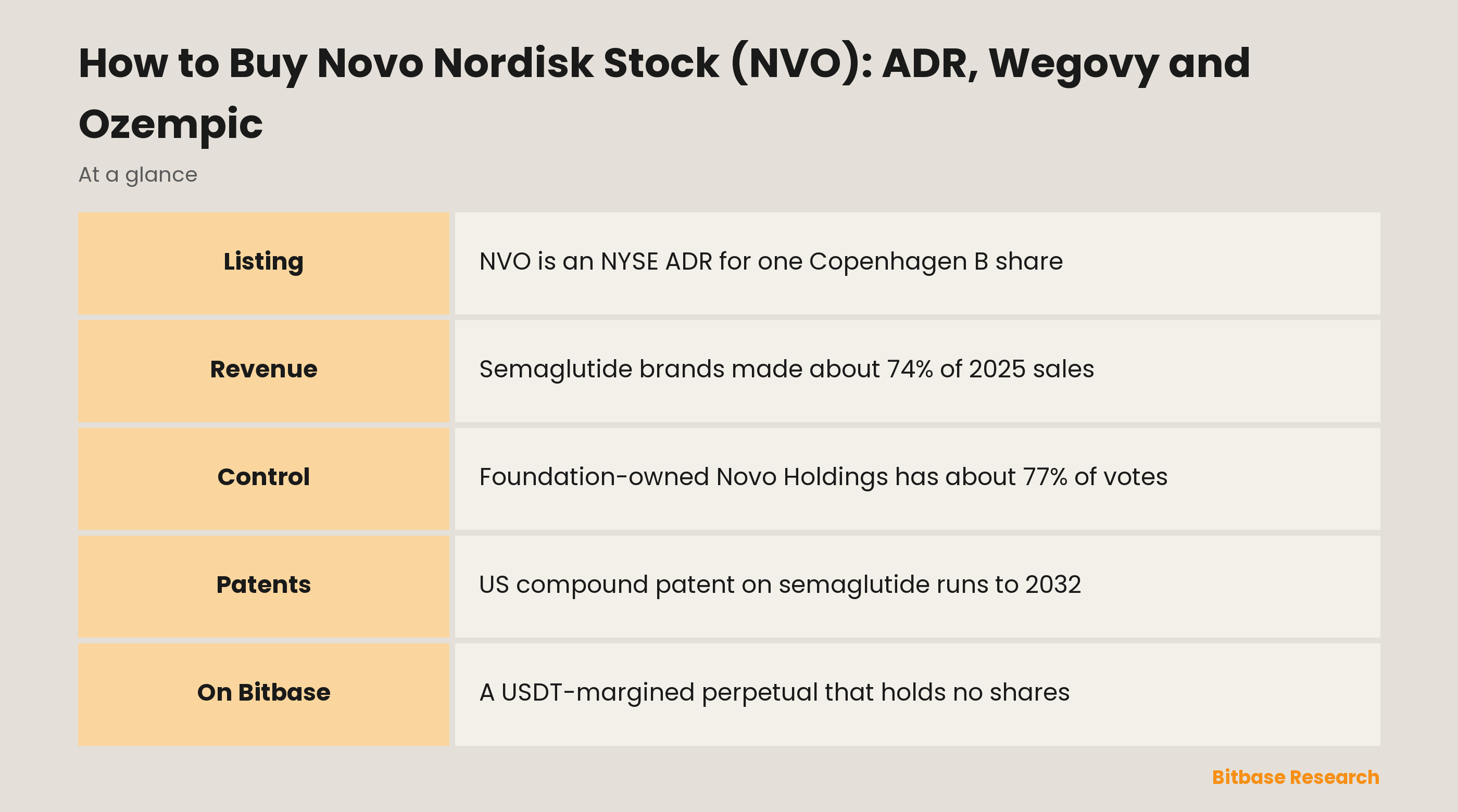
You can buy Novo Nordisk stock in New York under the ticker NVO, through any broker with access to the New York Stock Exchange; what you receive is an American depositary receipt, and each one stands for a single B share listed in Copenhagen. Behind it is a Danish drugmaker whose three semaglutide brands, Ozempic, Wegovy and Rybelsus, produced about 74% of 2025 sales, and whose votes are mostly controlled by a foundation that may not sell its A shares. On Bitbase the ticker exists as a USDT-margined NVO perpetual, which tracks the price and holds no share.
What Does Novo Nordisk Do?
Novo Nordisk develops, makes and sells medicines for chronic disease, above all diabetes and obesity. Its 20-F calls it "a global healthcare company and a world leader in Obesity and Diabetes care," marketing products in approximately 170 countries. It reports two segments: Obesity and Diabetes care, which holds the glucagon-like peptide-1 (GLP-1) receptor agonists and the insulins, and Rare disease, mainly growth hormone and haemophilia products.
One molecule runs through the best-known names. Semaglutide is the active ingredient in Ozempic, a once-weekly injection for type 2 diabetes launched in the US and Canada in February 2018; in Rybelsus, the same drug as a tablet; and in Wegovy, the weight-management brand, sold as an injection and, since its US launch in January 2026, as a daily pill. The older Victoza and Saxenda use liraglutide. In the annual report's words: "Semaglutide now represents the vast majority of our revenue."
The company is far older than these drugs: it was formed in 1989 by merging two Danish insulin makers, Nordisk Gentofte, whose business dates from 1923, and Novo Industri, from 1925. The legal entity was incorporated in 1931 and is headquartered in Bagsværd, Denmark.
2025 reshaped it. Maziar Mike Doustdar became chief executive in August, a company-wide transformation let around 9,000 employees go, and in December Novo Nordisk acquired Akero Therapeutics, whose lead candidate is in Phase 3 trials for the liver disease MASH. The main rival is named in the filing itself: in diabetes, in obesity and in GLP-1 medicines, "Novo Nordisk and Eli Lilly are the most significant companies measured by market share." The other side of that rivalry is in the guide to Eli Lilly stock.
How Novo Nordisk Makes Money
Revenue is reported in Danish kroner. In 2025 it rose 6% in kroner, or 10% at constant exchange rates (CER), the measure the company uses to strip out currency moves. Diabetes care brought in about 67% of sales, with GLP-1 medicines for type 2 diabetes at about 49% and insulin at about 17%. Obesity care, meaning Wegovy and the older Saxenda, made up most of the rest.
By product, the concentration is sharper. Ozempic alone was about 41% of 2025 sales, Wegovy about 26% and Rybelsus about 7%, so the three semaglutide brands came to about 74%. Wegovy, in its fifth year on sale, grew 36%. Victoza shows the other end of a product's life: its compound patent has expired, generics are on sale in the US, and its sales fell 45% in kroner.
The United States is the larger half. US Operations produced about 56% of 2025 sales and International Operations about 44%. Three major US wholesalers distributed products representing 23%, 18% and 14% of global net sales.
Much of the list price never reaches the income statement. In 2025 net sales came to about 42% of gross sales, after US rebates, discounts and returns took off an amount equal to about 54% of gross, the largest slice going to managed-care plans and Medicare. Gross margin was 81%, down from about 85% in 2024, which the company links partly to depreciation at three former Catalent fill-finish sites it bought in 2024 and to restructuring costs.
NVO Stock at a Glance
| Item | Detail |
|---|---|
| What NVO is | American depositary receipt (ADR), each representing one B share |
| New York listing | New York Stock Exchange, ticker NVO |
| Home listing | B shares on Nasdaq Copenhagen, ticker NOVO-B |
| Depositary | JPMorgan Chase Bank, N.A. |
| Share classes | Unlisted A shares, 100 votes each, all held by Novo Holdings; listed B shares, 10 votes each |
| Controlling shareholder | Novo Holdings A/S, about 77% of votes on 3 February 2026 |
| Industry | Pharmaceuticals: diabetes, obesity, rare disease |
| Headquarters | Bagsværd, Denmark |
| Fiscal year | Calendar year; IFRS accounts in Danish kroner |
| Dividend policy | Twice a year, interim in August and final after the March AGM; ADRs paid in US dollars |
| Share buybacks | New 12-month programme set out for 2026 |
| Benchmark in the annual report | Copenhagen's OMXC25 index and a pharmaceutical peer group |
Price, market value and yield change through the day; the Novo Nordisk stock page on Bitbase shows them live.
How to Buy Novo Nordisk Stock
The broker route takes six steps:
1. Decide which line you want. NVO trades in US dollars on the NYSE; NOVO-B trades in Danish kroner and needs a broker that reaches Nasdaq Copenhagen.
2. Open and verify the account. Confirm the broker takes clients from your country, and see which of its entities holds your account.
3. Fund it in the trading currency. Currency conversion is a cost too; check the rate you are given, not only the fee.
4. Search for NVO and check the result. It should read Novo Nordisk ADR on the New York Stock Exchange.
5. Set the order. A market order takes the price available now; a limit order sets a ceiling and may never execute.
6. Choose the size. Whole ADRs, or part of one where the broker supports fractional orders.
ADR or B share. Each ADR represents one B share on deposit with JPMorgan Chase Bank, the depositary, so both lines are claims on the same stock. "One ADR carries the same voting rights as one Novo Nordisk B share," but you exercise them by instructing the depositary, and dividends reach you after it converts them into dollars. The 20-F lists depositary fees for issuing and cancelling ADRs and a per-ADR fee on each dividend.
Tax on dividends. The withholding the 20-F describes is Danish: generally 27%, "the rate generally applicable to non-residents in Denmark." Holders entitled to a lower treaty rate, generally 15% for US holders, must claim the difference back from the Danish tax authorities, and a late-2025 ruling by Denmark's National Tax Tribunal "raises uncertainty" over whether US holders of ADRs qualify for that refund. Your own country's treaty with Denmark decides what applies to you. None of this is tax advice; it describes what the filing says.
Through a fund. Funds holding Danish, European or global healthcare stocks may own the Copenhagen B shares rather than the ADR. Check the holdings list before assuming a fund owns Novo Nordisk, and note which line it holds.
Trading NVO on Bitbase
Bitbase lists an NVO perpetual futures contract that uses USDT for both margin and settlement. The contract follows the NVO price without owning anything: no ADR, no B share, no dividend and no vote. In exchange, you can go long or short, with leverage, and the contract keeps trading while both New York and Copenhagen are closed.
Funding is paid at intervals from one side to the other, longs to shorts or the reverse, which holds the contract close to the market; when margin runs out, the position is closed out at the mark price. NVO adds a wrinkle: Copenhagen's trading day starts hours before New York's, so the B share can react to European-morning news while the ADR is shut, and NVO can open well away from its last close. Funding and liquidation are explained step by step in the guide to stock perpetuals.
Bitbase's contract specification sets out how often funding is paid, the margin tiers, the leverage cap and how the mark price is fixed while the NYSE is shut; check it before the first trade. Bitbase's TradFi page shows which other stocks are available and in what form.
What Moves NVO Stock
The semaglutide patent calendar. The active-ingredient patent behind Ozempic, Wegovy and Rybelsus runs to 2032 in the US, 2031 in Japan and Europe, and 2026 in China, including extensions, and the company "anticipates that the expiration of certain patents could impact sales starting in 2026." Several manufacturers have filed US generic applications challenging the listed patents; Novo Nordisk has settled with a number of them over Ozempic on confidential terms. In China, the Supreme People's Court upheld the compound patent in December 2025.
Competition in GLP-1 medicines. The filing names Eli Lilly as the other main company in these markets, and it records the turn: in the US a competing GLP-1 product, which it does not name, overtook Wegovy in total weekly prescriptions at the start of 2025 and overtook Ozempic later that year, and Novo Nordisk "lost volume market share" in both obesity and diabetes.
US drug pricing. Ozempic, Rybelsus and Wegovy were in the second round of Medicare Part D price negotiations under the Inflation Reduction Act, with the negotiated price taking effect in 2027. A 2025 most-favoured-nation agreement with the US administration widens access at lower cost through Medicare, Medicaid and the self-pay channel, and pharmacy benefit managers keep pressing on price.
Compounded copies. During the GLP-1 shortage, US compounding pharmacies sold unapproved versions of its obesity drugs, which the law allows while a shortage lasts. The 20-F says compounding "has illicitly continued" since the shortage ended.
New formats and the pipeline. The Wegovy pill, which the company calls the first FDA-approved oral GLP-1 therapy for weight management, launched in January 2026. CagriSema has been filed with the FDA, and the annual report scheduled Phase 3 trials of zenagamtide (amycretin) to begin in 2026. These decide what the business looks like after the patent dates.
The krone and the dollar. NVO is a dollar price for a share that trades in kroner, so the exchange rate sits between the listings, and the company's own exposure runs "mainly in USD, CNY and JPY." A stronger krone can lower reported growth even when volumes rise; CER growth, published beside the kroner figure, strips that effect out.
Risks to Weigh
One molecule. "Novo Nordisk is exposed to portfolio dependency with multiple brands relying on semaglutide as the active pharmaceutical ingredient." A legal, regulatory or clinical setback to semaglutide reaches most of the revenue at once.
Price, rivals and copies. The annual report names "intensified competition from branded and generic competitors and compounders," with "risks of price pressure, lowered sales volumes and supply rebalancing," and notes that US tariffs and "reference pricing measures" may keep targeting pharmaceuticals.
Supply. Ozempic faced periodic supply constraints in some markets in 2025, and "expanding production capacity is complex and associated with long lead times."
Litigation. Novo Nordisk and Eli Lilly are defendants in numerous product liability lawsuits, mainly in the US, alleging gastrointestinal and other injuries from GLP-1 medicines; the company does not expect a material impact. Its risk table also lists competitors "challenging patents critical for protection of commercial product."
Control and the ADR holder's position. Novo Holdings holds about 77% of the votes, the A shares "cannot be sold or be subject to any disposition so long as the Foundation exists," and the structure gives the Foundation "veto power against any change of control." ADR holders vote only through the depositary, and the refund question above affects how much of each dividend they keep.
What the perpetual adds. With leverage, a small move in NVO becomes a large move in your margin; funding is charged or paid for every interval you hold; and a gap at the New York open can carry a position beyond its liquidation price before any trade prints in between.
How to Research NVO Yourself
Novo Nordisk files with the SEC under CIK 353278 as a foreign private issuer: a Form 20-F each year instead of a 10-K, and 6-Ks for quarterly reports and announcements. The 20-F is largely a cross-reference: risk factors, financial statements and the share structure sit in the Annual Report filed with it as an exhibit. Item 10 covers Danish and US taxation and Item 12 the ADR programme and its fees. The 20-F and the annual reports can also be downloaded from the investors page at novonordisk.com.
Novo Nordisk Stock FAQ
How is NVO different from Novo Nordisk B shares in Copenhagen?
They are the same stock in two forms. NVO is an ADR traded in dollars on the NYSE, and each one represents a deposited B share, the security traded in kroner on Nasdaq Copenhagen as NOVO-B. The vote per unit is the same, but an ADR holder votes through the depositary, receives dividends in dollars about a week after B-share holders are paid, and may owe depositary fees. Neither line gives access to the unlisted A shares.
Can I buy Novo Nordisk stock with crypto?
Not in one step: a broker quotes NVO in dollars, so crypto must first be sold for cash. What Bitbase offers is the NVO perpetual, traded with USDT. It moves with the price, yet it is a derivative and not a share; it earns no dividend, has no vote and can be liquidated. The wider choice of routes is in buying stocks with crypto.
Does Novo Nordisk pay a dividend?
Yes, twice a year: an interim dividend in August and a final dividend after the annual general meeting in March, both also paid on ADRs. The policy sets the payout ratio against a pharmaceutical-industry benchmark and may be complemented by buybacks. The amount per share changes, and Danish withholding tax comes off first.
Who controls Novo Nordisk?
The Novo Nordisk Foundation, through its wholly owned Novo Holdings A/S. Novo Holdings owns every A share, each carrying ten times the votes of a B share, plus a block of B shares. On 3 February 2026 that gave it about 77% of the votes, on roughly 28% of the share capital at the end of 2025. In practice A and B shares receive the same dividend per share.
Has Novo Nordisk stock split?
Yes. The B shares were split two-for-one on 13 September 2023, and the ADRs followed on 20 September 2023 "to maintain the one-to-one relationship between the B-share and the ADR." The 2023 annual report restated earlier per-share figures to match.
When does Novo Nordisk report earnings?
Quarterly, on a calendar fiscal year. The 2025 20-F was filed on 4 February 2026, and interim reports arrive as 6-Ks. The company's calendar lists results for the first nine months of 2026 on 4 November 2026 and the 2026 annual report on 3 February 2027.
Conclusion
Buying Novo Nordisk stock means buying NVO through a broker, and the ADR is the easy part: one ADR, one B share, dollar dividends after Danish tax. The harder reading is in the 20-F, where about three-quarters of sales rest on one molecule whose patents start to expire in some markets from 2026, against a rival it names outright. The Bitbase perpetual offers the price without a stake in the company, with costs and risks of its own.
Related reading
Other Bitbase articles on this topic:
- How to Buy GSK Stock (GSK): Two-Share ADS, HIV and Haleon
- How to Buy Moderna Stock (MRNA): Vaccines, Cancer Trial and Perps
- How to Buy Regeneron Stock (REGN): Dupixent Profits and EYLEA HD
Disclaimer: This article is educational content from Bitbase Academy, provided for information only. It explains what a company or fund does and how the instruments referenced here differ from one another; it does not constitute investment, trading, tax, or financial advice, and it is neither a recommendation nor an endorsement of any security, token, or trading strategy. A tokenized stock is issued by a third party and is designed to give economic exposure to an underlying asset: it is not a share, it carries no shareholder rights, and it depends on the issuer's structure, eligibility rules, and redemption terms, which the issuer can change. Perpetual futures are leveraged derivatives that hold no underlying asset and can be liquidated, and trading hours, product availability, and eligibility differ by instrument and by jurisdiction and can change at any time. Written as of October 2026; verify everything yourself through company filings, the issuer's own documentation, and the product pages of the venue you trade on.
References
[1] Novo Nordisk Form 20-F for 2025 (SEC EDGAR) www.sec.gov
[2] Novo Nordisk Annual Report 2025, filed with the 20-F (SEC EDGAR) www.sec.gov
[3] Novo Nordisk: description of the rights of ADR holders, exhibit to the 2025 20-F (SEC EDGAR) www.sec.gov
[4] Novo Nordisk Form 20-F for 2023, including the 2023 share split (SEC EDGAR) www.sec.gov
[5] Novo Nordisk Form 6-K: financial report for the first half of 2026, with financial calendar (SEC EDGAR) www.sec.gov





