
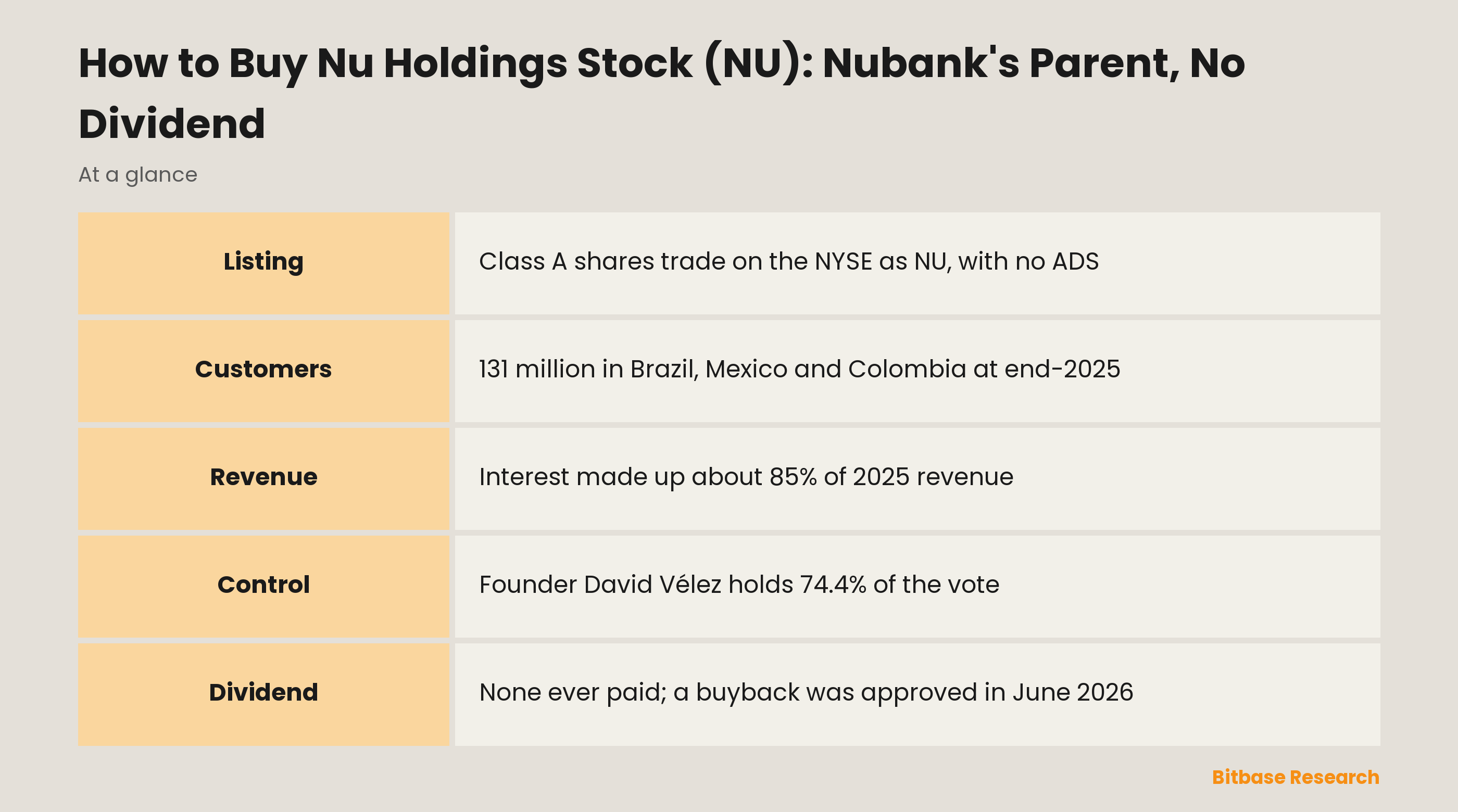
Everyone can buy Nu Holdings stock through a brokerage account that reaches the New York Stock Exchange, where its Class A ordinary shares have traded under NU since 8 December 2021. Behind the ticker is Nubank, run from São Paulo by a Cayman Islands holding company, with 131 million customers across Brazil, Mexico and Colombia at the end of 2025. This guide covers how it earns its revenue, how to place the order and which risks its 20-F puts first.
What Does Nu Holdings Do?
Nu Holdings is the parent of Nubank, a digital financial services platform whose stated mission is "to fight complexity to empower people in their daily lives." It began in 2013, and its first product, launched in Brazil in 2014, was the Nu Credit Card, a "no-annual-fee, digital-first Mastercard." The listed parent was incorporated in the Cayman Islands on 26 February 2016; the main operational headquarters are in São Paulo.
Scale came from Brazil. At the end of 2025 Nu counted 113 million customers there, about 62% of adults, and cites central bank data making it the country's largest private financial institution by number of customers. In Mexico it serves about 15% of the adult population; in Colombia it passed 4 million customers. By 30 June 2026 the total was 139 million, per its second-quarter release.
Products follow what Nu calls five financial seasons: spending, saving, investing, protecting and borrowing. That means cards, Pix instant payments, accounts, personal and payroll loans, investments, insurance and cryptocurrency trading through NuCrypto, reported as one operating segment. In September 2026 Nu added US accounts through a partner bank and Nu Global, a multi-currency account built on the USDC and EURC stablecoins.
How Nu Holdings Makes Money
Interest carries the business. In 2025 interest income and gains on financial instruments made up about 85% of total revenue, with fees and commissions supplying the rest. Total revenue grew 37.0%; the interest line rose 39.5%.
| Revenue line, 2025 | Share of revenue |
|---|---|
| Interest on loans | 30.3% |
| Interest on credit card balances | 29.1% |
| Interest on other assets at amortized cost | 14.5% |
| Credit and prepaid card income | 10.9% |
| Financial instruments at fair value | 8.6% |
| Late fees | 2.4% |
| Other interest, fees and commissions | 4.1% |
Calculated from the 20-F's revenue note and rounded.
Lending is where the mix moved: loan interest grew 57.4% and passed card interest as the largest line. The two largest expense lines are the expected credit loss charge, equal to 26.7% of revenue, and interest paid on deposits, which rose 65.5%.
Of the revenue the segment note assigns to countries, Brazil supplied about 91% and Mexico about 7%. The 20-F names Itaú Unibanco, Bradesco, Banco Santander (Brasil), Caixa and Banco do Brasil as its main rivals in Brazilian consumer credit; for the third, Brazil is the Spanish group's biggest country by income, as the Santander stock guide shows.
NU Stock at a Glance
| Item | Detail |
|---|---|
| Exchange | NYSE, since 8 December 2021 |
| Ticker | NU |
| Security | Class A ordinary shares, the only security on the 20-F cover |
| American depositary shares | None; the 20-F marks them not applicable |
| Other class | Class B, 20 votes per share, unlisted |
| Incorporated | Cayman Islands, 2016 |
| Filings | Form 20-F yearly, Form 6-K for quarterly results |
| Accounts | Calendar year, IFRS, US dollars |
| Dividend | Never declared or paid; no dividend policy |
| Index funds holding it | iShares MSCI Brazil ETF, iShares MSCI Emerging Markets ETF |
For price and market value, open the Nu Holdings stock page on Bitbase.
How to Buy Nu Holdings Stock
NU is the ordinary share itself, so there is no depositary ratio to convert:
1. Choose a broker with NYSE access and check which entity holds your account.
2. Open and verify the account. Expect identity and tax-residence checks.
3. Fund it. NYSE trades settle in US dollars, so compare the conversion rate as well as the commission.
4. Find the right line. Confirm the result reads Nu Holdings Ltd. Class A ordinary shares.
5. Pick an order type. A market order fills at the next available price; a limit order caps what you pay.
6. Decide the size. Some brokers offer fractional shares; check which order types they allow.
7. Keep the confirmations as your record of cost basis.
Tax. With no dividend paid so far, gains on sale are taxed under your home country's rules. For any future payout, the 20-F says the Cayman Islands levies no withholding tax "applicable to us or to any holder of Class A ordinary shares." US holders have one more point: the company does not believe it was a passive foreign investment company (PFIC) for 2025 but says the IRS may disagree.
Investors in Brazil. Nu's local BDR program ended in 2023 (see the FAQ); the FY2025 20-F names only the NYSE as a market.
Through an index fund. iShares MSCI Brazil ETF and iShares MSCI Emerging Markets ETF both listed Nu Holdings in reports for the period ended 31 August 2026, as one holding among many.
What Moves NU Stock
Brazilian interest rates. The 20-F notes that higher base rates can lift interest income but can also cause "a reduction in the demand for our credit and investment products, an increase in the cost of raising funds and the risk of default by our customers." In 2025 deposit interest grew faster than revenue, 65.5% against 37.0%.
Credit quality. Loans and card balances earn the bulk of the interest, so credit losses can swing results. Brazilian rules also cap pricing: since 3 January 2024, total interest and charges on revolving and installment card balances may not exceed the original debt. Quarterly 6-K releases report the delinquency ratios to watch.
The real. Nu reports in dollars while most revenue comes from Brazil, and the 20-F's central bank figures show the real losing 27.9% against the dollar in 2024 and regaining 11.1% in 2025. Petrobras shares carry the same currency channel, with the state as controlling shareholder.
Licenses. Nu does "not currently hold a banking license in Brazil," and under a 2025 rule on names, Joint Resolution No. 17, it needs one to keep "bank" in its branding; its July 2026 deal for Banco Porto Real awaits central bank approval. The filing also flagged Brazil's October 2026 presidential election as a source of uncertainty.
Expansion. Mexico's bank authorization in July 2026 ended a process the company called "critical as it unlocks the next phase of credit growth and customer depth." Building abroad has a cost: strategic investments "may result in near-term upward pressure on operating costs."
Buybacks. A 12-month Class A repurchase program approved in June 2026 carries no obligation to buy a set number.
Reading the Warnings in Nu's 20-F
These risk factors bear most directly on an NU share:
Credit models. Failing to improve its risk management, "including our credit risk management system," would "materially and adversely affect" the business.
Regulation. Nu is "subject to extensive regulation and regulatory and governmental oversight as a digital financial services platform and as a payment institution."
Expansion. "Our international expansion efforts may not be successful, or may subject our business to increased risks."
Founder control. David Vélez, founder, chairman and chief executive, owns 88.3% of the Class B shares and 74.4% of the total vote. Nu is therefore a "controlled company" under NYSE rules, exempt from some governance requirements, and while he and his affiliates hold at least 40% of the vote he can designate a majority of the board.
Above the business, Nu's "ability to pay dividends is directly related to positive and distributable net results from our subsidiaries," and one stock concentrates your money in a single company tied to three Latin American economies and their currencies.
How to Research NU Yourself
Nu files with the SEC under CIK 1691493 as a foreign private issuer: an annual report on Form 20-F, the latest dated 8 April 2026, and quarterly results and other notices on Form 6-K. In the 20-F, the business overview covers products and licenses by country, note 6 splits revenue, note 34 gives revenue by country and the major shareholders table shows voting power. The XBRL cover, R1.htm, confirms a single registered security. The investor site investors.nu adds earnings presentations; for other companies, browse US stock pages on Bitbase.
Nu Holdings Stock FAQ
Does Nu Holdings pay a dividend?
No. The 20-F states that Nu has "never declared or paid any cash dividends" and has no dividend policy; any future payout is up to the board and depends on dividends from its subsidiaries.
Can I buy Nu Holdings stock with crypto?
Not directly. NU shares are bought through a brokerage account and NYSE trades settle in US dollars, so crypto has to be sold for cash first, which may be taxable. Nu's own crypto services do not change this: a Class A share is a registered stake with a vote, a different instrument from a crypto token.
What is the difference between NU Class A and Class B shares?
Class A shares carry one vote and trade on the NYSE. Class B shares carry 20 votes, are held entirely by the co-founders and convert into Class A one for one. On the 1 March 2026 share count, Class B was about 21.0% of the shares but about 84.2% of the votes.
What happened to Nu Holdings' BDRs in Brazil?
Brazil's securities regulator, CVM, approved ending Nu's Level III BDR program on 28 June 2023. Holders chose among the plan's alternatives by 11 August; the CVM approved cancelling the program on 31 October 2023.
Is Nu Holdings a bank?
It depends on the country. In Mexico, Nubank was authorized in July 2026 to operate as a bank. In Brazil, Nu runs as a payment institution, a credit company and a brokerage while it seeks approval to buy Banco Porto Real. In the United States, its national bank remains in organization, and products are offered through a partner bank.
Conclusion
Buying NU takes a broker with NYSE access and the right line: the Class A share, in dollars, with no receipt in between. What it holds is harder: a lender built in Brazil whose results turn on interest rates, credit losses and the real, controlled by its founder and paying no dividend. Read the latest 20-F and the 6-Ks after it before deciding how much belongs in one Latin American financial stock.
Related reading
Other Bitbase articles on this topic:
- How to Buy KKR Stock (KKR): Buyouts, Credit and Global Atlantic
- How to Buy Moody's Stock (MCO): Ratings, Analytics and Berkshire
- How to Buy Nasdaq Stock (NDAQ): Its Own Listing, 5% Vote Cap
Disclaimer: This article is educational content from Bitbase Academy, provided for information only. It explains what a company or fund does and how the instruments referenced here differ from one another; it does not constitute investment, trading, tax, or financial advice, and it is neither a recommendation nor an endorsement of any security, token, or trading strategy. A tokenized stock is issued by a third party and is designed to give economic exposure to an underlying asset: it is not a share, it carries no shareholder rights, and it depends on the issuer's structure, eligibility rules, and redemption terms, which the issuer can change. Perpetual futures are leveraged derivatives that hold no underlying asset and can be liquidated, and trading hours, product availability, and eligibility differ by instrument and by jurisdiction and can change at any time. Written as of October 2026; verify everything yourself through company filings, the issuer's own documentation, and the product pages of the venue you trade on.
References
[1] Nu Holdings, Form 20-F for 2025 (SEC EDGAR) www.sec.gov
[2] Nu Holdings, 2025 Form 20-F, XBRL cover page (SEC EDGAR) www.sec.gov
[3] Nu Holdings, Form 20-F for 2024: Level III BDR program discontinuation (SEC EDGAR) www.sec.gov
[4] Nu Holdings, second-quarter 2026 results, Form 6-K, 13 August 2026 (SEC EDGAR) www.sec.gov
[5] Nu Holdings, notice on the CNBV operations authorization for Nubank México, Form 6-K, 10 July 2026 (SEC EDGAR) www.sec.gov
[6] Nu Holdings, agreement to acquire Banco Porto Real, Form 6-K, 20 July 2026 (SEC EDGAR) www.sec.gov
[7] Nu Holdings, US launch and Nu Global, Form 6-K, 10 September 2026 (SEC EDGAR) www.sec.gov
[8] Nu Holdings, share repurchase program, Form 6-K, 4 June 2026 (SEC EDGAR) www.sec.gov
[9] iShares, Inc., Form N-PORT for iShares MSCI Brazil ETF, period ended 31 August 2026 (SEC EDGAR) www.sec.gov
[10] iShares, Inc., Form N-PORT for iShares MSCI Emerging Markets ETF, period ended 31 August 2026 (SEC EDGAR) www.sec.gov





