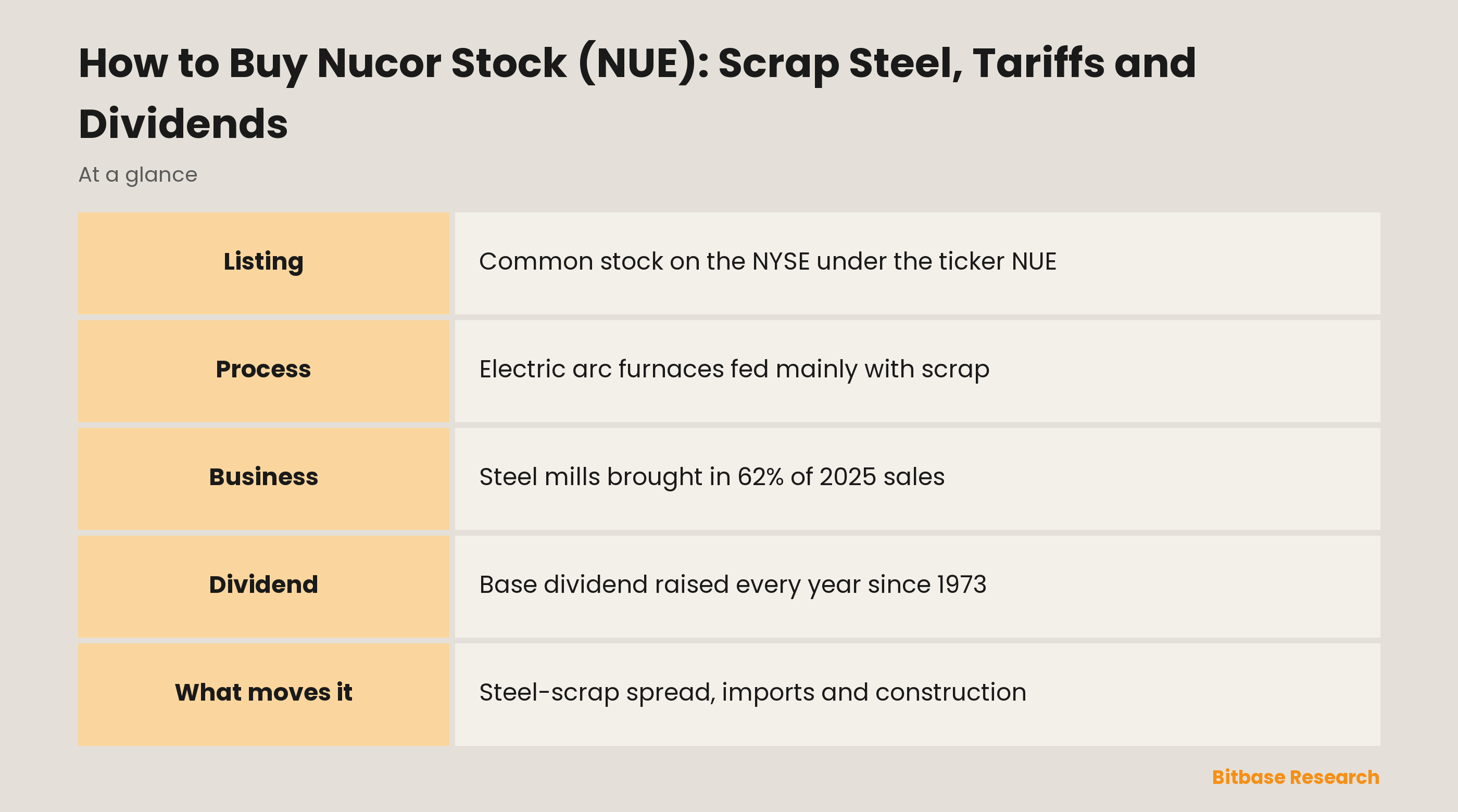
Several types of brokerage account can buy Nucor stock, listed on the New York Stock Exchange as NUE. Nucor makes its steel in electric arc furnaces fed mainly with scrap, and its steel mills segment brought in 62% of 2025 sales to outside customers, with fabricated steel products and raw materials making up the rest. The sections below cover where the revenue comes from, the steps to buy, and the risks its filings put first, from cheap imports and scrap and energy costs to a construction-driven cycle.
What Does Nucor Do?
Nucor Corporation was incorporated in Delaware in 1958 and is headquartered in Charlotte, North Carolina. Its 10-K says the company and its affiliates "manufacture steel and steel products," and that it also produces and buys ferrous and non-ferrous materials, mostly to feed its own mills. Most of its facilities and customers are in North America.
The way it makes steel defines the company. Nucor produces steel "principally from scrap steel and scrap steel substitutes using electric arc furnaces," and its steelmaking operations "utilize EAFs for 100% of their production." It calls itself North America's largest recycler: in 2025 it recycled about 20 million gross tons of scrap, and it takes roughly 1.1 tons of scrap and substitutes to make one ton of steel.
The business is reported in three segments:
Steel mills make sheet (hot-rolled, cold-rolled and galvanized), plate, structural steel such as wide-flange beams, and bar products from rebar to special bar quality grades. The 10-K counts 15 bar mills, six sheet mills, two structural mills and three plate mills, with estimated annual capacity of about 14.5 million tons for sheet, 9.8 million for bar, 3.6 million for plate and 3.3 million for structural. Buyers are mainly service centres, fabricators and manufacturers in the United States, Canada and Mexico, and 21% of the segment's 2025 shipments went to Nucor's own steel products businesses.
Steel products turns that steel into things builders order: joists and deck from the Vulcraft/Verco group, structural tubing and electrical conduit, fabricated rebar, metal buildings, insulated panels, warehouse and data-centre racking, overhead doors and utility towers. Several of these lines were acquired under what Nucor calls its "Expand Beyond" strategy.
Raw materials secures the inputs. It includes The David J. Joseph Company (DJJ), a scrap broker and processor acquired in 2008, direct reduced iron (DRI) plants in Trinidad and Louisiana, and natural gas wells in Colorado. In 2025 only about 7% of the metal it brokered and processed went to outside customers; the rest fed Nucor's mills.
How Nucor Makes Money
Nucor earns the spread between what steel sells for and what its main input costs. The 10-K calls it the metal margin: "the difference between the selling price of steel and the cost of scrap and scrap substitutes." Scrap and its substitutes are "the most significant element in the total cost of steel production," so the company has invested in its own scrap processing and DRI plants to gain more control over that supply.
The segment note splits 2025 sales by product group:
| Product group | Segment | Share of 2025 sales |
|---|---|---|
| Sheet | Steel mills | 28.2% |
| Bar | Steel mills | 17.6% |
| Structural | Steel mills | 8.1% |
| Plate | Steel mills | 7.7% |
| Joist and deck | Steel products | 6.8% |
| Rebar fabrication | Steel products | 5.9% |
| Tubular products | Steel products | 4.4% |
| Building systems | Steel products | 3.8% |
| Other steel products | Steel products | 10.8% |
| Raw materials | Raw materials | 6.7% |
Shares are calculated from 2025 net sales to external customers by product group and rounded to one decimal.
Pricing differs by line. About 85% of sheet sales in 2025 went to contract customers, under agreements of six to 12 months whose prices adjust monthly or quarterly with market indices or raw material costs. Bar, structural and plate are mostly sold at spot prices, while joist, deck and rebar fabrication jobs are typically fixed-price contracts won in competitive bidding.
2025 shows how the pieces move. Net sales rose 6% as tons shipped to outside customers increased 7% and the average price per ton slipped 2%. The mills ran at 83% of capacity, up from 76% in 2024. Steel products shipped 9% more tons, but its average price per ton fell 6%, so its sales rose only 2% and its earnings before income taxes dropped about 23%.
No single customer dominates: the largest represented about 5% of 2025 sales. The 10-K names nonresidential construction as the largest end market, and the 2025 annual report letter says it "accounts for more than half of the steel we ship."
Pay is built to flex. Nucor employs approximately 33,000 people, and "production teammates work under group incentives that provide increased earnings for increased production"; the company has also historically put 10% of earnings before federal taxes into profit sharing. In weak markets, the 10-K says, that system reduces payroll costs and "helps to offset lower selling prices."
NUE Stock at a Glance
| Item | Detail |
|---|---|
| Stock exchange | NYSE |
| Ticker | NUE |
| Security | Common stock, the only security registered on the 10-K cover |
| Sector | Steel: mills, fabricated steel products and raw materials |
| Index membership | S&P 500 |
| Headquarters | Charlotte, North Carolina |
| Incorporated | Delaware, 1958 |
| Fiscal year | Ends 31 December; quarters are reported as 13-week periods |
| Dividend policy | Quarterly; the base dividend has risen every year since payments began in 1973 |
| Capital return goal | At least 40% of net earnings over time, through dividends and buybacks |
| Joint ventures | 51% of Nucor-Yamato, California Steel Industries and a Mexican sheet venture; 50% of NuMit |
| SEC identifier | CIK 73309 |
The table leaves out price, market value and yield because they change all day; the Nucor stock page on Bitbase shows them live.
How to Buy Nucor Stock
Nucor is a US company whose common stock is registered on the NYSE, so you buy the stock itself, with no depositary receipt involved. The route runs through a broker:
1. Choose a broker that can reach the NYSE. Outside the US, that may be a local firm with access to American exchanges or an international platform; check which entity holds your shares and who regulates it.
2. Open the account and settle your tax status. The IRS tells a foreign person who is the beneficial owner of income subject to withholding to "give Form W-8 BEN to the withholding agent or payer."
3. Add funds. If your money is not in US dollars, the conversion spread is a cost alongside any commission.
4. Search for NUE. Confirm the result reads Nucor Corporation common stock on the NYSE.
5. Pick an order type. FINRA cautions that a market order buyer "might not get the price you saw or were originally quoted, especially in fast-moving markets"; by contrast, "a buy limit order can be executed only at or below the limit price." See how market orders are filled for the mechanics.
6. Decide on whole or fractional shares. Fractions let you invest a set amount, but availability, in FINRA's words, "varies by brokerage firm," and a fractional owner "might not have shareholder voting rights."
7. Keep every confirmation. Confirmations and statements record your cost and the dividends you receive.
For investors outside the US, dividends are taxed at source. In the IRS's words, "most types of U.S. source income received by a foreign person are subject to U.S. tax of 30%," though a treaty can lower the rate or remove it. Tax at home may come on top.
Through an index fund, Nucor comes as one constituent among hundreds: on 29 October 2026, the holdings list State Street publishes each day for SPY, which tracks the S&P 500, included Nucor under NUE.
What Moves NUE Stock
Steel prices against scrap costs. Because profit sits in the metal margin, the price of steel relative to scrap matters more than either price alone. Nucor does not mine its metal: a miner such as Southern Copper sells metal it extracts, while Nucor buys most of its scrap from outside suppliers. In the third quarter of 2026, the steel mills segment's average external price per ton was 19% higher than a year earlier while scrap cost per ton rose 8%, and the segment's earnings before income taxes for the first nine months of 2026 were more than double those of the same period in 2025.
Imports and trade policy. According to the 10-K, the Section 232 steel tariffs, first imposed in 2018, were fully reinstated in 2025 without exemptions or exclusions and extended to about 600 fabricated steel products. Imports of finished steel fell 17.4% in 2025 and supplied about 18% of US demand. The company also warns that there can be "no assurance as to when or if the Section 232 or other import tariffs, quotas or other duties may be enacted, enforced, extended, modified or terminated in the future," so trade policy remains a standing variable for the stock.
Construction and data centres. In 2025 the company reported strong demand from infrastructure, data centres, energy and advanced manufacturing, while interest-rate-sensitive markets such as cars and housing were softer. Data centres now reach across the portfolio, from joists and deck to racking, conduit and insulated panels.
Two segments that partly offset each other. Higher steel prices help the mills but raise costs for the steel products businesses that buy that steel. In the second quarter of 2026, the 10-Q says, steel products earnings fell as "increased volumes and modestly higher average selling prices were more than offset by margin compression resulting from higher steel input costs."
New mills coming on line. Nucor expenses pre-operating and start-up costs, "the losses attributable to facilities or major projects that are either under construction or in the early stages of operation," so new plants weigh on earnings before they add to them. The largest is a sheet mill in Mason County, West Virginia, designed for about three million tons a year; the third-quarter 2026 release reported its first heat in September.
Buybacks. In February 2026 the board replaced its repurchase programme with a new discretionary authorisation that has no expiration date. Average diluted shares fell about 1.5% between the third quarters of 2025 and 2026, and the 2025 annual report puts capital returned that year at about 70% of net earnings.
When the Steel Cycle Turns Against NUE
Nucor's most recent 10-Q says its risk factors have not changed materially since the 10-K. Of those, the following matter most for a shareholder:
Overcapacity and imports. "Global steel production overcapacity continues to be an ongoing risk to Nucor and the entire steel industry." The 10-K cites an OECD estimate of about 704 million net tons of excess capacity in 2025, eight times annual US production, and a projection that it could grow nearly 20% by 2027. China alone produced about 53% of the world's steel in 2025.
The cycle itself. "Demand for most of our products is cyclical in nature and sensitive to general economic conditions." The swing can be large: 2025 net sales were about 6% below 2023, yet earnings before income taxes were about 59% lower. The filing says downturns weigh "especially in light of the capital-intensive nature of our business."
Scrap and other inputs. Prices of "these critical raw materials are volatile," and when it has already quoted prices to customers, Nucor may be unable to pass a higher raw material cost on.
Electricity and natural gas. Every melt shop runs on electric arc furnaces and the DRI plants burn natural gas. The company warns that "we may be unable to raise the price of our products to offset increased energy costs."
Heavy capital spending. "Our business requires substantial capital investment and maintenance expenditures, and our capital resources may not be adequate to provide for all of our cash requirements." The West Virginia mill's cost estimate rose in 2025, which the 10-K attributes to "higher labor, material and equipment costs."
Other materials. Concrete, aluminium, plastics, composites and wood compete with steel, and greater use of them "could have a material adverse effect on prices and demand for our steel products."
Owning one stock adds its own limits: everything rides on one company's results, and a long dividend record is history, not a promise, since the board declares each payment.
How to Research NUE Yourself
Nucor files with the SEC under CIK 73309: the 10-K each year, a 10-Q each quarter and 8-Ks for events such as earnings releases and management changes. The company says it uses investors.nucor.com to distribute material information, so check the investor relations site alongside EDGAR.
In the 10-K, Item 1 lists the mills, their estimated capacity and each segment's products; Item 1A holds the risk factors; Item 2 gives utilization rates; and the segment note carries the sales-by-product table above. Each quarterly earnings release adds a page of operating data, including shipments by product, average price per ton, scrap cost per ton and mill utilization, which lets you follow the metal margin quarter by quarter.
Two details prevent misreadings. Quarters are 13-week periods, so the third quarter of 2026 ended on 3 October rather than 30 September. And earnings attributable to noncontrolling interests are the joint venture partners' share, deducted before the earnings that belong to Nucor stockholders. For quotes, use the stock page above; to compare other companies, browse Bitbase's US stock pages.
Nucor Stock FAQ
Can I buy Nucor stock with crypto?
No, not directly. Brokers take NUE orders in US dollars, so you would sell the crypto, move the cash to the brokerage account and then place the order; in many countries the sale counts as a taxable disposal. The two are different kinds of asset: a NUE share gives you a registered ownership interest with dividends and votes, which is how owning a share differs from holding crypto.
Does Nucor pay a dividend?
Yes, in cash four times a year. Its 2025 annual report says Nucor has raised its base dividend for 53 consecutive years, every year since it began paying dividends in 1973. The dividend declared on 18 September 2026, payable on 10 November 2026, was its 214th consecutive quarterly cash dividend.
Is NUE in the S&P 500?
Yes. Nucor Corp appears under NUE in the SPY holdings list State Street dated 29 October 2026. Its index weight shifts daily.
Does Nucor use blast furnaces?
No. According to the 10-K, its steelmaking operations use electric arc furnaces for all of their production, while integrated producers start from iron ore in a blast furnace. EAF producers such as Nucor, the filing says, "are more sensitive to increases in scrap prices but tend to have lower capital and fixed operating costs."
Does Nucor own all of its steel mills?
Not all of them outright. Nucor holds 51% of Nucor-Yamato, which the 10-K calls "the only North American producer of high-strength, low-alloy beams," of California Steel Industries and of a galvanized sheet venture in Mexico with JFE Steel, and consolidates all three, deducting the partners' share of profits. It also owns half of NuMit, parent of the sheet processor Steel Technologies, which it accounts for as an equity investment.
Conclusion
Placing a NUE order takes three things: a broker with NYSE access, the right ticker and a choice of order type. Knowing what the share represents takes longer. Its results hinge on the gap between steel prices and scrap costs, on how long trade protection lasts and on construction demand, while new mills are still ramping up. Check each of those in the latest 10-K and quarterly release before you buy a cyclical steel producer.
Related reading
Other Bitbase articles on this topic:
- How to Buy Ecolab Stock (ECL): Water, Hygiene and AI Data Centers
- How to Buy Freeport-McMoRan Stock (FCX): Copper, Gold and Grasberg
- How to Buy Howmet Aerospace Stock (HWM): Engine Parts, Alcoa Roots
Disclaimer: This article is educational content from Bitbase Academy, provided for information only. It explains what a company or fund does and how the instruments referenced here differ from one another; it does not constitute investment, trading, tax, or financial advice, and it is neither a recommendation nor an endorsement of any security, token, or trading strategy. A tokenized stock is issued by a third party and is designed to give economic exposure to an underlying asset: it is not a share, it carries no shareholder rights, and it depends on the issuer's structure, eligibility rules, and redemption terms, which the issuer can change. Perpetual futures are leveraged derivatives that hold no underlying asset and can be liquidated, and trading hours, product availability, and eligibility differ by instrument and by jurisdiction and can change at any time. Written as of October 2026; verify everything yourself through company filings, the issuer's own documentation, and the product pages of the venue you trade on.
References
[1] Nucor Form 10-K for 2025 (SEC EDGAR) www.sec.gov
[2] Nucor 2025 Form 10-K, XBRL cover page (SEC EDGAR) www.sec.gov
[3] Nucor Form 10-Q for the quarter ended 4 July 2026 (SEC EDGAR) www.sec.gov
[4] Nucor third-quarter 2026 results release, filed with Form 8-K on 26 October 2026 (SEC EDGAR) www.sec.gov
[5] Nucor 2025 Annual Report to stockholders (SEC EDGAR) www.sec.gov
[6] State Street: SPY daily holdings, 29 October 2026 www.ssga.com
[7] FINRA: Order Types www.finra.org
[8] FINRA: Investing in Fractional Shares www.finra.org
[9] IRS: NRA Withholding www.irs.gov
[10] IRS: About Form W-8 BEN www.irs.gov





