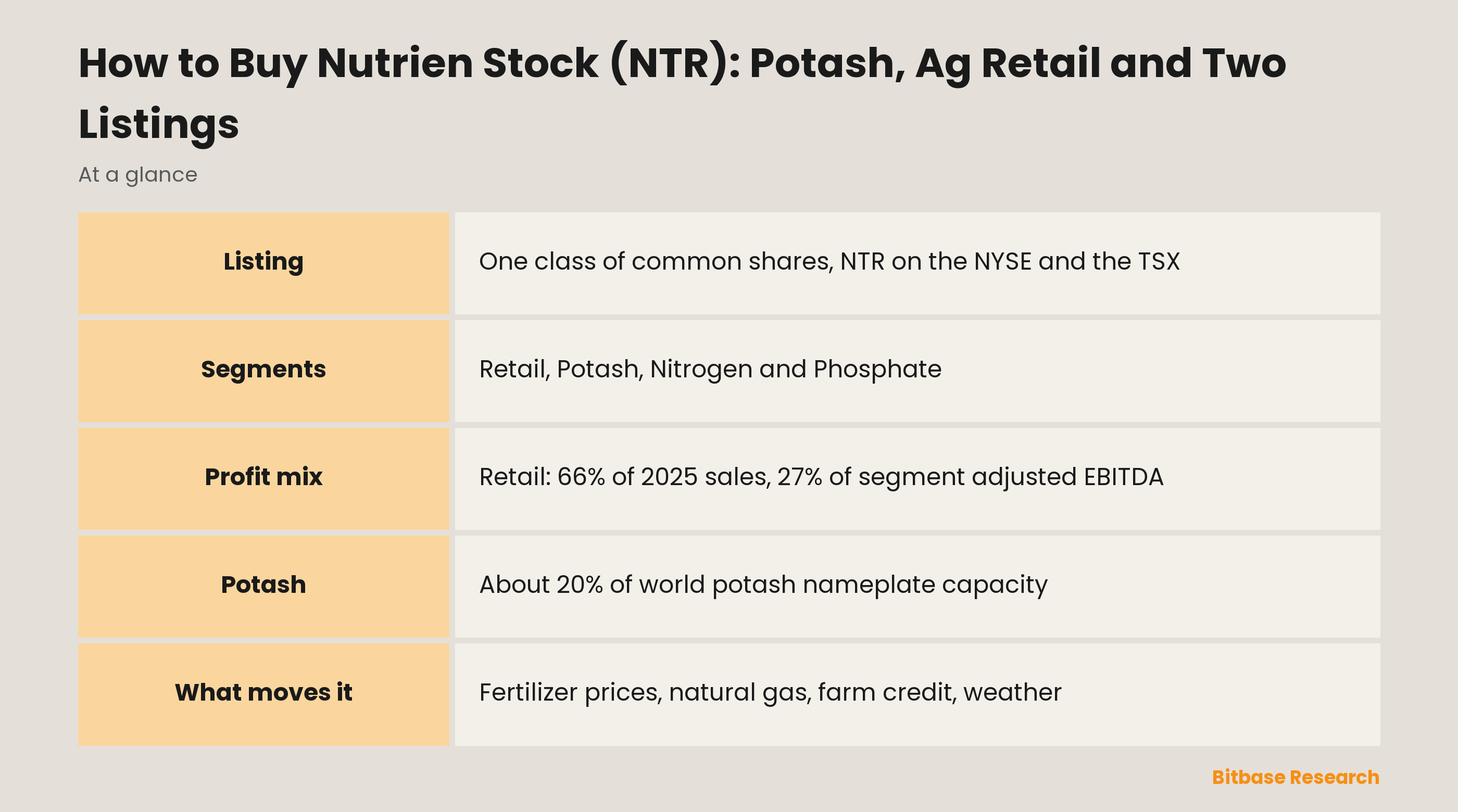
You reach Nutrien stock through any broker that connects to the New York Stock Exchange or the Toronto Stock Exchange, because the same common shares trade on both under the ticker NTR. The company has an unusual shape: two-thirds of its 2025 sales came from farm-supply stores, yet potash mined in Saskatchewan earned the largest slice of segment profit.
What Does Nutrien Do?
Nutrien describes itself as "a leading global provider of crop inputs and services." It mines and manufactures the three nutrients that fertilizer is built from, potash, nitrogen and phosphate, and it sells those and many other farm inputs to growers through its own retail network. It is organized under the Canada Business Corporations Act, with its head office in Saskatoon, Saskatchewan.
The company is young, its roots are not. Nutrien was incorporated on 2 June 2017 for one purpose: to carry out the merger of Potash Corporation of Saskatchewan (PotashCorp) and Agrium, which took effect on 1 January 2018. PotashCorp holders received 0.40 of a Nutrien share for each share and Agrium holders 2.23, and both companies became wholly owned subsidiaries.
The filings split the business into upstream, midstream and downstream. Upstream, potash comes from six Saskatchewan mines: Allan, Cory, Lanigan, Patience Lake, Rocanville and Vanscoy. Nitrogen comes from ammonia plants in Alberta, Georgia, Louisiana, Ohio and Texas, and phosphate from mine and processing complexes at Aurora, North Carolina, and White Springs, Florida. In 2025 the company sold about 27.5 million tonnes of fertilizer from its own production.
Its weight differs by nutrient. Nutrien estimates that at the end of 2025 it held about 20% of the world's potash nameplate capacity but only about 3% of global nitrogen capacity and 3% of phosphate capacity. In potash it is "the leading global producer," with 14.0 million tonnes produced in 2025, or 19% of world output; in nitrogen it is "the second-largest nitrogen producer in North America."
Midstream is the rail, terminal and port network in between. Downstream is Retail: more than 1,800 locations across North America, Australia and South America and more than 4,200 crop consultants who help growers plan crops, choose seed and sample soil. The company states that "Nutrien is the largest global agriculture retailer." The stores sell crop nutrients, crop protection products and seed from outside suppliers alongside proprietary lines such as the Loveland Products brands, which carry higher margins, and Nutrien Financial offers credit to customers in the United States and Australia.
How Nutrien Makes Money
Most of the revenue is retail; most of the profit is not. The annual information form gives each segment's share of 2025 sales, and the segment note gives adjusted EBITDA, the measure Nutrien's executive team uses to judge segments:
| Segment | Share of 2025 sales | Share of 2025 segment adjusted EBITDA | What it sells |
|---|---|---|---|
| Retail | 66% | 27% | Crop nutrients, crop protection, seed, services and financing, sold to growers |
| Potash | 13% | 35% | Potash from Saskatchewan, sold in North America and offshore through Canpotex |
| Nitrogen | 14% | 33% | Ammonia, urea, solutions and nitrates made from natural gas |
| Phosphate | 6% | 6% | Solid and liquid phosphate fertilizers, feed and industrial acid |
EBITDA shares are calculated across the four segments, leaving out Corporate and Others; sales shares are as stated in the annual information form, so rounding leaves a small remainder.
Retail is a high-volume, thin-margin business. Crop nutrients made up 42% of its 2025 sales, crop protection 35% and seed 12%, and its adjusted EBITDA rose only 2%. The producing segments moved with prices instead: Potash adjusted EBITDA grew 22% and Nitrogen 14%, and the MD&A credits the year's sales growth mainly to "higher fertilizer net selling prices and record upstream sales volumes." Total sales rose 3.5%; consolidated adjusted EBITDA rose 13%.
Potash leans on exports. All the potash Nutrien produces in Canada for buyers outside Canada and the United States is sold to Canpotex, an export company it owns in equal shares with another Canadian producer. In 2025 Nutrien supplied about 64% of what Canpotex sold, and offshore sales made up 57% of its potash revenue, up from 49% a year earlier.
By customer location, about 61% of 2025 sales were in the United States, 12% in Australia, 11% in Canada and 8% to Canpotex. The year has a rhythm too: crop input sales are "generally higher in spring and fall application seasons," so quarters compare poorly with one another.
NTR Stock at a Glance
| Feature | NTR |
|---|---|
| Exchanges | New York Stock Exchange (US dollars) and Toronto Stock Exchange (Canadian dollars) |
| Ticker | NTR on both |
| Security | Common shares, the only class registered in the US; no depositary receipt |
| Sector | Agricultural inputs: farm retail, potash, nitrogen and phosphate |
| Headquarters | Saskatoon, Saskatchewan, Canada |
| Incorporated | Canada Business Corporations Act, 2017; merger effective 1 January 2018 |
| SEC filings | Form 40-F each year, Form 6-K for quarters and news; IFRS, in US dollars |
| Fiscal year | Calendar year, ending 31 December |
| Payouts | Quarterly dividend at the board's discretion; buybacks under a normal course issuer bid |
| Index funds | Held by iShares XIU (S&P/TSX 60); not in SPY (S&P 500), per 9 November 2026 files |
| SEC identifier | CIK 1725964 |
Price, market value and dividend yield change with every trade; for live figures, see the Nutrien stock page on Bitbase.
How to Buy Nutrien Stock
Nutrien is a Canadian corporation listed directly in New York, so there is no American depositary receipt and no ratio to check: a share bought on the NYSE is the same common share that trades in Toronto. The exchange mainly decides your currency. A purchase usually runs like this:
1. Pick a broker that reaches the NYSE or the TSX. Check which legal entity holds your account and who regulates it.
2. Open and verify the account. Expect identity checks and tax residency forms, which the broker uses to decide what to withhold from dividends.
3. Fund it in the right currency. New York trades settle in US dollars and Toronto trades in Canadian dollars, so compare conversion costs along with commissions.
4. Find the right line. Search for NTR and confirm the result reads Nutrien Ltd. common shares on the exchange you want.
5. Choose the order type. FINRA explains that a market order gives the best chance of execution but no set price, while a limit order fills only at your price or better.
6. Decide the amount. Not every broker sells fractional shares, and FINRA notes that a fractional holder may not get voting rights.
Dividend currency. Nutrien declares its dividend in US dollars. Its dividend notices say holders whose shares sit with the Canadian depository CDS are paid in Canadian dollars at the Bank of Canada rate, while holders through the US depository DTC receive US dollars. Which applies to you depends on where your broker settles the shares.
Tax. The dividends come from Canada, so Canadian rules apply first. The Canada Revenue Agency says "Non-residents have to pay a 25% tax on amounts that are taxable under Part XIII," a list that includes dividends, and that the rate can be reduced or waived under Canadian law or a tax treaty. Your own country may tax the income again.
Through a fund. The iShares S&P/TSX 60 Index ETF (XIU) held NTR on 9 November 2026, classed under materials; the SPDR S&P 500 ETF (SPY) did not.
What Moves NTR Stock
Crop nutrient prices. In Nutrien's words, potash, nitrogen and phosphate "are global commodities with little or no product differentiation," so buyers choose mainly on delivered price. Higher benchmark prices drove most of the 2025 gain in Potash and Nitrogen earnings, and the same lever works in reverse.
Potash demand overseas. With more than half of potash revenue coming from offshore buyers through Canpotex, import demand matters. In the first nine months of 2026 Potash adjusted EBITDA rose 9% on "record first nine months sales volumes," and chief executive Ken Seitz pointed to "record potash sales volumes" in the results release.
Natural gas. Gas is the main raw material for ammonia. The company writes, "We generally benefit from relatively low North American natural gas prices," and adds that much cheaper gas in Europe or Asia would favor rivals there. Gas supply also ended its Trinidad nitrogen operations: after a controlled shutdown in October 2025, Nutrien said on 5 October 2026 that it would close the Point Lisas facility indefinitely. Nitrogen sales volumes were 16% lower in the first nine months of 2026, and Nitrogen adjusted EBITDA slipped 1%.
The farm economy. The third-quarter 2026 report said Brazilian buying was held back by "constrained credit availability and weaker farmer balance sheets," while Australian livestock markets helped. Our John Deere stock guide covers the machinery side of that cycle.
Portfolio changes. Since 2024 Nutrien has sold its remaining stake in Sinofert and its 50% stake in Profertil and closed more than 50 Retail locations in Brazil. On 4 November 2026 it completed a strategic review of Phosphate: the non-binding bids it received "did not adequately reflect the long-term value of the assets," so it will keep Aurora and close White Springs, expected in the second quarter of 2027. White Springs is expected to account for about 20% of Phosphate sales in 2026, a year in which Phosphate adjusted EBITDA fell 68% over nine months, partly on higher sulfur costs.
Capital returns. In February 2026 the board raised the quarterly dividend by about 1% and approved buying back up to 5% of the shares between 3 March 2026 and 2 March 2027. Repurchases in the first nine months of 2026 were 36% higher than a year earlier.
What Nutrien's Annual Information Form Warns About
The 2025 annual information form lists many risks. These bear most directly on an NTR share.
Price competition. "We are subject to intense price competition from both domestic and foreign sources, including state-owned and government-subsidized entities." Cheap or subsidized supply can drag prices down however well Nutrien runs its own mines.
Weather and the calendar. "Adverse weather conditions and/or seasonality may impact demand for our products or delay farmer purchases." A wet spring can push sales into another quarter or out of the year.
Water in the mines. Potash ore lies about a kilometer underground, and "it is not uncommon for water inflows of varying degrees to occur in potash mines." A serious inflow could raise costs or close a mine, and "the risk of underground water inflows, as with most other underground risks, is currently not insured."
Dependence on Canpotex. One risk factor reads "Canpotex may be dissolved or its ability to operate impaired," which the company says would hurt its access to key offshore markets.
Credit to farmers. "Our operations are exposed to counterparty risk." Nutrien extends trade credit and guarantees financing for some growers, so a bad farm year can leave unpaid bills.
Two more risks sit with the share itself. One stock ties your money to one company in one industry, and each dividend is a board decision: the form says declaration, amount and payment date are "at the discretion of the Board."
How to Research NTR Yourself
Nutrien files with the SEC as a Canadian issuer under CIK 1725964, so the forms differ from a US company's. The annual report is a Form 40-F, filed on 27 February 2026 for 2025, carrying three main documents: the annual information form, the MD&A and the audited financial statements. Quarterly results and news releases arrive as Form 6-K; the third-quarter 2026 release came on 4 November 2026. The same documents are on SEDAR+, the Canadian filing system, and our Canadian Natural Resources stock guide covers another company that reports this way.
In the annual information form, section 5 describes the segments and a subsection near its end lists the risks; the segment note in the financial statements sets sales beside adjusted EBITDA.
Two habits help. Compare full years rather than adjacent quarters, since spring and fall dominate the farm calendar. And check for reclassifications: in 2025 Nutrien moved its purchase-for-resale business from Nitrogen to Corporate and Others and restated the prior year. Be wary of unsolicited offers too; in June 2026 the company warned shareholders about a "mini-tender" offer for their shares below market price. Live quotes are on the stock page linked above, and the full list of US stock pages on Bitbase covers other companies.
Nutrien Stock FAQ
Can I buy Nutrien stock with crypto?
Not directly. NTR shares are bought through a brokerage account in US or Canadian dollars, so crypto must first be sold for cash and the money moved to the broker, a sale that may be taxable where you live. The two are different assets: a share carries dividend and voting rights in a registered company, which is how a stock differs from a crypto asset.
Is NTR in New York the same share as NTR in Toronto?
Yes. Nutrien has one class of common shares, traded on both exchanges as NTR. Its US registration covers only those shares, so nothing in New York is a depositary receipt; the price there is simply in US rather than Canadian dollars.
Does Nutrien pay a dividend?
Yes, quarterly. The board declares each payment in US dollars and raised the quarterly amount in 2024, 2025 and February 2026. The currency you receive depends on your broker's depository, and Canadian withholding tax generally applies to non-residents.
How did Nutrien come about?
It was formed to combine two Canadian fertilizer companies, PotashCorp and Agrium. Nutrien was incorporated in June 2017, and on 1 January 2018 shareholders of both swapped their shares for Nutrien shares and the two became its subsidiaries.
Is Nutrien in the S&P 500?
No. The S&P 500 fund SPY did not hold Nutrien on 9 November 2026. XIU, the iShares fund tracking the S&P/TSX 60 index of large Canadian companies, does hold it.
Conclusion
Nutrien is two businesses under one ticker: a farm retailer that brings in most of the sales, and mines and plants whose profits rise and fall with world fertilizer prices. Potash carries the most weight in that second half, while gas-fed nitrogen and a phosphate business being cut back to Aurora decide much of the rest. Before buying, read the latest 40-F and the newest 6-K, compare segment earnings across several full seasons rather than one strong quarter, and decide how much exposure to the crop cycle belongs in your portfolio.
Related reading
Other Bitbase articles on this topic:
- How to Buy Corteva Stock (CTVA): After the Vylor Seed Spin-Off
- How to Buy Franco-Nevada Stock (FNV): Royalties, Streams and Oil
- How to Buy Gold Fields Stock (GFI): One ADS, One JSE Share
- How to Buy Vulcan Materials Stock (VMC): Stone, Price and Mexico
Disclaimer: This article is educational content from Bitbase Academy, provided for information only. It explains what a company or fund does and how the instruments referenced here differ from one another; it does not constitute investment, trading, tax, or financial advice, and it is neither a recommendation nor an endorsement of any security, token, or trading strategy. A tokenized stock is issued by a third party and is designed to give economic exposure to an underlying asset: it is not a share, it carries no shareholder rights, and it depends on the issuer's structure, eligibility rules, and redemption terms, which the issuer can change. Perpetual futures are leveraged derivatives that hold no underlying asset and can be liquidated, and trading hours, product availability, and eligibility differ by instrument and by jurisdiction and can change at any time. Written as of November 2026; verify everything yourself through company filings, the issuer's own documentation, and the product pages of the venue you trade on.
References
[1] Nutrien Form 40-F for 2025 (SEC EDGAR) www.sec.gov
[2] Nutrien 2025 Form 40-F, XBRL cover page (SEC EDGAR) www.sec.gov
[3] Nutrien 2025 Annual Information Form, Exhibit 99.1 to Form 40-F (SEC EDGAR) www.sec.gov
[4] Nutrien 2025 annual report MD&A, Exhibit 99.2 to Form 40-F (SEC EDGAR) www.sec.gov
[5] Nutrien 2025 Form 40-F, XBRL segment data (SEC EDGAR) www.sec.gov
[6] Nutrien 2025 Form 40-F, XBRL sales by geography (SEC EDGAR) www.sec.gov
[7] Nutrien third-quarter 2026 results, filed with Form 6-K (SEC EDGAR) www.sec.gov
[8] Nutrien update on Trinidad nitrogen operations, 5 October 2026, Form 6-K (SEC EDGAR) www.sec.gov
[9] Nutrien dividend increase and share repurchase program, 18 February 2026, Form 6-K (SEC EDGAR) www.sec.gov
[10] Nutrien quarterly dividend notice, 4 November 2026, Form 6-K (SEC EDGAR) www.sec.gov
[11] Nutrien 2018 Annual Information Form: the PotashCorp and Agrium merger (SEC EDGAR) www.sec.gov
[12] Nutrien caution on a mini-tender offer, 12 June 2026, Form 6-K (SEC EDGAR) www.sec.gov
[13] BlackRock Canada: iShares S&P/TSX 60 Index ETF (XIU), fund page and holdings www.blackrock.com
[14] State Street SPDR S&P 500 ETF Trust (SPY): fund page and daily holdings www.ssga.com
[15] Canada Revenue Agency: NR4, non-resident tax withholding (T4061) www.canada.ca
[16] FINRA: Order Types www.finra.org
[17] FINRA: Investing in Fractional Shares www.finra.org





