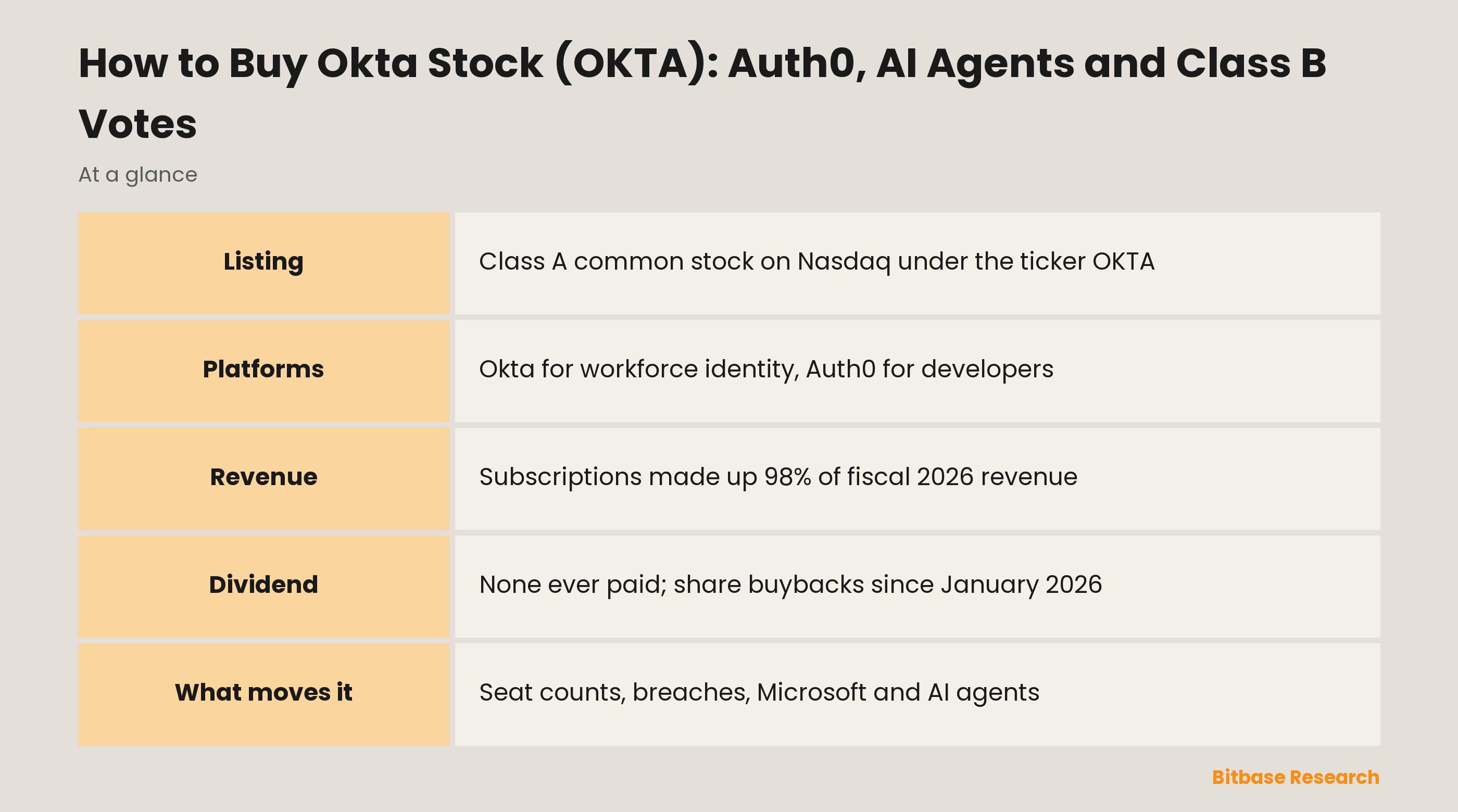
Okta stock is listed on Nasdaq under the ticker OKTA, so any broker that offers US shares can fill an order for its Class A common stock, the only class that trades. The company sells the sign-in checks between people and the software they use, and its fiscal year closes on 31 January, so the twelve months to January 2026 are called fiscal 2026. One detail sets the shares apart: unlisted Class B stock carries ten votes per share, and the annual report ties that class's voting power to a date in April 2027.
What Does Okta Do?
Okta describes itself as "the leading independent identity partner." Put simply, it runs cloud services that decide who may open which application: the single sign-on page an employee sees each morning, the extra prompt when a login looks unusual, and the sign-up screens inside consumer apps.
Two platforms carry the business. The Okta Platform serves IT and security teams with what the company calls workforce identity, covering employees, contractors, partners and non-human identities such as service accounts, with products such as Single Sign-on, Adaptive MFA and Okta Identity Governance. The Auth0 Platform, acquired with Auth0, Inc. on 3 May 2021, is built for developers who embed login and authorization in their own customer-facing apps, with tools such as Universal Login and passwordless sign-in with passkeys.
The company was incorporated in California in 2009 as Saasure Inc. and reincorporated in Delaware as Okta, Inc. in 2010. Todd McKinnon, the chief executive, is a co-founder, and headquarters are in San Francisco. On 31 January 2026 Okta had more than 20,000 customers, from small organizations to Fortune 50 companies and government agencies, and its Okta Integration Network listed over 7,000 pre-built connections to other software.
Neutrality is the pitch: the annual report describes "independent and neutral cloud-based identity solutions" that plug into nearly any application or cloud. The newest extension is AI: Okta for AI Agents and Cross App Access, a standard for letting agents act across applications, were in early access when the report was filed. Okta calls agent identity "a potential long-term opportunity" while noting that "adoption is in its early stages." In August 2026 it closed the purchase of Permiso Security, which detects threats across human, non-human and agent identities.
How Okta Makes Money
Okta sells multi-year subscriptions, typically invoiced one year in advance and recognized evenly over the contract. Subscriptions brought in 98% of fiscal 2026 revenue. Professional services supplied the other 2%, a line Okta expects to shrink from fiscal 2027 as partners take over deployments.
Revenue rose 12% in fiscal 2026 after 15% in fiscal 2025. The annual report tracks these measures:
| Measure from the annual report | Fiscal 2026 | Fiscal 2025 | Fiscal 2024 |
|---|---|---|---|
| Subscription share of revenue | 98% | 98% | 97% |
| Dollar-based net retention rate | 106% | 107% | 111% |
| Customers with six-figure annual contracts | 5,100 | 4,800 | 4,485 |
| GAAP gross margin | 77% | 76% | 74% |
The retention rate compares what last year's customers pay now with what they paid then: 106% means that group spends about 6% more, net of those who cut back or left. Okta attributed the dip in fiscal 2026 "primarily" to the macroeconomic environment.
Profit arrived recently. Of the three years the report presents, fiscal 2026 is the only one with operating income, at about 5% of revenue; net income turned positive a year earlier, in fiscal 2025. Stock-based compensation, which the non-GAAP figures leave out, equalled about 19% of fiscal 2026 revenue, down from about 30% in fiscal 2024.
Customers billed in the United States produced about 80% of fiscal 2026 revenue, and no other single country passed 10%. The pipeline appears as remaining performance obligations, contracted revenue not yet recognized; the part due within twelve months, known as current RPO, rose about 12% over fiscal 2026.
OKTA Stock at a Glance
| Feature | OKTA |
|---|---|
| Exchange | Nasdaq Global Select Market |
| Ticker | OKTA |
| Listed security | Class A common stock, the single class registered for exchange trading |
| Other class | Class B common stock, ten votes per share, not listed or traded |
| Sector | Identity and access management software |
| Index membership | S&P 500 (listed in SPY holdings for 9 November 2026) |
| Incorporated | Delaware, since 2010 |
| Head office | San Francisco |
| Listed since | 7 April 2017 |
| Fiscal year | Ends 31 January |
| Dividend | None ever paid; share repurchase program authorized in January 2026 |
| SEC identifier | CIK 1660134 |
For the live Okta share price, open the Okta stock page on Bitbase.
How to Buy Okta Stock
Because Okta is incorporated in Delaware and trades on Nasdaq, there is no depositary receipt in the way; the order buys Class A common stock itself.
1. Pick a broker that reaches Nasdaq. Outside the US, confirm which firm actually holds your account and which regulator oversees it.
2. Finish account opening. Non-US individuals usually certify their tax status on IRS Form W-8BEN, which the IRS says to submit "when requested by the withholding agent or payer."
3. Deposit funds. Converting another currency costs a spread, which can outweigh the commission.
4. Look up OKTA. The result should read Okta, Inc. Class A common stock; the Class B shares will not appear, because no exchange lists them.
5. Set the order. FINRA describes a market order as the type that "provides the most certainty that your order will be executed," whereas a limit order fills only "at or better than a specified price." Since quarterly results can swing, a limit caps the price you accept.
6. Decide on fractional shares. Some brokers sell a slice of a share for a fixed sum, but FINRA notes that "you can't transfer fractional shares to another brokerage firm."
7. Keep records. Confirmations show your cost basis for any later sale.
Withholding abroad. The IRS states that "most types of U.S. source income received by a foreign person are subject to U.S. tax of 30%," and a tax treaty can reduce that rate. Okta pays no dividend, so the rule has little to act on for now; tax on a gain when you sell is set by your home country.
Through index funds. Because OKTA is in the S&P 500, index funds tracking that benchmark hold it as one small line among about five hundred companies.
What Moves OKTA Stock
Seats and headcount. Revenue grows as customers add users, and the annual report spells out the reverse: if customers "reduce the size of their workforce," the identities Okta manages, "and therefore our revenue may potentially decrease." Job cuts at clients can reach Okta at renewal.
Retention and backlog. A weak sales quarter surfaces slowly in revenue, so retention and current RPO are the early signals. In the second quarter of fiscal 2027, the three months to 31 July 2026, revenue rose 11% and current RPO 14% from a year earlier, and retention stood at 107%.
Security incidents. For an identity vendor, a breach is a commercial event. The annual report recalls a January 2022 compromise of a third-party provider that was "widely publicized," and an October 2023 intrusion in which an attacker "stole information from inside our customer support system." A shareholder class action over statements about security controls and the Auth0 integration ended in a settlement that a federal court approved in November 2024, with no admission of wrongdoing.
Microsoft and bundling. "Our principal competitor is Microsoft," the report states, adding that larger rivals can win business by "selling at zero or negative margins, bundling products or maintaining closed technology platforms." Okta's answer is neutrality across vendors.
Margins, buybacks and tax. GAAP operating margin reached 13% in the second quarter of fiscal 2027, up from 6% a year before. By 31 July 2026 a little under half of the buyback authorized in January had been used, and the last convertible notes were repaid in cash on 15 June 2026. Okta also says it may release "a significant portion" of the reserve held against its American deferred tax assets, a bookkeeping gain that would inflate one quarter's net income.
AI agents. Presenting the second-quarter results, McKinnon said "every agent needs a trusted identity and clear controls over what it can access and do." The annual report itself calls adoption early.
Demand, Breaches and Voting Control in Okta's Risk Factors
The risk factors in the latest annual report that bear most directly on an OKTA share:
Demand. Weak economic conditions "and reductions in workforce identity and customer identity spending have, in the past and may, in the future, reduce demand for our solutions."
Renewals. "Our customers have no obligation to renew their subscriptions after the expiration of their subscription period."
Cybersecurity. Because its products sit in customers' "security software supply chain," Okta calls itself "an attractive target for such attacks," and it says past incidents allowed unauthorized access to its systems or data or to customers' data.
Voting control. Directors, executive officers and their affiliates held 32% of the voting power on 31 January 2026, and Class B holders "could continue to control nearly a majority of the combined voting power" until 12 April 2027, the tenth anniversary of the IPO's closing.
And the share itself: "The stock price of our Class A common stock may be volatile or may decline."
How to Research OKTA Yourself
Okta files with the SEC under CIK 1660134. The annual report for fiscal 2026 was filed on 5 March 2026, and earnings releases arrived as 8-K filings on 4 March, 28 May and 26 August 2026. The company also names investor.okta.com and its blogs at okta.com/blog as channels for material disclosures.
In each filing, the key business metrics table gives retention, current RPO and the six-figure customer count, and the stockholders' equity note shows Class B conversions and buybacks.
One trap catches first-time readers: fiscal 2027 covers February 2026 to January 2027, so line up periods before comparing Okta with companies on a calendar year. For other listed security companies, see our Palo Alto Networks stock guide and Fortinet stock guide; the US stock pages on Bitbase carry quotes for other companies.
Okta Stock FAQ
Can I buy Okta stock with crypto?
Not directly. A broker settles OKTA purchases in dollars, so you would sell crypto for cash first, a sale that may be taxed in your country, and then fund the account. Owning the share means owning part of a company with a vote at its meetings, which is how a share differs from a crypto asset.
Does Okta pay a dividend?
No. The annual report says Okta has "never declared or paid any cash dividends" on its common stock and does not intend to "in the foreseeable future." Instead, it began repurchasing shares in January 2026.
What is the difference between Okta's Class A and Class B shares?
Class A shares carry one vote each and trade on Nasdaq; Class B shares carry ten votes each and are not listed. Otherwise they are identical. A Class B share can be converted into one Class A share at any time and generally converts automatically when sold or transferred.
Is OKTA in the S&P 500?
Yes. The SPY holdings list that State Street published for 9 November 2026 includes Okta; SPY is built to track the S&P 500. A constituent's weight moves with its share price.
What is the difference between Okta and Auth0?
Auth0 is part of Okta. Bought in May 2021, it is now the platform for developers who build login into their own apps, while the Okta Platform focuses on workforce users.
Conclusion
Owning OKTA is a wager that identity stays a separate purchase, not a feature folded into bigger software suites. Fiscal 2026 showed a company that had become profitable while growth slowed to 12%, with almost all revenue from subscriptions. The signals to follow are retention and current RPO, any new security incident, how hard Microsoft competes, and whether the AI agent products move from early access to revenue; the voting structure deserves a look before April 2027. Read the latest annual report and quarterly filing, then decide how much weight one identity vendor should carry in your portfolio.
Related reading
Other Bitbase articles on this topic:
- How to Buy Cognizant Stock (CTSH): Banks, Health Care and India
- How to Buy Corpay Stock (CPAY): Fuel Cards to Cross-Border FX
- How to Buy Fiserv Stock (FISV): Clover, Bank Tech and a New Ticker
- How to Buy Workday Stock (WDAY): Class A Shares, Founder Control
Disclaimer: This article is educational content from Bitbase Academy, provided for information only. It explains what a company or fund does and how the instruments referenced here differ from one another; it does not constitute investment, trading, tax, or financial advice, and it is neither a recommendation nor an endorsement of any security, token, or trading strategy. A tokenized stock is issued by a third party and is designed to give economic exposure to an underlying asset: it is not a share, it carries no shareholder rights, and it depends on the issuer's structure, eligibility rules, and redemption terms, which the issuer can change. Perpetual futures are leveraged derivatives that hold no underlying asset and can be liquidated, and trading hours, product availability, and eligibility differ by instrument and by jurisdiction and can change at any time. Written as of November 2026; verify everything yourself through company filings, the issuer's own documentation, and the product pages of the venue you trade on.
References
[1] Okta Form 10-K for fiscal 2026 (SEC EDGAR) www.sec.gov
[2] Okta fiscal 2026 Form 10-K, XBRL cover page (SEC EDGAR) www.sec.gov
[3] Okta Form 10-Q for the second quarter of fiscal 2027 (SEC EDGAR) www.sec.gov
[4] Okta second-quarter fiscal 2027 results release, filed with Form 8-K (SEC EDGAR) www.sec.gov
[5] Okta Form 10-K for fiscal 2022: Auth0 acquisition (SEC EDGAR) www.sec.gov
[6] State Street: SPDR S&P 500 ETF Trust (SPY) holdings www.ssga.com
[7] FINRA: Order Types www.finra.org
[8] FINRA: Investing in Fractional Shares www.finra.org
[9] IRS: NRA Withholding www.irs.gov
[10] IRS: About Form W-8 BEN www.irs.gov





