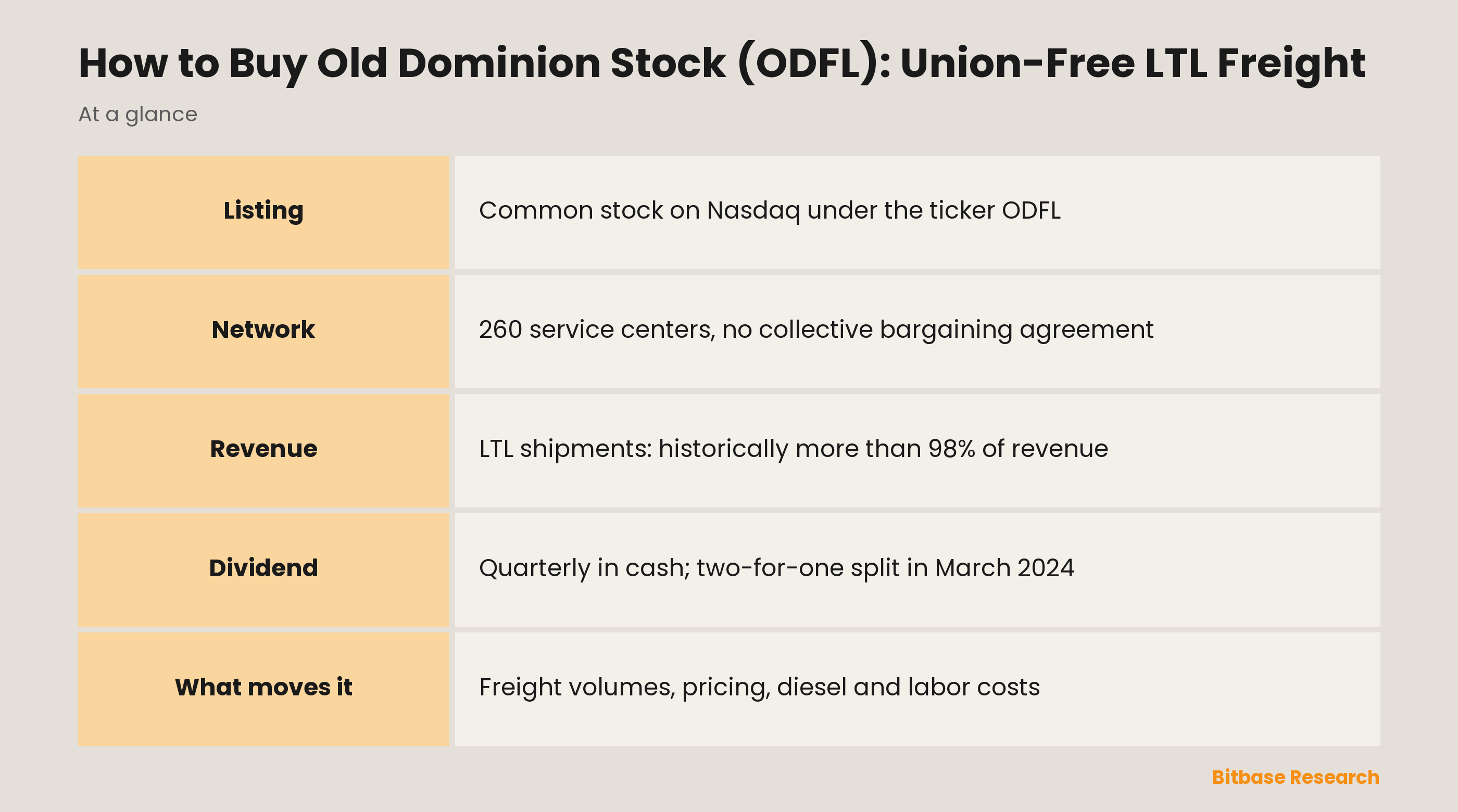
Because Old Dominion Freight Line, Inc. has a single class of common stock on Nasdaq under the ticker ODFL, any broker that reaches the US market can take your order for Old Dominion stock. The company is a less-than-truckload (LTL) carrier running 260 service centers with a workforce that has no collective bargaining agreement, and LTL shipments have historically brought in more than 98% of its revenue.
What Does Old Dominion Do?
Old Dominion moves freight that is too large for a parcel network but too small to fill a trailer. Its 10-K explains the model: LTL carriers "typically pick up multiple shipments from multiple customers on a single truck," then route that freight through service centers where it is transferred to trucks heading for similar destinations.
Founded in 1934 and incorporated in Virginia in 1950, the company is based in Thomasville, North Carolina. It calls itself "one of the largest North American less-than-truckload ('LTL') motor carriers," offering regional, inter-regional and national service through "a single integrated, union-free organization," plus container drayage, truckload brokerage and supply chain consulting.
At the end of 2025 the network had 260 service centers, 240 of them owned, and the owned sites held about 96% of its door capacity. The company owned 10,184 tractors and employed 20,591 full-time people, about half of them drivers, none covered by a collective bargaining agreement.
The industry is concentrated: the largest five LTL carriers had about 56% of the US market in 2024 and the largest ten about 81%, according to Transport Topics data cited in the 10-K. Old Dominion also competes "to a lesser extent" with truckload, small package and airfreight carriers and railroads, businesses covered in our guides to FedEx stock and Union Pacific stock.
How Old Dominion Makes Money
Almost all revenue is a fee for moving a shipment. In 2025 LTL services produced about 99% of revenue and other services such as drayage and brokerage the rest. More than 95% came from services performed in the United States in each of the last three years, and no customer was large: the biggest represented about 4% of revenue, the top 20 about 23%.
Prices are generally set by weight, commodity and distance, and light, bulky freight is priced higher per hundred pounds than dense, heavy freight. The key yield measure is LTL revenue per hundredweight. It includes fuel surcharges, which are indexed to weekly diesel prices from the US Department of Energy, so the company also reports it without them.
Profit depends on density, which the 10-K defines as "shipment and tonnage growth within our existing infrastructure." Cost control is tracked through the operating ratio, operating expenses divided by revenue, where lower is better. In 2025 it rose to 75.2% from 73.4%: revenue fell 5.5% as LTL tons per day dropped 8.8%, while revenue per hundredweight rose 3.9%, or 4.8% excluding fuel surcharges. Salaries, wages and benefits were the largest cost, at 47.9% of revenue.
ODFL Stock at a Glance
| Item | Old Dominion Freight Line |
|---|---|
| Exchange | Nasdaq Global Select Market |
| Ticker | ODFL |
| Share class | Common stock, the only class registered under Section 12(b) |
| Business | Less-than-truckload (LTL) freight carrier |
| Index | S&P 500 |
| Headquarters | Thomasville, North Carolina |
| Incorporated | Virginia, 1950 (founded 1934) |
| Fiscal year | Calendar year, ending 31 December |
| Dividend policy | Quarterly cash dividend, declared by the board |
| Stock split | Two-for-one, March 2024 |
| SEC identifier | CIK 878927 |
Price, market value and dividend yield move with each trade; follow them on the Old Dominion stock page on Bitbase.
How to Buy Old Dominion Stock
Old Dominion is a Virginia company filing a 10-K, so there is no ADR to choose from. The steps are those of any US share purchase:
1. Pick a broker with US market access. Abroad, confirm the company behind the account and the regulator supervising it.
2. Complete the account checks. Non-US individuals are usually asked for IRS Form W-8BEN, which documents foreign status for withholding.
3. Fund the account. Depositing another currency adds a conversion cost on top of commission.
4. Search for ODFL. The line should read Old Dominion Freight Line, Inc. common stock on Nasdaq; Dominion Energy is a different company with a different ticker.
5. Choose the order type. A market order fills at the prevailing price; a limit order fills only at your price or better and may not fill at all.
6. Decide the size. Some brokers offer fractional shares, so you can invest a fixed sum, but not every broker offers them for every stock.
Tax outside the United States. The IRS says "most types of U.S. source income received by a foreign person are subject to U.S. tax of 30%," and a tax treaty can lower the rate. ODFL dividends fall under that rule, and your home country may tax them again.
Through a fund. State Street's daily holdings file for SPY, its S&P 500 fund, listed Old Dominion Freight Line on 9 November 2026, so S&P 500 index funds hold it as one small position among hundreds.
What Moves ODFL Stock
Industrial demand. The 10-K ties demand to "industrial production and the overall health of the U.S. domestic economy." Weak freight hurts twice: fewer, lighter shipments cut revenue, and lower density spreads fixed costs such as depreciation over less freight.
Yield discipline. The company calls its pricing "cost-based," meant to offset cost inflation and fund capacity. In the third quarter of 2026 revenue rose 13.1% while LTL tons per day slipped 0.1%; revenue per hundredweight rose 13.3%, or 5.1% excluding fuel surcharges, and the operating ratio improved to 71.5% from 74.3%. In October 2026 tons per day rose 2.1% from a year earlier.
Diesel and the surcharge. Old Dominion does not hedge fuel. Its average cost per gallon of diesel rose 68.4% in the third quarter of 2026, and the surcharge carried much of that quarter's revenue gain. The 10-K warns that recovery "lags behind changes in fuel prices," which matters most when prices are rising.
Capacity spending. The company has historically spent 10% to 15% of revenue on capital expenditures; in 2025 it spent about 7%. The 10-K expected 2026 to stay below the range, yet by October the 2026 plan had been raised by about 43%, with more for real estate and for tractors and trailers.
Labor and seasons. Pay is the biggest expense; in the third quarter of 2026 it fell to 44.3% of revenue from 47.1% as pricing outran it. Revenue and margins are typically lower in the first and fourth quarters, when winter cuts shipments.
Density, Diesel and Unions in the ODFL Risk Factors
Of the risk factors in the 10-K, which the latest 10-Q says have not changed materially, these matter most for a shareholder:
Economy and inflation. "Reduced freight density in our network can have a deleveraging impact on fixed costs," and if rates cannot rise enough to cover inflation, "our profitability and cash flows could be materially affected."
Unionization. "If our employees were to unionize, our operating costs would increase and our ability to compete would be impaired." The company notes past efforts to organize employees at various service centers.
Fuel. "We do not hedge against the risk of diesel fuel price increases," and there is no assurance surcharges "will be sufficiently effective in offsetting increases."
Control. The Congdon family beneficially owns about 10% of the shares, and Virginia law and the company's charter contain provisions that could delay a change in control.
Beyond the business, a single stock concentrates your money in one company, and the dividend depends on the board and is limited by state law and loan covenants.
How to Research ODFL Yourself
Old Dominion's SEC filings sit under CIK 878927: an annual 10-K, a 10-Q after each of the first three quarters, and 8-Ks for events, including quarterly results and each dividend declaration. Its website, odfl.com, posts the same reports free of charge, and ir.odfl.com carries each earnings call and its replay.
In the 10-K, Item 1 covers the network and workforce, Item 1A the risks, and Item 5 a performance graph against the S&P 500 and the Dow Jones Transportation Average. The MD&A table of tons per day, weight per shipment and revenue per hundredweight is the most useful single page.
Two habits help. Compare revenue per hundredweight with and without fuel surcharges, since fuel can move the headline figure while base pricing barely changes. And read the monthly update in the latest 10-K and 10-Q, which gives revenue per day and tons per day for the month after the period ends. For live prices, use the stock page above, while Bitbase's US stock pages cover other listed companies.
Old Dominion Stock FAQ
Can I buy Old Dominion stock with crypto?
Not directly. You buy ODFL shares with US dollars at a broker, which means converting crypto to cash first, a step that may be taxable where you live. Owning the stock gives voting and dividend rights in a registered company, which is how a share differs from a crypto asset.
Does Old Dominion pay a dividend?
Yes, quarterly in cash. The board raised the quarterly amount in 2024, 2025 and early 2026, and the 10-K says future payments "are not guaranteed"; each declaration comes in an 8-K.
Has ODFL stock split?
Yes. On 27 March 2024, shareholders of record as of 13 March received one additional share for every share they owned, a two-for-one split. Per-share history in later filings is restated for it, so compare only adjusted data.
Is ODFL in the S&P 500?
Yes. Old Dominion Freight Line appears in State Street's daily holdings file for SPY, the fund that tracks the S&P 500, dated 9 November 2026. Its weight changes daily.
Conclusion
Old Dominion is a bet on density: a network built with room to spare that earns more as freight fills it, run by a workforce without union contracts. Recent years show both sides, with tonnage falling and the operating ratio rising in 2025, then pricing and a diesel-driven surcharge lifting revenue in 2026 before volumes turned up in the autumn. Read the latest 10-Q, follow tons per day and revenue per hundredweight excluding fuel over several quarters, and size any position knowing that one freight carrier's fortunes rest on the shipping cycle.
Related reading
Other Bitbase articles on this topic:
- How to Buy Elbit Systems Stock (ESLT): Nasdaq and Tel Aviv
- How to Buy EMCOR Stock (EME): Wiring and Cooling Data Centers
- How to Buy Ferguson Stock (FERG): From London to NYSE Only
- How to Buy UPS Stock (UPS): Class B Shares, Amazon and Teamsters
Disclaimer: This article is educational content from Bitbase Academy, provided for information only. It explains what a company or fund does and how the instruments referenced here differ from one another; it does not constitute investment, trading, tax, or financial advice, and it is neither a recommendation nor an endorsement of any security, token, or trading strategy. A tokenized stock is issued by a third party and is designed to give economic exposure to an underlying asset: it is not a share, it carries no shareholder rights, and it depends on the issuer's structure, eligibility rules, and redemption terms, which the issuer can change. Perpetual futures are leveraged derivatives that hold no underlying asset and can be liquidated, and trading hours, product availability, and eligibility differ by instrument and by jurisdiction and can change at any time. Written as of November 2026; verify everything yourself through company filings, the issuer's own documentation, and the product pages of the venue you trade on.
References
[1] Old Dominion Form 10-K for 2025 (SEC EDGAR) www.sec.gov
[2] Old Dominion 2025 Form 10-K, XBRL cover page (SEC EDGAR) www.sec.gov
[3] Old Dominion Form 10-Q for the third quarter of 2026 (SEC EDGAR) www.sec.gov
[4] Old Dominion third-quarter 2026 earnings release, filed with Form 8-K (SEC EDGAR) www.sec.gov
[5] Old Dominion Form 10-K for 2024: two-for-one stock split (SEC EDGAR) www.sec.gov
[6] State Street SPDR S&P 500 ETF Trust (SPY): fund page and daily holdings www.ssga.com
[7] IRS: NRA Withholding www.irs.gov





