
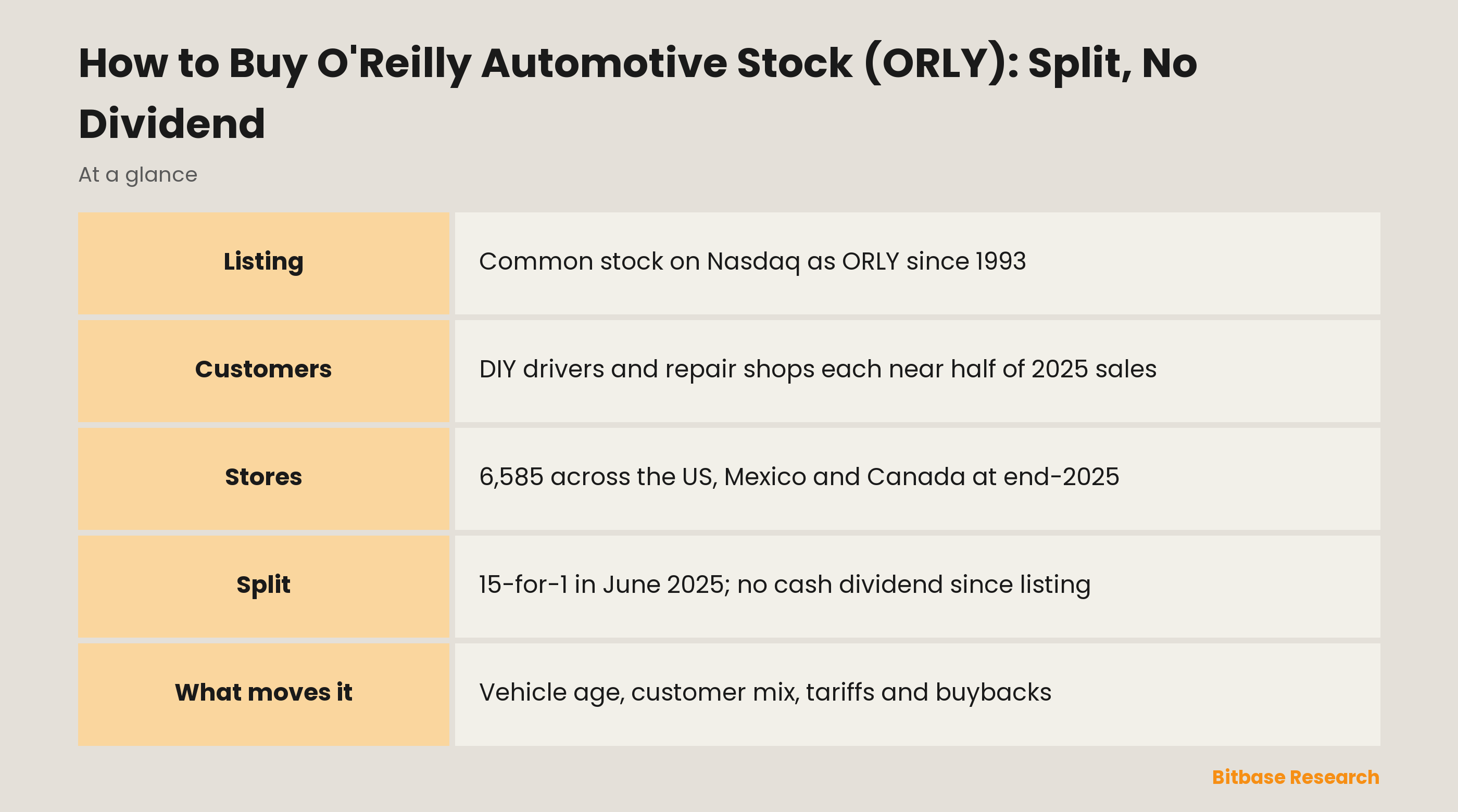
Even after its 15-for-1 stock split in June 2025, O'Reilly Automotive stock is bought the ordinary way: through a brokerage account with access to Nasdaq, where its common shares have been listed as ORLY since April 1993. The company sells auto parts to two very different customers at once, drivers who fix their own cars and professional repair shops, and in 2025 each group brought in roughly half of sales. It has declared no cash dividend since listing and returns cash through buybacks instead. This guide covers how O'Reilly earns its money, how to place an order and what its filings say could slow it down.
What Does O'Reilly Automotive Do?
O'Reilly Automotive sells replacement parts, tools, supplies and accessories for cars, vans and trucks. Its annual report calls it "one of the largest specialty retailers of automotive aftermarket parts, tools, supplies, equipment, and accessories across North America." Charles F. O'Reilly and his son, Charles H. "Chub" O'Reilly Sr., founded it in 1957 with a single store in Springfield, Missouri, which is still the headquarters.
A store stocks hard parts such as alternators, batteries, brake components and starters, maintenance items such as oil, filters and wiper blades, and accessories like floor mats. National brands share the shelves with the company's own labels, from Super Start batteries to BrakeBest brakes, on a "good, better, best" ladder of quality and price. O'Reilly supplies the parts; as the FAQ below explains, someone else turns the wrench.
At 31 December 2025 it operated 6,447 stores across 48 US states and Puerto Rico, 112 in Mexico and 26 in Canada, for 6,585 in all. Texas had the most, with 878. Both foreign footholds came through acquisitions: Mayasa in Mexico in 2019 and Vast Auto in Canada in January 2024.
Distribution holds the network together. Its 32 distribution centers typically give stores same-day or overnight access to more than 156,000 stock-keeping units, against about 24,000 on an average US store's shelves, and 399 Hub stores carry deeper stock for nearby branches. More than 95% of stores get multiple same-day deliveries, a speed the 10-K counts as a key competitive advantage. Chief executive Brad Beckham, in the role since 2024, started there as a parts specialist.
How O'Reilly Automotive Makes Money
The 10-K reports a single segment and states that "product sales of automotive aftermarket parts are the only material source of revenue for the Company." What varies is the buyer. Under what it calls a "dual market strategy", O'Reilly sells both to do-it-yourself (DIY) customers and to professional service providers, the repair shops and fleet operators that do the work for others. The revenue note splits sales this way:
| Customer type | 2023 | 2024 | 2025 |
|---|---|---|---|
| Do-it-yourself customers | 52.2% | 50.7% | 49.3% |
| Professional service providers | 45.8% | 46.9% | 48.7% |
| Other sales and adjustments | 2.0% | 2.4% | 2.1% |
Shares are calculated from the fiscal 2025 10-K revenue note and rounded to one decimal.
The trend is plain. In 2025 professional sales rose 10.4% and DIY sales 3.5%, and in the first half of 2026 professionals accounted for 50.4% of sales against 47.9% for DIY. The 10-K says the professional side has "historically" grown faster because that market is more fragmented; about 825 full-time salespeople do nothing but call on repair shops.
The shift has a cost: professional sales "carry a lower gross margin percentage than DIY sales." In 2025 cheaper purchasing and distribution efficiencies outweighed that drag, and gross margin rose to 51.6% of sales from 51.2%. Operating margin held at 19.5%, and net income came to 14.3% of sales.
Comparable store sales, measured on US stores open at least a year, rose 4.7% in 2025. The 10-K credits larger average tickets from both groups and more professional transactions, partly offset by fewer DIY transactions. Tickets grew because tariffs raised inventory costs that "were passed on in selling prices," and because newer vehicles need more complex, costlier parts. New stores add the rest: 207 net openings in 2025, with 225 to 235 planned for 2026 in the 10-K.
ORLY Stock at a Glance
| Item | Detail |
|---|---|
| Exchange | Nasdaq Global Select Market |
| Ticker | ORLY |
| Security | Common stock; the 10-K cover registers no other class |
| Trading since | 22 April 1993 |
| Stock splits | 15-for-1 in June 2025; two-for-one in June 2005 |
| Sector | Consumer discretionary: automotive aftermarket retail |
| Index membership | S&P 500 and Nasdaq-100 |
| Headquarters | Springfield, Missouri |
| Incorporated | Missouri |
| Fiscal year | Calendar year, ending 31 December |
| Dividend policy | No cash dividend declared since 1993; buybacks instead |
| SEC identifier | CIK 898173 |
Live figures such as the share price, market value and volume belong on a quote screen, and the O'Reilly Automotive stock page on Bitbase shows them.
How to Buy O'Reilly Automotive Stock
Because O'Reilly is a US company with one listed share class, there is no depositary receipt or second line to choose from. The route runs through a broker:
1. Choose a broker that reaches Nasdaq. Outside the US, check which entity holds your account and who supervises it.
2. Complete the account checks. Non-US individuals are usually asked for IRS Form W-8BEN, which the IRS says to submit "when requested by the withholding agent or payer whether or not you are claiming a reduced rate of, or exemption from, withholding."
3. Fund it in US dollars. If your money starts in another currency, look at the exchange rate you are offered, not only the commission.
4. Search for ORLY. Check that the result reads O'Reilly Automotive common stock on Nasdaq; the 10-K cover registers no other O'Reilly security on an exchange.
5. Pick an order type. FINRA notes that firms "typically enter your order as a market order unless you specify otherwise," while "a buy limit order can be executed only at or below the limit price," though "there's a chance your order doesn't get executed at all."
6. Settle the size. Since June 2025 one ORLY share has equalled a fifteenth of a pre-split share, so a whole share takes less money than before. Fractional shares are an option where offered, but "the availability of fractional share trading varies by brokerage firm," and you "might not have shareholder voting rights" on a fraction.
7. Keep the confirmations. They record what you paid, which you will need when you sell.
Regular Nasdaq trading runs from 9:30 a.m. to 4 p.m. Eastern Time. Outside those hours, FINRA warns, news "might significantly impact the price of the security when the market opens again," and regular and extended-hours prices can drift apart; a limit order caps what you pay.
Outside the United States, withholding is mostly a dividend question: the IRS says "most types of U.S. source income received by a foreign person are subject to U.S. tax of 30%," with lower treaty rates possible. With no cash dividend declared since 1993, dividend withholding has not arisen for ORLY holders so far; your home country's rules on investment gains apply regardless.
Through a fund, you can hold O'Reilly without picking it: on 29 October 2026 it appeared in the daily holdings of State Street's SPY and Invesco's QQQ, which track the S&P 500 and the Nasdaq-100, and of the consumer discretionary sector fund XLY.
What Moves ORLY Stock
The age of the cars on the road. The 10-K, citing the Auto Care Association, puts the average age of US vehicles at 12.6 years in 2024, up from 11.4 years a decade earlier, and argues that rising new and used car prices keep owners investing in what they have. It also cites Department of Transportation data showing US miles driven up 2.1%, 1.0% and 0.9% in 2023, 2024 and 2025: slower driving growth means slower wear.
The professional share of sales. Because professional sales carry lower gross margins, the customer mix in each quarterly release moves profit as well as revenue. In the third quarter of 2026 the company reported double-digit growth in its professional business and mid-single-digit growth in DIY, with comparable store sales up 7.2% on top of 5.6% a year earlier.
Tariffs and pricing. O'Reilly has historically passed cost increases through to shelf prices, as it did in 2025. That lifted tickets, while DIY transactions fell amid "pressured consumer spending on discretionary categories." Trade policy can cut the other way too: third-quarter 2026 results included a benefit from tariff refunds.
Weather and the calendar. Sales and profits have historically run higher from April through September than from October through March. Extreme heat and cold raise part failure rates, while storms keep shoppers home.
Buybacks. Repurchases are how cash goes back to owners. From the program's start in January 2011 through 27 February 2026 the company bought back about 1.5 billion shares, split-adjusted, and the board enlarged the authorization in November 2025 and again in June 2026. Diluted shares averaged 856 million in 2025, down from 881 million a year earlier.
Speed Bumps for an ORLY Holder
The risk factors in the 10-K are long, and the June 2026 quarterly report says they have not changed materially. These bear most directly on an ORLY share:
A weaker consumer. Demand for many of its products is "primarily non-discretionary," yet "deteriorating economic conditions may adversely impact demand for our products." In 2025 it was the DIY side whose transaction counts fell.
Changing vehicles. New vehicle technology, "including but not limited to electric, hybrid, and internal combustion engines, may result in less frequent repairs, parts lasting longer, or elimination of certain repairs." Carmakers' limits on telematics and repair data could also push owners toward dealers.
Competition. The 10-K names AutoZone, Advance Auto Parts, CARQUEST and NAPA among national chains, and Walmart and Amazon among mass and online sellers, adding that "some of our competitors are larger than we are and have greater financial resources."
Suppliers and trade. Supplier consolidation, offshore manufacturing and tariff changes "could affect our ability to source products" at current volumes or prices.
Debt. O'Reilly borrows through a revolving credit facility, commercial paper and senior notes, and issued three more series of notes in August 2026. Its selected financial data show a shareholders' deficit at every year-end from 2021 to 2025, and a ratings downgrade "would impact our cost of capital."
The share carries risks of its own: the 10-K warns that "the market price of our common stock may be volatile," and with no dividend, your return depends entirely on the price at which you sell.
How to Research ORLY Yourself
Every O'Reilly filing sits on SEC EDGAR under CIK 898173: the annual 10-K, a 10-Q for each of the first three quarters, and 8-Ks for events in between. In 2025 and 2026 it announced each earnings date in an 8-K at the start of the quarter, then published results in a later 8-K followed by a call on the Investor Relations section of www.OReillyAuto.com.
In the 10-K, the business section has the store table by state and country, the revenue note splits DIY from professional sales, and the market section lists recent buybacks beside a performance graph against the S&P 500 Retail Index and the S&P 500.
Two checks prevent mistakes. Filings from before June 2025 show pre-split figures, so divide their per-share data by 15 before comparing. And comparable store sales cover only US stores open at least a year, excluding items such as sales to independent parts stores, so they differ from total sales growth. Quotes live on the stock page linked earlier, the wider list of US stock pages on Bitbase covers other companies, and for contrast our Home Depot stock guide covers a US retailer that pays a quarterly dividend.
O'Reilly Automotive Stock FAQ
Does O'Reilly Automotive pay a dividend?
No. The 10-K says no cash dividends have been declared since the stock began trading in April 1993 and that the company "does not anticipate paying any cash dividends in the foreseeable future." It buys back shares on the open market instead.
Can I buy O'Reilly Automotive stock with crypto?
Not directly. A broker executes ORLY orders on Nasdaq in US dollars, so crypto would need to be converted to cash and moved to the brokerage account first, and depending on where you live, selling it can create a tax bill. Keep the two decisions apart: a share is a registered stake in a company with voting rights, which is what sets a share apart from a crypto asset.
Has ORLY stock ever split?
Yes. In the latest, a 15-for-1 split paid as a special stock dividend, holders of record on 2 June 2025 received 14 additional shares for each one held, and trading on a post-split basis began on 10 June 2025. The company said it wanted employees to buy whole shares more easily through a payroll purchase plan with a 15% discount. The previous split, in 2005, was two-for-one.
Is ORLY in the S&P 500 and the Nasdaq-100?
Yes, both. The daily holdings State Street publishes for SPY and Invesco publishes for QQQ each included O'Reilly Automotive on 29 October 2026. Weights change daily.
Does O'Reilly repair cars?
No. The 10-K states: "We do not sell tires or perform for-fee automotive repairs or installations." Its stores do offer services such as battery testing, check-engine-light code reading and tool loans, and staff can refer drivers to trusted local repair shops.
Conclusion
Buying ORLY takes a broker with Nasdaq access and a market or limit order; the 2025 split only made each share smaller. The share represents an auto parts retailer whose sales are now split almost evenly between home mechanics and repair shops, with the professional side growing faster at lower margins. With no dividend, returns rest on the share price, and buybacks are how the company hands back cash. Read the latest 10-K and quarterly releases, especially the customer split and comparable store sales, before deciding how much of your money belongs in one retail stock.
Related reading
Other Bitbase articles on this topic:
- How to Buy General Motors Stock (GM): Nasdaq Move, Trucks and EVs
- How to Buy Hilton Stock (HLT): Fees, Honors and the Nasdaq Move
- How to Buy Lowe's Stock (LOW): FBM, Pro Customers and Dividend
Disclaimer: This article is educational content from Bitbase Academy, provided for information only. It explains what a company or fund does and how the instruments referenced here differ from one another; it does not constitute investment, trading, tax, or financial advice, and it is neither a recommendation nor an endorsement of any security, token, or trading strategy. A tokenized stock is issued by a third party and is designed to give economic exposure to an underlying asset: it is not a share, it carries no shareholder rights, and it depends on the issuer's structure, eligibility rules, and redemption terms, which the issuer can change. Perpetual futures are leveraged derivatives that hold no underlying asset and can be liquidated, and trading hours, product availability, and eligibility differ by instrument and by jurisdiction and can change at any time. Written as of October 2026; verify everything yourself through company filings, the issuer's own documentation, and the product pages of the venue you trade on.
References
[1] O'Reilly Automotive Form 10-K for fiscal 2025 (SEC EDGAR) www.sec.gov
[2] O'Reilly Automotive Form 10-Q for the quarter ended 30 June 2026 (SEC EDGAR) www.sec.gov
[3] O'Reilly Automotive Form 8-K, 28 October 2026: third-quarter results (SEC EDGAR) www.sec.gov
[4] O'Reilly Automotive Form 8-K, 13 March 2025: 15-for-1 stock split (SEC EDGAR) www.sec.gov
[5] O'Reilly Automotive Form 10-K for 2005: the two-for-one split (SEC EDGAR) www.sec.gov
[6] O'Reilly Automotive Form 8-K, 1 June 2026: larger buyback authorization (SEC EDGAR) www.sec.gov
[7] O'Reilly Automotive Form 8-K, 14 August 2026: new senior notes (SEC EDGAR) www.sec.gov
[8] State Street: SPY daily holdings, 29 October 2026 www.ssga.com
[9] State Street: XLY daily holdings, 29 October 2026 www.ssga.com
[10] Invesco: QQQ fund page and holdings, 29 October 2026 www.invesco.com
[11] FINRA: Order Types www.finra.org
[12] FINRA: Investing in Fractional Shares www.finra.org
[13] IRS: NRA Withholding www.irs.gov
[14] IRS: About Form W-8 BEN www.irs.gov





