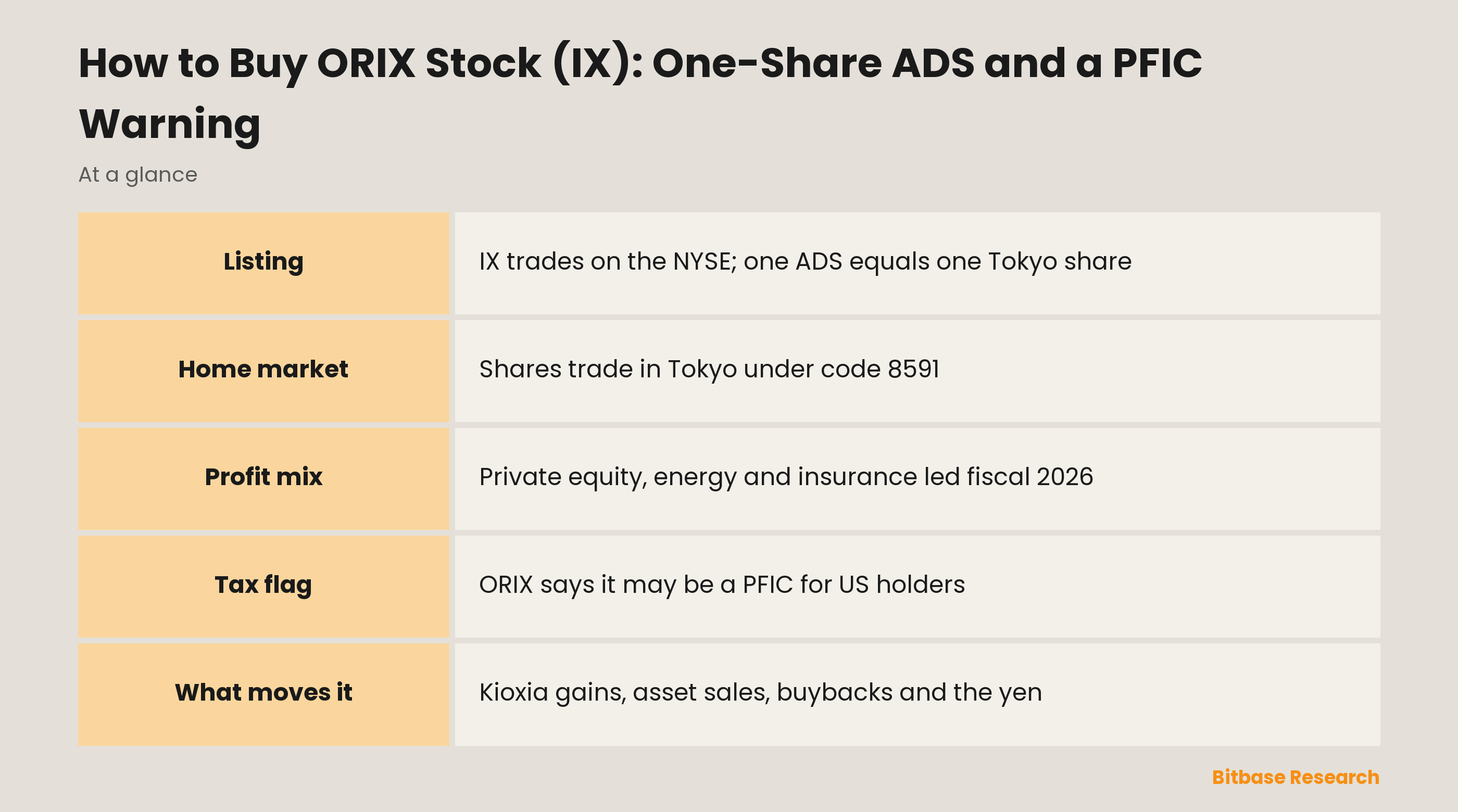
ORIX trades in New York as IX, an American depositary share (ADS) on the NYSE that has represented exactly one Tokyo share since 27 February 2025, when the ratio moved from five shares to one. The company behind it started in 1964 as a leasing firm and now earns its profits from private equity, renewable energy, life insurance, aircraft and asset management. Before buying, US investors should know that ORIX says it may be a passive foreign investment company, a status that changes how they are taxed.
What Does ORIX Do?
ORIX Corporation was set up in Osaka in April 1964 as Orient Leasing Co., Ltd. Its founders were three trading companies and five banks, among them predecessors of today's MUFG Bank, Mizuho Bank and Sumitomo Mitsui Banking Corporation. It opened its first overseas office in Hong Kong in 1971 and took the ORIX name in 1989 to reflect a growing international profile and a move beyond leasing.
The group grew by adding businesses. It entered life insurance in 1991, bought Yamaichi Trust & Bank in 1998 and acquired Robeco, a Dutch asset manager, in 2013, taking full ownership in 2016; Robeco is now ORIX Corporation Europe. In 2014 it bought Hartford Life Insurance K.K., which became ORIX Life Insurance. A year later it formed Kansai Airports with France's VINCI Airports, and it took 30% of Avolon, an Irish aircraft lessor, in November 2018.
It sells businesses just as readily. Houlihan Lokey, the US investment bank bought in 2006, was fully sold by July 2019. In March 2024 ORIX sold 66% of ORIX Credit to NTT DOCOMO, and on 3 August 2026 it completed the sale of ORIX Bank to Daiwa Next Bank.
Today ORIX describes itself as active in around 30 countries and regions with approximately 37,000 people. Its strategy, ORIX Group Growth Strategy 2035, rests on two models: Alternative Investment & Operations, which brings in outside capital for assets ORIX buys and runs, and Business Solutions, which tackles customers' problems with resources from inside and outside the group. Hidetake Takahashi has been chief executive since January 2026, succeeding Makoto Inoue, who held the post from 2014 and remains chairman.
How ORIX Makes Money
ORIX's profit mix shifts from year to year. In fiscal 2026, the year to 31 March 2026, it reported ten segments:
| Segment | Share of fiscal 2026 segment profit | What it covers |
|---|---|---|
| PE Investment and Concession | 17.1% | Private equity in Japan; three Kansai airports |
| Environment and Energy | 15.8% | Solar and other renewables, power retailing, waste management |
| Insurance | 14.0% | Life insurance sold through agents, banks and online |
| Corporate Financial Services and Maintenance Leasing | 13.8% | Lending to small and mid-sized Japanese firms, car leasing, equipment rental |
| Real Estate | 10.7% | Development, rental, hotels and Japanese inns, asset management |
| Aircraft and Ships | 9.1% | Aircraft leasing and sales, ship finance |
| ORIX Europe | 8.6% | Equity and fixed income asset management |
| Asia and Australia | 7.0% | Leasing and lending; private equity in Asia |
| Banking and Credit | 3.7% | ORIX Bank and consumer finance |
| ORIX USA | 0.1% | Corporate and real estate finance, bond and private equity investing |
Shares computed from the fiscal 2026 Form 20-F.
Several of those shares owe a lot to one-off deals. Total revenues rose 16%, helped by fund valuation gains at the US subsidiary and a gain on transferring shares of Greenko Energy Holdings, which turned Environment and Energy from a loss in fiscal 2025 into the second-largest contributor. Insurance profit rose 38% on higher premiums and investment income, while ORIX USA fell 98%, hit by goodwill and intangible impairments among other costs. Measured by revenue rather than profit, Insurance was the biggest segment, with 19.3% of the total. Net income attributable to shareholders rose 27%, and return on equity reached 10.4%, up from 8.8%.
Since 1 April 2026 the group has reported four segments instead of ten. Japan & APAC covers corporate finance, leasing, car fleets, equipment rental and corporate investments in Japan, Asia and Australia. Infrastructure holds energy, real estate, hotels, airports, aircraft and ships. USA & Europe combines ORIX USA with the European asset manager, and Insurance stands alone. Earlier periods have been recast to the new layout.
IX Stock at a Glance
| Item | Detail |
|---|---|
| What IX is | American depositary share representing one share of common stock |
| New York | NYSE, ticker IX, listed since 1998 |
| Home market | Tokyo Stock Exchange Prime Market, code 8591; the primary market for the shares |
| Depositary | Citibank, N.A., under a deposit agreement dated 14 September 1998 |
| Shares held as ADSs | About 33.3 million, roughly 2.96% of shares issued on 31 March 2026 |
| Voting unit in Japan | 100 shares |
| Accounts | US GAAP, in yen; fiscal year ends 31 March |
| Dividends | Interim and year-end; fiscal 2026 payout ratio 39.0% |
| S&P 500 | Not a member (absent from SPY holdings on 6 November 2026) |
| SEC reporting | Form 20-F yearly and Forms 6-K, CIK 1070304 |
For the live quote, see the ORIX stock page on Bitbase.
How to Buy ORIX Stock
Two lines lead to the same company: IX in dollars on the NYSE and 8591 in yen in Tokyo.
1. Choose a market. Any broker offering US-listed stocks can usually fill an IX order; buying 8591 needs a broker with access to the Tokyo Stock Exchange.
2. Open and fund the account. Brokers decide which countries' residents they accept, and currency conversion can cost more than the commission.
3. Look up IX. The result should show ORIX Corporation ADS on the NYSE.
4. Pick an order type. A market order takes whatever price comes next; a limit order waits for your price or a better one.
5. Decide on size. Some brokers let you buy part of one ADS; others sell only whole units.
Holding through Citibank. Citibank, as depositary, holds the Tokyo shares and is the only party that can exercise shareholder rights on them. It votes as ADS holders instruct and passes on dividends in dollars, but ADS holders cannot directly bring a derivative action or inspect the company's books. The depositary charges fees for issuing and cancelling ADSs and for distributing cash; Item 12 of the 20-F lists them. Because a Japanese voting unit is 100 shares, an IX holder cannot withdraw fewer than 100 shares' worth from the program.
Japanese tax on dividends. Japan withholds 15.315% from dividends paid to holders who are not Japanese residents, or 20.42% for an individual owning 3% or more of the shares. Treaties can lower that; under the US-Japan treaty the rate is generally capped at 10%, and claiming it requires an application filed in advance or a refund request later.
The PFIC point. ORIX writes that it may have been a passive foreign investment company in fiscal 2026 "because of the composition of our assets and the nature of our income," and may remain one. For US taxpayers, this means gains on a sale, and some dividends, can be spread back over the holding period, taxed at the top rate and charged interest. Lower qualified dividend rates also stop applying. Because IX trades on the NYSE, a mark-to-market election is available.
Through funds. ORIX is not in the S&P 500, so an S&P 500 fund gives no exposure to it; check the holdings list of any Japan or international fund before assuming it owns ORIX.
What Moves IX Stock
Kioxia. In the six months to 30 September 2026, net income attributable to ORIX shareholders rose 216%. Most of the jump came through TB Investment Limited Partnership, an equity-method affiliate, which booked gains from Toshiba's sale and revaluation of Kioxia Holdings shares. ORIX warns these gains will move with Kioxia's share price and that it will not directly receive cash for them.
Buying and selling companies. Disposal gains swing results: Greenko and Ormat a year earlier, SGK Holdings in the latest half, partly offset by an impairment on China Water Affairs.
Buybacks. On 11 May 2026 the board approved repurchases of up to 100 million shares, about 9.1% of those outstanding, between 22 May 2026 and 31 March 2027. By 31 October 2026, 28,364,900 shares had been bought, and ORIX files a 6-K each month with progress.
Rates and the yen. Funding costs feed into the lease and loan terms ORIX can offer, and higher rates can strain customers with floating-rate loans. The ADS price also follows the dollar-yen rate, because the shares and dividends behind it are in yen.
Aircraft leasing. Equity income from Avolon was a plus for the new Infrastructure segment in the latest half, even as that segment's profit fell, and Aircraft and Ships produced 9.1% of segment profit in fiscal 2026.
Where the 20-F Says ORIX Could Stumble
Asset values. ORIX holds real estate, aircraft, ships and investments, and warns that "the market values of these assets and investments may be volatile and may decline substantially in the future."
Interest rates and currencies. Even with asset-liability management, "changes in the yield curve and currency exchange rates could adversely affect our results of operations."
Deals. It names risks from "acquisitions of companies and assets, entry into joint ventures and alliances with other companies and similar activities with uncertain outcomes."
The ADS and the yen. "A holder of ADRs has fewer rights than a shareholder and must act through the depositary to exercise those rights," and "Market prices for our ADSs may decline if the value of the yen declines against the dollar."
Tax. Once PFIC status applies to a US holder, it generally sticks for as long as that holder keeps the shares, even if ORIX later stops meeting the test.
How to Research IX Yourself
ORIX files with the SEC under CIK 1070304. The fiscal 2026 Form 20-F came out on 22 June 2026; the half-year results to 30 September 2026 arrived as a 6-K on 9 November 2026.
In the 20-F, Item 3 holds the risk factors, including PFIC; Item 4 gives the history and segment descriptions; Item 5 explains each segment's profit; Item 10 covers Japanese and US taxation; and Item 12 lists depositary fees. The XBRL cover page lists two registered securities: the ADS trading as IX and the common stock, which has no US ticker.
For other Japanese financial groups with NYSE ADSs, read our Mitsubishi UFJ stock guide and Mizuho stock guide. More companies are listed on Bitbase's US stock pages.
ORIX Stock FAQ
Can I buy ORIX stock with crypto?
Not directly. IX is bought with dollars through a brokerage account, so crypto must first be sold for cash, and that sale may be taxable where you live. Buying stocks with crypto explains the usual routes.
Why does one IX ADS equal one ORIX share?
ORIX changed the ratio on 27 February 2025. Before then each ADS stood for five Tokyo shares; now each one stands for one, so per-ADS dividend figures from before and after the change are not comparable.
Does ORIX pay a dividend?
Yes, twice a year, as an interim and a year-end payment. The payout ratio for fiscal 2026 was 39.0%. For fiscal 2027, ORIX plans to pay the higher of 39% of adjusted earnings per share, excluding Kioxia gains, or the fiscal 2026 total.
Is ORIX a PFIC?
ORIX says it may have been one for fiscal 2026 and may be one for the foreseeable future, and repeated that warning in its November 2026 results. It stops short of saying it definitely is one; a tax adviser can explain the consequences and the mark-to-market election.
Is ORIX in the S&P 500?
No. State Street's SPY, which tracks the S&P 500, did not hold ORIX on 6 November 2026.
Conclusion
A large share of ORIX's recent profit has come from selling and revaluing businesses, and its latest half-year was dominated by Kioxia gains that bring in no cash. IX makes that easy to own from the US, with one ADS now equal to one Tokyo share, but the PFIC warning means American buyers should settle the tax treatment first. The 20-F and the half-year 6-K are where to check how much of each year's profit came from deals rather than recurring business.
Related reading
Other Bitbase articles on this topic:
- How to Buy Ameriprise Stock (AMP): Advisors, Funds and Annuities
- How to Buy Ares Management Stock (ARES): Private Credit and Votes
- How to Buy Nomura Stock (NMR): NYSE ADSs or Tokyo Code 8604
Disclaimer: This article is educational content from Bitbase Academy, provided for information only. It explains what a company or fund does and how the instruments referenced here differ from one another; it does not constitute investment, trading, tax, or financial advice, and it is neither a recommendation nor an endorsement of any security, token, or trading strategy. A tokenized stock is issued by a third party and is designed to give economic exposure to an underlying asset: it is not a share, it carries no shareholder rights, and it depends on the issuer's structure, eligibility rules, and redemption terms, which the issuer can change. Perpetual futures are leveraged derivatives that hold no underlying asset and can be liquidated, and trading hours, product availability, and eligibility differ by instrument and by jurisdiction and can change at any time. Written as of November 2026; verify everything yourself through company filings, the issuer's own documentation, and the product pages of the venue you trade on.
References
[1] ORIX Form 20-F for the fiscal year ended 31 March 2026 (SEC EDGAR) www.sec.gov
[2] ORIX fiscal 2026 Form 20-F, XBRL cover page R1.htm (SEC EDGAR) www.sec.gov
[3] ORIX results for the six months ended 30 September 2026 (Form 6-K, 9 November 2026) www.sec.gov
[4] ORIX share repurchase status report (Form 6-K, 5 November 2026) www.sec.gov
[5] State Street SPDR S&P 500 ETF (SPY) daily holdings file www.ssga.com





