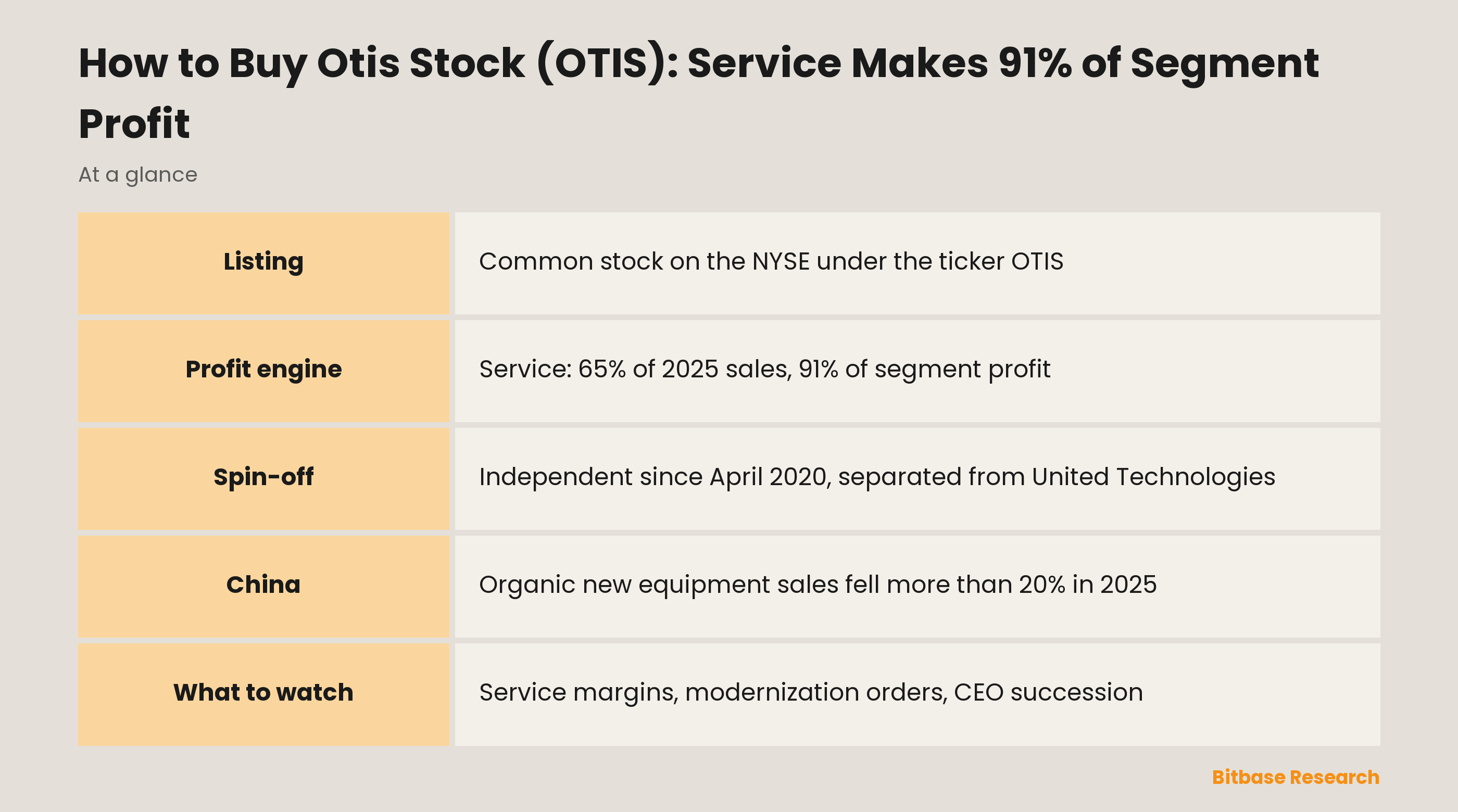
Otis stock is listed on the New York Stock Exchange under the ticker OTIS, so any broker that offers US shares can take the order. The name on the elevator is only half the story: in 2025 the Service segment, which maintains, repairs and modernizes lifts and escalators already in buildings, produced 65% of net sales and 91% of segment operating profit, while new installations in China kept shrinking. Below: how the money flows, how to buy, and what to watch.
What Does Otis Do?
Otis calls itself "the world's leading elevator and escalator manufacturing, installation, service and modernization company." It serves customers in more than 200 countries and territories and works out of more than 1,400 branches and offices.
The business is split in two. New Equipment designs, manufactures, sells and installs passenger and freight elevators, escalators and moving walkways. Buyers include developers, contractors and agencies building airports or metros. Otis usually sells directly, though in China and some other markets agents and distributors add to the sales force. Installation usually happens midway through a building's construction, and orders are generally delivered within 12 months of booking. Gen2, the low- and mid-rise platform launched in 2000, has sold over one million units; its successors are Gen3 and Gen360, and SkyRise serves high-rise towers.
Service maintains and repairs elevators and escalators and upgrades older ones through modernization. Its maintenance portfolio is about 2.5 million units worldwide, and that count includes equipment built by other manufacturers. A network of 37,000 service mechanics does the work. At the end of 2025 about 1.1 million units in the portfolio were connected for remote monitoring.
Otis employs about 72,000 people and runs 16 factories. The 10-K names KONE, Schindler and TK Elevator as its major global competitors in both segments, and says independent service providers hold about 50% of service units worldwide, though a smaller share by value.
Otis Worldwide was incorporated in Delaware on 1 March 2019 in connection with the separation of Otis and Carrier Global from United Technologies Corporation, which later renamed itself RTX (see our RTX stock guide). The spin-off was completed on 3 April 2020, and Otis began trading on the NYSE that same day.
How Otis Makes Money
Both segments sell into the same buildings, but their economics differ sharply:
| Segment | Share of 2025 net sales | Share of 2025 segment operating profit | 2025 operating margin |
|---|---|---|---|
| New Equipment | 35% | 9% | 4.8% |
| Service | 65% | 91% | 25.1% |
Within Service, maintenance and repair accounted for about 53% of total net sales in 2025 and modernization for about 13%, according to the 10-K's breakdown of sales by type. The filing spells out how the segments connect: Otis seeks "to grow our maintenance portfolio, in part, through the conversion of new elevator and escalator installations into service contracts." A new unit is sold once; a maintenance contract can follow it for years.
In 2025 the two segments moved apart. Net sales rose 1%, but organic volume was flat because Service grew 5% organically, with maintenance and repair up 4% and modernization up 9%, while New Equipment fell 7%. The 10-K attributes that drop to a decline of more than 20% in China and a high single-digit decline in the Americas. Service operating profit rose 9%; New Equipment operating profit fell 27%.
International operations were about 71% of 2025 net sales. China, shown on its own line in the segment note, made up about 11% of net sales in 2025, down from about 17% in 2023. The risk factors add that China accounts for "approximately one fifth of our global New Equipment net sales and over half of our global New Equipment unit volume."
OTIS Stock at a Glance
| Feature | OTIS |
|---|---|
| Exchange | New York Stock Exchange (NYSE) |
| Ticker | OTIS |
| Share class | Common stock, the only equity line registered under Section 12(b) |
| Other listed securities | Three series of notes, quoted as OTIS/26, OTIS/27 and OTIS/31; these are bonds, not shares |
| Sector | Elevators and escalators: new equipment, maintenance, repair and modernization |
| Index membership | S&P 500 |
| Headquarters | Farmington, Connecticut |
| Incorporated | Delaware, 2019 |
| Independent since | 3 April 2020, after the spin-off from United Technologies |
| Fiscal year | Calendar year, ending 31 December |
| Shareholder returns | Quarterly cash dividend and a share repurchase program |
| SEC identifier | CIK 1781335 |
Share price, market value and yield change during every session; live figures are on the Otis stock page on Bitbase.
How to Buy Otis Stock
No depositary receipt sits between you and the company: Otis is a Delaware corporation, and the NYSE line is the common stock itself. A purchase runs like this:
1. Pick the broker. Outside the US, use a local firm with NYSE access or an international broker, and check which regulated entity holds your account.
2. Complete onboarding. Non-US residents normally fill in IRS Form W-8BEN, which the IRS says to submit "when requested by the withholding agent or payer."
3. Fund in dollars. If your money is in another currency, the conversion rate can cost more than the commission.
4. Search the right line. Type OTIS and confirm the result is Otis Worldwide common stock. Symbols with a slash, such as OTIS/27, are notes.
5. Choose the order. FINRA describes limit orders as suited to investors "who know the price they want," while market orders "can leave a buyer or seller exposed to changes in the current price."
6. Decide on the amount. Fractional shares let you invest a set sum, but FINRA warns that "you often can't trade fractional shares outside of regular market hours" and that you "can't transfer fractional shares to another brokerage firm."
Withholding on dividends. According to the IRS, "most types of U.S. source income received by a foreign person are subject to U.S. tax of 30%," and a tax treaty may lower the rate. Your home country may also tax the dividend.
Through a fund. State Street's daily holdings file for SPY, dated 9 November 2026, lists OTIS WORLDWIDE CORP, so any fund that tracks the S&P 500 holds it as one small position.
What Moves OTIS Stock
Service pricing and portfolio growth. With Service earning 91% of segment operating profit, its margin carries the result. The third-quarter 2026 earnings release reported Service net sales up 8%, organic modernization sales up 20% and organic maintenance and repair up 4%, yet the Service operating margin fell 130 basis points from a year earlier to 24.2%. Chief executive Judy Marks credited "investments in field capability and AI-enabled pricing."
The modernization pipeline. In the same quarter, modernization orders rose 10% at constant currency and the modernization backlog, work booked but not yet delivered, was up 20%.
China. Organic New Equipment sales in China fell by more than 20% in 2024, again in 2025 and again in the third quarter of 2026. Otis announced a reorganization of its China operations in January 2025, and in October 2025 it bought out the minority partner in Otis Electric, one of its two main Chinese joint ventures.
New Equipment margins. The segment's operating margin fell from 6.1% in 2024 to 4.8% in 2025, and to 3.2% in the third quarter of 2026, which the release put down to "unfavorable price and mix." New Equipment orders still rose 1% at constant currency that quarter, with low-teens growth in the Americas and a low-teens decline in China.
Tariffs. The third-quarter 10-Q says new import tariffs implemented in 2025 and 2026 "could have a material impact on our results in 2026 and future years."
A change of chief executive. Under an 8-K filed on 15 September 2026, Ms. Marks will retire when her successor starts, expected in the first half of 2027 and no later than 31 July 2027.
China Exposure, Cartel Claims and Other Otis Risks
These risk factors from the 10-K bear most directly on the share:
Construction demand. "A slowdown in building and remodeling activity, whether due to remote work or otherwise, or decreased public spending on infrastructure projects could adversely affect our financial performance."
China and emerging markets. The filing calls China "currently the largest end market for sales of new equipment in our industry" and says conditions there "have recently impacted and may continue to impact" sales. It names countries such as Argentina, Brazil, India, Turkey and Ukraine as carrying "high levels of currency, political, compliance and economic risk."
Labor. About 64% of the US workforce is covered by a collective bargaining agreement, and the main US agreement is set to expire in July 2027. The 10-K calls its mechanics critical to delivering service.
Cartel claims in Europe. Otis is "subject to claims for overcharges on elevators and escalators related to civil cartel cases" in certain European countries. Past settlements have not been material, it says, but "the future outcome of these cases cannot be determined."
Separation obligations. Otis, RTX and Carrier agreed to indemnify one another, and the indemnities Otis may owe "are not subject to any cap." Otis and RTX still disagree over the scope of what Otis owes after a German tax ruling in 2024.
Payouts and concentration. "Quarterly cash dividends and share repurchases may be discontinued, accelerated or modified." And one company's results can move your whole position.
How to Research OTIS Yourself
Otis files under CIK 1781335 on SEC EDGAR. The 2025 Form 10-K was filed on 5 February 2026 and the third-quarter 10-Q on 29 October 2026. Quarterly earnings releases come with 8-K filings, in 2026 on 28 January, 22 April, 22 July and 28 October. Otis also posts these filings free of charge on otis.com.
In the 10-K, the segment note gives sales and operating profit for both segments plus sales by type; the geographic table shows China on its own line; the note on contingent liabilities covers the cartel claims and the German tax dispute with RTX.
Each new 10-Q has a risk-factor section: the third-quarter 2026 report says that, except as noted, nothing material changed from the 10-K. For prices, use the stock page linked above, and Bitbase's list of US stock pages for other companies.
Otis Stock FAQ
Can I buy Otis stock with crypto?
Not as such. You need a brokerage account funded in US dollars, which means converting crypto to cash first, possibly a taxable sale in your country, and then transferring it. A share is a stake in a registered company with dividend and voting rights; stocks and crypto assets differ in what you own.
Does Otis pay a dividend?
Yes. Otis pays a quarterly cash dividend and also buys back shares. The 10-K says both "may be discontinued, accelerated, suspended or delayed at any time without prior notice," so check the latest release for the current amount.
When did Otis become a separate public company?
On 3 April 2020, when United Technologies completed the spin-off. Holders of UTC stock on the record date of 19 March 2020 received 0.5 Otis shares for every UTC share.
Is Otis in the S&P 500?
Yes. OTIS WORLDWIDE CORP appears in State Street's SPY holdings file dated 9 November 2026. Its weight changes daily.
Who are Otis's main competitors?
The 10-K names KONE Oyj, Schindler Group and TK Elevator as major competitors in both segments worldwide, with more rivals in Asia Pacific. In Service, independent providers and small local operators compete in most markets.
Conclusion
Otis is less a manufacturer that also does maintenance than a maintenance company whose factories feed its portfolio. Whether that model keeps working depends on Service pricing and modernization outrunning higher labor costs, on how far China's new equipment market falls, and on how the next chief executive handles both. Read the latest 10-Q next to the 10-K segment note, compare both segment margins over several years, and size the position accordingly.
Related reading
Other Bitbase articles on this topic:
- How to Buy Elbit Systems Stock (ESLT): Nasdaq and Tel Aviv
- How to Buy EMCOR Stock (EME): Wiring and Cooling Data Centers
- How to Buy Ferguson Stock (FERG): From London to NYSE Only
- How to Buy Veralto Stock (VLTO): Hach, Videojet and Pantone
Disclaimer: This article is educational content from Bitbase Academy, provided for information only. It explains what a company or fund does and how the instruments referenced here differ from one another; it does not constitute investment, trading, tax, or financial advice, and it is neither a recommendation nor an endorsement of any security, token, or trading strategy. A tokenized stock is issued by a third party and is designed to give economic exposure to an underlying asset: it is not a share, it carries no shareholder rights, and it depends on the issuer's structure, eligibility rules, and redemption terms, which the issuer can change. Perpetual futures are leveraged derivatives that hold no underlying asset and can be liquidated, and trading hours, product availability, and eligibility differ by instrument and by jurisdiction and can change at any time. Written as of November 2026; verify everything yourself through company filings, the issuer's own documentation, and the product pages of the venue you trade on.
References
[1] Otis Worldwide Form 10-K for 2025 (SEC EDGAR) www.sec.gov
[2] Otis 2025 Form 10-K, XBRL cover page (SEC EDGAR) www.sec.gov
[3] Otis 2025 Form 10-K, XBRL segment data (SEC EDGAR) www.sec.gov
[4] Otis Form 10-Q for the third quarter of 2026 (SEC EDGAR) www.sec.gov
[5] Otis third-quarter 2026 earnings release, filed with Form 8-K (SEC EDGAR) www.sec.gov
[6] Otis Form 8-K of 15 September 2026: CEO transition (SEC EDGAR) www.sec.gov
[7] State Street SPDR S&P 500 ETF Trust (SPY): fund page and daily holdings www.ssga.com
[8] FINRA: Order Types www.finra.org
[9] FINRA: Investing in Fractional Shares www.finra.org
[10] IRS: NRA Withholding www.irs.gov
[11] IRS: About Form W-8 BEN www.irs.gov





