
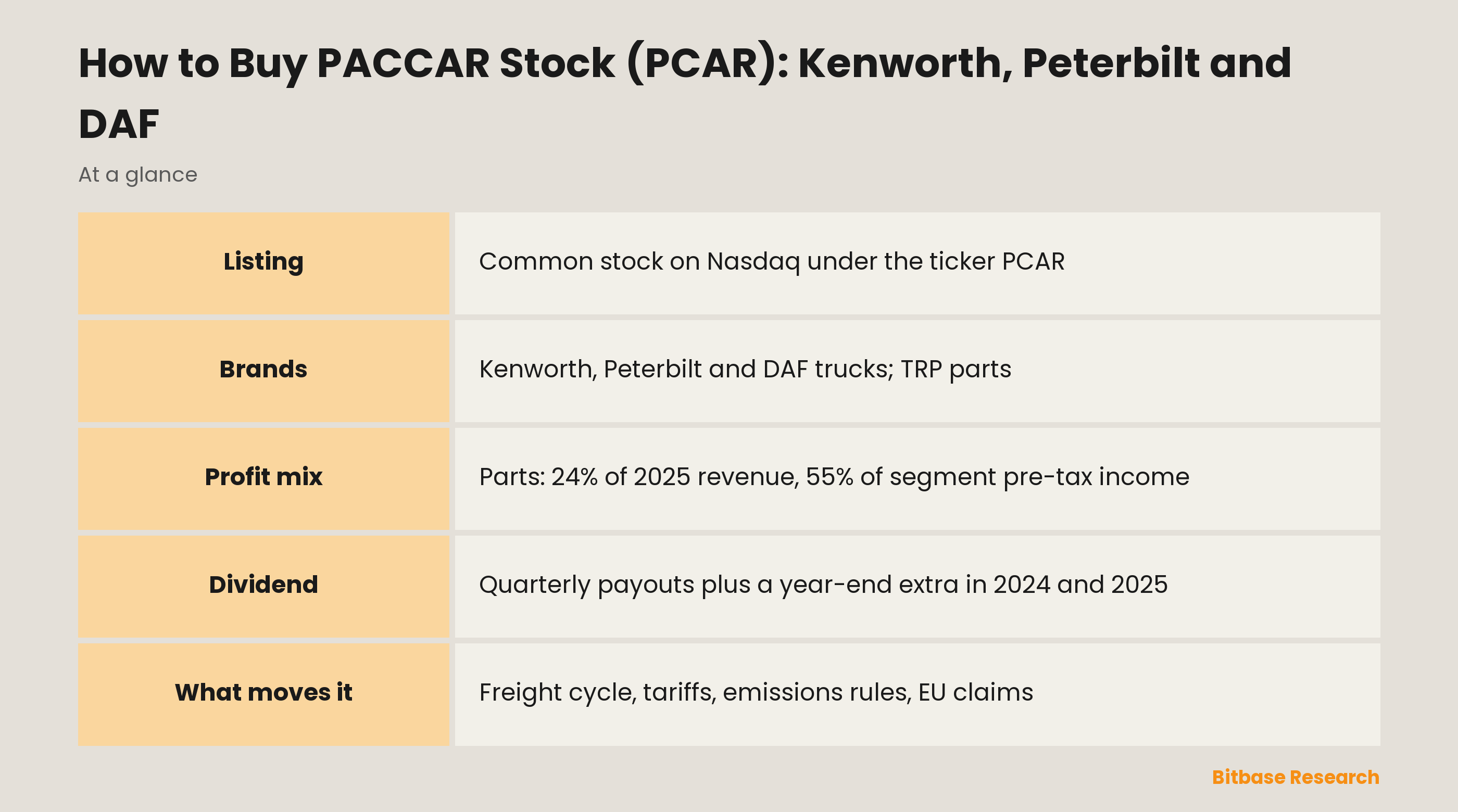
Someone in the market for PACCAR stock can place the order with any broker that offers US equities, because the common shares are listed on Nasdaq as PCAR. PACCAR's trucks are sold under the Kenworth, Peterbilt and DAF names, yet in 2025, a year of weaker truck demand, its parts business brought in about 24% of revenue and 55% of the pre-tax income earned by its three segments. Below: what the company sells, the steps of an order, and the forces its filings keep returning to, from the freight cycle, tariffs and emissions rules to European claims dating back to 2016.
What Does PACCAR Do?
PACCAR designs, builds and finances commercial trucks. Its annual report describes it as "a multinational company operating in three principal industry segments": Truck, Parts and Financial Services. The company was incorporated in Delaware in 1971 as the successor to Pacific Car and Foundry Company, a Washington corporation formed in 1924, and it traces its roots to Seattle Car Manufacturing Company, formed in 1905.
The trucks carry three nameplates. Kenworth and Peterbilt are sold in the United States and Canada, DAF in Europe, and Kenworth and DAF models in Mexico, Australia and South America. They are built in three plants in the United States, three in Europe and one each in Australia, Brazil, Canada and Mexico. In Class 8, the heavy-duty category, PACCAR's share of 2025 retail sales in the US and Canada was 29.9%, and DAF took 13.5% of Europe's heavy-duty market, according to third-party data cited in the 10-K.
PACCAR also makes its own diesel engines. In 2025 they went into about 29% of the Kenworth and Peterbilt heavy-duty trucks in the US and Canada and into substantially all DAF heavy-duty trucks; the other engines come from Cummins. Eaton and ZF supply many of its transmissions and Magna many North American cab stampings, and the 10-K says a loss of supply from any of the four "would have a material effect on the Company's results."
"Substantially all trucks are sold to independent dealers," most of them ordered to customer specifications. The company says it "is not dependent on any single customer for its sales" and counts four principal competitors in the US and Canada and six in Europe, without naming them.
The second business, Parts, distributes aftermarket parts to more than 2,000 Kenworth, Peterbilt and DAF dealers and more than 350 stores of TRP, PACCAR's aftermarket parts brand, in 99 countries. The third, Financial Services, lends to and leases trucks for customers and dealers in 26 countries under the PACCAR Financial name, runs full-service leasing as PacLease, and resells the company's used trucks from matured leases, trade-ins and repossessions.
PACCAR also produces battery-electric Kenworth, Peterbilt and DAF trucks and has partnered with Cummins, Daimler Trucks and EVE Energy on a battery factory in Marshall County, Mississippi, though it is "reviewing the timing of investments as a result of changing market-adoption projections." In October 2026 it unveiled PACCAR Connect, a technology platform due in Kenworth and Peterbilt Class 8 trucks from early 2027.
How PACCAR Makes Money
In 2025 the Truck segment accounted for 68% of revenues, down from 74% in 2024, while Parts accounted for 24% and Financial Services for 8%. Measured by income before taxes, the ranking flips:
| Segment | Share of 2025 revenue | Share of 2025 segment pre-tax income | What it sells |
|---|---|---|---|
| Truck | 68% | 29% | Kenworth, Peterbilt and DAF trucks, through independent dealers |
| Parts | 24% | 55% | Aftermarket parts, through the same dealers and TRP stores |
| Financial Services | 8% | 16% | Truck loans, leases and PacLease rentals |
Pre-tax shares are calculated from the 10-K segment note across the three segments, leaving out investment income and the "Other" line, which in 2025 carried a charge for European litigation.
The year shows why. Truck deliveries fell 22%, "reflecting lower retail demand in all major markets," with the US and Canada down 27%. Lower volume and higher tariff costs, mainly in the US, cut Truck's pre-tax return on revenues to 4.5% from 11.5%. Parts revenue rose 3.1% on higher average prices, which the 10-K attributes to price realization in the US and Canada and to tariff cost increases in the US, and the segment kept a pre-tax return of 24.3%. Total revenue fell 15.5%.
Parts demand is tied to trucks already on the road. The 10-K says aftermarket sales are "influenced by the total number of the Company's trucks in service and the average age and mileage of those trucks," and that they "are generally concentrated in the first five years after truck delivery."
Financial Services lends mainly against PACCAR's own products. It accounted for 8% of 2025 revenue but 51% of total assets, so about half the balance sheet is a loan and lease portfolio whose earnings depend on new loan volume, yields, funding costs, collections and used truck prices.
By customer location, the United States produced about 54% of 2025 revenue, Europe 24% and other countries 21%. One long record also sits in the 10-K: in 2025, "PACCAR earned net income for the 87th consecutive year."
PCAR Stock at a Glance
| Feature | PCAR |
|---|---|
| Exchange | Nasdaq (The Nasdaq Stock Market) |
| Ticker | PCAR |
| Security | Common stock, the only class registered under Section 12(b) |
| Sector | Commercial vehicles: trucks, aftermarket parts and truck finance |
| Brands | Kenworth, Peterbilt and DAF trucks; TRP parts; PacLease leasing |
| Index membership | S&P 500 and Nasdaq-100 |
| Headquarters | Bellevue, Washington |
| Incorporated | Delaware, 1971 |
| Fiscal year | Calendar year, ending 31 December |
| Payouts | Quarterly cash dividend; in 2024 and 2025 also a year-end extra, paid the following January |
| SEC identifier | CIK 75362 |
Price, market value and dividend yield change with every trade; for live figures, see the PACCAR stock page on Bitbase.
How to Buy PACCAR Stock
PACCAR is a Delaware corporation listed on a US exchange, so no depositary receipt is involved: what trades on Nasdaq is the common stock itself. Buying it takes seven steps at a broker:
1. Choose a broker with Nasdaq access. Abroad, that means a local broker offering US shares or an international one; confirm the legal entity behind the account and its regulator.
2. Open and verify the account. Non-US individuals usually document their status on IRS Form W-8BEN, which the IRS says to submit "when requested by the withholding agent or payer."
3. Add money. Funding in another currency adds a conversion cost, so compare exchange rates as well as commissions.
4. Look up the ticker. Search PCAR and confirm the result reads PACCAR Inc common stock on Nasdaq; the 10-K cover lists only that one registered class.
5. Pick an order type. FINRA says a market order "provides the most certainty that your order will be executed," while a limit order executes only "at or better than a specified price."
6. Size the position. Fractional shares let you put in a set sum of money, but some firms offer them only for "large-cap stocks or ETFs" or not at all, and "as a fractional share owner, you might not have shareholder voting rights."
7. Keep the paperwork. Trade confirmations and statements document your cost basis and the dividends you receive.
Taxes for investors abroad. The IRS states that "most types of U.S. source income received by a foreign person are subject to U.S. tax of 30%," and that a lower rate or exemption may apply under a tax treaty, hence the W-8BEN request at account opening. Dividends can also be taxed again where you live.
Through index funds. PCAR sits in both the S&P 500 and the Nasdaq-100, so index funds tracking either benchmark, State Street's SPY and Invesco's QQQ among them, carry it as one position among many.
What Moves PCAR Stock
The truck cycle. The 10-K says Truck sales and margins "tend to be cyclical based on the level of overall economic activity, the availability of capital and the amount of freight being transported," and that yearly demand for commercial vehicles "may increase or decrease more than overall gross domestic product." Truck's pre-tax return on revenues was 2.3% in the third quarter of 2025 and 8.1% a year later, when deliveries rose 26%, and 39% in the US and Canada. Chief executive Preston Feight said third-quarter revenues increased by 19% and net income by 44%.
Parts against trucks. In 2025 the Parts share of the three segments' pre-tax income rose to 55% from 34% in 2024 as Truck income shrank, and the October 2026 earnings release reported record quarterly Parts revenue. The balance swings back with the cycle: in the third quarter of 2026, Truck again earned more before tax than Parts.
Tariffs. The 10-K says the truck and parts products "have been negatively affected since March 2025 by import tariffs imposed by the U.S. government and actions taken by other countries," and new Section 232 truck tariffs began in November 2025. PACCAR says local production for the United States, Canada and Mexico minimizes its exposure. On 20 February 2026 the US Supreme Court invalidated tariffs imposed under the International Emergency Economic Powers Act, which the company says "resulted in tariff relief and recovery of certain amounts previously paid," and it credited the third-quarter rise in Truck income mainly to "higher price realization and lower tariff costs."
Emissions rules. In July 2026 the EPA issued a proposed rulemaking that reaffirmed its EPA 27 NOx limits while revising some compliance requirements, including extended warranty periods and useful-life requirements; a final decision is expected in the fourth quarter of 2026. In Europe, CO2 targets "require a significant portion of vehicles sold to be zero or near zero emission."
European claims. On 19 July 2016 the European Commission concluded its investigation of "all major European truck manufacturers" and reached a settlement with DAF Trucks N.V., DAF Trucks Deutschland GmbH and PACCAR Inc. Damages claims followed, including class actions in the United Kingdom, the Netherlands and Israel. PACCAR recorded charges for them in the first quarter of 2023 and again in the first quarter of 2025, and it says it "has settled with a significant majority of claimants."
Truck Cycles, Credit Losses and Court Claims at PACCAR
These items from Item 1A of the 10-K bear most directly on a PCAR share:
Demand. "The Company's business is highly sensitive to global and national economic conditions as well as economic conditions in the industries and markets it serves," principally North America and Europe.
Costs and supply. "Commodity or component price increases, cost pressures due to inflation, significant shortages of component products and labor availability may adversely impact the Company's financial results." The reliance on Cummins, Eaton, ZF and Magna belongs here too.
Powertrain transition. "The pace of transition from diesel combustion to alternative powertrain commercial vehicles is highly uncertain," shaped by technology costs, infrastructure and regulation.
Regulation and trade. Missing EU emissions targets "would result in significant fines." In California, the authority behind the Advanced Clean Truck regulation was revoked by Congress and the President, but the revocation is being challenged and "the outcome is uncertain." Trade policies, "including tariffs, may impact demand for the Company's products."
Credit and funding. If a borrower defaults, "there is a risk the value of the underlying collateral will not be sufficient to recover the amounts owed." For over sixty years, the 10-K says, economic weakness has brought "higher past dues and increased rates of repossession," while used truck prices "tend to fall" in such periods, and "a lowering of the Company's credit ratings could increase the cost of borrowing."
Litigation and recalls. "Product recalls, lawsuits, regulatory actions or increases in the reserves the Company establishes for contingencies may increase the Company's costs and lower profits." On the European claims, "additional claimants may bring EC-related claims and lawsuits" in certain jurisdictions.
Currency. Results are reported in US dollars while significant operations run in other currencies; derivatives and local production "reduce, but not eliminate," the effect.
Two more risks sit above the business. A single stock ties your money to one company. And the dividend carries no promise: PACCAR expects to keep paying regular cash dividends, "although there is no assurance as to future dividends because they are dependent upon future earnings, capital requirements and financial conditions." The year-end extra declared for 2025 was smaller than the one for 2024.
How to Research PCAR Yourself
PACCAR's SEC filings sit under CIK 75362: the 10-K, 10-Qs for the first three quarters, and 8-Ks for events, including each quarterly earnings release, which in 2026 came on 27 January, 28 April, 28 July and 27 October. The same reports are free on paccar.com.
In the 10-K, Item 1 covers the segments and market shares, Item 1A the risks, the MD&A deliveries by region and the pre-tax returns of Truck and Parts, and Note L the European claims. The segment note sets revenue and pre-tax income for the three segments side by side. Item 5 compares PACCAR's shareholder return with the S&P 500 and a peer group that includes Caterpillar and Deere, both profiled in our Caterpillar stock guide and Deere stock guide.
Two checks prevent common mistakes. The 10-K's dividend table separates the four quarterly payments from the year-end extra, so compare both when you compare years. And market share data comes from a third party and can be restated: the third-quarter 2026 10-Q notes that prior-year US and Canada medium-duty figures "have been revised." Live quotes are on the stock page linked earlier, and the full list of US stock pages on Bitbase covers other listed companies.
PACCAR Stock FAQ
Can I buy PACCAR stock with crypto?
Not directly. PCAR shares are bought through a brokerage account in US dollars, so crypto must first be sold for cash and moved to the broker, a sale that may be taxable where you live. Keep the two steps apart, since a share gives you dividend and voting rights in a registered company, which is how a share differs from a crypto asset.
Does PACCAR pay a dividend?
Yes. PACCAR declares a regular quarterly cash dividend, and in both 2024 and 2025 the board added a year-end extra dividend, paid in January of the following year. The 10-K gives "no assurance as to future dividends"; check the latest earnings release and filings for the size and timing of each payment.
Is PCAR in the S&P 500 and the Nasdaq-100?
Yes, both. On 29 October 2026, PACCAR Inc appeared in State Street's daily holdings file for SPY, and PCAR in Invesco's holdings data for QQQ, the fund that tracks the Nasdaq-100. Weights move daily.
What brands does PACCAR own?
Its trucks are sold as Kenworth, Peterbilt and DAF, TRP is its aftermarket parts brand, finance runs under the PACCAR Financial name and full-service leasing under PacLease.
Has PACCAR stock ever split?
PACCAR paid a 50% stock dividend on 7 February 2023, which works like a three-for-two split: shareholders of record on 17 January 2023 received one new share for every two they held, with fractions paid in cash. Later filings restate earlier per-share figures for it, so check that older data you compare has been adjusted.
Conclusion
The purchase itself is short: a broker that reaches Nasdaq, the PACCAR Inc common stock line, and a market or limit order. Knowing what the share represents takes longer: a truck maker whose profits in a weak year leaned on parts and finance, whose margins swing with freight and tariffs, and whose filings still carry European claims from 2016. Read the latest 10-K and quarterly release, compare segment profits across a full cycle, and decide how much one truck company should weigh in your portfolio.
Related reading
Other Bitbase articles on this topic:
- How to Buy General Motors Stock (GM): Nasdaq Move, Trucks and EVs
- How to Buy Hilton Stock (HLT): Fees, Honors and the Nasdaq Move
- How to Buy Lowe's Stock (LOW): FBM, Pro Customers and Dividend
Disclaimer: This article is educational content from Bitbase Academy, provided for information only. It explains what a company or fund does and how the instruments referenced here differ from one another; it does not constitute investment, trading, tax, or financial advice, and it is neither a recommendation nor an endorsement of any security, token, or trading strategy. A tokenized stock is issued by a third party and is designed to give economic exposure to an underlying asset: it is not a share, it carries no shareholder rights, and it depends on the issuer's structure, eligibility rules, and redemption terms, which the issuer can change. Perpetual futures are leveraged derivatives that hold no underlying asset and can be liquidated, and trading hours, product availability, and eligibility differ by instrument and by jurisdiction and can change at any time. Written as of October 2026; verify everything yourself through company filings, the issuer's own documentation, and the product pages of the venue you trade on.
References
[1] PACCAR Form 10-K for 2025 (SEC EDGAR) www.sec.gov
[2] PACCAR 2025 Form 10-K, XBRL cover page (SEC EDGAR) www.sec.gov
[3] PACCAR 2025 Form 10-K, XBRL segment data (SEC EDGAR) www.sec.gov
[4] PACCAR Form 10-Q for the third quarter of 2026 (SEC EDGAR) www.sec.gov
[5] PACCAR third-quarter 2026 earnings release, filed with Form 8-K (SEC EDGAR) www.sec.gov
[6] PACCAR Form 10-K for 2023: 50% stock dividend (SEC EDGAR) www.sec.gov
[7] State Street SPDR S&P 500 ETF Trust (SPY): fund page and daily holdings www.ssga.com
[8] Invesco QQQ: fund overview www.invesco.com
[9] FINRA: Order Types www.finra.org
[10] FINRA: Investing in Fractional Shares www.finra.org
[11] IRS: NRA Withholding www.irs.gov
[12] IRS: About Form W-8 BEN www.irs.gov





