
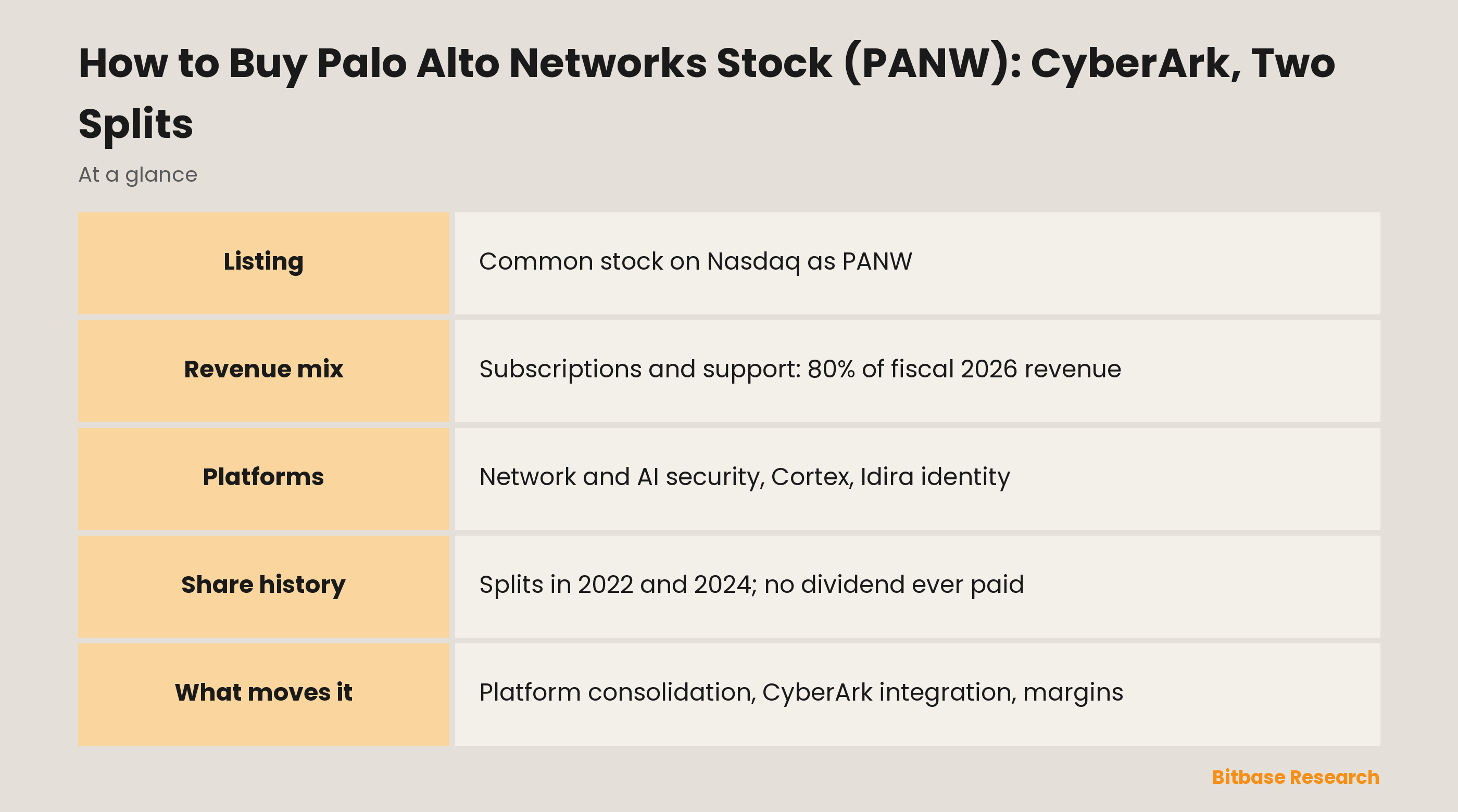
One ticker is all you need: Palo Alto Networks common stock trades on the Nasdaq Global Select Market as PANW, and any brokerage account with US market access can buy it. The company behind it is no longer the firewall maker that listed in 2012: in fiscal 2026, the year to 31 July, subscriptions and support made up 80% of revenue, and the February 2026 purchase of CyberArk added identity security. Below: what it sells, how to place the order, its two splits and missing dividend, and the risks its filings put first.
What Does Palo Alto Networks Do?
Palo Alto Networks sells cybersecurity to enterprises, service providers and government entities; its fiscal 2026 annual report calls it a global AI cybersecurity provider. Incorporated in 2005 and based in Santa Clara, California, it began trading on the New York Stock Exchange on 20 July 2012 and moved to Nasdaq in October 2021, keeping the PANW symbol.
Its strategy, platformization, packages products into a few platforms so one vendor can replace several, helping customers "simplify their security architectures through consolidating disparate point products." There are three:
Network & AI Security is the original franchise: hardware and software next-generation firewalls running PAN-OS, the Prisma Access and Prisma SD-WAN service for remote users and branches, cloud-delivered security add-ons, and Prisma AIRS for securing AI applications and agents.
Cortex covers security operations (XSIAM, XDR, XSOAR, Xpanse), cloud security and, since the Chronosphere deal, observability, the monitoring of cloud infrastructure and applications.
Idira is the identity security platform built from CyberArk. Alongside them, Unit 42 sells threat intelligence and incident response.
Acquisitions redrew that map in under a year. Chronosphere closed on 29 January 2026 and CyberArk on 11 February 2026, followed by Koi (endpoint security) in April and Portkey (AI gateway) in May; Embrace and Console closed after the fiscal year ended.
How Palo Alto Networks Makes Money
There are two revenue lines. Product revenue, from firewall hardware and software licences, is booked "at the time of hardware shipment or delivery of software license." Subscription and support revenue is booked over contracts that typically run one to five years. The 10-K splits it further:
| Revenue line | What it includes | Share of fiscal 2026 revenue | Growth on fiscal 2025 |
|---|---|---|---|
| Product | Firewall hardware, software licences, some identity products | 19.9% | 27% |
| Subscription | Cloud security services, Cortex, observability, identity | 54.3% | 25% |
| Support | Security updates, upgrades, bug fixes, hardware repairs | 25.8% | 21% |
Shares are calculated from fiscal 2026 revenue in the 10-K, rounded to one decimal.
Total revenue rose 24% in fiscal 2026 after 15% the year before, and the company credits CyberArk and Chronosphere with part of that: some growth was bought.
The Americas produced 66.9% of fiscal 2026 revenue, Europe, the Middle East and Africa 21.1%, and Asia Pacific and Japan 12.0%. A substantial portion of sales runs through distributors and then resellers: two distributors accounted for 30% of fiscal 2026 revenue, while no single end customer exceeded 10%.
PANW Stock at a Glance
| Item | Detail |
|---|---|
| Exchange | Nasdaq Global Select Market (from the NYSE, October 2021) |
| Ticker | PANW |
| Security | Common stock, the only security registered on the 10-K cover |
| CUSIP / ISIN | 697435105 / US6974351057 |
| Index membership | S&P 500 and Nasdaq-100 |
| Headquarters | Santa Clara, California |
| Incorporated | Delaware, 2005 |
| Fiscal year | Ends 31 July |
| Dividend policy | None ever declared or paid |
| Stock splits since listing | Three-for-one (September 2022), two-for-one (December 2024) |
| SEC identifier | CIK 1327567 |
Nothing in this table moves with the market. What does, from share price to market value, is on the Palo Alto Networks stock page on Bitbase.
How to Buy Palo Alto Networks Stock
PANW is a US company's ordinary share, so no depositary receipt is involved. Every purchase goes through a broker:
1. Choose a broker that reaches Nasdaq and check which entity holds your shares and who regulates it.
2. Complete the account checks. If you live outside the US, you file IRS Form W-8BEN, which certifies foreign status for US tax purposes.
3. Deposit money. PANW is quoted in US dollars, so if your account runs in another currency, the exchange rate is a cost alongside the fee.
4. Find the right line. Search PANW and confirm it reads Palo Alto Networks, Inc. common stock on Nasdaq; brokers that search by identifier use ISIN US6974351057.
5. Pick an order type. A market order fills at whatever price is available; a limit order caps the price you pay, useful around results releases.
6. Size the order. Buying by cash amount through fractional shares is possible at some brokers, but "not every brokerage firm offers fractional share investing," and fractions may carry no voting rights.
Outside the United States, US dividend withholding does not arise, since PANW has never paid a dividend; the W-8BEN still documents your status, and how your home country taxes a gain is a local question.
Through an index fund, PANW comes as one holding among many: State Street's SPY, which tracks the S&P 500, and Invesco's QQQ, which tracks the Nasdaq-100, both listed it on 16 October 2026. If you are weighing Nasdaq-100 funds, how QQQM compares with QQQ has its own guide.
What Moves PANW Stock
Whether customers consolidate onto its platforms. Platformization bets that buyers want fewer security vendors, and the 10-K admits the trend cuts both ways: "Customer trends toward vendor consolidation in cybersecurity may favor competitors offering broader platforms." Named rivals run from Microsoft, Alphabet and Cisco to Fortinet, Zscaler, Okta and CrowdStrike, whose per-module subscription model is profiled separately. Cloud and AI companies "increasingly offer native security and observability capabilities" as well.
How the acquisitions bed in. CyberArk was paid for partly in new PANW shares, so each existing share is a smaller slice of a bigger company, and CyberArk's convertible notes are now exchangeable into PANW stock and cash. Margins carry the cost: gross margin slipped from 73.4% to 70.4% in fiscal 2026, largely on amortization of acquired intangibles, and operating margin fell from 13.5% to 6.1% as deal costs and accelerated equity vesting more than doubled administrative expense.
The metrics it reports. Subscription revenue is spread over contract terms, so a strong or weak selling quarter reaches revenue slowly; management also highlights Next-Generation Security annualized recurring revenue (NGS ARR), which excludes hardware, and remaining performance obligations; the 10-K notes that NGS ARR "does not represent our revenue under U.S. GAAP." Sequential growth peaks in the fiscal second and fourth quarters.
Its own security record. "As a well-known provider of security solutions, we and others in our industry are attractive targets for cyberattacks," the risk factors state, and flaws in its own products "could harm our reputation and adversely impact our operating results."
Hardware supply. Firewalls are physical boxes, assembled by the contract manufacturer Flex, and the 10-K cites "supply chain challenges" behind lower product margins in fiscal 2026.
Risks to Weigh Before Buying PANW
Of the 10-K's risk headings, these bear most directly on the share.
Competition. "We face intense competition and we may lack sufficient financial or other resources to maintain or improve our competitive position."
A changed company. "As a result of the CyberArk acquisition, the scope and size of our business have substantially changed, which resulted in certain incremental risks, including increased competition."
Channel dependence. It relies "on our channel partners to sell a substantial portion of our products," and two distributors carried 30% of fiscal 2026 revenue.
Israel. "We face risks associated with having operations and employees located in Israel," where CyberArk was incorporated.
Above the business, a single stock ties your money to one company, and with no dividend the only return is the share price. Outside the US, the exchange rate moves your result too.
How to Research PANW Yourself
The company's SEC filer number is CIK 1327567; its fiscal 2026 10-K was filed on 10 September 2026, and the four results releases for fiscal 2026 came on 19 November 2025, 17 February 2026, 2 June 2026 and 1 September 2026. In the 10-K, Item 1 describes the platforms and names competitors, Item 1A lists the risks, the MD&A defines NGS ARR under Key Financial Metrics, and Note 8 covers the acquisitions.
Two checks avoid common mistakes: fiscal 2026 ran from August 2025 to July 2026, so it does not line up with a December year-end rival, and per-share history before September 2022 needs adjusting for both splits. Live quotes sit on the stock page above; for other companies, browse US stock pages on Bitbase.
Palo Alto Networks Stock FAQ
Does Palo Alto Networks pay a dividend?
No. The 10-K says the company has "never declared or paid" cash dividends and does not expect to in the foreseeable future. It runs a board-authorised share repurchase program instead, which can be suspended at any time.
Has Palo Alto Networks stock split?
Yes, twice since its 2012 listing: three-for-one as a stock dividend, with split-adjusted trading from 14 September 2022, and two-for-one, effected on 12 December 2024. One pre-split share is now six.
Can I buy Palo Alto Networks stock with crypto?
Not directly. A broker sells you PANW for US dollars, which means converting crypto to cash and transferring that cash before any order; the conversion itself can create a tax bill in some countries. The routes from crypto to stocks are compared in a separate guide.
Is PANW in the S&P 500 and the Nasdaq-100?
Yes. The daily holdings of State Street's S&P 500 fund (SPY) and Invesco's Nasdaq-100 fund (QQQ) both included Palo Alto Networks on 16 October 2026. Weights change daily.
Did Palo Alto Networks buy CyberArk?
Yes. Agreed on 30 July 2025, the deal completed on 11 February 2026, when CyberArk shareholders received cash plus 2.2005 PANW shares for each share. CyberArk is now a wholly owned subsidiary, and its products form the Idira platform.
Conclusion
Placing the order is the easy part: a broker with Nasdaq access, the PANW line, a market or limit order. Knowing what the share holds takes more work: a subscription-led security company with no dividend that spent fiscal 2026 absorbing CyberArk and Chronosphere. Read the latest 10-K and results release before deciding how much of a portfolio one cybersecurity stock should be.
Related reading
Other Bitbase articles on this topic:
- How to Buy Lumentum Stock (LITE): Lasers, NVIDIA Stake and Perps
- How to Buy Motorola Solutions Stock (MSI): Radios, Video and 911
- How to Buy Sony Stock (SONY): PlayStation, Sensors and 24/7 Perps
Disclaimer: This article is educational content from Bitbase Academy, provided for information only. It explains what a company or fund does and how the instruments referenced here differ from one another; it does not constitute investment, trading, tax, or financial advice, and it is neither a recommendation nor an endorsement of any security, token, or trading strategy. A tokenized stock is issued by a third party and is designed to give economic exposure to an underlying asset: it is not a share, it carries no shareholder rights, and it depends on the issuer's structure, eligibility rules, and redemption terms, which the issuer can change. Perpetual futures are leveraged derivatives that hold no underlying asset and can be liquidated, and trading hours, product availability, and eligibility differ by instrument and by jurisdiction and can change at any time. Written as of October 2026; verify everything yourself through company filings, the issuer's own documentation, and the product pages of the venue you trade on.
References
[1] Palo Alto Networks Form 10-K, fiscal 2026: business, revenue, acquisitions and risk factors (SEC EDGAR) www.sec.gov
[2] Palo Alto Networks Form 8-K, 31 July 2025: merger agreement with CyberArk Software (SEC EDGAR) www.sec.gov
[3] Palo Alto Networks Form 8-K, 11 February 2026: completion of the CyberArk merger and CyberArk's convertible notes (SEC EDGAR) www.sec.gov
[4] Palo Alto Networks press release, 22 August 2022: three-for-one stock split (Form 8-K, Exhibit 99.1) www.sec.gov
[5] Palo Alto Networks Form 8-K, 20 November 2024: two-for-one stock split (SEC EDGAR) www.sec.gov
[6] Palo Alto Networks Form 8-K, 12 October 2021: transfer of the stock listing from the NYSE to Nasdaq (SEC EDGAR) www.sec.gov
[7] Palo Alto Networks Form 10-K, fiscal 2012: initial public offering and start of NYSE trading on 20 July 2012 (SEC EDGAR) www.sec.gov
[8] Palo Alto Networks Form 8-K, 1 September 2026: results for the fourth quarter and fiscal year 2026 (SEC EDGAR) www.sec.gov
[9] State Street SPDR S&P 500 ETF Trust (SPY): fund page and daily holdings www.ssga.com
[10] Invesco QQQ ETF: fund overview (tracks the Nasdaq-100 Index) and holdings www.invesco.com
[11] Investor.gov (SEC): Types of Orders www.investor.gov
[12] Investor.gov (SEC): Investor Bulletin on fractional share investing www.investor.gov
[13] IRS: NRA Withholding www.irs.gov





