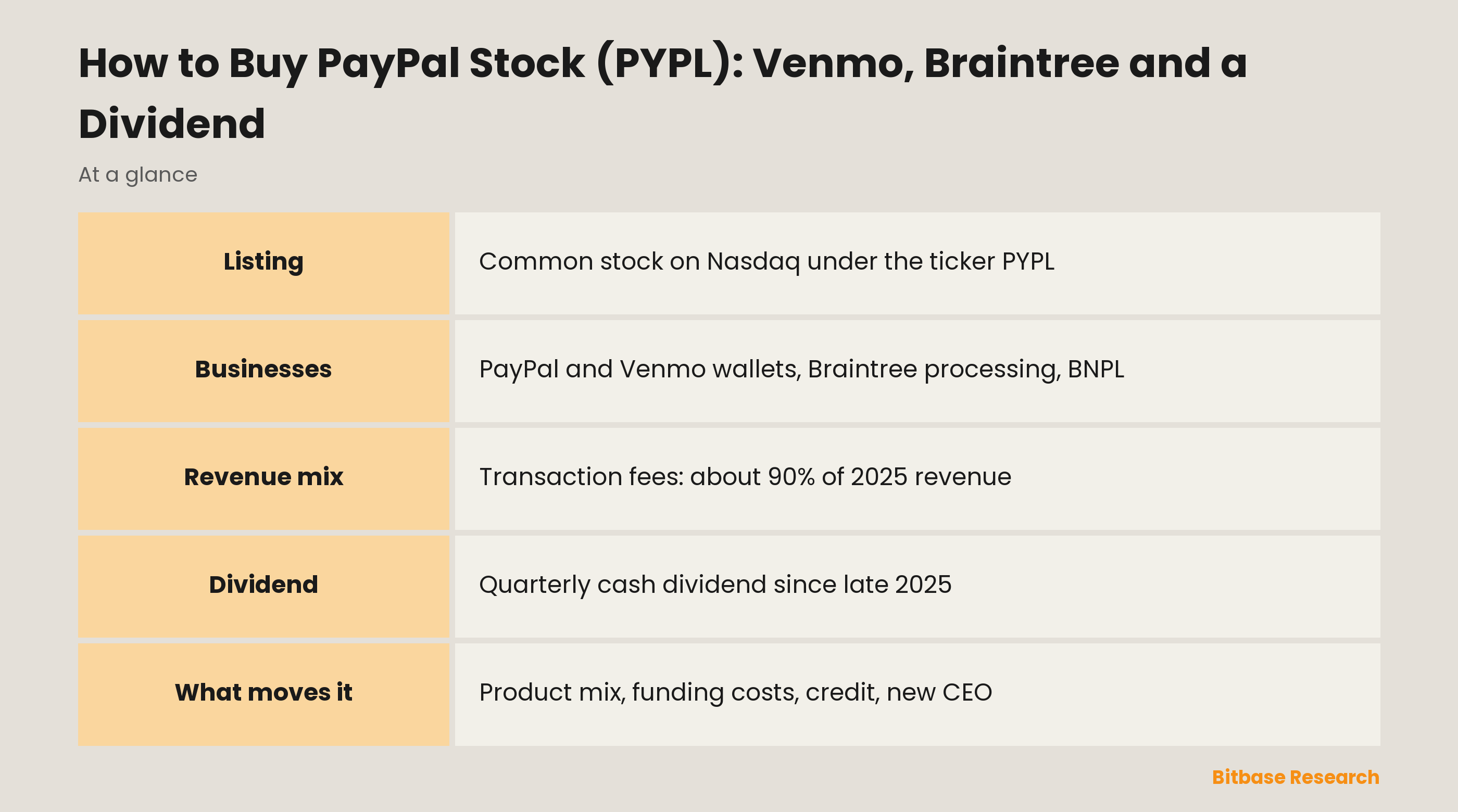
With any broker that offers US equities, PayPal stock is an ordinary purchase: the common shares trade on the Nasdaq Global Select Market under the ticker PYPL. What sits behind the ticker is less familiar than the checkout button, since about 90% of 2025 revenue came from fees on payments and the company started paying a quarterly cash dividend only in late 2025. Below: what PayPal runs beyond its wallet, how an order works, and what its filings say moves the shares.
What Does PayPal Do?
PayPal Holdings, Inc. runs what its annual report calls "a global, two-sided network at scale that connects consumers and merchants." At the end of 2025 that network counted 439 million active accounts across approximately 200 markets. An active account is one that completed a transaction in the previous 12 months.
On the consumer side, PayPal and Venmo are digital wallets used to pay online and in stores, to send money to friends and family, and to buy and sell cryptocurrencies. Xoom handles international money transfers. Buy now, pay later loans are offered in the US, Germany, France, the United Kingdom and Australia among other markets, and in Japan under the Paidy brand. PayPal- and Venmo-branded credit cards in the US are issued through a partner bank rather than by PayPal itself.
On the merchant side, the company sells branded checkout (the PayPal and Venmo buttons), unbranded card processing through Braintree, in-person point of sale tools, payouts through Hyperwallet, fraud and risk tools, and business financing through PayPal Working Capital and PayPal Business Loan.
Newer bets named in the 10-K strategy include the PayPal USD stablecoin (see what a stablecoin is), payments made through AI agents, and PayPal World, which links different digital wallets.
Much of the business runs on licenses: state money transmitter licenses in the US, a New York BitLicense for crypto, and a Luxembourg credit institution for the EU. In December 2025 PayPal also applied to set up PayPal Bank, a proposed Utah industrial loan company; the 10-K says approval is not assured.
PayPal has been an independent public company since its separation from eBay in 2015. In April 2026 it reorganized into three businesses: Checkout Solutions and PayPal; Consumer Financial Services and Venmo; and Payment Services and Crypto, which groups Braintree, small business processing and PYUSD. Its financial statements still report a single segment.
How PayPal Makes Money
The core charge is a fee for completing a payment, paid mainly by the customer who receives the money, usually a merchant. The 10-K says these fees "may have a fixed and variable component," the variable part being a percentage of the payment. PayPal also earns on currency conversion, cross-border payments, instant transfers to a bank account or card, and crypto purchases and sales, while it "generally" does not charge customers to fund or withdraw from their accounts.
Everything else falls under other value added services: partner revenue, interest and fees on loans, interest on assets backing customer balances, and referral, subscription and gateway fees.
| Revenue line | Share of 2025 net revenues | Change from 2024 | What it includes |
|---|---|---|---|
| Transaction revenues | 90% | Up 3% | Payment fees, currency conversion, instant transfers, crypto |
| Other value added services | 10% | Up 14% | Loan interest and fees, partner revenue, interest on customer balances |
| Customers in the US | 57% | Up 3% | Revenue from customers located in the United States |
| Customers elsewhere | 43% | Up 6% | Revenue from customers located in all other countries |
Shares and changes are calculated from the revenue note in the 2025 10-K. Total net revenues rose 4%, mainly on 7% growth in total payment volume (TPV) and higher loan income, while payment transactions fell 4% after what the 10-K calls a "strategic shift" toward profitable growth in Braintree.
The biggest cost sits on the other side of each payment. Transaction expense, the fees PayPal pays card networks, banks and processors to pull money from a customer's funding source, equaled about 48% of 2025 net revenues. Cards cost more than bank transfers or PayPal balances, so the mix of funding sources matters almost as much as volume. In 2025 transaction expense rose 2% while TPV rose 7%; the 10-K credits the lower expense rate mainly to a smaller share of volume from Braintree, which generally carries higher expense rates, and to merchant mix.
Cross-border payments, those where the buyer and seller are in different countries, made up 12% of 2025 TPV, and 37% of TPV was generated outside the US. The 10-K says such transactions "generally provide higher revenues and operating income" than domestic ones. Net income rose 26% in 2025.
PYPL Stock at a Glance
| Feature | PYPL |
|---|---|
| Exchange | Nasdaq Global Select Market |
| Ticker | PYPL |
| Security | Common stock, the only class registered under Section 12(b) |
| Sector | Digital payments: wallets, merchant processing, consumer and merchant credit |
| Main brands | PayPal, Venmo, Braintree, Xoom, Hyperwallet, Honey, Paidy |
| Index membership | S&P 500 and Nasdaq-100 |
| Headquarters | San Jose, California |
| Incorporated | Delaware |
| Fiscal year | Calendar year, ending 31 December |
| Payouts | Quarterly cash dividend since late 2025, plus share repurchases |
| Origin as a listed company | Separated from eBay in 2015 |
| SEC identifier | CIK 1633917 |
Prices, market value and yield move all day; the PayPal stock page on Bitbase shows live quotes.
How to Buy PayPal Stock
PYPL is a Delaware company's common stock, with no depositary receipt or foreign line to choose. A typical purchase:
1. Pick a broker that trades Nasdaq stocks. Outside the US, that is a local firm with US market access or an international broker. Check which legal entity holds your account and who regulates it.
2. Complete account verification. Non-US residents are usually asked for IRS Form W-8BEN, which the IRS says should be given "when requested by the withholding agent or payer."
3. Fund the account. If your money is not in US dollars, the broker's exchange rate is part of the cost, so compare it alongside commissions.
4. Search for the ticker. Enter PYPL and make sure the result is PayPal Holdings common stock on Nasdaq. Venmo, Braintree and Xoom have no tickers of their own; they are all inside this one share.
5. Choose the order type. In FINRA's words, a market order "provides the most certainty that your order will be executed," but not of the price, while a limit order fills only "at or better than a specified price."
6. Decide the amount. Whole shares are the default; if you would rather invest a fixed sum, check whether your broker sells fractional shares and what rights they carry.
7. Store the records. Contract notes and monthly statements show your purchase price and any dividends, which you will need for tax.
Tax for non-US holders. According to the IRS, "most types of U.S. source income received by a foreign person are subject to U.S. tax of 30%," and a tax treaty can reduce that rate. That covers PYPL dividends, which your home country may tax as well.
Owning it through a fund. Because PayPal is in both the S&P 500 and the Nasdaq-100, funds that track those indexes, such as State Street's SPY and Invesco's QQQ, hold it as a small slice of a much larger basket.
What Moves PYPL Stock
Which product carries the payment. Branded checkout, Venmo and unbranded Braintree processing carry different fees and costs, so the product mix shapes revenue as much as total volume does. In the third quarter of 2026, Braintree and Venmo revenue grew while revenue from PayPal-branded products fell, which the 10-Q puts down to product and geographic mix, more co-marketing incentives with large merchants and lower foreign exchange fees. Total revenue rose 2% and TPV 6%.
What it costs to move the money. The 10-K warns that the company's "financial performance is sensitive to changes in the rate at which our consumers fund payments using payment cards." Card networks also matter: the 10-K notes that some have "imposed special fees or assessments for transactions that are executed through digital wallets such as those PayPal offers."
Credit and interest rates. Interest and fees on loans drove the 14% jump in value-added revenue in 2025, but credit adds default risk, and the 10-K lists lower revenue from Honey and from interest on customer balances, caused by lower interest rates, among the offsets. Rules are changing as well: the 10-K says the EU's revised Consumer Credit Directive, taking effect in November 2026, brings formerly unregulated credit products under the same laws as regulated credit.
Fraud and losses. Transaction losses, which cover purchase protection claims, fraud and chargebacks, were 0.07% of TPV in the third quarter of 2026 against 0.09% a year earlier. The 10-Q credits lower fraud losses, risk mitigation and higher recoveries.
Leadership and restructuring. On 2 February 2026 Alex Chriss ceased to be chief executive and the board appointed Enrique Lores, previously chief executive of HP Inc. and PayPal's board chair, effective 1 March 2026. The board said "the pace of change and execution was not in line with the Board's expectations." The April 2026 reorganization followed, then a third-quarter workforce reduction to remove organizational layers.
Buybacks. Repurchase programs have no expiration date, and in the 12 months to September 2026 PayPal bought back about 117 million shares.
Crypto rules. The GENIUS Act of July 2025 set a federal stablecoin framework that, the 10-K says, includes requirements for crypto businesses such as PayPal.
Competition, Card Fees and Credit Risk at PayPal
These items from the risk factors in the 2025 10-K bear most directly on a PYPL share:
Competition. "Some of our current and potential competitors are or may be larger than we are, have larger customer bases, greater brand recognition," and others "may be more agile." The 10-K counts banks, card networks, digital wallets, buy now, pay later methods, real-time payment systems and stablecoins among them, without naming companies.
Network and funding costs. Higher interchange, network assessments or a shift toward card funding would raise costs. The 10-K says such increases "could make our pricing less competitive, increase our operating costs, and reduce our operating income."
Credit. "We are subject to the risk that account holders who use our credit products may default on their payment obligations," and recessions, higher interest rates or unemployment can raise that rate.
Cross-border trade. Tariffs, sanctions, currency swings or new trade barriers that reduce cross-border trade "could reduce our cross-border transactions and volume, negatively impact our revenues and profits."
Outages. In August 2025 a coding error in a system update caused a temporary disruption, mainly in Germany, followed by some fraudulent activity. Frequent or persistent interruptions "could permanently harm our relationship with our customers and partners and our reputation."
Regulation. PayPal answers to US state regulators, the Consumer Financial Protection Bureau and supervisors in Luxembourg, the UK, Singapore and elsewhere; failing to comply with "extensive, complex, overlapping, and frequently changing rules" could materially harm the business.
Capital returns. Dividends and buybacks "may be suspended or terminated at any time," and the 10-K says future dividends depend on market conditions, results, liquidity and board approval.
And a single stock concentrates your exposure: one company's setback is not offset by anything else you hold.
How to Research PYPL Yourself
PayPal files with the SEC under CIK 1633917. The annual 10-K, quarterly 10-Qs and 8-Ks for events are all on EDGAR, and the 10-K says the same documents are posted free on its investor relations site, investor.pypl.com. In 2026 the earnings releases arrived on 8-Ks dated 3 February, 5 May, 28 July and 27 October.
In the 10-K, Item 1 covers products and regulation, Item 1A the risks, Item 5 the dividend and buybacks, and the MD&A TPV, payment transactions and active accounts. Note 2 splits revenue by type and customer location; the segment note lists transaction expense and losses.
Two habits help. Read volume and revenue together, since in 2025 TPV grew while payment transactions fell. And the earnings releases lead with non-GAAP measures such as transaction margin dollars, so check each release's reconciliation to GAAP figures. For live quotes, use the stock page linked above or browse all US stock pages on Bitbase.
PayPal Stock FAQ
Can I buy PayPal stock with crypto?
Not directly. PYPL shares are bought through a brokerage account in US dollars, so crypto has to be sold for cash and the money sent to the broker first, and that sale may be taxable where you live. PayPal's app lets eligible users buy and sell some cryptocurrencies, but crypto held there is not a PayPal share, and the two give different rights, as explained in how stocks and crypto differ.
Does PayPal pay a dividend?
Yes, since late 2025. In October 2025 the board approved a quarterly cash dividend program, with the first payment on 10 December 2025, and the October 2026 earnings release announced another quarterly declaration. Each payment needs board approval; check the latest release for amounts and dates.
Is PYPL in the S&P 500 and the Nasdaq-100?
Yes. On 5 November 2026, PayPal Holdings appeared in State Street's daily holdings file for SPY and in Invesco's holdings data for QQQ, the fund that tracks the Nasdaq-100. Index weights change daily.
Is PayPal still part of eBay?
No. PayPal separated from eBay in 2015 and has traded as an independent company since then. The two still have agreements from the separation, including a tax matters agreement, and PayPal's 10-K lists indemnity disputes with eBay as a risk. Our eBay stock guide covers the other side.
Who runs PayPal?
Enrique Lores has been President and Chief Executive Officer since 1 March 2026, succeeding Alex Chriss. He previously ran HP Inc. and had chaired PayPal's board since July 2024; David W. Dorman became independent chair in February 2026.
Conclusion
PayPal is midway through a leadership change and reorganization, so part of what a PYPL holder owns today is an unfinished transition. Underneath, it is still a payments company that earns mostly on transaction fees, with margins that hinge on funding costs and branded checkout. Read the latest 10-K and quarterly release, set TPV against revenue and transaction expense, and decide how much weight a single payments stock deserves in your portfolio.
Related reading
Other Bitbase articles on this topic:
- How to Buy Cognizant Stock (CTSH): Banks, Health Care and India
- How to Buy Corpay Stock (CPAY): Fuel Cards to Cross-Border FX
- How to Buy Fiserv Stock (FISV): Clover, Bank Tech and a New Ticker
- How to Buy Zoom Stock (ZM): Founder Votes and an Anthropic Stake
Disclaimer: This article is educational content from Bitbase Academy, provided for information only. It explains what a company or fund does and how the instruments referenced here differ from one another; it does not constitute investment, trading, tax, or financial advice, and it is neither a recommendation nor an endorsement of any security, token, or trading strategy. A tokenized stock is issued by a third party and is designed to give economic exposure to an underlying asset: it is not a share, it carries no shareholder rights, and it depends on the issuer's structure, eligibility rules, and redemption terms, which the issuer can change. Perpetual futures are leveraged derivatives that hold no underlying asset and can be liquidated, and trading hours, product availability, and eligibility differ by instrument and by jurisdiction and can change at any time. Written as of November 2026; verify everything yourself through company filings, the issuer's own documentation, and the product pages of the venue you trade on.
References
[1] PayPal Form 10-K for 2025 (SEC EDGAR) www.sec.gov
[2] PayPal 2025 Form 10-K, XBRL cover page (SEC EDGAR) www.sec.gov
[3] PayPal 2025 Form 10-K, XBRL revenue breakdown (SEC EDGAR) www.sec.gov
[4] PayPal Form 10-Q for the third quarter of 2026 (SEC EDGAR) www.sec.gov
[5] PayPal third-quarter 2026 earnings release, filed with Form 8-K (SEC EDGAR) www.sec.gov
[6] PayPal Form 8-K of 3 February 2026: CEO change (SEC EDGAR) www.sec.gov
[7] PayPal press release on the appointment of Enrique Lores, filed with Form 8-K (SEC EDGAR) www.sec.gov
[8] PayPal press release on its April 2026 reorganization, filed with Form 8-K (SEC EDGAR) www.sec.gov
[9] State Street SPDR S&P 500 ETF Trust (SPY): fund page and daily holdings www.ssga.com
[10] Invesco QQQ: fund overview www.invesco.com
[11] FINRA: Order Types www.finra.org
[12] IRS: NRA Withholding www.irs.gov
[13] IRS: About Form W-8 BEN www.irs.gov





