
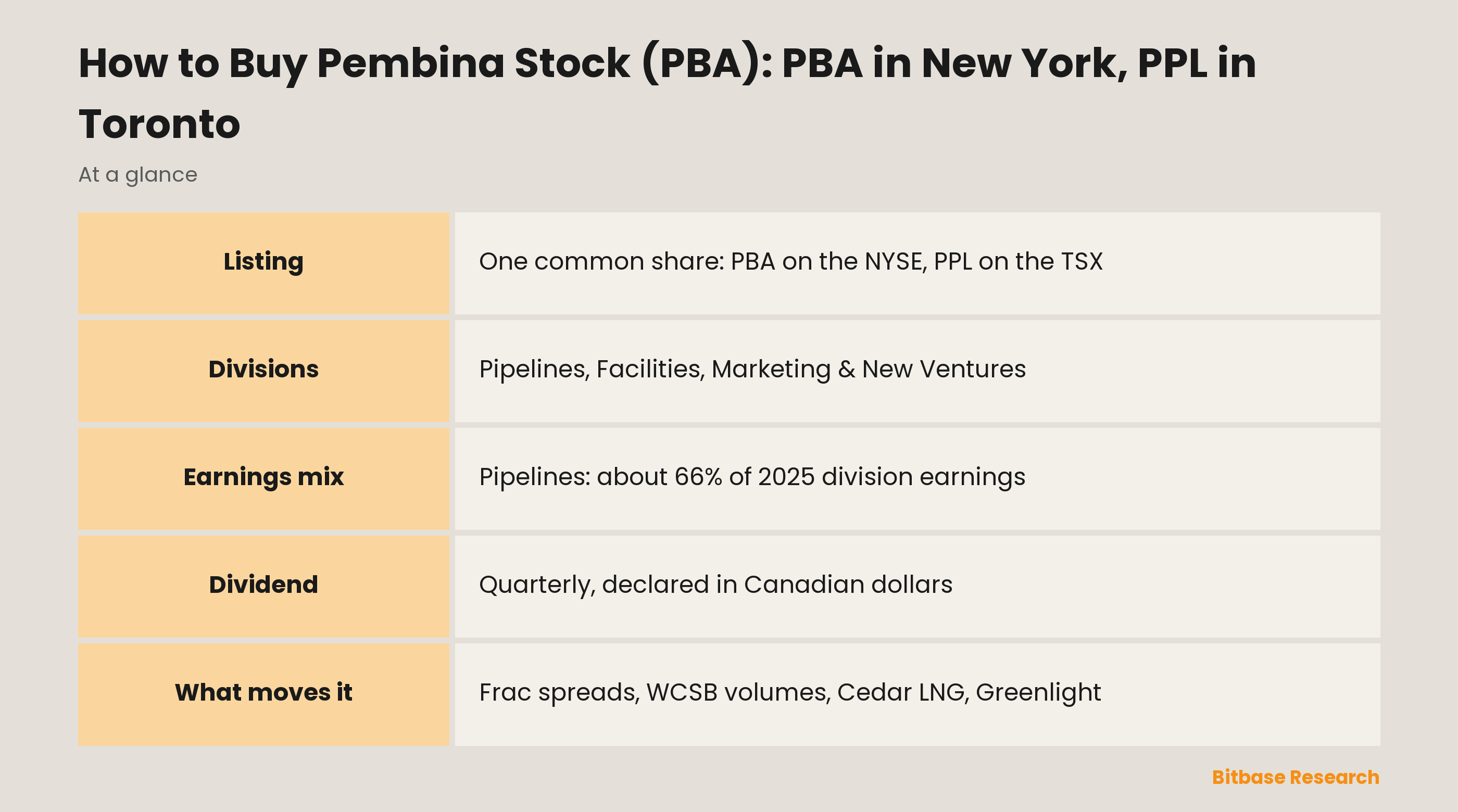
A single Pembina Pipeline share trades under two symbols, PBA on the New York Stock Exchange and PPL on the Toronto Stock Exchange, so a broker with access to either market can place the order. Pembina gathers, processes and ships oil, natural gas liquids and gas from western Canada, and in 2025 its Pipelines division produced about 66% of the earnings of its three divisions, while marketing, the part most exposed to prices, produced 15%.
What Does Pembina Do?
Pembina Pipeline Corporation, based in Calgary, Alberta, is a midstream company: it links the producers that pull oil and gas from the ground with refineries, petrochemical plants and export buyers. Its annual information form (AIF) says it "has served North America's energy industry for more than 70 years." The present corporation, governed by Alberta's Business Corporations Act, succeeded Pembina Pipeline Income Fund when that trust converted into a corporation on 1 October 2010.
The business is run as three divisions.
Pipelines. The conventional network, led by the Peace and Northern systems, gathers crude oil, condensate and natural gas liquids (NGL) in northwestern Alberta and northeastern British Columbia and carries them toward Edmonton and Fort Saskatchewan. On the oil sands side, Pembina is "the sole transporter of synthetic crude oil for the Syncrude Project." Long-haul lines include Alliance, which moves rich gas from the Western Canadian Sedimentary Basin (WCSB) and North Dakota to the Chicago area, and Cochin, which brings condensate north from Illinois as diluent for bitumen.
Facilities. Gas processing sits mostly inside Pembina Gas Infrastructure (PGI), formed in 2023 when Pembina and KKR combined their western Canadian processing plants; Pembina holds 60% of it. The division also runs fractionation and storage at the Redwater Complex near Edmonton, where a fourth fractionator, RFS IV, entered service in May 2026, and the Prince Rupert Terminal, which exports propane. At the Chicago end of Alliance, the Aux Sable plant in Illinois strips NGL out of the gas; Pembina bought the interests of Enbridge in Alliance and Aux Sable in a deal that closed on 1 April 2024.
Marketing & New Ventures. The marketing arm buys and sells natural gas, NGL, condensate, crude oil, electricity and carbon credits. New Ventures develops larger projects: Cedar LNG, a floating liquefied natural gas plant at Kitimat, British Columbia, developed with the Haisla Nation, in which Pembina owns 49.9%; the Greenlight Electricity Centre, a gas-fired power plant for a data centre in Alberta; and Alberta Carbon Grid, a carbon transport and storage platform formed with TC Energy.
How Pembina Makes Money
Mostly through fees. Pipelines charge tolls under firm take-or-pay contracts, cost-of-service agreements or interruptible terms; under cost-of-service contracts, shippers pay their share of costs "whether they use all of the fixed capacity or not." The AIF calls gas processing "primarily fee-based and therefore Pembina is largely protected from fluctuations in the price of natural gas and NGL."
| Division | Main business | Share of 2025 revenue | Share of 2025 earnings |
|---|---|---|---|
| Pipelines | Tolls on crude, condensate, NGL and gas lines; terminals | 40% | 66% |
| Facilities | Gas processing through PGI, fractionation, storage, export terminals | 14% | 19% |
| Marketing & New Ventures | Commodity buying and selling; Cedar LNG and Greenlight stakes | 46% | 15% |
Calculated from the 2025 segment note across the three divisions, before inter-segment eliminations and excluding Corporate.
Marketing looks largest by revenue because it books the full price of what it trades: in 2025 its cost of goods sold equalled about 87% of its revenue. Its earnings fell about 20% that year, which the management's discussion and analysis (MD&A) attributes mainly to "narrower WCSB and U.S. NGL frac spreads." The MD&A's glossary defines a frac spread as "the margin between the value of extracted NGLs and the cost of the natural gas used to produce them."
Pipelines carry the steadier income. In 2025, take-or-pay contracts produced 82% of the division's revenue from contracts with customers, and on the Peace and Northern systems the weighted average remaining term of firm contracts was about eight years at year-end.
Facilities matters more than its revenue line suggests: PGI is equity-accounted, so its sales never reach Pembina's revenue, only Pembina's portion of its profit.
PBA Stock at a Glance
| Item | Detail |
|---|---|
| Exchanges | New York Stock Exchange (PBA) and Toronto Stock Exchange (PPL) |
| Security | Common shares, the only class registered for NYSE trading on the 40-F cover |
| Preferred shares | Class A series listed only in Toronto, such as PPL.PR.A |
| Sector | Energy midstream: pipelines, gas processing, NGL, marketing |
| Index funds | Held by the iShares S&P/TSX 60 Index ETF (XIU); not in SPY |
| Headquarters | Calgary, Alberta |
| Corporate law | Business Corporations Act (Alberta) |
| Annual report | Form 40-F; IFRS statements in Canadian dollars |
| Fiscal year | Ends 31 December |
| Dividend | Quarterly, declared in Canadian dollars |
| SEC identifier | CIK 1546066 |
Prices and dividend yield change through every session; the Pembina stock page on Bitbase shows live figures.
How to Buy Pembina Stock
PBA is not an American depositary receipt. The same common shares are listed in both cities, and the AIF quotes NYSE prices in US dollars and TSX prices in Canadian dollars, so the choice is mostly about currency.
1. Pick the listing. In a US-market account, search for PBA; with Canadian access, search for PPL.
2. Open and verify the account, including the tax-residence declaration the broker asks for.
3. Fund it in US or Canadian dollars, checking the conversion cost.
4. Skip the preferred lines. Toronto symbols such as PPL.PR.A belong to Class A preferred shares with their own dividend terms; the common share is plain PPL or PBA.
5. Choose an order type. FINRA says a market order "provides the most certainty that your order will be executed," though not at a set price, while a limit order is one "to buy or sell a security at or better than a specified price."
6. Check fractions. Some brokers sell fractional shares widely; FINRA notes that others "don't offer fractional share trading at all."
Dividends outside Canada. Pembina declares dividends in Canadian dollars. Its first-quarter 2026 news release said the amount received in US dollars "will depend on the Canadian/U.S. dollar exchange rate on the payment date," and that for non-resident shareholders the dividends "may be subject to Canadian withholding tax." Ask your broker or a tax adviser about the rate.
Through a fund. On 10 November 2026, the iShares S&P/TSX 60 Index ETF (XIU) listed PPL among its energy holdings, so funds tracking that index hold Pembina among dozens of Canadian companies.
What Moves PBA Stock
Frac spreads and commodity prices. The AIF says profit on the extraction side of marketing "will generally increase or decrease with frac spreads," which move with NGL and gas prices and the Canadian dollar. Seasons add a pattern: western Canadian propane inventory "generally builds over the second and third quarters of the year" and is sold through the winter heating season. In the third quarter of 2026, adjusted EBITDA, a non-GAAP measure, rose 9% from a year earlier, driven primarily by the Facilities and Marketing divisions.
Western Canadian drilling. Pipelines without take-or-pay terms move with what producers drill and ship, so contract renewals are worth watching; the first-quarter 2026 release reported renewed and new contracts on the Peace Pipeline.
Projects under construction. By the end of the third quarter of 2026, the Cedar LNG floating vessel was over 77% built, with service expected in late 2028; Pembina's own capacity there has been recontracted to PETRONAS and Ovintiv. Greenlight reached a final investment decision on 2 July 2026. Pembina owns 47.5% of the 932-megawatt plant, which is due in the second half of 2030 and will sell power to a data centre under a long-term tolling agreement.
Pacific Link. Also on 2 July 2026, Pembina signed a non-binding agreement to join a proposed crude oil pipeline of about one million barrels per day from Alberta to Canada's West Coast, with Trans Mountain Corporation as lead proponent. Pembina's economic interest would be 10% during construction, with the option to add up to another 10% at commercial operation. The federal government listed the project as a Project of National Interest on 1 October 2026, but the third-quarter report still treated definitive agreements as pending.
Interest rates and the loonie. The AIF warns that higher interest rates "may lead holders and/or purchasers of Common Shares or Class A Preferred Shares to demand a higher annual dividend yield." Outside Canada, the exchange rate also changes what each dividend is worth.
Where Pembina's Fee Model Leaves Gaps
Of the AIF's many risk factors, four bear directly on shareholders.
Volume exposure. "Certain of the transportation contracts or tolling arrangements with respect to Pembina's pipeline assets do not include take-or-pay commitments," the AIF says, so lower volumes "can directly and adversely affect Pembina's revenues and earnings."
One basin. "The majority of Pembina's assets are concentrated in the WCSB, which leaves the Company exposed to the economic conditions of that area."
Cost overruns. Under most construction and operating agreements, Pembina "is obligated to construct the facilities and pipelines regardless of delays and cost increases and Pembina bears the risk for any cost overruns."
Trade policy. Many Canadian customers depend on access to US markets, and new tariffs on Canadian hydrocarbons "could result in a decrease in, or increase the volatility of, commodity prices and/or price differentials."
The shares add risks of their own. Dividends are at the board's discretion and barred while Pembina is in default under its credit facilities, and the company can issue an unlimited number of common shares, in some cases without a shareholder vote.
Checking Pembina's Numbers in Its Own Filings
Pembina files its annual report with the SEC on Form 40-F, not a 10-K, under CIK 1546066. The 2025 40-F, filed on 27 February 2026, carries the AIF, the MD&A and IFRS financial statements in Canadian dollars. Quarterly results arrive as 6-K filings, the latest on 5 November 2026, and the same documents sit on SEDAR+. The structured XBRL cover, R1.htm, lists one class registered under Section 12(b): Common Shares, trading as PBA on the NYSE.
Pembina's releases lead with adjusted EBITDA and adjusted earnings, which are non-GAAP, so read them next to IFRS earnings; the segment note sets revenue and earnings for each division side by side. For other companies, browse Bitbase's US stock pages.
Pembina Stock FAQ
Can I buy Pembina stock with crypto?
Not directly. Crypto must first be sold for US or Canadian dollars and the cash sent to a broker, a sale that may be taxable where you live. Our guide to buying stocks with crypto separates the two steps.
Are PBA and PPL the same shares?
Yes. The AIF says the common shares trade on the TSX "under the symbol" PPL and are "also listed on the NYSE under the trading symbol" PBA. Only the venue and the currency differ.
Does Pembina pay a dividend?
Yes, quarterly, to holders of record on the 15th of March, June, September and December. The board raised the rate each May from 2023 to 2026, but every payment remains its decision.
Is Pembina in the S&P 500?
No. State Street's daily holdings file for SPY, dated 10 November 2026, does not list Pembina, while XIU, which tracks the S&P/TSX 60, held PPL that day.
What is Cedar LNG?
A floating LNG export plant being built at Kitimat, British Columbia, with a nameplate capacity of 3.3 million tonnes a year, powered by BC Hydro. Its partners are the Haisla Nation and Pembina, and long-term take-or-pay contracts cover 3 million tonnes a year.
Conclusion
Pembina is mainly a toll collector on western Canadian energy, with a marketing arm that turns NGL prices into a swing factor. Its next chapter rests on projects that do not earn yet: Cedar LNG, Greenlight and, if agreements are signed, Pacific Link. Before buying PBA or PPL, read the latest 40-F and 6-K, compare the adjusted figures with IFRS earnings, and decide how much weight one company tied to a single basin deserves in your portfolio.
Related reading
Other Bitbase articles on this topic:
- How to Buy Cheniere Energy Partners Stock (CQP): Sabine Pass Units
- How to Buy Ecopetrol Stock (EC): One ADS, 20 Colombian Shares
- How to Buy EQT Stock (EQT): Range Deal, Marcellus Gas and Perps
- How to Buy Halliburton Stock (HAL): Frac Fleets and NYSE Texas
Disclaimer: This article is educational content from Bitbase Academy, provided for information only. It explains what a company or fund does and how the instruments referenced here differ from one another; it does not constitute investment, trading, tax, or financial advice, and it is neither a recommendation nor an endorsement of any security, token, or trading strategy. A tokenized stock is issued by a third party and is designed to give economic exposure to an underlying asset: it is not a share, it carries no shareholder rights, and it depends on the issuer's structure, eligibility rules, and redemption terms, which the issuer can change. Perpetual futures are leveraged derivatives that hold no underlying asset and can be liquidated, and trading hours, product availability, and eligibility differ by instrument and by jurisdiction and can change at any time. Written as of November 2026; verify everything yourself through company filings, the issuer's own documentation, and the product pages of the venue you trade on.
References
[1] Pembina Form 40-F for 2025 (SEC EDGAR) www.sec.gov
[2] Pembina 2025 Form 40-F, XBRL cover page (SEC EDGAR) www.sec.gov
[3] Pembina Annual Information Form for 2025 (SEC EDGAR) www.sec.gov
[4] Pembina 2025 MD&A and financial statements (SEC EDGAR) www.sec.gov
[5] Pembina 2025 Form 40-F, XBRL segment data (SEC EDGAR) www.sec.gov
[6] Pembina 2025 Form 40-F, XBRL revenue breakdown (SEC EDGAR) www.sec.gov
[7] Pembina 2025 Form 40-F, XBRL equity investees (SEC EDGAR) www.sec.gov
[8] Pembina first-quarter 2026 results release, filed with Form 6-K (SEC EDGAR) www.sec.gov
[9] Pembina third-quarter 2026 results release, filed with Form 6-K (SEC EDGAR) www.sec.gov
[10] Pembina third-quarter 2026 interim report, filed with Form 6-K (SEC EDGAR) www.sec.gov
[11] BlackRock: iShares S&P/TSX 60 Index ETF (XIU), fund page and holdings www.blackrock.com
[12] State Street SPDR S&P 500 ETF Trust (SPY): fund page and daily holdings www.ssga.com
[13] FINRA: Order Types www.finra.org
[14] FINRA: Investing in Fractional Shares www.finra.org





