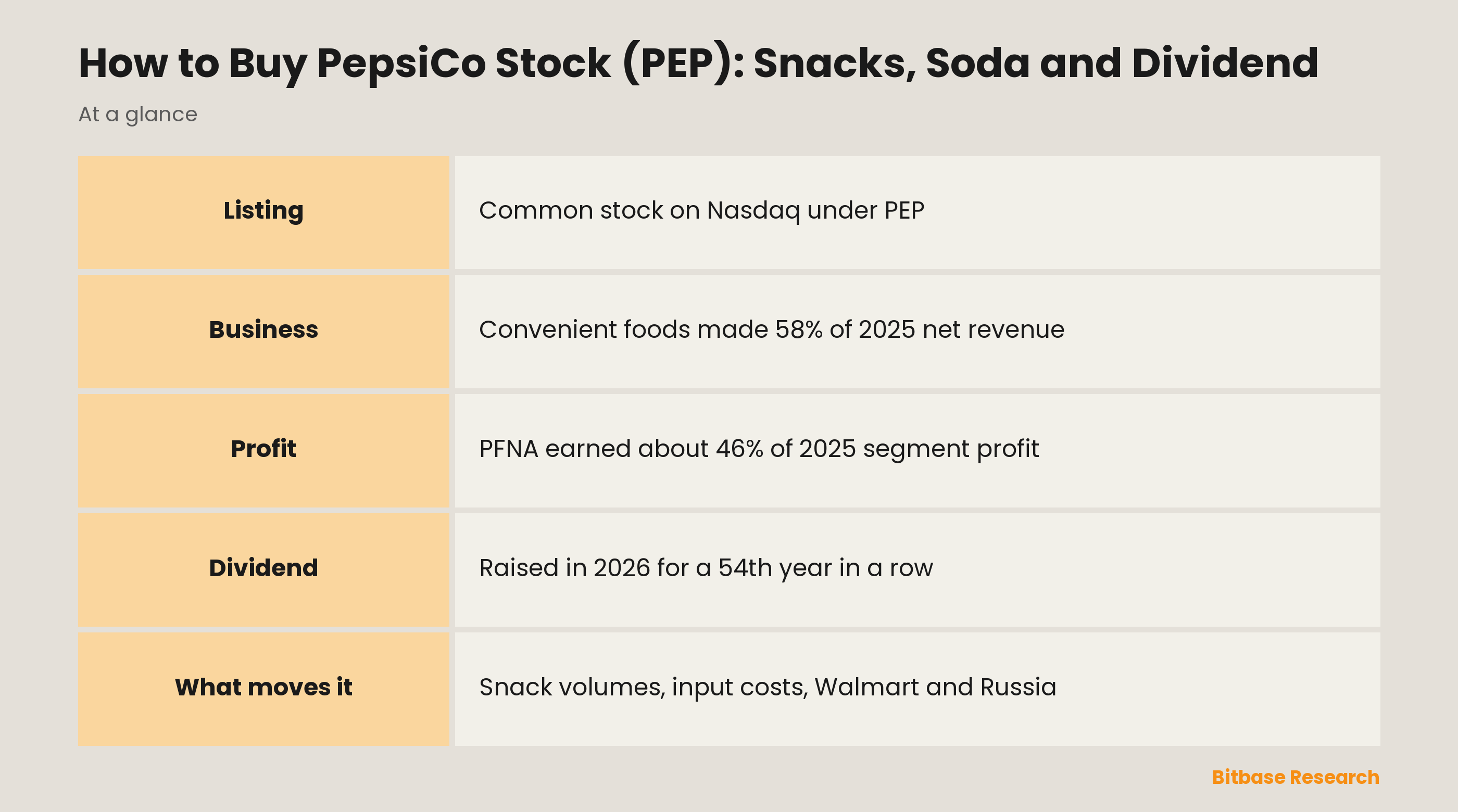
PepsiCo is listed on the Nasdaq Global Select Market under the ticker PEP, so you can buy it through any broker that reaches US exchanges. The company is less of a soda business than its name suggests: convenient foods such as Lay's, Doritos and Quaker brought in about 58% of fiscal 2025 net revenue, and beverages the other 42%. Below you will find where the money comes from, the order steps for a buyer outside the United States, and the pressures PepsiCo's own filings point to: soft snack volumes in North America, input costs, one very large customer, and Russia.
What Does PepsiCo Do?
PepsiCo makes, markets, distributes and sells beverages and convenient foods. Its annual report names Lay's, Doritos, Cheetos, Gatorade, Pepsi-Cola, Mountain Dew, Quaker and SodaStream first, sold in "more than 200 countries and territories." The company was incorporated in Delaware in 1919, reincorporated in North Carolina in 1986, and has its headquarters in Purchase, New York.
It reports six segments, divided by product in North America and by region elsewhere. PepsiCo Foods North America (PFNA) holds the US and Canadian snack and pantry brands, from Lay's, Doritos, Fritos and Tostitos to Quaker, Sabra dips and Siete. PepsiCo Beverages North America (PBNA) sells Pepsi, Mountain Dew, Gatorade and Aquafina, runs its own bottling plants and also distributes brands it does not own, such as Celsius energy drinks in certain channels. International Beverages Franchise sells concentrate to bottlers abroad and includes SodaStream. Europe, Middle East and Africa combines snacks such as Walkers with company-owned bottling and a dairy business. Latin America Foods and Asia Pacific Foods hold convenient foods only, so the drinks sold in those regions are reported under the franchise segment.
Three deals shaped this mix: the 1997 spin-off of Pizza Hut, KFC and Taco Bell as TRICON Global Restaurants, the 2001 merger with The Quaker Oats Company, and the 2010 purchase of the anchor bottlers, The Pepsi Bottling Group and PepsiAmericas. PepsiCo sold Tropicana, Naked and other juice brands but keeps a 39% noncontrolling stake in Tropicana Beverages Group; it bought Siete in January 2025 and the prebiotic soda poppi in May 2025; and in August 2025 it handed the Rockstar brand in the United States and Canada to Celsius in return for convertible preferred shares.
How PepsiCo Makes Money
Convenient foods made up 58% of fiscal 2025 net revenue. In North America the two sides are close to even; outside it, foods account for about 69%. The six segments compare like this:
| Segment | Part of 2025 net revenue | Main products |
|---|---|---|
| PepsiCo Beverages North America | 30.0% | Pepsi, Mountain Dew, Gatorade; own bottling |
| PepsiCo Foods North America | 29.3% | Lay's, Doritos, Cheetos, Quaker |
| Europe, Middle East and Africa | 19.2% | Snacks, company-owned bottling, dairy |
| Latin America Foods | 11.2% | Sabritas, Gamesa, Doritos |
| International Beverages Franchise | 5.3% | Concentrate for bottlers, SodaStream |
| Asia Pacific Foods | 4.9% | Lay's, Kurkure, Smith's |
Shares are calculated from fiscal 2025 segment net revenue and rounded to one decimal.
Profit is spread less evenly. PFNA earned about 46% of 2025 segment operating profit on less than a third of revenue, while PBNA's profit that year was cut by impairment charges, mostly on the Rockstar brand. Company-owned bottlers produced about 36% of consolidated net revenue, so most beverage revenue comes from bottling rather than concentrate, and the 10-K notes that "our finished goods beverage operations produce higher net revenue, but lower operating margins as compared to concentrate sold to authorized bottling partners."
One customer stands out. In 2025 Walmart and its affiliates, including Sam's Club, accounted for about 14% of consolidated net revenue, and the 10-K says losing it "would have a material adverse effect on our PFNA and PBNA segments."
About 56% of 2025 net revenue came from the United States and 44% from elsewhere; Russia alone made up about 5%. In drinks the main rival is Coca-Cola: in 2025 PepsiCo held about 16% of US liquid refreshment beverage sales in measured channels and Coca-Cola about 20%, according to Information Resources data cited in the filing. Sales are "generally highest in the third quarter" and lowest in the first.
PEP Stock at a Glance
| Fact | Detail |
|---|---|
| Exchange | Nasdaq Global Select Market, the principal market; also listed on the SIX Swiss Exchange |
| Ticker | PEP |
| Security | Common stock, the only class of shares registered on the 10-K cover |
| Other listed securities | Senior notes with their own symbols, such as PEP29 |
| Sector | Consumer staples: beverages and convenient foods |
| Index membership | S&P 500 and Nasdaq-100; not in the Dow Jones Industrial Average |
| Headquarters | Purchase, New York |
| Incorporated | Delaware in 1919; reincorporated in North Carolina in 1986 |
| Fiscal year | Ends on the last Saturday of December; a 53rd week every five or six years |
| Quarter lengths | 12, 12, 12 and 16 weeks in the US and Canada; calendar months elsewhere |
| Dividend policy | Quarterly cash dividends since 1965; the February 2026 raise was the 54th annual increase in a row |
| SEC identifier | CIK 77476 |
Quotes, market value and dividend yield change through the trading day, so this guide leaves them out; check them on the PepsiCo stock page on Bitbase.
How to Buy PepsiCo Stock
PepsiCo is a US company and its common stock trades on Nasdaq, so there is no depositary receipt between you and the share. Buying it runs through a brokerage account:
1. Pick a broker with Nasdaq access. If you live outside the United States, that means a local firm able to place orders on US exchanges or a broker operating across borders; find out which legal entity will hold your shares and which authority licenses it.
2. Open and verify the account. If you are not a US person, expect to give the broker Form W-8BEN, which the IRS titles "Certificate of Foreign Status of Beneficial Owner for United States Tax Withholding."
3. Move money in. When your savings sit in another currency, the conversion rate the broker uses is a cost alongside its trading fee.
4. Confirm the security. Typing PEP should bring up PepsiCo, Inc. common stock listed on Nasdaq. Symbols carrying a year, such as PEP29, are the company's bonds. A ticker identifies a share only on the exchange that allocated it, and crypto tickers can collide, so check the company name as well.
5. Choose how the order executes. Investor.gov explains that a market order "guarantees that the order will be executed, but does not guarantee the execution price," whereas a limit order trades only "at a specific price or better."
6. Settle the size. Fractional shares let you spend a set amount of cash, though "not every brokerage firm offers fractional share investing," and Investor.gov adds that "you generally cannot transfer fractional shares to another brokerage firm."
7. File the records. Your statements show what you paid and every dividend credited. For 2026 the 10-K expects dividend record dates of 6 March, 5 June, 4 September and 4 December, subject to Board approval.
Orders placed before the opening bell or after the close meet thinner trading, and pre-market and after-hours prices can sit some way from the regular-session quote; setting a limit protects you from an unexpected fill.
If you live outside the United States, dividends arrive with US tax already withheld. The IRS states that "most types of U.S. source income received by a foreign person are subject to U.S. tax of 30%," and a treaty between your country and the United States can lower that rate; tax at home may apply on top.
Through a fund, you own a small slice of PepsiCo alongside many other companies: on 16 October 2026 it was among the holdings of SPY and QQQ, which track the S&P 500 and the Nasdaq-100, and of State Street's consumer staples fund XLP.
What Moves PEP Stock
Snack volumes in North America. PFNA is the largest profit contributor, and in 2025 its unit volume fell 2%, savory snacks volume fell 3% and its operating profit fell 7%. On 8 December 2025, after what it called constructive engagement with Elliott Investment Management, a PepsiCo shareholder, the company set out a plan for PFNA: cheaper price tiers on mainstream brands, recipes without artificial colors and flavors, three plant closures during 2025 and the removal of nearly a fifth of its US SKUs by early 2026.
Price against volume. Fiscal 2025 net revenue grew about 2%, with effective net pricing adding about four percentage points and lower organic volume taking away about two. The 10-K lists affordability pressures, private-label switching, the "increasing use of weight-loss drugs, such as GLP-1 medications," and changes to benefit programs such as SNAP among the forces shaping demand.
Input costs and tariffs. Potatoes, corn, oats, sugar, vegetable oils, aluminum and plastic resin all feed the cost base, and when prices rise, the 10-K says, "we may or may not pass on such increases to our customers." In 2025 higher commodity costs took about five percentage points off operating profit growth. During 2026 the US Supreme Court ruled many tariffs imposed under the International Emergency Economic Powers Act invalid; the latest 10-Q says PepsiCo received substantially all of the refunds, while new tariffs have been initiated.
Currency and Russia. With 44% of revenue earned abroad, exchange rates run through every reported number. Russia, about 5% of revenue, also held about 20% of the company's cash and cash equivalents at the end of 2025, and the 10-K warns that geopolitical conflicts "could result in temporary or permanent loss of assets, including the nationalization or expropriation of assets."
Supply chain and brand values. The December 2025 announcement said PepsiCo was "carefully evaluating an integrated model" for its North American supply chain and go-to-market systems, with an update to investors planned for late 2026. Brand values matter too: the Rockstar impairment cut 2025 profit, and the estimated fair value of SodaStream "narrowly exceeded its carrying value" at year-end.
Risks to Weigh Before Buying PEP
Of the 10-K's more than two dozen risk factors, these bear most directly on a PEP share:
Demand. "Reduction in future demand for our products would adversely affect our business."
Costs and supply. "Disruption of our manufacturing operations or supply chain, including increased commodity, packaging, transportation, labor and other input costs, can adversely affect our business."
Product taxes. "Taxes aimed at our products can adversely affect our business or financial performance."
Packaging. "Laws and regulations related to the use or disposal of plastics or other packaging materials can adversely affect our business and financial performance." Item 3 also lists plastic pollution lawsuits brought by New York State, Baltimore, Los Angeles County and the US Virgin Islands; management does not expect a material adverse effect from them.
Two risks belong to the share itself. However many brands PepsiCo owns, one stock is still one company's results. And each dividend depends on a Board decision, since "the declaration and payment of future dividends are at the discretion of the Board"; if you count in another currency, price and payout both pass through the exchange rate.
How to Research PEP Yourself
PepsiCo files with the SEC under CIK 77476: the 10-K once a year, 10-Qs for the first three quarters, and 8-Ks for events in between, such as the December 2025 announcement, the February 2026 dividend increase and each earnings release. In the 10-K, Item 1 describes the segments, Item 1A the risks, and the "Our Business Risks" part of Item 7 the Russia, tariff and tax exposures; the segment note gives revenue and operating profit by segment. On results days, the investor site, pepsico.com/investors, posts prepared management remarks in PDF, and the company then hosts a live question-and-answer webcast with analysts.
Two calendar quirks trip up comparisons: the 16-week fourth quarter in the US and Canada, and calendar-month reporting abroad, which leaves the international first quarter with only January and February. Fiscal 2026 ends on 26 December 2026. Organic revenue and "core" figures are company-defined measures; check the reconciliations. For quotes, use the stock page above, and to compare companies, browse other US stock pages on Bitbase.
PepsiCo Stock FAQ
Does PepsiCo pay a dividend?
Yes, quarterly. PepsiCo has "paid consecutive quarterly cash dividends since 1965," and on 3 February 2026 it announced a 4% increase in the annualized dividend from the June 2026 payment, which it called its 54th consecutive annual increase. Each payment still needs the Board's approval.
Can I buy PepsiCo stock with crypto?
Not directly. You need a brokerage account for PEP shares, and they are priced in US dollars, so your coins have to be converted into fiat money and the proceeds sent to the broker first. Where you live, that sale may count as a taxable disposal. Coins and shares also behave differently, and how crypto and stocks compare on volatility, drawdowns and tax is worth reading before you switch.
Is PEP in the S&P 500 and the Nasdaq-100?
Yes, both. On 16 October 2026, State Street's SPY holdings file and Invesco's QQQ holdings data each included PepsiCo. It is not a Dow Jones Industrial Average stock: State Street's DIA file for the same date lists 30 companies, Coca-Cola among them, and PepsiCo is not one of them.
Does PepsiCo own Frito-Lay and Quaker?
Yes. Frito-Lay is among the trademarks the 10-K lists as PepsiCo's own, and its chips sit in PFNA. Quaker joined through a merger completed on 2 August 2001, when The Quaker Oats Company became a wholly owned subsidiary.
Has PepsiCo stock ever split?
Yes. PepsiCo's filings record a two-for-one split authorized by the Board on 1 May 1996 for shareholders of record on 10 May 1996, so older per-share figures need adjusting before comparison.
Conclusion
Placing a PEP order is the easy part: a broker that reaches Nasdaq, the PepsiCo, Inc. common stock line, and a market or limit order. Understanding the share takes longer. It holds a North American snack business that produces the largest slice of profit, a drinks operation that bottles much of its own product and competes with Coca-Cola, and a dividend paid every quarter since 1965. The filings put dates on the open questions, from snack volumes to the supply chain update planned for late 2026, so read the latest 10-K and 10-Q before deciding how much weight one consumer staples stock deserves.
Related reading
Other Bitbase articles on this topic:
- How to Buy Altria Stock (MO): Marlboro, Dividend, PMI Spin-Off
- How to Buy British American Tobacco Stock (BTI): ADS and Dividends
- How to Buy Colgate-Palmolive Stock (CL): Toothpaste and Pet Food
Disclaimer: This article is educational content from Bitbase Academy, provided for information only. It explains what a company or fund does and how the instruments referenced here differ from one another; it does not constitute investment, trading, tax, or financial advice, and it is neither a recommendation nor an endorsement of any security, token, or trading strategy. A tokenized stock is issued by a third party and is designed to give economic exposure to an underlying asset: it is not a share, it carries no shareholder rights, and it depends on the issuer's structure, eligibility rules, and redemption terms, which the issuer can change. Perpetual futures are leveraged derivatives that hold no underlying asset and can be liquidated, and trading hours, product availability, and eligibility differ by instrument and by jurisdiction and can change at any time. Written as of October 2026; verify everything yourself through company filings, the issuer's own documentation, and the product pages of the venue you trade on.
References
[1] PepsiCo Form 10-K, fiscal year ended 27 December 2025: business, segments, risk factors and dividends (SEC EDGAR) www.sec.gov
[2] PepsiCo Form 10-Q for the 12 and 36 weeks ended 5 September 2026: tariff refunds, Russia and legal proceedings (SEC EDGAR) www.sec.gov
[3] PepsiCo press release, 8 December 2025: priorities to enhance shareholder value (Form 8-K, Exhibit 99.1) www.sec.gov
[4] PepsiCo fourth-quarter and full-year 2025 results, 3 February 2026, announcing the annual dividend increase (Form 8-K, Exhibit 99.1) www.sec.gov
[5] PepsiCo Form 10-Q for the 12 weeks ended 23 March 1996: two-for-one stock split (SEC EDGAR) www.sec.gov
[6] PepsiCo Form 10-K for fiscal 1997: spin-off of the restaurant businesses as TRICON Global Restaurants (SEC EDGAR) www.sec.gov
[7] PepsiCo Form 10-K for fiscal 2001: merger with The Quaker Oats Company (SEC EDGAR) www.sec.gov
[8] PepsiCo Form 10-K for fiscal 2010: acquisition of The Pepsi Bottling Group and PepsiAmericas (SEC EDGAR) www.sec.gov
[9] State Street: SPY daily holdings, 16 October 2026 www.ssga.com
[10] State Street: XLP (Consumer Staples Select Sector SPDR) daily holdings, 16 October 2026 www.ssga.com
[11] State Street: DIA daily holdings, 16 October 2026 www.ssga.com
[12] Invesco QQQ: fund overview and holdings (tracks the Nasdaq-100) www.invesco.com
[13] Investor.gov (SEC): Types of Orders www.investor.gov
[14] Investor.gov (SEC): Investor Bulletin on fractional share investing www.investor.gov
[15] IRS: NRA Withholding www.irs.gov





