
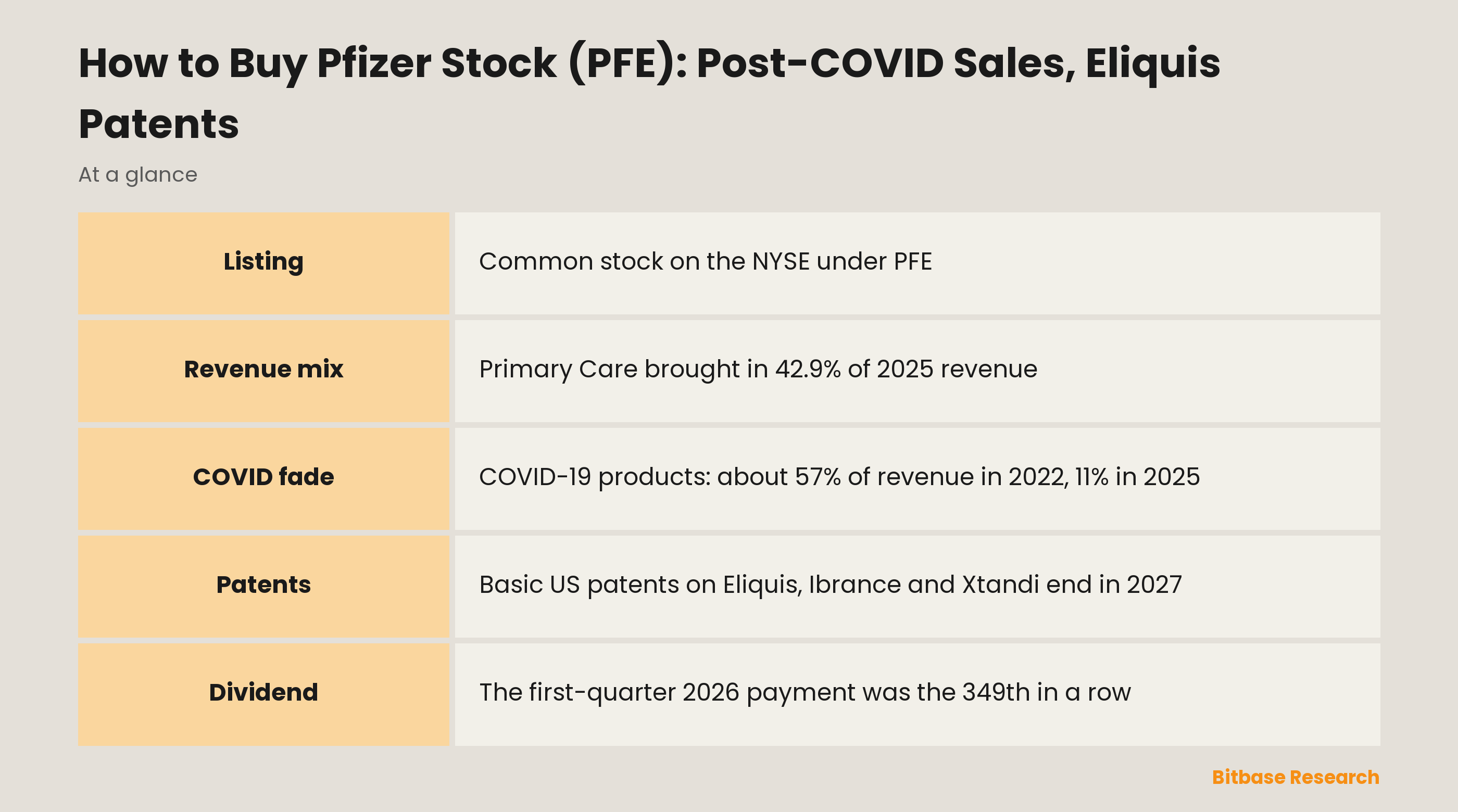
Under the ticker PFE, Pfizer's common stock trades on the New York Stock Exchange, so buying it takes a brokerage account with NYSE access and an order for that symbol. The business behind it sits between two eras: COVID-19 products brought in about 57% of revenue in 2022 but about 11% in 2025, and the basic US patents on Eliquis, Ibrance, Xtandi and the Vyndaqel family run out in 2026 or 2027. Below: the revenue mix, the order itself, and the dates Pfizer's own filings flag.
What Does Pfizer Do?
Pfizer calls itself "a research-based, global biopharmaceutical company," and its annual report states that "Most of our revenues come from the manufacture and sale of biopharmaceutical products." The company says it was founded in 1849; the present corporation was incorporated in Delaware on 2 June 1942 and is based in New York.
Nearly everything sits in one reportable segment, Biopharma, which from January 2026 serves four customer groups. Primary Care holds the anticoagulant Eliquis, the migraine drugs Nurtec ODT/Vydura and Zavzpret, the vaccines (the Prevnar pneumococcal family, the COVID-19 vaccine Comirnaty, the RSV vaccine Abrysvo) and the COVID-19 pill Paxlovid. Specialty Care covers inflammation and immunology, such as Xeljanz and Cibinqo, and rare diseases, including the Vyndaqel family for transthyretin amyloidosis. Oncology spans antibody-drug conjugates, small molecules and bispecific antibodies, from Ibrance for a type of breast cancer to Xtandi for prostate cancer and Padcev for urothelial cancer. Hospital and Biosimilars, new in 2026, gathers off-patent sterile injectables and biosimilars such as Inflectra.
The other segment is PC1 (Pfizer CentreOne), a contract manufacturer that also supplies specialty drug ingredients. A third unit, Pfizer Ignite, was discontinued in 2025.
The portfolio has been reworked many times. Pfizer bought Wyeth in 2009 and Hospira in 2015. On 16 November 2020 it spun off the Upjohn business, home to Lipitor, Lyrica, Norvasc and Viagra, which merged with Mylan to form Viatris, and in early 2025 it sold the last of its stake in the consumer-health company Haleon. It completed the Seagen acquisition on 14 December 2023, adding cancer medicines built mainly on antibody-drug conjugates, and the Metsera acquisition on 13 November 2025, adding clinical-stage obesity candidates.
How Pfizer Makes Money
The money comes from prescription medicines and vaccines. The fiscal 2025 10-K splits revenue like this:
| Area | Share of 2025 revenue | Products named in the 10-K |
|---|---|---|
| Primary Care | 42.9% | Eliquis, Prevnar family, Comirnaty, Paxlovid, Nurtec ODT/Vydura |
| Specialty Care | 28.0% | Vyndaqel family, Xeljanz, Inflectra, Enbrel outside the US and Canada |
| Oncology | 26.9% | Ibrance, Xtandi, Padcev, Lorbrena, Adcetris |
| PC1 (Pfizer CentreOne) | 2.1% | Contract manufacturing, active ingredients |
Percentages are computed from the 10-K's figures, using the 2025 groups; the wound-down Pfizer Ignite is the small remainder.
Eight products brought in more than half of 2025 revenue, and they moved in different directions:
| Product | Use | Share of 2025 revenue | Change vs 2024 |
|---|---|---|---|
| Eliquis | Atrial fibrillation, blood clots | 12.7% | +8% |
| Prevnar family | Pneumococcal vaccine | 10.4% | +1% |
| Vyndaqel family | Transthyretin amyloidosis | 10.2% | +17% |
| Comirnaty | COVID-19 vaccine | 7.0% | −18% |
| Ibrance | Metastatic breast cancer | 6.6% | −6% |
| Paxlovid | COVID-19 treatment | 3.8% | −59% |
| Xtandi | Prostate cancer | 3.5% | +8% |
| Padcev | Urothelial cancer | 3.1% | +22% |
Several are shared. Pfizer and Bristol Myers Squibb developed Eliquis together and generally split its profits equally; Pfizer and BioNTech split Comirnaty's gross profits equally outside mainland China, Hong Kong, Macau and Taiwan, where Pfizer has no rights; and Astellas shares Xtandi's US gross profits equally while selling it everywhere else. Alliance revenues like these were about 15% of the 2025 total.
Most sales go through middlemen. Medicines other than Paxlovid are sold principally to wholesalers, and McKesson, Cencora and Cardinal Health alone accounted for 25%, 16% and 13% of 2025 revenue. About 59% came from the United States, the only country above a tenth of the total; China, the largest market outside it, contributed about 5%.
Total revenue fell 2% in 2025, but "Excluding contributions from Comirnaty and Paxlovid, Total revenues increased 6% operationally." In the first half of 2026 revenue rose 4%, and again 6% operationally without the two COVID-19 products.
PFE Stock at a Glance
| Field | PFE |
|---|---|
| Exchange | New York Stock Exchange (NYSE) |
| Ticker | PFE |
| Security | Common stock; the 10-K cover registers no other share class |
| Other listed securities | Five series of notes with symbols such as PFE/27 |
| Sector | Healthcare: medicines and vaccines |
| Index membership | S&P 500; out of the Dow Jones Industrial Average since August 2020 |
| Headquarters | New York, New York |
| Incorporated | Delaware, 2 June 1942 |
| Fiscal year | Ends 31 December |
| Dividend policy | Quarterly cash dividend; the first-quarter 2026 payment was the 349th in a row |
| Last stock split | Three-for-one, June 1999 |
| SEC identifier | CIK 78003 |
Quotes, market value and yield move all day; the Pfizer stock page on Bitbase shows them live.
How to Buy Pfizer Stock
Pfizer is incorporated in the US and its shares trade directly on the NYSE, so no depositary receipt is involved. Most investors buy through a broker:
1. Find a broker that trades NYSE shares. Outside the US, that can be a domestic firm with US-market access or a global broker; confirm which company holds the account and who licenses it.
2. Complete the account checks. If you are not a US person, expect to sign IRS Form W-8BEN, the certificate of foreign status used for US tax withholding.
3. Deposit money. A currency conversion is a cost in its own right, so look at the FX spread, not just the trading fee.
4. Select the stock, not a bond. A search for PFE should return Pfizer Inc. common stock, NYSE; codes like PFE/27 are Pfizer notes, and unlike a token name, a stock symbol points to one listed security.
5. Choose the order type. In FINRA's words, a market order "generally will execute at or near the current bid or ask prices"; a limit order trades only "at or better than a specified price," and it may not fill at all.
6. Set the size. A fractional share lets you buy by amount rather than by share, but availability "varies by brokerage firm," they often cannot trade outside regular hours, and "you might not have shareholder voting rights."
7. Send the order and file the paperwork. Trade confirmations and account statements are your proof of purchase price and income.
Directly through the transfer agent. Pfizer's investor site says its transfer agent, Computershare Trust Company, N.A., "administers our direct stock purchase and dividend reinvestment plan for Pfizer common stock." Read the plan's own documents before choosing it over a broker.
Outside the United States, tax comes off the dividend first. Under IRS rules, "Most types of U.S. source income received by a foreign person are subject to U.S. tax of 30%," usually withheld from the payment, and a treaty between your country and the US may cut that rate or waive it, which is what Form W-8BEN is for. Your country of residence can levy its own tax as well.
Through an index fund, Pfizer arrives as one holding among hundreds. State Street's S&P 500 fund, SPY, listed it on 16 October 2026; the firm's Dow fund, DIA, did not.
What Drives the PFE Share Price
The COVID-19 unwind. Comirnaty and Paxlovid fell from about 57% of revenue in 2022 to about 11% in 2025. The 10-K expects more of the vaccine revenue "in the fall and winter seasons," notes that "Paxlovid revenues trend with COVID-19 infection rates," and blames part of the 2025 Comirnaty decline on a "narrower recommendation for vaccination" in the US. Recommendations move other vaccines too: CDC advice for adults aged 50 to 64 helped Prevnar, while an updated recommendation for older adults held back Abrysvo.
A run of patent expiries. The 10-K's patent table dates the basic US patents of Xeljanz, Prevnar 13, Adcetris and the Vyndaqel family to 2026, with an extension to 2028 sought for Vyndaqel, and those of Eliquis, Ibrance and Xtandi to 2027. For Eliquis, settled generic makers may launch in the US on 1 April 2028, while three others that lost in court must wait for a formulation patent expiring in 2031, and the patents behind those dates can still be challenged. Pfizer expects "a significant reduction of revenue from patent-based or regulatory exclusivity expiries in 2026 through 2030." Big drugmakers meet this cycle in turn; see how Eli Lilly describes the same pressure.
Drug prices and tariffs. Through the Inflation Reduction Act, a government-set Medicare price for Eliquis took effect on 1 January 2026, with Ibrance and Xtandi following in 2027. Xeljanz was selected in January 2026, but Medicare's administrator then found a generic genuinely on the market, so no price will be set. In September 2025 Pfizer also agreed with the Trump administration to bring certain US prices closer to those of other developed countries and to sell some medicines at a discount through TrumpRx.gov. By its second-quarter 2026 report the deal was final and binding, and the tariff rate on Pfizer products under the April 2026 pharmaceutical tariffs is zero until 20 January 2029.
Refilling the pipeline. One of Pfizer's 2026 priorities is to "Invest to maximize post-2028 growth." The deals show where: Seagen's conjugates, Metsera's obesity candidates and a collaboration with China's Innovent on 12 early-stage cancer medicines, closed on 10 July 2026. Trial readouts cut both ways: in June 2026 the Phase 3 SigVie-002 study of sigvotatug vedotin, an experimental lung cancer drug, missed its primary endpoint.
Risk Factors That Matter for PFE
The 10-K's risk-factor section is long; these passages bear most directly on a PFE share.
Concentration. The filing counts 12 products that together made up 65% of 2025 revenue, so trouble with any one shows up in the total.
Payers. "We may fail to obtain or maintain timely or adequate pricing or formulary placement of our products," it warns, as insurers and benefit managers push for bigger rebates.
Competition. "Competitive product launches have and may erode future sales of our products," with more rivals emerging, "including from China."
Research and deals. New products and new uses "are necessary for the continued strength of our business," and acquisitions add a test of "our ability to successfully integrate acquired businesses and develop and commercialize acquired products."
Manufacturing and safety. "We could encounter difficulties, delays or inefficiencies in our supply chain, product manufacturing and distribution networks." Oxbryta is the concrete case: Pfizer withdrew the sickle cell drug from every market where it was approved and in July 2026 found no viable path back to the US market.
On top of that sit the risks of any single stock. A single share ties your money to one company's results; a long dividend streak guarantees nothing, because each payment needs a fresh board declaration; and if you spend another currency, exchange-rate swings change what the price and dividend are worth to you.
Where to Verify PFE Information
Pfizer's SEC filings sit under CIK 78003: a 10-K each year, 10-Qs each quarter and 8-Ks for earnings releases and events in between. The 10-K's business section holds the patent table, the risk-factor section the risks, and the revenue note the sales of each product. "Operational" growth strips out exchange rates, so it can differ from plain year-on-year arithmetic. The shareholder-return graph names its peer group, AbbVie, Eli Lilly, Merck and Novartis among them.
Two details prevent misreadings. The machine-readable cover page (R1.htm) of the 2025 annual report registers six securities, and only PFE is the stock. And although the fiscal year ends on 31 December, subsidiaries outside the US close their books on 30 November. The investor site keeps the dividend and split history; the stock page linked above has the quote, and the Bitbase list of US stock pages covers other companies.
Pfizer Stock FAQ
How long has Pfizer paid a quarterly dividend?
For more than 80 years without a break: the 10-K calls the first-quarter 2026 payment the "349th consecutive quarterly dividend." Pfizer's capital allocation framework begins with "maintaining and, over the long term, growing our dividend," and it bought back no shares in 2025.
Can I buy Pfizer stock with crypto?
Not directly. A broker sells PFE for US dollars, so crypto must first be converted to cash and moved into the brokerage account; whether that conversion is taxed depends on where you live. What you then hold is a registered stake in Pfizer that carries dividends and votes, unlike a token, as the comparison of crypto and stocks explains.
Is Pfizer still in the Dow Jones Industrial Average?
No. S&P Dow Jones Indices replaced Pfizer with Amgen before the market opened on 31 August 2020, a change prompted by Apple's stock split. Pfizer is still in the S&P 500.
How much of Pfizer's revenue still comes from COVID-19 products?
About 11% in 2025, against about 57% in 2022. Comirnaty fell 18% in 2025 and Paxlovid 59%, and Pfizer shares Comirnaty's gross profits equally with BioNTech.
What did Pfizer buy when it acquired Metsera?
A clinical-stage developer of medicines for obesity and cardiometabolic disease, acquired on 13 November 2025. Its candidates include MET-097i, intended for monthly dosing, alone and combined with MET-233i. None is approved yet, so the deal adds no sales today.
Conclusion
Placing the trade takes three things: NYSE access, the PFE common stock line and a market or limit order. Understanding what the share now represents takes longer. The COVID-19 boom has mostly passed, Eliquis, Ibrance, Xtandi and Vyndaqel near their US patent dates, and newer products and deals must fill the gap. The filings put dates on most of it, from the Eliquis generic entry on 1 April 2028 to the zero tariff rate running to January 2029, and the newest 10-K and 10-Q are where to check them before you size a position in a single drugmaker.
Related reading
Other Bitbase articles on this topic:
- How to Buy Novo Nordisk Stock (NVO): ADR, Wegovy and Ozempic
- How to Buy Regeneron Stock (REGN): Dupixent Profits and EYLEA HD
- How to Buy Sanofi Stock (SNY): Half-Share ADS and Dupixent
Disclaimer: This article is educational content from Bitbase Academy, provided for information only. It explains what a company or fund does and how the instruments referenced here differ from one another; it does not constitute investment, trading, tax, or financial advice, and it is neither a recommendation nor an endorsement of any security, token, or trading strategy. A tokenized stock is issued by a third party and is designed to give economic exposure to an underlying asset: it is not a share, it carries no shareholder rights, and it depends on the issuer's structure, eligibility rules, and redemption terms, which the issuer can change. Perpetual futures are leveraged derivatives that hold no underlying asset and can be liquidated, and trading hours, product availability, and eligibility differ by instrument and by jurisdiction and can change at any time. Written as of October 2026; verify everything yourself through company filings, the issuer's own documentation, and the product pages of the venue you trade on.
References
[1] Pfizer Form 10-K, fiscal 2025: business, product revenues, patents and risk factors (SEC EDGAR) www.sec.gov
[2] Pfizer Form 10-Q for the quarter ended 28 June 2026: revenues, pricing agreements, tariffs and pipeline (SEC EDGAR) www.sec.gov
[3] Pfizer Form 10-K, fiscal 2022: 2022 revenues by product, including Comirnaty and Paxlovid (SEC EDGAR) www.sec.gov
[4] Pfizer press release filed on Form 8-K, 2 September 2009: company description, 'Founded in 1849' www.sec.gov
[5] Pfizer investor relations: Shareholder Services (transfer agent, direct stock purchase plan) investors.pfizer.com
[6] Pfizer investor relations: Dividend & Split History investors.pfizer.com
[7] S&P Dow Jones Indices press release, 24 August 2020: Salesforce.com, Amgen and Honeywell set to join the Dow Jones Industrial Average press.spglobal.com
[8] State Street: SPY daily holdings, 16 October 2026 www.ssga.com
[9] State Street: DIA daily holdings, 16 October 2026 www.ssga.com
[10] FINRA: Order Types www.finra.org
[11] FINRA: Investing in Fractional Shares www.finra.org
[12] IRS: NRA Withholding www.irs.gov





