
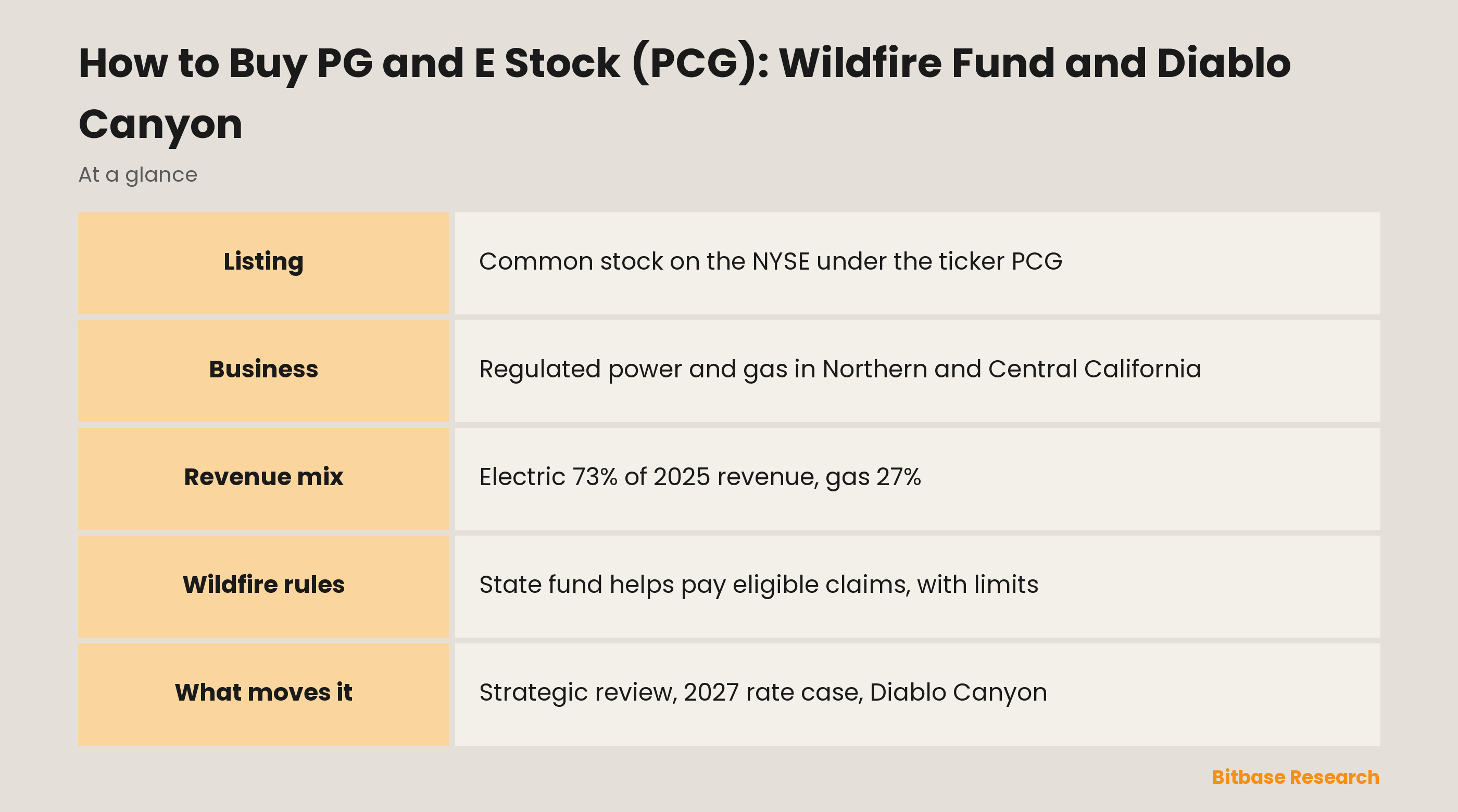
You need only a broker with access to the New York Stock Exchange, since PG&E Corporation's common stock is listed there as PCG. The ticker buys a holding company whose utility serves Northern and Central California, whose Chapter 11 plan of 2020 set up a trust for wildfire victims' claims, and whose results now hinge on a state wildfire fund, rate cases and a strategic review announced in September 2026.
What Does PG&E Do?
PG&E Corporation was incorporated in California in 1995 and became the holding company of Pacific Gas and Electric Company in 1997. The utility, incorporated in 1905, is "a public utility operating in Northern and Central California."
The utility sells and delivers electricity and natural gas to homes, businesses, industry and farms: in 2025 it averaged about 5.7 million customers on the electric side and 4.6 million on gas. Of its roughly 109,000 circuit miles of distribution lines, about 73% run overhead, which matters in a service area the 10-K says "encompasses some of the most densely forested areas in California."
It also generates power. The largest plant is Diablo Canyon, a two-unit nuclear station in San Luis Obispo County; most of the rest is hydro, including the Helms pumped-storage plant. Utility-owned plants supplied about 60% of the electricity delivered to its retail customers in 2025, and about 71% of those deliveries came from greenhouse-gas-free sources: 34% renewables, 32% nuclear and 5% large hydro.
How PG&E Makes Money
The California Public Utilities Commission (CPUC) sets most of PG&E's rates, while electric transmission rates are set federally by FERC, the Federal Energy Regulatory Commission. Under cost-of-service ratemaking, the 10-K explains, "a utility's earnings depend on the outcomes of its ratemaking proceedings and its ability to manage costs."
| Business line | Share of 2025 operating revenue | Average customers in 2025 | Main regulator |
|---|---|---|---|
| Electric | 73% | About 5.7 million | CPUC; FERC for transmission |
| Natural gas | 27% | About 4.6 million | CPUC |
Shares are calculated from the income statement and include pass-through fuel and power costs.
Sales volume matters less than it seems. Apart from some gas transmission and storage revenue, base revenue is "decoupled" from sales, so "the Utility's net income is not impacted by fluctuations in sales." Profit follows the rate base the CPUC approves and the return allowed on it: for 2026 the CPUC set the return on equity at 9.98%, against the 11.30% requested. The next General Rate Case (GRC), filed on 15 May 2025, covers revenue for 2027 through 2030. In 2025 operating revenue rose about 2% and income available for common shareholders about 5%.
PCG Stock at a Glance
| Fact | PCG |
|---|---|
| Listed on | New York Stock Exchange |
| Symbol | PCG |
| Security | Common stock, no par value |
| Other listed PG&E securities | PCG-PrX mandatory convertible preferred (NYSE); the utility's preferred stocks (NYSE American) |
| Industry | Electric and gas utility, rate-regulated |
| S&P 500 | Yes, per State Street's SPY holdings of 9 November 2026 |
| Head office | Oakland, California |
| Financial year | Ends 31 December |
| Dividends | Paid quarterly; target payout of about 20% of core earnings by 2028 |
| SEC filer | CIK 1004980; combined 10-K with Pacific Gas and Electric Company |
| Holders of record | 38,490 on 4 February 2026 |
For quotes, market value and yield, open the PG&E stock page on Bitbase.
How to Buy PG&E Stock
PCG is the common stock of a California company, with no depositary receipt in between:
1. Pick a broker that reaches the NYSE and check who regulates it.
2. Complete onboarding. Non-US investors will normally be asked to provide IRS Form W-8BEN, which the IRS says to submit "when requested by the withholding agent or payer."
3. Fund the account. Deposits in other currencies get changed into dollars, so the conversion rate counts alongside fees.
4. Choose the right line. Confirm the result reads PG&E Corporation common stock. PCG-PrX is a mandatory convertible preferred share, and PCG-PA to PCG-PI on NYSE American are the utility's preferred stocks, each with its own dividend terms.
5. Set the order. A market order, FINRA says, "provides the most certainty that your order will be executed," while a limit order executes only "at or better than a specified price."
6. Decide on fractions. Some firms offer fractional shares only for "large-cap stocks or ETFs," FINRA notes, and a fractional holder may get no vote.
An ownership cap. To protect tax losses carried forward from earlier years, PG&E's articles bar anyone, with limited exceptions, from acquiring 4.75% or more of the combined value of its equity securities. An ordinary purchase is far below that line.
From abroad, the IRS states that "most types of U.S. source income received by a foreign person are subject to U.S. tax of 30%," unless a treaty provides a lower rate. Index funds also hold it: PCG appears in State Street's SPY and in its utilities sector fund XLU, per holdings files of 9 November 2026.
What Moves PCG Stock
California's wildfire framework. Since 2019 a statewide Wildfire Fund has helped participating utilities pay eligible claims, and SB 254, law since September 2025, added a Continuation Account in case it runs short. Other utilities' fires draw on the same money: after Southern California Edison disclosed probable losses from the Eaton fire of January 2025, PG&E said it could cut the estimated life of its Wildfire Fund asset, possibly to zero. Its third-quarter 2026 10-Q adds that the legislature ended its 2025-2026 session "without enacting additional legislation to modify the state's wildfire liability framework."
The strategic review. On 2 September 2026 PG&E began a review of "the full range of options related to how PG&E Corporation and the Utility are organized and financed," cut planned 2027 capital spending by about 15% and withdrew its forecast for 2028 to 2030. An investment-grade credit rating is "a foundational objective"; one major agency still rates the utility below that level.
Rate decisions. A proposed decision in the 2027 GRC is expected by March 2027 and a final decision by May 2027.
Diablo Canyon. In April 2026 the Nuclear Regulatory Commission approved a 20-year license renewal, but running Unit 1 beyond October 2029 and Unit 2 beyond October 2030 still requires action by the California Legislature.
Load growth and new shares. PG&E expects data centers, electric vehicles and building electrification to raise electric demand, spreading its revenue requirement over more sales. And its 6.000% Series A mandatory convertible preferred stock is due to convert into common shares on 1 December 2027.
Fire Liability, Credit Ratings and Other PG&E Risks
Four groups of 10-K risk factors bear most on a PCG holder.
Wildfire liability. The Wildfire Fund and related laws "may not effectively mitigate the risk of liability for damages arising from catastrophic wildfires." Under inverse condemnation, a utility can be held strictly liable for fire damage linked to its equipment, and losses for the 2019 Kincade, 2021 Dixie and 2022 Mosquito fires "could exceed their estimated liabilities."
Cost recovery. Rate proceedings "may not authorize sufficient revenues." PG&E aims to limit average annual customer rate increases to 3%, and high rates "could also lead to a decline in the number of customers."
Financing. The spending plan depends on debt and equity markets; a downgrade could raise borrowing costs and the collateral the utility must post.
The holding company. PG&E Corporation "relies on dividends, distributions, and other payments" from the utility, whose capital needs get first priority under CPUC rules, and no common dividend may be paid while preferred dividends are in arrears.
Above these sits single-stock risk: PG&E has already been through bankruptcy once, and its regulated status did not prevent it.
How to Research PCG Yourself
PG&E Corporation files under CIK 1004980 and the utility under CIK 75488; their reports are combined, so note which registrant a given table describes. In 2026 earnings came out as 8-Ks on 12 February, 23 April, 23 July and 22 October, each on the same day as the 10-K or a 10-Q.
In the 10-K, the "Regulatory Matters" pages of the MD&A track open rate cases and the wildfire note lists liabilities fire by fire; each 10-Q updates the strategic review and the Wildfire Fund asset.
One trap: the share count on the 10-K cover includes PG&E Corporation shares owned by the utility, which the equity note excludes. For another California utility in the same wildfire system, see our Sempra stock guide. Bitbase's US stock pages cover the rest of the market.
PG&E Stock FAQ
Can I buy PG&E stock with crypto?
No, not straight from a wallet. Brokers settle PCG in US dollars, so crypto has to be sold for cash first, which may trigger tax in your country. A PCG share is equity with voting and dividend rights; see stocks and crypto compared.
Does PG&E pay a dividend?
Yes, quarterly, though none is payable "unless and until declared" by the board. The December 2025 declaration doubled the quarterly amount, and the target of about 20% of core earnings by 2028 can be changed by the board at any time.
Is PCG in the S&P 500?
Yes. It appears among the holdings in State Street's SPY file of 9 November 2026.
Did PG&E go bankrupt?
Yes. PG&E Corporation and the utility filed Chapter 11 cases on 29 January 2019, and the reorganization plan took effect on 1 July 2020. The plan created the Fire Victim Trust for wildfire victims' claims; securities claims tied to the 2017 Northern California wildfires and the 2018 Camp fire are still being resolved.
What is the difference between PCG and PCG-PrX?
PCG is the common stock. PCG-PrX is PG&E Corporation's 6.000% Series A mandatory convertible preferred stock, which ranks ahead of the common for dividends and converts into common shares on 1 December 2027.
Conclusion
What a PCG share earns over the next few years depends on how California divides wildfire risk among utilities, customers and shareholders. The Wildfire Fund, the strategic review and the 2027 GRC will settle much of that, while Diablo Canyon's life beyond 2030 rests with the legislature. Read the newest 10-Q next to the 10-K risk factors, then judge what share of your portfolio one utility with this history should take.
Related reading
Other Bitbase articles on this topic:
- How to Buy CenterPoint Energy Stock (CNP): Houston Grid and Gas
- How to Buy Con Edison Stock (ED): NYC Grid, Steam and Dividends
- How to Buy DTE Energy Stock (DTE): A Century of Dividends
Disclaimer: This article is educational content from Bitbase Academy, provided for information only. It explains what a company or fund does and how the instruments referenced here differ from one another; it does not constitute investment, trading, tax, or financial advice, and it is neither a recommendation nor an endorsement of any security, token, or trading strategy. A tokenized stock is issued by a third party and is designed to give economic exposure to an underlying asset: it is not a share, it carries no shareholder rights, and it depends on the issuer's structure, eligibility rules, and redemption terms, which the issuer can change. Perpetual futures are leveraged derivatives that hold no underlying asset and can be liquidated, and trading hours, product availability, and eligibility differ by instrument and by jurisdiction and can change at any time. Written as of November 2026; verify everything yourself through company filings, the issuer's own documentation, and the product pages of the venue you trade on.
References
[1] PG&E Form 10-K for 2025 (SEC EDGAR) www.sec.gov
[2] PG&E 2025 Form 10-K, XBRL cover page (SEC EDGAR) www.sec.gov
[3] PG&E 2025 Form 10-K, XBRL income statement (SEC EDGAR) www.sec.gov
[4] PG&E Form 10-Q for the third quarter of 2026 (SEC EDGAR) www.sec.gov
[5] State Street, SPY daily holdings www.ssga.com
[6] State Street, XLU daily holdings www.ssga.com
[7] FINRA, Order Types www.finra.org
[8] FINRA, Investing in Fractional Shares www.finra.org
[9] IRS, NRA Withholding www.irs.gov
[10] IRS, About Form W-8 BEN www.irs.gov





