
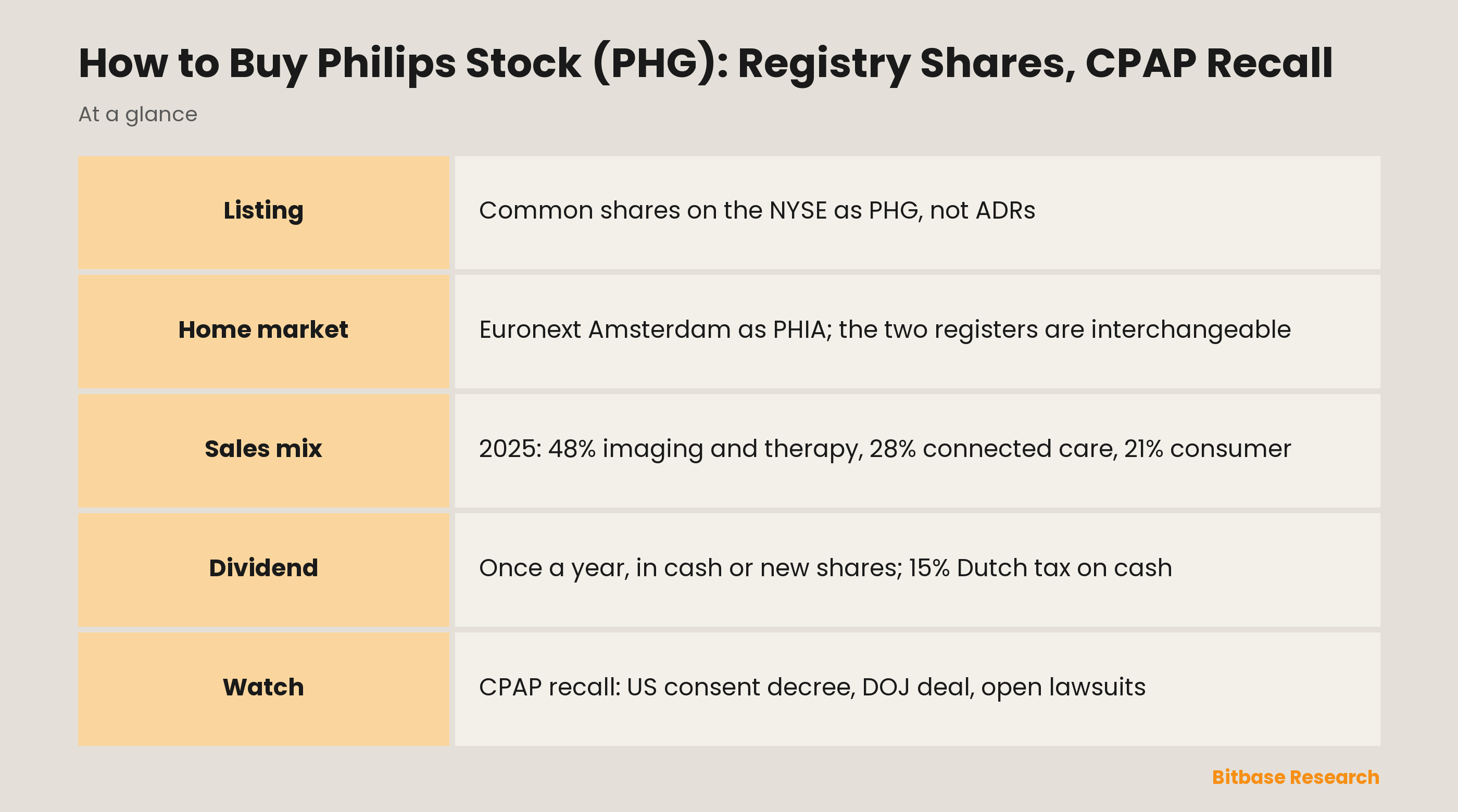
Your Philips order can go through any brokerage account with New York Stock Exchange access: the ticker is PHG, and what trades under it are the company's own common shares, held on a New York register, not American depositary receipts. Behind the ticker is a Dutch health technology group whose 2025 sales came about 48% from imaging and image-guided therapy, 28% from monitoring, informatics and sleep care, and 21% from shavers, toothbrushes and baby products. Below: how it earns its money, the buying steps, the annual cash-or-shares dividend and the CPAP recall that still runs through its filings.
What Does Philips Do?
Royal Philips, legally Koninklijke Philips N.V., is a Dutch company headquartered in Amsterdam. It began in Eindhoven in 1891 as a partnership called Philips & Co and became a limited company in 1912; the current name dates from 2013. The former lighting segment became the separately listed Signify and left the accounts at the end of November 2017, and Domestic Appliances is reported as a discontinued operation. What remains is a health technology company with three reportable segments.
Diagnosis & Treatment sells imaging and minimally invasive treatment equipment. Precision Diagnosis, 59% of the segment's 2025 sales, covers MRI, ultrasound, CT and diagnostic X-ray, including helium-free BlueSeal MRI magnets and the Verida spectral CT. Image Guided Therapy, the other 41%, pairs the Azurion interventional X-ray platform with devices and software for heart, vascular, neurological and cancer procedures.
Connected Care covers what happens around the patient. Monitoring, 59% of the segment, makes bedside, transport and fetal monitors and runs remote cardiac monitoring services. Enterprise Informatics, 22%, sells imaging archives (PACS) and clinical software. Sleep & Respiratory Care, 19%, is the home of Philips Respironics and its CPAP machines and masks. The defibrillator unit, Emergency Care, was sold to Bridgefield Capital at the end of 2025 and now operates as Heartstream.
Personal Health is the consumer arm: Personal Care (55% of the segment), with shavers, OneBlade and Lumea hair removal devices; Oral Healthcare (33%), led by Sonicare toothbrushes; and Mother and Child Care (11%), with Avent breast pumps, bottles and baby monitors. A fourth bucket, Other, holds Innovation & Design, IP royalties and central costs.
Governance is two-tier: a Board of Management runs the company and a Supervisory Board oversees it. Roy Jakobs has been chief executive since October 2022 and was reappointed on 8 May 2026. The largest disclosed shareholder is Exor N.V., controlled by Giovanni Agnelli B.V., with 19.03% in an August 2026 filing; under a 2023 relationship agreement it committed to being a long-term minority investor and can propose one Supervisory Board member.
How Philips Makes Money
Philips reports in euros under International Financial Reporting Standards. For its segments it uses Adjusted EBITA, a non-IFRS profit measure that strips out acquired-intangible amortisation, restructuring, acquisition costs and other items such as Respironics charges. On that basis the consumer business punches above its weight:
| Segment | Share of 2025 sales | Share of 2025 segment Adjusted EBITA | What it sells |
|---|---|---|---|
| Diagnosis & Treatment | 48% | 45% | MRI, CT, ultrasound, X-ray, interventional systems and devices |
| Connected Care | 28% | 25% | Patient monitoring, informatics, sleep and respiratory care |
| Personal Health | 21% | 30% | Shavers, power toothbrushes, mother and baby products |
| Other | 3% | n/a | IP royalties, innovation and central costs |
Shares are calculated from the segment note; the Adjusted EBITA shares cover the three operating segments, since Other ran a small loss on that measure. Personal Health's Adjusted EBITA reached 18% of its sales in 2025.
Hospital equipment earns through system sales, leases, service contracts, per-procedure fees on disposable devices and software licences, and both professional segments usually sell more in the second half of the year. Personal Health sells mainly through retailers and online. No single customer reached 10% of sales.
North America produced 33% of 2025 sales, Western Europe 32%, other mature markets 5% and what the company calls growth geographies 29%. China has been the soft spot: sales booked there fell about 15% between 2023 and 2025, which the 20-F attributes to "adverse market conditions."
The 2025 totals show slow growth against a stronger euro. Sales were 1% lower in nominal terms, but after a 3% negative effect from currencies and portfolio changes, comparable sales grew 2% and comparable order intake rose 6%. The Adjusted EBITA margin improved to 12.3% from 11.5%, and the group returned to a net profit after net losses in 2023 and 2024, years weighed down by Respironics litigation provisions.
PHG Stock at a Glance
| Feature | PHG |
|---|---|
| US listing | New York Stock Exchange, ticker PHG |
| Home listing | Euronext Amsterdam, ticker PHIA |
| Security | Common shares, par value EUR 0.20, the only class registered under Section 12(b) |
| Form on the NYSE | New York Registry Shares: the common shares themselves, on a New York register; no ADR, no ratio |
| Sector | Health technology: imaging, monitoring, informatics, personal health |
| Index membership | AEX and STOXX Europe 600 Healthcare, among the indices the 20-F lists |
| Headquarters | Amsterdam, the Netherlands |
| Fiscal year | Calendar year, ending 31 December |
| Reports | Form 20-F yearly, Form 6-K for quarterly results; IFRS, in euros |
| Payouts | One dividend a year, in cash or new shares at the holder's choice |
| SEC identifier | CIK 313216 |
Quotes, market value and yield move all day; for live data, open the Philips stock page on Bitbase.
How to Buy Philips Stock
Philips shares trade in two places, and they are the same shares. The 20-F says "Only Euroclear shares are traded on Euronext Amsterdam. Only New York Registry Shares are traded on the New York Stock Exchange," and the two "may be exchanged for each other." At the end of 2025 about 93% of the common shares were held through Euroclear Nederland and about 7% sat on the New York register, kept by Deutsche Bank Trust Company Americas as transfer agent and dividend agent. Compare ING, whose NYSE line is an ADS issued by a depositary bank: with PHG there is no depositary and no conversion ratio, so one PHG share is one Philips common share.
1. Pick a broker that reaches the NYSE, local or international, and check which legal entity holds your account and who regulates it.
2. Open and verify the account, including identity checks and tax residency forms.
3. Fund it. PHG is quoted in US dollars, so paying in from another currency adds a conversion spread on top of commission.
4. Find the right line. Search PHG and confirm the name reads Koninklijke Philips N.V.
5. Choose the order type. FINRA says a market order "provides the most certainty that your order will be executed because it's not tied to any restrictions," while a limit order executes only "at or better than a specified price."
6. Keep records. Trade confirmations document your cost basis and the dividend tax withheld.
Which line to use. If your broker reaches Euronext Amsterdam, the same share trades there as PHIA, priced in euros, which spares a euro-based investor two conversions. Shares can move between the registers, but the New York agent may charge for exchanges and deduct fees from distributions.
Dividend tax. Wherever you buy, the dividends follow Dutch rules. "Dividend in cash is in principle subject to 15% Dutch dividend withholding tax," the 20-F says, while a dividend taken in shares is taxed only on the par value of the new shares. Whether a tax treaty lets you credit or reclaim any of it is a question for your broker or tax adviser.
Through funds. Funds tracking the AEX or STOXX Europe 600 Healthcare hold Philips as one position among many.
What Moves PHG Stock
The Respironics recall and its legal tail. In June 2021 Philips Respironics recalled certain CPAP, BiPAP and ventilator devices over their sound-dampening foam. Under a 2024 consent decree with the US Department of Justice, acting for the FDA, Respironics will not sell new CPAP or BiPAP devices in the US "until the relevant requirements of the consent decree are met," though it keeps servicing existing devices there and selling new ones elsewhere. In the third quarter of 2026 Respironics reached an agreement in principle with the DOJ to resolve its criminal and civil investigations, with payment expected in the first quarter of 2027 once the documents are final. Still open: an inquiry by more than 30 state attorneys general, a US securities class action and investor claims in the Netherlands.
Quality and the FDA. After the FDA inspected nine Philips facilities in early 2025, observations at three sites led to a warning letter in September 2025. Findings like these can hold back products or add remediation costs in any segment.
China. "China's anti-corruption campaign has also negatively impacted demand and increased uncertainty within the medical industry," the 20-F says. In the third quarter of 2026, lower sales in China helped leave Diagnosis & Treatment flat, while Connected Care grew 5% and Personal Health 8% on a comparable basis.
Tariffs. Philips makes and sources mainly in the US, the EU and China. A US tariff refund lifted the second-quarter 2026 Adjusted EBITA margin to 16.4%, "including US tariff refund benefit of effectively 4.2%."
The euro. With 33% of 2025 sales in North America and accounts in euros, a weaker dollar shrinks reported sales, as in 2025. A dollar-based PHG holder also carries the euro-dollar rate directly, because the share and its dividend are euro-denominated.
Recalls, Regulators and the Euro in Philips' Risk Factors
The 20-F ranks its risks within each category by expected significance. These bear most on a PHG share:
Geopolitics. "Philips' global operations are exposed to geopolitical and macro-economic changes," with tariffs, sanctions and the US-China relationship named among the concerns.
Quality and patient safety. "Products and services may fail quality or security standards, which could adversely affect patient safety or customer operations." Under a consent decree, that is not hypothetical.
The recall's legacy. "Philips is exposed to the ongoing impact of the Respironics voluntary recall/field action and related matters, including securities claims and regulatory investigations." For the remaining lawsuits abroad, the company says it is "not currently able to reliably estimate the amount of the obligation."
Supply chain. "Philips may be unable to ensure a resilient supply chain." Its medical systems stay in production longer than the semiconductors inside them.
Currency. "Philips operates in over 100 countries and its reported earnings and equity are therefore inevitably exposed to fluctuations in the exchange rates of foreign currencies against the euro."
Payouts. "Any announced share-buyback program or dividend policy may also be amended, suspended or terminated at any time."
At the share level, one stock ties your result to one company's legal path, and a large holder can grow: Exor's August 2026 agreement raised the cap on its permitted stake from 20% to 22%.
How to Research PHG Yourself
Philips files with the SEC as a foreign private issuer under CIK 313216, so there are no 10-K or 10-Q reports. The annual report is a Form 20-F (the 2025 edition was filed on 19 February 2026) and quarterly results come as Form 6-K, in 2026 on 10 February, 6 May, 28 July and 3 November.
In the 20-F, the Business chapter splits each segment into businesses, Risk factors ranks the risks, and the Contingencies note gives the status of every Respironics proceeding. Investor information lists the tickers, indices and dividend dates, and a governance section describes the New York Registry Shares and their fees. Read the non-IFRS reconciliation before comparing Adjusted EBITA with net income, because recall charges sit in the gap, and remember that comparable sales strip out currency effects that reported sales keep. For a device maker that files 10-K reports instead, see our Medtronic stock guide, and for other companies the Bitbase list of US stock pages.
Philips Stock FAQ
Can I buy Philips stock with crypto?
Not directly. PHG is bought through a brokerage account in US dollars, or PHIA in euros, so crypto has to be sold for cash and moved to the broker first, and that sale may be taxable where you live. Our guide on how to buy stocks with crypto walks through that route and its costs.
Is PHG an ADR?
No. PHG is a New York Registry Share: a Philips common share recorded on a register that Deutsche Bank Trust Company Americas keeps in New York. It can be exchanged for a share held through Euroclear in Amsterdam, with no depositary and no ratio.
Does Philips pay a dividend?
Yes, once a year, and shareholders choose between cash and new shares; for the 2025 dividend, paid from 3 June 2026, the cash election came to 43.8%. The policy aims at "dividend stability" and a pay-out of 40% to 50% of adjusted income from continuing operations. The NYSE ex-dividend date can fall a day after Amsterdam's, as it did in May 2026.
Where else does Philips stock trade?
On Euronext Amsterdam, its home market since 1912, as PHIA. Philips shares have traded in the US since 1962 and on the NYSE since 1987.
What happened with the Philips CPAP recall?
In June 2021 Philips Respironics recalled certain sleep and respiratory devices over noise-reducing polyurethane foam. By December 2025 more than 99% of registered affected CPAP and BiPAP devices had been remediated worldwide. The US personal injury and medical monitoring settlements were paid in 2025, an agreement in principle with the DOJ followed in 2026, and new CPAP sales in the US remain on hold under the consent decree.
Conclusion
Philips is a company in repair: a hospital technology and consumer health group whose margins are rising again, whose consumer arm earns more than its share of sales suggests, and whose sleep business cannot sell new therapy devices in the US while the consent decree runs. The DOJ agreement, the consent decree and the remaining lawsuits will decide how much of the recovery reaches shareholders. Read the latest 20-F and quarterly 6-K, follow comparable sales alongside the euro, and decide how much weight one Dutch medtech company should carry in your holdings.
Related reading
Other Bitbase articles on this topic:
- How to Buy GE HealthCare Stock (GEHC): Scanners and Imaging Agents
- How to Buy Humana Stock (HUM): Medicare Advantage and CenterWell
- How to Buy Illumina Stock (ILMN): Reagents, China and GRAIL
- How to Buy ResMed Stock (RMD): NYSE Shares and ASX CDIs
Disclaimer: This article is educational content from Bitbase Academy, provided for information only. It explains what a company or fund does and how the instruments referenced here differ from one another; it does not constitute investment, trading, tax, or financial advice, and it is neither a recommendation nor an endorsement of any security, token, or trading strategy. A tokenized stock is issued by a third party and is designed to give economic exposure to an underlying asset: it is not a share, it carries no shareholder rights, and it depends on the issuer's structure, eligibility rules, and redemption terms, which the issuer can change. Perpetual futures are leveraged derivatives that hold no underlying asset and can be liquidated, and trading hours, product availability, and eligibility differ by instrument and by jurisdiction and can change at any time. Written as of November 2026; verify everything yourself through company filings, the issuer's own documentation, and the product pages of the venue you trade on.
References
[1] Philips Form 20-F for 2025 (SEC EDGAR) www.sec.gov
[2] Philips 2025 Form 20-F, XBRL cover page (SEC EDGAR) www.sec.gov
[3] Philips third-quarter 2026 report, Form 6-K (SEC EDGAR) www.sec.gov
[4] Philips second-quarter 2026 report, Form 6-K (SEC EDGAR) www.sec.gov
[5] Philips Form 6-K, June 2026: 2025 dividend in shares or cash (SEC EDGAR) www.sec.gov
[6] Philips Form 6-K, May 2026: 2026 AGM results (SEC EDGAR) www.sec.gov
[7] Exor and Giovanni Agnelli, Schedule 13D/A on Philips, August 2026 (SEC EDGAR) www.sec.gov
[8] FINRA: Order Types www.finra.org





