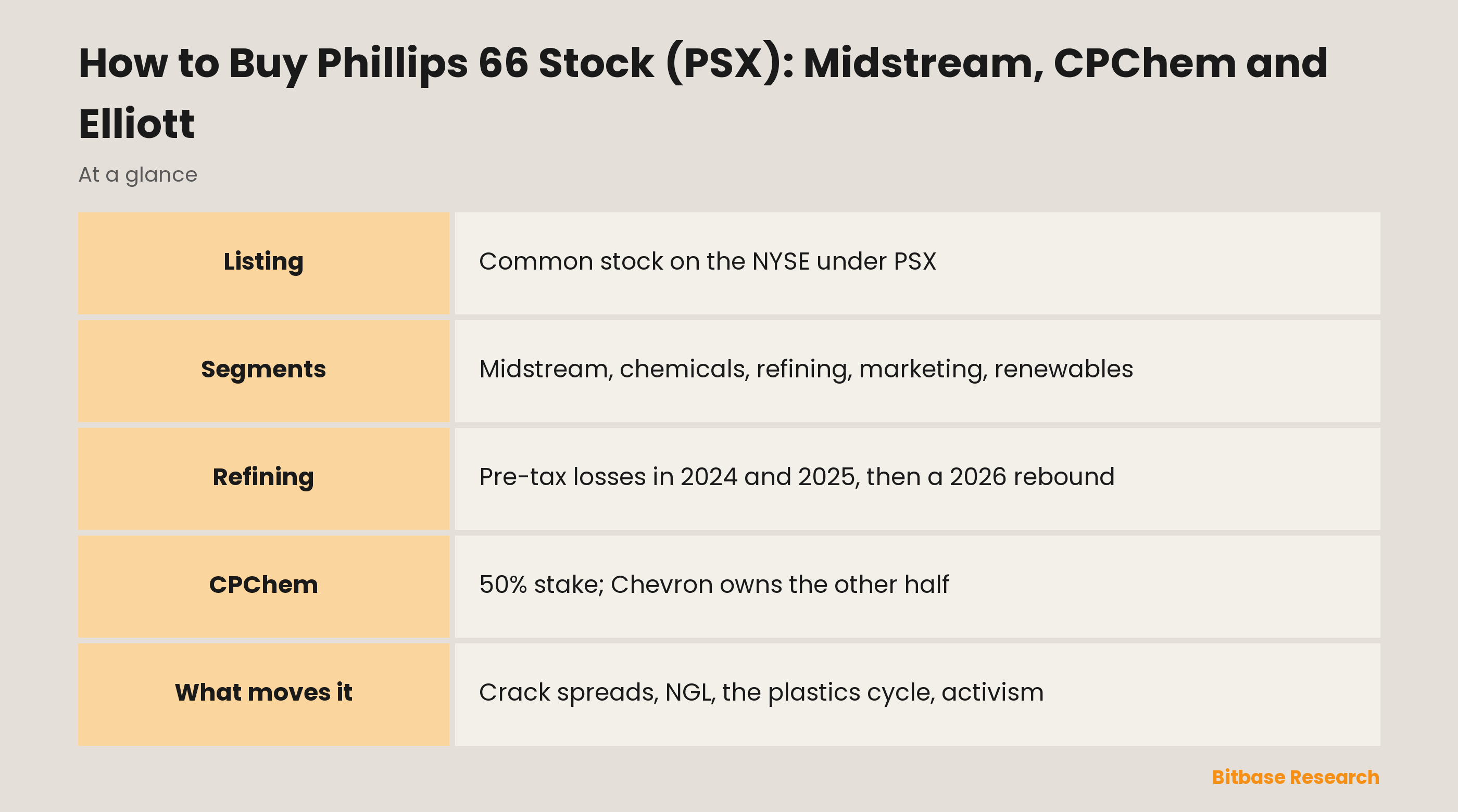
Your purchase of Phillips 66 stock goes through an ordinary brokerage account that can reach the New York Stock Exchange, where its common shares are listed as PSX. The share holds five businesses whose profits rarely move together: Refining lost money before tax in 2024 and 2025, then produced about 75% of pre-tax income in the first nine months of 2026. This guide covers the segments, the half-stake in Chevron Phillips Chemical, the 2025 proxy contest with Elliott and the order itself.
What Does Phillips 66 Do?
Phillips 66 buys crude oil and natural gas liquids that it does not produce, turns them into fuels and petrochemical feedstocks, moves them through its own pipelines and terminals, and sells them under brands drivers know. Its annual report calls the company "a leading integrated downstream energy provider." Headquartered in Houston, it was incorporated in Delaware in 2011 for the restructuring that separated the downstream businesses of ConocoPhillips. ConocoPhillips completed the split by distributing all Phillips 66 common shares to its shareholders after the market closed on 30 April 2012. The 10-K reports five operating segments.
Midstream moves and processes hydrocarbons. At the end of 2025 it owned or held interests in approximately 70,000 miles of crude oil, refined product, natural gas liquids (NGL) and natural gas pipelines, plus terminals, gas processing plants and fractionators. Its NGL chain centers on the Sweeny Hub in Old Ocean, Texas: four fractionators linked to storage caverns and an LPG export terminal in Freeport. Much of the gathering and processing runs through DCP Midstream, LP, a consolidated subsidiary in which Phillips 66 holds an 86.8% economic interest.
Chemicals is a single shareholding: a 50% equity investment in Chevron Phillips Chemical Company LLC (CPChem), a joint venture with Chevron, which owns the other half. CPChem makes ethylene, polyethylene, normal alpha olefins, aromatics and specialty chemicals at 29 manufacturing facilities it owns or shares in five countries, and two large ethane-cracker projects, on the US Gulf Coast and in Qatar, are expected to be fully operational in 2027.
Refining ran 10 refineries in the United States and Europe at the end of 2025, including Bayway in New Jersey, Humber in England, Lake Charles in Louisiana, Sweeny in Texas and an 18.75% stake in MiRO in Germany. On 1 October 2025 Phillips 66 bought the remaining 50% of WRB Refining, owner of the Wood River and Borger plants, from Cenovus Energy; in the fourth quarter it ceased fuel production at its Los Angeles refinery and began idling the site.
Marketing and Specialties (M&S) sells the fuel. In the United States it markets under the Phillips 66, Conoco and 76 brands, with approximately 7,620 branded outlets in 48 states at the end of 2025, and the company says it emphasizes the wholesale channel "because of its relatively lower capital requirements." In the United Kingdom it uses the JET brand. Elsewhere in Europe it has been selling down: its 49% stake in the Swiss fuel marketer Coop Mineraloel went in January 2025, and in December 2025 it sold 65% of its Germany and Austria retail business, keeping a 35% non-operating interest. The specialties side makes Phillips 66, Kendall and Red Line lubricants.
Renewable Fuels turns used cooking oil, vegetable oils, tallow and other waste fats into renewable diesel and renewable jet fuel at the Rodeo Renewable Energy Complex and co-processes renewable feedstocks at Humber. It also manages regulatory credits, so part of its result depends on what those credits are worth.
How Phillips 66 Makes Money
The top line is dominated by fuel resale; the bottom line rests on margins, fees and one shareholding. The FY2025 segment note shows the split:
| Segment | How it earns | Share of 2025 third-party revenue | Pre-tax result, 2023 to 2025 |
|---|---|---|---|
| Marketing and Specialties | Margin on fuel sales, plus lubricants | 63.3% | Profit each year; 2025 lifted by gains on asset sales |
| Refining | Spread between crude oil and refined product prices | 20.3% | Profit in 2023, losses in 2024 and 2025 |
| Midstream | Pipeline, terminal and storage fees; NGL processing and exports | 14.0% | Profit each year, up 6.8% in 2025 |
| Renewable Fuels | Renewable diesel, renewable jet fuel and credits | 2.4% | Profit in 2023, losses in 2024 and 2025 |
| Chemicals | Half of CPChem's earnings, booked as equity income | None (equity method) | Profit each year, down 66.1% in 2025 |
Revenue shares are calculated from fiscal 2025 third-party sales; the last column uses income before income taxes, the segment measure the chief executive reviews.
M&S carries most of the revenue because Refining sells much of its output inside the group: 64.1% of Refining's 2025 sales went to other Phillips 66 segments, at prices the company says "approximate market," and those internal sales vanish on consolidation. M&S's 2025 profit was unusual too: close to two-thirds of its pre-tax income came from net gains on dispositions, chiefly the Germany and Austria sale and the Coop sale.
By product line, refined petroleum products and renewable fuels made up 73.5% of 2025 sales, NGL and natural gas 12.9%, crude oil resales 11.5%, and services and other 2.1%. US operations generated 78.8% of the total, the United Kingdom 10.0% and Germany 3.8%. Total revenue fell about 8%, "primarily due to lower prices for crude oil, refined petroleum products, and NGL," the 10-K says.
Profit swung far more than revenue. Refining's 2025 loss included an impairment on the WRB stake taken before the buyout; in the first nine months of 2026 the segment supplied about 75% of company income before income taxes, which the quarterly report puts down to "improved realized margins." Midstream's pre-tax income over those nine months was 4.6% lower than a year earlier.
PSX Stock at a Glance
| Item | Detail |
|---|---|
| Exchange | New York Stock Exchange (NYSE) |
| Ticker | PSX |
| Security | Common stock; no other class is registered under Section 12(b) on the 10-K cover |
| Sector | Energy: refining, midstream, fuel marketing, renewable fuels and a chemicals joint venture |
| Index membership | S&P 500 constituent; a holding of the Energy Select Sector SPDR ETF (XLE); not a Dow Jones Industrial Average member |
| Headquarters | Houston, Texas |
| Incorporated | Delaware, 2011 |
| Independent since | 30 April 2012, after the market close |
| Fiscal year | Ends 31 December |
| Dividend policy | Quarterly cash dividend, raised in February and again in October 2026 |
| Board structure | Directors split into three classes; declassification has fallen short of the 80% vote it needs |
| Identifiers | CIK 1534701; CUSIP 718546104 |
For the live quote, chart and market value, see the Phillips 66 stock page on Bitbase.
How to Buy Phillips 66 Stock
As a Delaware company listed in New York, Phillips 66 has no depositary receipts or overseas line to sort out; a standard brokerage purchase covers it:
1. Find a broker that reaches the NYSE. Outside the United States this is usually a domestic firm with a US-market add-on or a global brokerage; confirm the legal entity behind your account and the authority that licenses it.
2. Complete the onboarding. Foreign individuals normally sign IRS Form W-8BEN, a certificate of non-US status that the broker relies on when it withholds tax on US dividends.
3. Deposit money. Funding in a currency other than the dollar means a conversion, and the rate you get is a cost just as the commission is.
4. Search by ticker, not by name. Typing "Phillips" can also bring up ConocoPhillips, a separate company that trades as COP. Make sure the order ticket shows Phillips 66 common stock, NYSE, PSX.
5. Choose market or limit. Investor.gov, the SEC's investor site, explains that a market order "guarantees that the order will be executed, but does not guarantee the execution price"; a limit order fills only "at a specific price or better."
6. Settle the share count. "Not every brokerage firm offers fractional share investing," the same site says, and "you may not have voting rights if you own fractional shares," which carries extra weight at a company whose board seats were contested in 2025.
7. Submit and file the records. Keep every confirmation and statement; together they document what you paid and each dividend credited.
Holders abroad face US withholding on dividends. "Most types of U.S. source income received by a foreign person are subject to U.S. tax of 30%," according to the IRS, though "a reduced rate, including exemption, may apply" if the tax code or a treaty with your country of residence provides one. Your home tax authority may count the same payment as income too.
Indirect exposure comes with broad funds. State Street's holdings files dated 28 October 2026 show Phillips 66 inside both its SPDR S&P 500 ETF Trust (SPY) and its Energy Select Sector SPDR ETF (XLE); in either fund it is a single line among many.
What Moves PSX Stock
Refining margins. The 10-K says market crack spreads "measure the difference between market prices for refined petroleum products and crude oil," and it follows a composite 3:2:1 spread. The company owns no oil fields: "We do not produce crude oil and other feedstocks and must purchase all of the feedstocks we process." When product prices outrun crude, refining profit widens quickly and can narrow just as fast. The third-quarter 2026 report ties that quarter's wider spread to "low seasonal global product inventories, particularly diesel, and geopolitical events reducing global product supply."
The NGL chain. Transportation consists of "fee-based operations not directly exposed to commodity price risk," while the NGL business is partly "directly impacted by NGL and natural gas prices." Management says its strategy "remains focused on growing our Midstream and Chemicals businesses." In the third quarter of 2026 Phillips 66 took a final investment decision on the proposed Western Gateway pipeline, a 1,300-mile refined products system linking its Central Corridor and Gulf Coast refineries to its West Coast and Southwest marketing assets, with a 49.9% share. It now expects 2027 capital spending to exceed its earlier target.
CPChem and the plastics cycle. Chemicals pre-tax income fell 66.1% in 2025; the 10-K attributes the weaker polyethylene chain margin to "higher ethane prices, partially driven by rising natural gas prices, and continued industry oversupply from capacity additions." In the third quarter of 2026 the segment earned 76.7% more than a year earlier. One contract ties CPChem to the parent's credit standing: Chevron may buy the Phillips 66 half at fair market value after a change in control, or if both S&P and Moody's cut Phillips 66 below investment grade and either rating stays there for 365 days.
Activism. Elliott Investment Management ran a proxy contest at the 21 May 2025 annual meeting, nominating four candidates for the four Class I seats. Its proxy statement called on Phillips 66 to sell or spin off its midstream operations, divest the CPChem stake and sell the JET retail business in Germany and Austria; the board backed its own nominees. Shareholders elected two from each slate. The board's proposal to declassify itself failed: it needed 80% of outstanding shares, and votes in favor equaled about 72.5%. The FY2025 10-K says the company "has been and may again be subject to shareholder activism."
Capital returns. Phillips 66 aims for "a secure, competitive and growing dividend, complemented by share repurchases," and through 2027 targets returning more than 50% of operating cash flow, excluding working capital, to shareholders. The board raised the dividend in February and October 2026 and enlarged the buyback authorization in July 2026; authorizations do not expire. Shares outstanding on the 10-K cover fell 35.5% between January 2013 and January 2026.
Pressure Points in the PSX Risk Factors
Of the many risk factors in Item 1A, these apply most directly to PSX holders.
Margin cycles. "Margins for the products we produce are cyclical and volatile due to changes in market conditions, which are largely dependent on factors beyond our control." Significant margin declines "may adversely affect our ability to fund our capital priorities, including share repurchases and dividends."
No production cushion. Rivals that produce their own crude may be "better positioned to withstand periods of depressed refining margins or feedstock shortages."
Downtime and hazards. "Our operations are subject to planned and unplanned downtime, business interruptions, and operational hazards," including shutdowns ahead of hurricanes.
Joint ventures. "Our investments in joint ventures decrease our ability to manage risk." The whole Chemicals segment sits in one.
California rules. The SBx 1-2 law authorizes a cap on gross gasoline refining margins, with a financial penalty for exceeding it, and lets the state energy commission regulate the timing of refinery maintenance.
Litigation. A California jury found against Phillips 66 Company in a trade-secrets suit by Propel Fuels in October 2024; the company has appealed, "denies any wrongdoing" and warns it "may be exposed to losses in excess of the amount recorded."
Beyond the business, one stock ties your result to one company's cycle, and the board declares each dividend separately; past increases do not bind it. For holders outside the United States, the share price and every payment are also converted at whatever exchange rate applies.
How to Research PSX Yourself
Every Phillips 66 filing sits on EDGAR under CIK 1534701: the 10-K annually, 10-Qs quarterly, and 8-Ks for events such as results releases and the voting results of each annual meeting.
In the 10-K, Items 1 and 2 hold the refinery list and pipeline tables, and Item 1A the risk factors. The MD&A's Business Environment section names the indicator management watches for each segment, Note 30 gives revenue and pre-tax income by segment, and Note 18 covers contingencies, including the Propel Fuels case. The DEF 14A proxy statement covers board elections and pay, and the 2025 contest left DEFC14A filings from both the company and Elliott.
Live prices are on the stock page linked earlier, and Bitbase's index of US stock pages lets you compare other listed companies.
Phillips 66 Stock FAQ
Is Phillips 66 the same company as ConocoPhillips?
No. ConocoPhillips separated its downstream businesses into Phillips 66 and distributed the shares after the market closed on 30 April 2012. Phillips 66 trades as PSX, ConocoPhillips as COP. Some ties remain: ConocoPhillips has indemnified Phillips 66 for certain matters, and Phillips 66 still carries contingent liabilities linked to its former parent.
Can I buy Phillips 66 stock with crypto?
Not directly. A PSX order is paid in US dollars from a brokerage account, so any crypto you want to use must first be converted to cash and transferred to that broker. In many countries selling the crypto may itself be a taxable event, which makes the conversion a decision in its own right, separate from the share purchase.
Does Phillips 66 pay a dividend?
Yes, in cash every quarter. The board raised it in February 2026 and again in October 2026. Each payment is declared separately; the latest amount and dates are in the most recent results release and 10-Q.
How much of Chevron Phillips Chemical does Phillips 66 own?
Half. Phillips 66 accounts for its 50% stake using the equity method, so the Chemicals segment reports a share of CPChem's earnings rather than revenue. Chevron owns the other half.
What happened in the Elliott proxy fight?
At the 21 May 2025 annual meeting, shareholders filled four seats from two slates and elected the company's A. Nigel Hearne and Robert W. Pease and Elliott's Sigmund L. Cornelius and Michael A. Heim. The final tallies are in the 8-K that Phillips 66 filed on 28 May 2025.
Is PSX in the S&P 500?
Yes. State Street's SPDR S&P 500 ETF Trust listed Phillips 66 in its holdings as of 28 October 2026. Its Dow Jones Industrial Average trust did not, so PSX is not a Dow component.
Conclusion
The mechanics of a PSX purchase are short: a broker with NYSE access, the correct ticker and a market or limit order. Knowing what the share holds takes longer, because it combines a cyclical refiner, a fee-heavy midstream network, half of a chemicals company and a fuel marketer that has sold down its holdings in Germany, Austria and Switzerland. The filings date most of the moving parts, from the 2027 start-ups at CPChem and the Western Gateway decision to the Propel Fuels appeal. Read the latest 10-K, 10-Q and proxy statement before settling on the weight one downstream energy stock should carry in your holdings.
Related reading
Other Bitbase articles on this topic:
- How to Buy Enterprise Products Stock (EPD): MLP Units and the K-1
- How to Buy EOG Resources Stock (EOG): Shale and Enron Roots
- How to Buy Equinor Stock (EQNR): ADS, Oslo Shares and the State
Disclaimer: This article is educational content from Bitbase Academy, provided for information only. It explains what a company or fund does and how the instruments referenced here differ from one another; it does not constitute investment, trading, tax, or financial advice, and it is neither a recommendation nor an endorsement of any security, token, or trading strategy. A tokenized stock is issued by a third party and is designed to give economic exposure to an underlying asset: it is not a share, it carries no shareholder rights, and it depends on the issuer's structure, eligibility rules, and redemption terms, which the issuer can change. Perpetual futures are leveraged derivatives that hold no underlying asset and can be liquidated, and trading hours, product availability, and eligibility differ by instrument and by jurisdiction and can change at any time. Written as of October 2026; verify everything yourself through company filings, the issuer's own documentation, and the product pages of the venue you trade on.
References
[1] Phillips 66 Form 10-K, fiscal 2025: business, segments, risk factors and share data (SEC EDGAR) www.sec.gov
[2] Phillips 66 Form 10-Q for the quarter ended 30 September 2026 (SEC EDGAR) www.sec.gov
[3] Phillips 66 definitive proxy statement (DEFC14A) for the 2025 annual meeting (SEC EDGAR) www.sec.gov
[4] Elliott Investment Management definitive proxy statement (DEFC14A) on Phillips 66, 3 April 2025 (SEC EDGAR) www.sec.gov
[5] Phillips 66 Form 8-K, 28 May 2025: results of the 2025 annual meeting vote (SEC EDGAR) www.sec.gov
[6] Phillips 66 proxy statement (DEF 14A) for the 2026 annual meeting (SEC EDGAR) www.sec.gov
[7] Phillips 66 Form 10-K, fiscal 2012: cover page with shares outstanding (SEC EDGAR) www.sec.gov
[8] Chevron Form 10-K, fiscal 2025: 50% interest in CPChem (SEC EDGAR) www.sec.gov
[9] State Street SPDR S&P 500 ETF Trust (SPY): fund page and daily holdings www.ssga.com
[10] State Street Energy Select Sector SPDR ETF (XLE): fund page and daily holdings www.ssga.com
[11] State Street SPDR Dow Jones Industrial Average ETF Trust (DIA): fund page and daily holdings www.ssga.com
[12] Investor.gov (SEC): Types of Orders www.investor.gov
[13] Investor.gov (SEC): investor bulletin on fractional share investing www.investor.gov
[14] IRS: NRA Withholding www.irs.gov





