
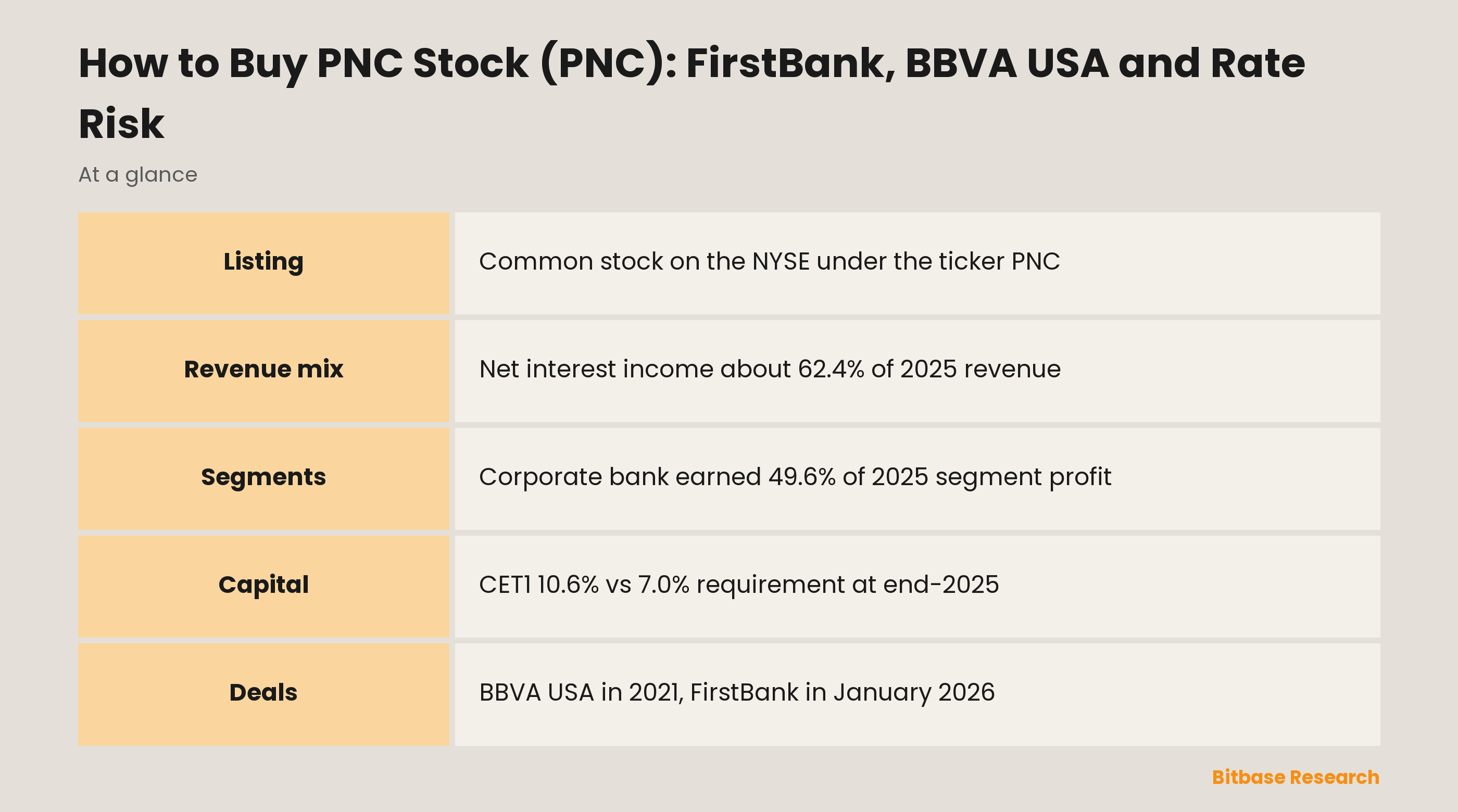
Some investors know PNC only as the bank down the street, yet its shares are bought like any other stock on the New York Stock Exchange: through a brokerage account with NYSE access, under the ticker PNC. The company behind them, The PNC Financial Services Group of Pittsburgh, became a coast-to-coast lender largely by acquisition, from National City in 2008 to BBVA USA in 2021 and FirstBank in January 2026, and net interest income still supplied about 62.4% of its 2025 revenue.
What Does PNC Do?
The PNC Financial Services Group is a Pittsburgh-based bank holding company that has opted for financial holding company status. In its annual report it describes itself as "one of the largest diversified financial institutions in the U.S.," with three lines of work: retail banking, corporate and institutional banking, and asset management. Most of it runs through its one domestic bank subsidiary, PNC Bank, a national bank chartered in Wilmington, Delaware.
PNC's present corporate form goes back to 1983, when it was incorporated in Pennsylvania through the consolidation of Pittsburgh National Corporation and Provident National Corporation. Purchases redrew the map from there. On 31 December 2008 PNC acquired National City Corporation, a deal that, in its own words, ended up "nearly doubling our assets." On 1 June 2021 it completed the cash purchase of BBVA USA Bancshares from Banco Bilbao Vizcaya Argentaria; BBVA USA, with more than 600 branches in seven states, merged into PNC Bank that October. On 5 January 2026 it closed the acquisition of FirstBank Holding Company of Lakewood, Colorado, and in June 2026 all 95 FirstBank branches in Colorado and Arizona became PNC Bank branches.
One large holding went the other way: PNC sold its stake in BlackRock in 2020, so a PNC share bought today carries none of the asset manager described in the BlackRock stock guide.
The branch network is still growing. Retail Banking counted 2,224 branches at the end of 2025. In 2024 PNC announced plans to open more than 200 new ones within five years in cities such as Atlanta, Dallas, Denver, Houston, Miami and Phoenix, and in the fourth quarter of 2025 it added 100 more to the plan.
How PNC Makes Money
Lending still carries the income statement. In 2025 net interest income, the gap between what PNC earns on loans and securities and what it pays depositors and lenders, accounted for about 62.4% of total revenue, and fees and other noninterest income the remaining 37.6%. Net interest income dipped 3.0% in 2024 and rose 6.7% in 2025, a recovery the company traced to lower funding costs, "the continued benefit of fixed rate asset repricing" and loan growth. The net interest margin widened to 2.83% from 2.66%.
The 10-K splits the business into three reportable segments:
| Segment | Who it serves | Share of segments' 2025 revenue | Share of segments' 2025 net income | Revenue change vs 2024 |
|---|---|---|---|---|
| Retail Banking | Consumers and small businesses through branches, digital channels and ATMs; includes PNC Wealth Management | 53.5% | 46.1% | Up 2.2% |
| Corporate & Institutional Banking | Mid-sized and large companies, governments and not-for-profits: lending, treasury management, capital markets | 40.4% | 49.6% | Up 9.8% |
| Asset Management Group | PNC Private Bank for wealthy families; institutional asset management | 6.2% | 4.3% | Up 9.5% |
Shares are calculated from the 2025 10-K segment note and exclude "other activities", such as asset and liability management.
The branch business brings in more revenue, yet the corporate bank turned more of it into profit, and the loan book leans the same way. At the end of 2025 commercial loans were about 70.1% of total loans, mostly commercial and industrial lending (about 59.0%), while commercial real estate stood at about 8.9% after shrinking 12.1% during the year. Consumer loans, chiefly mortgages, home equity lines, auto loans and credit cards, made up the other 29.9%.
Among fees, card and cash management was the largest line in 2025, at about 12.6% of total revenue.
PNC Stock at a Glance
| Item | Detail |
|---|---|
| Exchange | New York Stock Exchange (NYSE) |
| Ticker | PNC |
| Security | Common stock, the only exchange-registered security on the 2025 10-K cover |
| Sector | Banking: retail, corporate and institutional, asset management |
| Index membership | In the S&P 500 (held by SPY) and the Financial Select Sector SPDR (XLF); not in the Dow (State Street files, 29 October 2026) |
| Headquarters | Pittsburgh, Pennsylvania |
| Incorporated | Pennsylvania, 1983 |
| Main subsidiary | PNC Bank, National Association, chartered in Wilmington, Delaware |
| Regulatory tier | Category III banking organization |
| Share split history | Two-for-one, approved in October 1992 |
| Dividend | Paid quarterly; up 18% from July 2026 |
| Fiscal year | Calendar year, ending 31 December |
| SEC identifier | CIK 713676 |
The table leaves out anything that changes by the minute. Quotes, market value and dividend yield are on the PNC stock page on Bitbase.
How to Buy PNC Stock
PNC is a Pennsylvania corporation trading in New York, and what you buy there is its ordinary common stock, with no depositary receipt involved. A purchase comes down to six steps:
1. Pick a broker that can trade NYSE stocks. For investors abroad, that may be a local firm offering US market access or a global broker; check which entity holds your account and who regulates it.
2. Open the account and settle your tax status. Non-US individuals normally complete IRS Form W-8BEN, which a foreign person gives "to the withholding agent or payer."
3. Fund it. If your savings are not in dollars, the currency conversion is priced separately from the commission, so check both.
4. Pull up the right line. Search PNC and confirm the result reads The PNC Financial Services Group common stock on the NYSE; PNC's preferred shares and notes are separate securities.
5. Pick an order type. A market order "generally will execute at or near the current bid or ask prices," FINRA explains, but "you might not get the price you saw or were originally quoted, especially in fast-moving markets"; with a limit order, "there's a chance your order doesn't get executed at all."
6. Choose a size. With fractional shares you can put in a fixed sum of money, but "the availability of fractional share trading varies by brokerage firm," and "as a fractional share owner, you might not have shareholder voting rights."
Withholding on dividends. For foreign investors, the IRS says that "most types of U.S. source income received by a foreign person are subject to U.S. tax of 30%," and that "a reduced rate, including exemption, may apply" under a tax treaty, which is what Form W-8BEN is for. How your own tax authority then treats the dividend is a separate question.
Through a fund. S&P 500 funds such as State Street's SPY, and financial sector funds such as XLF, hold PNC among many other stocks.
What Moves PNC Stock
Interest rates, now pointing the other way. The rate simulation in the 2025 10-K estimated that an instant rise of 200 basis points would lift net interest income over the following year by about 2.0%, while an equal fall would cut it by about 2.9%; a year earlier the same test showed small declines in both directions. Deposit pricing is the other half: since August 2024, when the current cycle of rate cuts began, the rate PNC paid on interest-bearing deposits fell by about 41% as much as the federal funds target, a measure it calls the cumulative deposit beta.
Capital and the stress test. PNC's common equity tier 1 ratio (CET1) stood at 10.6% at the end of 2025. The same 10-K put its requirement at 7.0%: the 4.5% regulatory minimum plus a stress capital buffer of 2.5%, the lowest buffer the rules allow. Its second-quarter 2026 report said the buffer will remain at 2.5% until 30 September 2027 and gave a CET1 ratio of 9.9% at the end of June, after FirstBank joined; goodwill is deducted in that calculation. The third-quarter release estimated 9.8%. As a Category III bank it also leaves certain unrealized gains and losses (AOCI) out of CET1; moving up to Category I or II would bring "more stringent capital and liquidity standards."
Absorbing FirstBank. The third-quarter 2026 release still listed FirstBank integration costs, and net interest income for that quarter was about 15.3% higher than a year earlier, which PNC put down to commercial loan growth, FirstBank and lower funding costs. PNC paid for it partly in new stock, issuing 13,715,133 shares, roughly 3.4% of the common shares outstanding in early February 2026.
Office loans. Office loans were about 1.5% of total loans at the end of 2025, and PNC held reserves of 11.0% against them while saying it expects "continued stress in the office sector."
Deal-driven fees. Capital markets and advisory revenue grew about 23.8% in 2025, on "higher merger and acquisition advisory activity and increased trading revenue," but it swings with deals: in the third quarter of 2026 fee income fell 6% from the second, which the release put down to "elevated 2Q26 capital markets activity."
Pressure Points for a PNC Share
Of the risk factors in the 2025 10-K, these headings matter most for shareholders:
Rates. "Our business and financial performance are impacted significantly by market interest rates and movements in those rates."
Capital rules. "We are subject to regulatory capital and liquidity standards that affect our business, operations and ability to pay dividends or otherwise return capital to shareholders."
Concentration. "The concentration and mix of our assets could increase the potential for significant credit losses." Real estate is the example the filing gives: such loans "typically represent a significant percentage of our overall credit portfolio."
Acquisitions. "Acquisitions present several risks and uncertainties related both to the acquisition transactions themselves and to the integration of the acquired businesses into PNC after closing." For a company built by buying banks, this one describes the growth model itself.
Deposits. Customers "could continue to remove money from deposit accounts with us in favor of other banks or other types of products," the filing warns, naming digital wallets and "cryptocurrencies (including stablecoins)" among them.
The share carries risks of its own as well. Bank stocks can fall together: the 10-K notes that "uncertainty about the stability of other financial services institutions could lead to market-wide losses and defaults." Each dividend is a board decision, not a commitment, and if you spend in another currency, the dollar's moves can add to or erase what the share returns.
How to Research PNC Stock Yourself
Every PNC filing sits on EDGAR under CIK 713676. The 10-K is the annual report, 10-Qs arrive each quarter, and 8-Ks cover events in between: results, dividend declarations, debt offerings and deals such as the FirstBank closing. Inside the 10-K, Item 1 covers the business and its regulation, Item 1A the risk factors, the segment note revenue and profit by business, and the risk management section the rate sensitivity table and office loan figures. Quarterly earnings releases, filed as 8-K exhibits, are the quickest place to find the latest CET1 ratio, margin and dividend.
Two cautions for comparisons: the three segments add up to more than consolidated revenue, because "other activities" reduced revenue in 2025; and FirstBank is included only from 5 January 2026, so 2026 growth rates mix acquired and organic business.
The performance graph in the 10-K compares PNC's five-year total return with the S&P 500, the KBW Bank Index and a peer group; the board's 2026 peers include JPMorgan Chase, Wells Fargo and Bank of America, and the Bank of America stock guide is one place to start comparing. Quotes are on the stock page linked above, and the Bitbase US stock list covers other listed companies.
PNC Stock FAQ
Does PNC pay a dividend?
Yes, every quarter. On 6 July 2026 the board raised the quarterly common dividend by 18%, and the 10-K says the board "presently intends to continue the policy of paying quarterly cash dividends." Each payment still depends on earnings and on the stress capital buffer; amounts and dates are in the latest 8-K and earnings release.
Can I buy PNC stock with crypto?
Not directly. PNC shares are priced and settled in US dollars on the NYSE, so you would first sell crypto for dollars and transfer the proceeds to your broker, and that sale may be taxable where you live. A PNC share is equity in a regulated bank holding company that carries dividend and voting rights, and that is how a stock differs from a crypto asset.
Is PNC in the S&P 500?
Yes. PNC appeared in the 29 October 2026 holdings file of SPY, State Street's S&P 500 trust, and in that day's file for the Financial Select Sector SPDR (XLF). It was not a holding of DIA, State Street's fund tracking the Dow Jones Industrial Average.
Did PNC own part of BlackRock?
Yes, until 2020. PNC held 22.4% of BlackRock in early May 2020, then sold it that month through a public offering and a share buyback by BlackRock, keeping only 500,000 shares for the PNC Foundation. BlackRock now appears in PNC's accounts only as discontinued operations.
Has PNC stock ever split?
Yes. PNC's 1993 annual filing records a two-for-one split of the common stock, approved by the board on 1 October 1992 and effected as a 100% stock dividend. Price histories reaching back before it should be split-adjusted before you compare them.
Conclusion
The purchase itself is routine: an account that reaches the NYSE, the PNC common stock line, a market or limit order. Judging the share takes more reading: PNC is a rate-sensitive lender whose corporate bank out-earned its branches in 2025, whose CET1 ratio eased after the FirstBank deal, and whose history is a series of bank purchases. Check how those pieces are moving in the latest 10-K, 10-Q and earnings release before deciding how much of one bank belongs in your portfolio.
Related reading
Other Bitbase articles on this topic:
- How to Buy Deutsche Bank Stock (DB): Same Share as Frankfurt's DBK
- How to Buy HDFC Bank Stock (HDB): Three Shares per ADS, No Vote
- How to Buy ICICI Bank Stock (IBN): ADS Voting and Indian GAAP
Disclaimer: This article is educational content from Bitbase Academy, provided for information only. It explains what a company or fund does and how the instruments referenced here differ from one another; it does not constitute investment, trading, tax, or financial advice, and it is neither a recommendation nor an endorsement of any security, token, or trading strategy. A tokenized stock is issued by a third party and is designed to give economic exposure to an underlying asset: it is not a share, it carries no shareholder rights, and it depends on the issuer's structure, eligibility rules, and redemption terms, which the issuer can change. Perpetual futures are leveraged derivatives that hold no underlying asset and can be liquidated, and trading hours, product availability, and eligibility differ by instrument and by jurisdiction and can change at any time. Written as of October 2026; verify everything yourself through company filings, the issuer's own documentation, and the product pages of the venue you trade on.
References
[1] PNC Form 10-K for 2025: business, segments, capital, risk factors (SEC EDGAR) www.sec.gov
[2] PNC Form 10-Q for the quarter ended 30 June 2026 (SEC EDGAR) www.sec.gov
[3] PNC third-quarter 2026 earnings release, 15 October 2026 (Form 8-K) www.sec.gov
[4] PNC Form 10-K for 2021: the BBVA USA acquisition and the BlackRock exit www.sec.gov
[5] PNC Form 10-K for 2008: the National City acquisition www.sec.gov
[6] PNC Form 8-K, 15 May 2020: sale of the BlackRock stake www.sec.gov
[7] PNC Bank Corp. Form 10-K for 1993: the 1992 stock split www.sec.gov
[8] State Street: SPY, with XLF and DIA holdings as of 29 October 2026 www.ssga.com
[9] FINRA: Order Types www.finra.org
[10] FINRA: Investing in Fractional Shares www.finra.org
[11] IRS: NRA Withholding www.irs.gov
[12] IRS: About Form W-8 BEN www.irs.gov





