
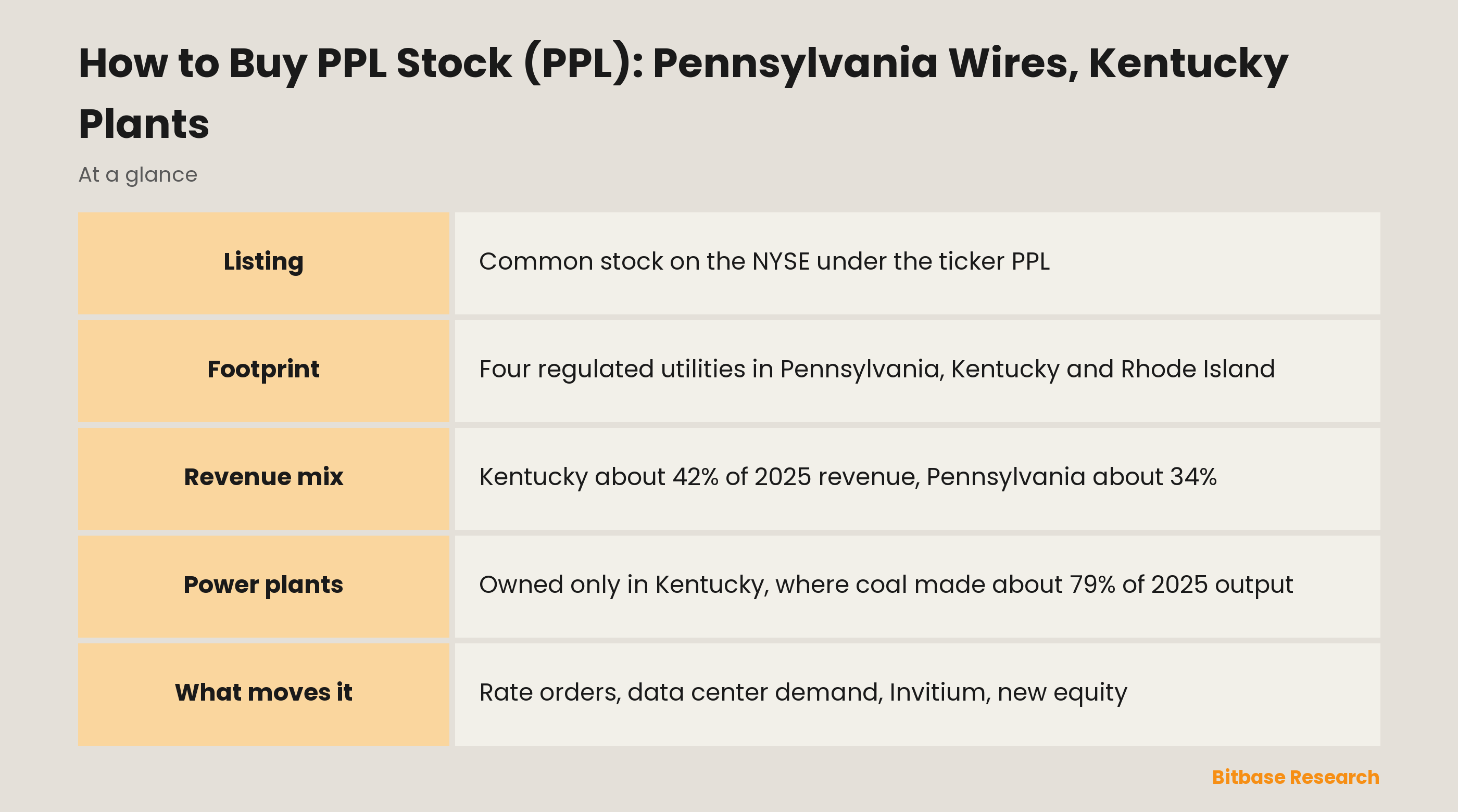
Four regulated utilities, run from Pennsylvania, Kentucky and Rhode Island, sit behind the ticker PPL, and owning a slice of them means buying PPL Corporation common stock through a broker that offers New York Stock Exchange listings. The Allentown, Pennsylvania company is a pure regulated utility holding company: it sold its UK networks in 2021, bought Rhode Island's electric and gas utility in 2022, and now runs coal and gas plants in Kentucky while only delivering power in Pennsylvania.
What Does PPL Do?
PPL Corporation was incorporated in 1994 as a utility holding company. Its oldest piece is PPL Electric Utilities, organized in 1920 as Pennsylvania Power & Light Company. EDGAR records show the parent filing as PP&L Resources until February 2000.
The 10-K describes four regulated utilities reported in three segments:
Kentucky Regulated. Louisville Gas and Electric (LG&E) and Kentucky Utilities (KU) generate, transmit and sell electricity, and LG&E also distributes natural gas. LG&E serves about 443,000 electric and 336,000 gas customers in Louisville and 16 surrounding counties. KU serves about 553,000 electric customers in 77 Kentucky counties plus about 28,000 in five counties of southwestern Virginia, where it trades as Old Dominion Power. These two are the only PPL utilities that own power plants: at the end of 2025 LG&E owned 2,466 megawatts of generating capacity and KU 4,798 megawatts, dispatched together so the cheaper unit runs first. No other electric utility operates in their service areas, and Kentucky has not adopted retail competition.
Pennsylvania Regulated. PPL Electric moves electricity over transmission and distribution lines in eastern and central Pennsylvania. It does not own generation. Pennsylvania lets customers pick their own supplier; for those who do not, PPL Electric buys power through auctions and passes the cost through. Under a default service plan running from June 2025 to May 2029, it holds two supply auctions a year. In 2025 competitive suppliers provided about 40% of residential load, 81% of small commercial and industrial load and 98% of large commercial and industrial load in its territory.
Rhode Island Regulated. Rhode Island Energy, the trading name of Narragansett Electric, delivers electricity to about 515,000 customers and gas to about 280,000 across substantially all of the state. PPL bought Narragansett from National Grid USA on 25 May 2022.
Two portfolio moves explain the current shape. On 14 June 2021 PPL sold its UK utility business. Less than a year later the Rhode Island deal added a third state. What is left has no unregulated power trading arm and no overseas exposure.
The newest piece sits outside the utilities: Invitium Energy, a joint venture with Blackstone Infrastructure set up to build gas-fired generation for data centers in Pennsylvania. PPL owns 51% and Blackstone 49%.
At the end of 2025 the group had 6,546 full-time employees, about 36% of them represented by unions.
How PPL Makes Money
Every segment earns money the same basic way: state commissions set rates designed to recover prudent costs and give a return on the capital the utility has invested, and the federal regulator does the same for transmission. The regulators are the Kentucky Public Service Commission (KPSC), the Virginia State Corporation Commission, the Pennsylvania Public Utility Commission (PAPUC), the Rhode Island Public Utilities Commission (RIPUC) and FERC. More invested capital, approved by those bodies, is what lets profit grow.
The 10-K gives this split for 2025:
| Segment | What it does | Share of 2025 operating revenue | Share of 2025 segment net income |
|---|---|---|---|
| Kentucky Regulated | Owns plants; sells electricity and gas | About 42% | About 48% |
| Pennsylvania Regulated | Delivers electricity only | About 34% | About 46% |
| Rhode Island Regulated | Delivers electricity and gas | About 24% | About 6% |
The table shows why revenue alone misleads. Rhode Island brings in roughly a quarter of the revenue but only a small slice of the profit. One reason: energy purchases, passed through to customers, took up about 37% of Rhode Island's segment revenue, against about 28% in Pennsylvania. A corporate line, mainly holding company financing costs plus unallocated and acquisition-related costs, sits outside the three segments and posted a loss.
Consolidated operating revenue rose about 7% in 2025, and net income rose about 33%, helped in part by lower operation and maintenance expense.
Kentucky is where fuel choices matter. In 2025 coal produced about 79% of the electricity LG&E and KU generated, with natural gas making up about 20% and small amounts of hydro and solar. Mill Creek Unit 5, a new combined-cycle gas plant, is expected to start commercial operation in mid-2027, and the companies' 2025 application to the KPSC proposed two more 645-megawatt gas units.
Pennsylvania is a pure wires business, so its earnings follow the size of its network and the rates it may charge on it, not wholesale prices.
PPL Stock at a Glance
| Fact | PPL Corporation |
|---|---|
| Exchange | New York Stock Exchange |
| Ticker | PPL |
| Security | Common Stock of PPL Corporation |
| Other NYSE listings | PPL/67 (subordinated notes of PPL Capital Funding) and PPLC (Corporate Units); neither is common stock |
| Industry | Regulated electric and gas utilities |
| Index | S&P 500 constituent (State Street SPY holdings, 10 November 2026) |
| Headquarters | 645 Hamilton Street, Allentown, Pennsylvania |
| Incorporated | Pennsylvania, 1994 |
| Financial year | Ends 31 December |
| Dividends | Paid on the first business day of January, April, July and October, if declared |
| Shareowners of record | 39,811 at 30 January 2026 |
| SEC filings | CIK 922224; one 10-K shared with PPL Electric, LG&E and KU |
For the live quote, market value and dividend yield, see the PPL stock page on Bitbase.
How to Buy PPL Stock
PPL is a Pennsylvania corporation whose shares trade directly on the NYSE; there is no depositary receipt in between. A typical path:
1. Choose a regulated broker that gives you access to US-listed shares from your country.
2. Pass the account checks. Brokers usually ask non-US clients to file IRS Form W-8BEN, a certificate of foreign status that lets them withhold US tax at the correct rate.
3. Move money in. If you deposit euros, pounds or another currency, the broker converts it into dollars, often with a spread on top of the exchange rate.
4. Search for PPL and check the line you pick. PPL/67 and PPLC can appear in the same search. The first is debt and the second is a unit combining a share purchase contract with notes, so pick "PPL Corporation common stock".
5. Set the order. A market order fills at whatever price is available; a limit order caps the price you pay and may sit unfilled.
6. Size the position. Many brokers sell fractional shares. Ask how fractions are handled for dividends, votes and transfers.
Buying from the company. The 10-K describes a direct stock purchase and dividend reinvestment plan, administered by Equiniti, with a monthly cap on new investment. Shareowners in it can reinvest all, part or none of their dividends. PPL also takes part in the Direct Registration System, so shares can be held in book-entry form with the transfer agent instead of at a broker. Check eligibility for your country before relying on either.
Tax for investors abroad. Dividends from a US company are US-source income. The IRS says "Most types of U.S. source income received by a foreign person are subject to U.S. tax of 30%," and a tax treaty may lower that. Treat this as background; your own residence decides the rate.
Fund route. State Street's holdings files dated 10 November 2026 list PPL in SPY, which tracks the S&P 500, and in XLU, its utilities sector fund. Buying either gives you a small, indirect stake alongside many other companies.
What Moves PPL Stock
Data center demand in two states. PPL's November 2026 earnings release says PPL Electric's Pennsylvania data center pipeline stood at about 35.3 gigawatts in advanced stages of planning, with 11.4 gigawatts under signed electric service agreements and 8.5 gigawatts under construction. In Kentucky the economic development pipeline was about 14.7 gigawatts through 2032, including 12.8 gigawatts tied to data centers, and about 2.3 gigawatts was under signed reimbursement agreements. Pipelines are not load; how much becomes billed demand is the open question. Both states now have tariffs for very large customers: Kentucky's Extremely High Load Factor Tariff requires long-term contracts, minimum revenue payments and collateral, and the Pennsylvania settlement added a rate schedule for large loads such as data centers. Our Duke Energy stock guide looks at another utility in a similar position.
Invitium and the QTS terms. The same release says Invitium agreed key commercial terms with QTS for about 2 gigawatts of generation for a data center project in Salem Township, Pennsylvania, with a 20-year initial term. The term sheet is nonbinding, and the combined-cycle units are expected online in 2032 and 2033. A signed contract, or a collapse of talks, would change how investors value the venture.
Rate decisions in all three states. In Pennsylvania, PPL Electric asked for an 11.3% return on equity; the settlement approved in June 2026 set no return on equity, delivered about 77% of the requested revenue increase and froze base rates for two years from 1 July 2026. In Kentucky, orders effective 1 January 2026 allowed a 9.775% return on equity for base rates, and the companies promised not to raise base rates before August 2028. In Rhode Island, RIE asked for 10.75% and in August 2026 received 9.275%, with a 52% equity ratio and no second rate year.
Rhode Island bill credits. To settle a commitment made when it bought Narragansett, RIE accepted a RIPUC alternative in August 2026: most of the amount goes back to customers as bill credits from October 2026 through September 2027, recorded as lower revenue as they are issued. That weighs on Rhode Island's reported revenue over those twelve months.
The Kentucky merger. LG&E and KU have regulator approvals in Kentucky, Virginia and at FERC to combine into a single company, with LG&E as the survivor and a target date of 1 January 2027. Board approval and final agreements are still pending.
Coal and the generation build. Kentucky's plants still run mainly on coal, so federal rules on emissions, wastewater and coal ash, and the KPSC's decisions on retiring or extending units such as Mill Creek Unit 2, feed straight into costs and capital plans.
New equity. PPL sold 23 million Corporate Units in February 2026, each obliging the holder to buy common shares by 15 February 2029, and it uses forward sales through an at-the-market program. The November 2026 release points to further equity financing. More shares spread future earnings more thinly.
Rate Orders, Coal Rules and Other PPL Risks
The 10-K lists dozens of risks. These are the ones most tied to PPL's own mix:
The data center bet. "The business and capital investment plans of PPL depend, in part, on the continued growth and viability of data centers and large load customers in its service territories." The company adds that if expected demand does not arrive, it "could experience unrecovered capital investments."
Cost recovery. "Regulators may not approve the rates we request and existing rates may be challenged." With five commissions involved, a weak order in any one state shows up in the consolidated result.
Coal in Kentucky. The filing warns of costs from environmental rules "particularly as applicable to coal-fired generation," and notes that at some older plants pollution controls may be uneconomic, which could force retirements that need regulatory approval.
Gas networks. LG&E and RIE run pipelines under federal integrity rules; test results can bring "significant and unexpected costs" for repairs.
Holding company structure. PPL's ability to pay dividends "largely depends on the financial performance of its respective subsidiaries," and its claims rank behind those subsidiaries' own liabilities.
Pennsylvania energy efficiency rules. Under Act 129, missing usage-reduction targets brings "significant penalties that cannot be recovered in rates."
Owning one stock concentrates risk, and no dividend is guaranteed.
How to Research PPL Yourself
Start with EDGAR, CIK 922224. The 10-K is a combined filing for four registrants, so each section names the company it covers in parentheses. The business section carries the segment comparison table, the risk factors section the risks, and the note on utility rate regulation the open rate cases in each state. Quarterly updates come in 10-Qs, and earnings arrive as 8-Ks with a news release attached. In 2026 those came on 20 February, 8 May, 7 August and 6 November.
Three numbers are worth tracking from one filing to the next: gigawatts under signed agreements in Pennsylvania and Kentucky, the return on equity in each new rate order, and the count of shares outstanding as equity units and forward sales settle.
PPL publishes its reports and proxy statement on its investor site, pplweb.com. To compare PPL with other US names, browse Bitbase's US stock pages.
PPL Stock FAQ
Can I buy PPL stock with crypto?
Not directly. Brokers settle PPL trades in US dollars, so crypto must be sold for cash first, and that sale may be a taxable event where you live. A PPL share carries a vote and a claim on declared dividends, which no crypto token gives you; this guide to how stocks differ from crypto explains the rest.
Does PPL pay a dividend?
Yes, quarterly, when the board or its executive committee declares it. The dividend declared for the third quarter of 2026 was about 5% higher than a year earlier. In November 2026 PPL said it targets annual dividend growth of about 4% to 6% and expects to be at the low end of that range.
Is PPL in the S&P 500?
Yes. PPL Corp appears in the SPY holdings list State Street published for 10 November 2026, and in its utilities fund XLU.
What is PPLC?
PPLC is the NYSE symbol for PPL's Corporate Units, sold in February 2026. Each unit pairs a contract to buy PPL common stock by 15 February 2029 with an interest in senior notes, and pays a 7.00% annual distribution on its stated amount. It is not a share; when the contracts settle, holders buy PPL common stock under them, adding to the share count.
What happened to PPL's UK business?
PPL sold it on 14 June 2021. The last UK holding entity left behind, PPL WPD Limited, was dissolved on 17 June 2025, so the company now reports no UK operations; all three segments are in the United States.
Does PPL generate electricity in Pennsylvania?
Not through its utility. PPL Electric only transmits and delivers power, and customers buy supply from competitive suppliers or through PPL Electric's auctions. PPL's owned plants are in Kentucky. Invitium, the Blackstone joint venture, plans to build gas generation in Pennsylvania, but its first customer deal is still a nonbinding term sheet.
Conclusion
PPL is now a regulated utility group whose growth story runs through data centers: wires in Pennsylvania, coal and new gas plants in Kentucky, and a joint venture that wants to build generation it has not yet contracted. The returns that shareholders actually see depend on five regulators and on how many of those gigawatts turn into paying load. Read the latest rate orders, the Invitium terms and the share count side by side before deciding whether one utility from Allentown fits your portfolio.
Related reading
Other Bitbase articles on this topic:
- How to Buy CenterPoint Energy Stock (CNP): Houston Grid and Gas
- How to Buy Con Edison Stock (ED): NYC Grid, Steam and Dividends
- How to Buy DTE Energy Stock (DTE): A Century of Dividends
Disclaimer: This article is educational content from Bitbase Academy, provided for information only. It explains what a company or fund does and how the instruments referenced here differ from one another; it does not constitute investment, trading, tax, or financial advice, and it is neither a recommendation nor an endorsement of any security, token, or trading strategy. A tokenized stock is issued by a third party and is designed to give economic exposure to an underlying asset: it is not a share, it carries no shareholder rights, and it depends on the issuer's structure, eligibility rules, and redemption terms, which the issuer can change. Perpetual futures are leveraged derivatives that hold no underlying asset and can be liquidated, and trading hours, product availability, and eligibility differ by instrument and by jurisdiction and can change at any time. Written as of November 2026; verify everything yourself through company filings, the issuer's own documentation, and the product pages of the venue you trade on.
References
[1] PPL Corporation Form 10-K for 2025 (SEC EDGAR) www.sec.gov
[2] PPL 2025 Form 10-K, XBRL cover page (SEC EDGAR) www.sec.gov
[3] PPL 2025 Form 10-K, XBRL income statement (SEC EDGAR) www.sec.gov
[4] PPL Corporation Form 10-Q for the third quarter of 2026 (SEC EDGAR) www.sec.gov
[5] PPL third-quarter 2026 earnings release, Form 8-K of 6 November 2026 (SEC EDGAR) www.sec.gov
[6] SEC EDGAR, PPL Corp filing index data.sec.gov
[7] State Street, SPY daily holdings www.ssga.com
[8] State Street, XLU daily holdings www.ssga.com
[9] IRS, NRA Withholding www.irs.gov
[10] IRS, About Form W-8 BEN www.irs.gov





