
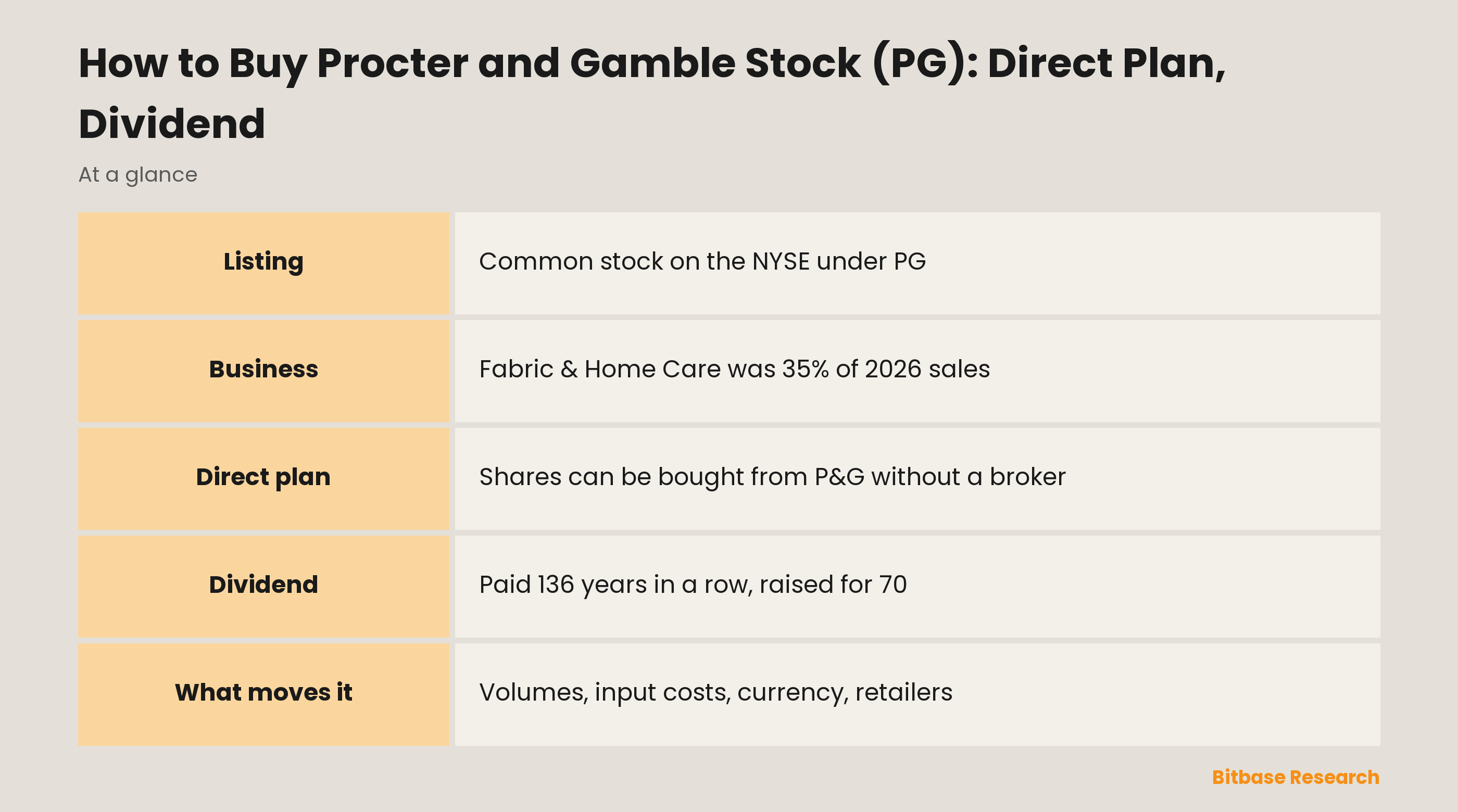
There are two routes to Procter & Gamble stock: a broker that offers New York Stock Exchange listings, where P&G's common shares carry the ticker PG, or an account in the company's own Direct Stock Purchase Plan, which sells shares without a broker. Behind the ticker sit five segments of everyday consumer goods, led by Fabric & Home Care at 35% of fiscal 2026 net sales, and a dividend paid for 136 consecutive years and raised for 70. This guide covers the business, both routes to the shares and what the filings flag: flat volumes, input costs, currency and concentrated retail customers.
What Does Procter & Gamble Do?
Procter & Gamble makes and sells branded consumer goods, "a diversified portfolio of daily-use products" in the words of its annual report, in about 180 countries and territories. The business was founded in Cincinnati in 1837 by William Procter and James Gamble, became a New Jersey corporation in 1890 and was incorporated in Ohio in 1905.
The products fall into five reportable segments. Beauty covers hair, personal and skin care (Pantene, Head & Shoulders, Old Spice, Olay, SK-II). Grooming is Gillette, Venus and Braun; Gillette arrived with the 2005 acquisition of The Gillette Company. Health Care joins oral care from Crest and Oral-B with remedies such as Vicks and Metamucil. The two largest are Fabric & Home Care (Tide, Ariel, Downy, Dawn, Febreze, Swiffer) and Baby, Feminine & Family Care (Pampers, Always, Tampax, Bounty, Charmin).
On its own estimates, built from purchased market data and internal figures, P&G holds more than 60% of the global blades and razors market, over 35% of fabric care in the markets where it competes, and more than 30% of baby care worldwide.
Shailesh Jejurikar, who joined the company in 1989, became Chief Executive Officer on 1 January 2026, succeeding Jon Moeller, and added the chairman's role on 1 August 2026.
How Procter & Gamble Makes Money
The fiscal 2026 10-K, for the year ended 30 June 2026, breaks sales down by segment:
| Segment | Share of fiscal 2026 net sales | Net sales growth | Organic sales growth | Major brands |
|---|---|---|---|---|
| Fabric & Home Care | 35% | 2% | 1% | Tide, Ariel, Downy, Dawn |
| Baby, Feminine & Family Care | 24% | 1% | −1% | Pampers, Always, Bounty, Charmin |
| Beauty | 19% | 7% | 5% | Pantene, Head & Shoulders, Olay, SK-II |
| Health Care | 14% | 4% | 1% | Crest, Oral-B, Vicks |
| Grooming | 8% | 4% | 1% | Gillette, Venus, Braun |
Percentages exclude sales recorded in Corporate; organic growth strips out exchange rates, acquisitions and divestitures.
By category, Fabric Care alone made up 23% of net sales and Home Care 12%. For the whole company, net sales rose 3%, of which currency contributed 2% and higher prices 1%; unit volume and mix were unchanged, so organic sales grew 1%.
P&G sells mostly through retailers. Walmart and its affiliates accounted for about 16% of total sales in each of fiscal 2024, 2025 and 2026, and the top ten customers for about 43% in 2026; the Walmart stock guide covers that retailer's own business. The United States produced about 48% of net sales, and the five largest international markets, Greater China, the United Kingdom, Canada, Japan and Germany, about 21% together.
Gross margin fell 100 basis points to 50.2% of net sales, as product mix, packaging investments, restructuring, tariffs and commodities outweighed manufacturing savings and higher pricing.
PG Stock at a Glance
| Feature | PG |
|---|---|
| Listing | NYSE (New York Stock Exchange) |
| Ticker | PG |
| Security | Common stock without par value, the only share class on the 10-K cover |
| Listed debt | 17 note series, each with a symbol of its own (for example PG28) |
| Sector | Consumer staples: household and personal care |
| Indexes | S&P 500 and Dow Jones Industrial Average |
| Headquarters | Cincinnati, Ohio |
| Fiscal year | Ends on 30 June |
| Dividend policy | Quarterly; paid for 136 consecutive years, raised for 70 |
| Transfer agent | Equiniti Trust Company (EQ), which also runs the direct plan |
| SEC identifier | CIK 80424 |
Quotes and the current yield change through every session; the Procter & Gamble stock page on Bitbase shows them live.
How to Buy Procter & Gamble Stock
The NYSE listing is the common stock itself, with no depositary receipt in between, and there are two routes to it.
Through a broker:
1. Choose a broker with NYSE access. Outside the US, confirm which legal entity will hold your account and which regulator oversees it.
2. Complete the account checks. Individuals who are not US persons fill in IRS Form W-8BEN; the IRS tells foreign persons to "give Form W-8 BEN to the withholding agent or payer."
3. Deposit funds, comparing the broker's exchange rate as well as its commission.
4. Find the right line. Search PG and make sure the match is Procter & Gamble common stock listed on the NYSE; codes like PG28 are P&G bonds, not shares.
5. Pick an order type. A market order "guarantees that the order will be executed, but does not guarantee the execution price"; a limit order fills only "at a specific price or better."
6. Size it. Fractional shares let a cash amount buy part of a share, but "not every brokerage firm offers fractional share investing," and holders of fractions "may not have voting rights."
Directly from P&G, through the Procter & Gamble Direct Stock Purchase Plan, whose current prospectus was filed with the SEC on 15 October 2026. The plan is run by EQ, and the first feature its prospectus lists is "Make your initial investment directly through the Plan — no need for a broker." It buys whole and fractional shares, takes recurring automatic investments, a built-in form of dollar-cost averaging, and reinvests dividends in full unless the participant opts for partial reinvestment or cash.
Three things differ from a brokerage order. Purchases can be pooled with other participants' and are normally made within five trading days, and "the Company has no control over the times when and the prices at which EQ purchases shares." The fee table charges for enrolment, each investment and each sale, and those fees can change. Payment comes by automatic bank withdrawal or a US-dollar check drawn on a US or Canadian institution, and enrolment "may not be available to investors in certain countries."
Outside the United States, US tax is withheld from dividends. In the IRS's words, "most types of U.S. source income received by a foreign person are subject to U.S. tax of 30%," with a lower rate possible under a tax treaty, and your home country may tax the income again.
Through a fund, P&G is one holding among many: State Street's holdings files dated 16 October 2026 list it in SPY (S&P 500), DIA (Dow Jones Industrial Average) and XLP (consumer staples).
What Moves PG Stock
Volume against price. In fiscal 2026 volume was flat and organic sales rose only 1%. The 10-K notes that "consumers are changing how they perceive value across their basket of goods as cumulative inflation impacts their shopping behavior." Baby, Feminine & Family Care shrank organically.
Input costs and tariffs. The filing names oil-derived resins and pulp as key commodity exposures, and says that when such prices change, "we may or may not pass the change to our customers." Tariffs took about 30 basis points off gross margin. After the US Supreme Court struck down tariffs imposed under the International Emergency Economic Powers Act on 20 February 2026, P&G booked, in the quarter to June 2026, a recovery of half the IEEPA tariffs it had paid.
Currency. With more than half of sales outside the United States, a strong dollar shrinks reported results. Currency added 2% to fiscal 2026 sales, but the 10-K records that weaker currencies have "negatively impacted net sales, net earnings and cash flows" in the past.
Retailers. With about 16% of sales going through one customer, shelf space and trade terms are a matter of negotiation. The risk factors also cite private labels and "growth in hard discounter channels."
Restructuring and deals. A plan announced in June 2025 removes up to 7,000 non-manufacturing overhead roles by the end of fiscal 2027. On 4 August 2026 P&G agreed to buy Thorne, a premium supplements brand, with completion expected in the second quarter of fiscal 2027, subject to regulatory approval.
Risks to Weigh Before Buying PG
Of the risk factors in Item 1A, four headings matter most for the shares:
International exposure. "Our business is subject to numerous risks as a result of having significant operations and sales in international markets," from currency swings to exchange and pricing controls.
Costs. "Our businesses face cost fluctuations and pressures that could affect our results."
Customer concentration. "A significant change in customer relationships or in customer demand for our products could have a significant impact on our business."
Brand reputation. "If the reputation of the Company or one or more of our brands erodes significantly, it could have a material impact on our financial results."
Beyond the business, a single stock ties the outcome to one company, however many brands it owns. A long dividend record is not a promise either: future dividends "will be declared at the discretion of the Company's Board of Directors." And for an investor who counts in another currency, the exchange rate moves both the price and the dividend.
How to Research PG Yourself
P&G's SEC filer number (CIK) is 80424. The fiscal 2026 10-K was filed on 4 August 2026; 10-Qs cover quarters ending in September, December and March, and 8-Ks carry dividends, earnings and leadership changes.
In the 10-K, Item 1A lists the risks and the MD&A splits each segment's sales change into volume, currency, price and mix, which shows whether growth came from more units or higher prices. Item 5 holds the dividend history and a five-year total-return graph against the S&P 500 and the S&P 500 Consumer Staples Index; over the five years to June 2026, P&G's line ends below both.
Two checks prevent mix-ups. "Fiscal 2026" ran from July 2025 to June 2026, so line up periods before comparing with calendar-year companies. And the structured cover, R1.htm, lists 18 registered securities; the plain PG symbol belongs to the common stock alone. Other US-listed companies have their own stock pages on Bitbase.
Procter & Gamble Stock FAQ
Does Procter & Gamble pay a dividend?
Yes, quarterly. According to the 10-K, P&G has paid a dividend for 136 consecutive years since 1890 and raised it for 70 consecutive years, at a compound 5% a year over the last decade. The latest increase, declared on 14 April 2026, was 3%.
Can I buy Procter & Gamble stock with crypto?
Not directly. Brokers and the direct plan both take US dollars, so any crypto must first be converted to cash and moved across, and depending on the jurisdiction, that conversion may be taxed. The share itself puts your name, or your broker's, on the company's register with dividend and voting rights attached, one of the ways crypto and stocks differ.
Can I buy P&G stock directly from the company?
Yes, through the Direct Stock Purchase Plan run by EQ, which takes a first purchase without a broker. Eligibility depends on where you live, and the plan charges its own fees.
Is Procter & Gamble part of the S&P 500 and the Dow Jones Industrial Average?
Yes, both. The 16 October 2026 holdings files of State Street's SPY and DIA, which track those two indexes, each include Procter & Gamble.
Has Procter & Gamble stock ever split?
Yes. In March 2004 the board approved a two-for-one split in the form of a 100% stock dividend, with the new shares distributed from 18 June 2004.
Conclusion
PG can be bought through any broker with NYSE access or through P&G's own plan, which gives up control over timing and price in exchange for skipping the broker. The share holds household brands whose fiscal 2026 growth came from price and currency while volumes stood still. The restructuring to the end of fiscal 2027, the Thorne deal and each quarterly dividend decision are the dated items to follow in the next 10-K and 8-Ks.
Related reading
Other Bitbase articles on this topic:
- How to Buy Mondelez Stock (MDLZ): Oreo, Cadbury and Cocoa Costs
- How to Buy Monster Beverage Stock (MNST): Coca-Cola and the Split
- How to Buy Target Stock (TGT): Quarterly Dividends Since 1967
Disclaimer: This article is educational content from Bitbase Academy, provided for information only. It explains what a company or fund does and how the instruments referenced here differ from one another; it does not constitute investment, trading, tax, or financial advice, and it is neither a recommendation nor an endorsement of any security, token, or trading strategy. A tokenized stock is issued by a third party and is designed to give economic exposure to an underlying asset: it is not a share, it carries no shareholder rights, and it depends on the issuer's structure, eligibility rules, and redemption terms, which the issuer can change. Perpetual futures are leveraged derivatives that hold no underlying asset and can be liquidated, and trading hours, product availability, and eligibility differ by instrument and by jurisdiction and can change at any time. Written as of October 2026; verify everything yourself through company filings, the issuer's own documentation, and the product pages of the venue you trade on.
References
[1] Procter & Gamble Form 10-K, fiscal year ended 30 June 2026: business, segment results, risk factors and dividend history (SEC EDGAR) www.sec.gov
[2] The Procter & Gamble Company Direct Stock Purchase Plan, prospectus dated 15 October 2026 (Form S-3ASR, SEC EDGAR) www.sec.gov
[3] P&G press release, 14 April 2026: dividend increase (Form 8-K, Exhibit 99.1) www.sec.gov
[4] P&G press release, 28 July 2025: Shailesh Jejurikar elected President and CEO from 1 January 2026 (Form 8-K, Exhibit 99.1) www.sec.gov
[5] P&G Form 8-K, 29 July 2026: Jon Moeller retires as Executive Chairman; Shailesh Jejurikar appointed Chairman (Item 5.02) www.sec.gov
[6] P&G Form 8-K, 9 March 2004: board approves two-for-one stock split in the form of a 100% stock dividend www.sec.gov
[7] State Street: SPY daily holdings, 16 October 2026 www.ssga.com
[8] State Street: DIA daily holdings, 16 October 2026 www.ssga.com
[9] State Street: XLP (Consumer Staples Select Sector SPDR) daily holdings, 16 October 2026 www.ssga.com
[10] Investor.gov (SEC): Types of Orders www.investor.gov
[11] Investor.gov (SEC): Investor Bulletin on fractional share investing www.investor.gov
[12] IRS: NRA Withholding www.irs.gov
[13] IRS: About Form W-8 BEN www.irs.gov





