
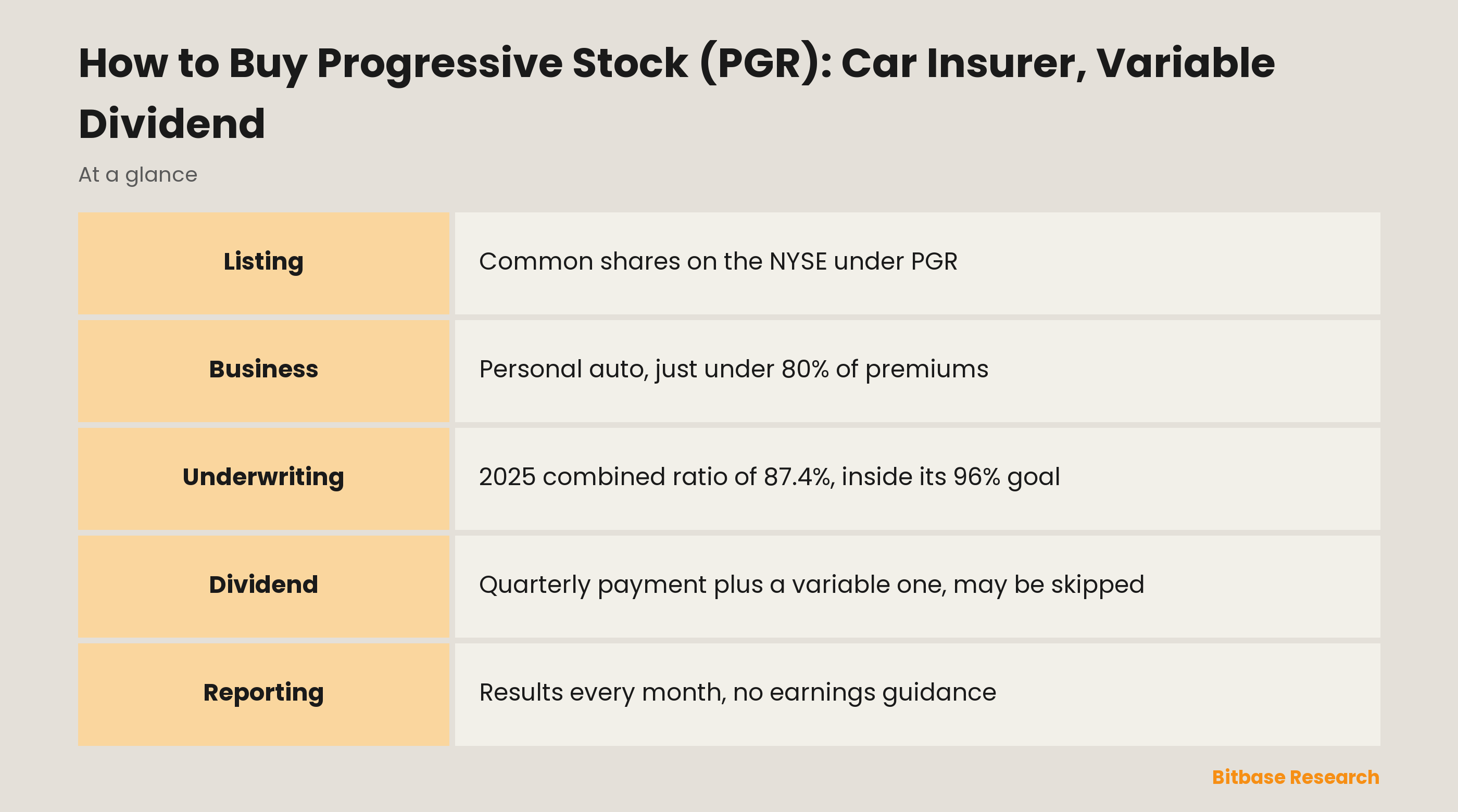
To buy Progressive stock, open an account with a broker that offers New York Stock Exchange shares, then place an order for the common shares of The Progressive Corporation under the ticker PGR. What you get is a stake in an Ohio holding company whose insurers write just under 80% of their premiums in personal auto, according to the 2025 annual report, and which publishes its results every month instead of only every quarter. Its dividend is built differently from most: a regular payment each quarter, plus a variable one that the board considers at least once a year and may decide not to pay. The sections below cover how Progressive earns its profit, how to place the order, and which risks its own filings put first.
What Does Progressive Do?
Progressive sells insurance, most of it for vehicles. Its subsidiaries write personal and commercial auto policies, cover motorcycles, boats and RVs, insure homes and rentals, and sell general liability and property cover to small businesses, along with workers' compensation aimed mainly at trucking. All of it is written in the United States. The insurance organization has been "offering insurance to consumers since 1937," and the listed parent, incorporated in Ohio and based in Mayfield Village, is a pure holding company that "does not have any revenue producing operations, physical property, or employees of its own."
The business reports two segments. Personal Lines produced 87% of net premiums written in 2025. It covers private cars, the "special lines" of motorcycles, RVs and watercraft, and homeowners and renters. Commercial Lines produced the other 13%: trucks, vans and cars used by contractors, haulers, tow operators and other small businesses, plus ride-hailing coverage that Progressive provides to Uber subsidiaries in 14 states.
Customers arrive by two routes: more than 40,000 independent insurance agencies, which also sell other carriers' policies, and direct sales online and by phone. The direct side keeps gaining ground: it wrote 57% of personal vehicle premiums in 2025, up from 54% in 2023.
On size, the annual report uses A.M. Best and S&P Global data. By 2024 premiums written, Progressive was the second-largest private passenger auto insurer in the United States, the largest writer of motorcycle insurance and of commercial auto insurance, and the twelfth-largest homeowners carrier; it has ranked first in commercial auto since 2015.
Snapshot, its usage-based program, lets a driver's recorded behavior adjust the rate and is offered in every state except California; Name Your Price, a quoting feature on its website, is covered by two of its patents. Tricia Griffith is president and chief executive officer, and Andrew Quigg became chief financial officer in July 2026.
How Progressive Makes Money
An insurer collects premiums first and pays claims later, so it earns in two ways: by charging more than its claims and expenses end up costing, and by investing the money in the meantime. Premiums dominate the top line:
| Revenue source | Share of 2025 revenue |
|---|---|
| Net premiums earned | 93.1% |
| Investment income | 4.1% |
| Fees and other revenues | 1.4% |
| Net realized gains on securities | 0.8% |
| Service revenues | 0.6% |
Shares are calculated from the 2025 income statement and rounded to one decimal.
Profit is less lopsided. In 2025 the underwriting profit, meaning premiums and fees minus claims and expenses, equaled about 72.1% of pretax income, and the investment portfolio contributed about 30.1%; interest on debt and a small loss in the service businesses took back the difference.
The yardstick for the underwriting side is the combined ratio: claims, claim-handling costs and underwriting expenses as a percentage of premiums earned. Below 100% the policies make money before any investment income; above it they lose money. Progressive sets itself a companywide goal of a 4% underwriting profit in every calendar year, which is the same as a combined ratio no higher than 96%. The annual report shows how each business has stood against that line:
| Business | 2025 | 2024 | 2023 |
|---|---|---|---|
| Personal vehicles, agency channel | 85.4% | 86.1% | 95.1% |
| Personal vehicles, direct channel | 90.1% | 89.7% | 92.7% |
| Personal property | 75.1% | 98.3% | 98.9% |
| Commercial Lines | 87.0% | 89.4% | 98.8% |
| Companywide | 87.4% | 88.8% | 94.9% |
In 2023 Commercial Lines and personal property were both close to break-even; by 2025 every business sat well inside the goal. The property book, the smallest of the four, swings the most, and the company credits its 2025 result mainly to low catastrophe losses.
PGR Stock at a Glance
| Field | What it is |
|---|---|
| Exchange | New York Stock Exchange (NYSE) |
| Ticker | PGR |
| Security | Common shares, the only security registered on the 10-K cover |
| Issuer | The Progressive Corporation, an insurance holding company |
| Sector | Property and casualty insurance, led by auto |
| Index membership | S&P 500 |
| Headquarters | Mayfield Village, Ohio |
| Incorporated | Ohio |
| Fiscal year | Calendar year, ending 31 December |
| Reporting rhythm | A results release every month, plus the 10-Q and 10-K |
| Dividend policy | Regular quarterly dividend; an additional variable dividend considered at least once a year |
| Transfer agent | Equiniti Trust Company |
| SEC identifier | CIK 80661 |
Live numbers, from the share price to market value, belong on a page that updates with the market: the Progressive stock page on Bitbase.
How to Buy Progressive Stock
Progressive is a US company with one listed share line, so there is no ADR and no second share class to choose between. The steps:
1. Choose a broker with NYSE access. Outside the US, that can be a local or an international broker; find out which company actually holds your account and which authority licenses it.
2. Open and verify the account. Non-US individuals usually complete IRS Form W-8BEN. The IRS tells foreign persons to "give Form W-8 BEN to the withholding agent or payer," which in this case is the broker.
3. Fund it. If your savings are in another currency, the conversion has its own cost, so look at the currency spread and not only the trading fee.
4. Find the right line. Search for PGR and confirm that the result is The Progressive Corporation's common shares on the NYSE.
5. Pick an order type. FINRA describes a market order as the type that "provides the most certainty that your order will be executed," although "you might not get the price you saw or were originally quoted, especially in fast-moving markets." A limit order guarantees "your limit price or a better price if your order is executed," with "a chance your order doesn't get executed at all." More on how market orders execute and fill.
6. Decide the size. Buying part of a share lets you put in a fixed sum of money, but "the availability of fractional share trading varies by brokerage firm," a fractional owner "might not have shareholder voting rights," and FINRA notes that fractional shares cannot currently be transferred to another firm.
7. Keep the paperwork. Confirmations and statements record your cost basis and dividends, which with PGR arrive unevenly: in each of the last three years the variable dividend was declared in December and paid in January.
Tax outside the United States. The IRS states that "most types of U.S. source income received by a foreign person are subject to U.S. tax of 30%," and that a reduced rate, including exemption, may apply where your country has a tax treaty with the United States; the W-8BEN is how the broker learns which rate applies. Your home country may tax the income again.
Holding it through a fund. Progressive is an S&P 500 constituent, so funds that track the S&P 500 hold it as one position among hundreds.
What Moves PGR Stock
A results release every month. Progressive publishes results for each month, not only at quarter-end: September 2026 figures, together with the quarter, came out on 14 October 2026, and October's were scheduled for 18 November 2026. In its own words, "We do not provide earnings estimates to the market and do not comment on earnings estimates by analysts." Each month's combined ratio and policy count therefore arrive with nothing official to compare them against.
Claim frequency and severity. Auto claims are the largest cost, and they can move in opposite directions. In 2025, personal auto claim frequency fell 3% while severity, the average cost per claim, rose 6%. Bodily injury severity rose 10%, which the company tied to "more large losses, higher medical costs, and increased bodily injury coverage reserves due to a higher rate of plaintiff-attorney represented claims." Tariffs are the newest variable: the annual report says they "may result in higher loss costs," with "the possible need for rate increases throughout 2026."
Rates, growth and shopping. Progressive cut personal auto rates by less than 1% in aggregate during 2025, and net premiums written still rose 12%; in the first nine months of 2026 the increase slowed to 5%. Policies are also expected to stay on the books for less time: personal auto policy life expectancy, the company's main retention measure, fell 7% over 2025, which it linked to "increased shopping and competition in the marketplace." Commercial Lines has its own swing factor in the ride-hailing book, where some policies were not renewed in 2025.
Florida's profit cap. A Florida statute limits the profit any insurance group can earn on personal auto insurance over three consecutive accident years. After the state's 2023 insurance reform brought down some claim costs, Progressive's Florida profit went past that limit, and in 2025 it booked policyholder credits that added 1.5 points to its companywide expense ratio. The credits were paid out in the first quarter of 2026.
Weather and the property book. Catastrophes added 1.8 points to the 2025 combined ratio, half the 3.6 points of 2024. Measured against premiums, the exposure is heaviest in personal property, where catastrophes cost 10.4 points in 2025 against 1.6 for personal vehicles. Property carries catastrophe reinsurance; the company says it has no "catastrophe-specific reinsurance for our personal auto, special lines, or core commercial auto businesses." It also cut its exposure in weather-prone markets during 2025, accepting new homeowners business, where permitted, only when bundled with a Progressive auto policy, before starting to reopen some markets late in the year.
Interest rates. The portfolio is "invested primarily in short-term and intermediate-term, investment-grade fixed-income securities," with a duration of 3.4 years at the end of 2025. Higher yields raise the income on new money but cut the value of bonds already held: in September 2026, net income was positive while unrealized bond losses left total comprehensive income negative.
Risks Progressive Flags in Its 10-K
Of the headings in Item 1A, these bear most directly on a PGR share; the latest quarterly report says none has changed materially:
Pricing. "Our success depends on our ability to underwrite and price risks accurately and to charge adequate rates to policyholders." Rates are set before claims are known, and regulators decide how quickly they can change, under rules that run from "use and file" to "prior approval."
Reserves. "Our success depends on our ability to establish accurate loss reserves." Reserves are estimates; when claims from earlier years settle for more than reserved, the difference is charged against current results.
Catastrophes. "Our insurance operating results have been and likely will continue to be materially adversely affected by severe weather and other catastrophe events, and climate change may be exacerbating these events and their impacts."
Competition. "We compete in property and casualty insurance markets that are highly competitive."
Litigation. "Lawsuits challenging our business practices, and those of our competitors and other companies, are pending and more may be filed in the future." The annual report describes class actions in several states alleging that Progressive undervalues total-loss vehicle claims through a "negotiation adjustment," with classes certified in three states.
The dividend. "Our dividend policy likely will result in varying amounts being paid to our common shareholders, or no payment in some periods, and the dividend policy ultimately may be changed in the discretion of the Board of Directors."
Above the business, a single stock ties your money to one company, and this one is concentrated in auto insurance in one country; its results for any period "may vary, perhaps significantly, from investors' expectations," the 10-K warns. And for anyone who measures wealth in another currency, exchange-rate moves add to or subtract from both the share price and the dividends.
How to Research PGR Yourself
Progressive's SEC filings sit under CIK 80661: the 10-K once a year, 10-Qs each quarter, and 8-Ks for every monthly results release and other events. One quirk matters: the 10-K's main document carries the business description and the risk factors, while the financial statements, the management discussion and the segment notes sit in the Annual Report to Shareholders, filed with the 10-K as an exhibit. If the combined ratio table seems missing from the 10-K, that is where it is.
The monthly release is the most current source. It reports premiums written and earned, the combined ratio by business, catastrophe losses, reserve development and policies in force, which stood at about 40.5 million at the end of September 2026. The investor relations site, investors.progressive.com, collects those releases along with the dividend history, the stock split table and the events calendar.
The annual report's performance graph compares PGR with the S&P 500 and the S&P 500 Property & Casualty Insurance Index, a useful pair for your own comparison. The stock page linked earlier has the live quote; to compare other companies, see the full list of US stock pages on Bitbase.
Progressive Stock FAQ
Does Progressive pay a dividend?
Yes, in two parts. Under the board's policy, Progressive declares a regular quarterly dividend and, at least once a year, considers an additional variable dividend; in each of the last three years that variable dividend was declared in December and paid in January. The 10-K warns that the policy will likely produce varying amounts, "or no payment in some periods," and the board can change it. Amounts are in each declaration's 8-K and in the investor site's dividend history.
Can I buy Progressive stock with crypto?
Not in one step. A PGR purchase goes through a brokerage account and is paid in US dollars, so any crypto would first have to be sold, which may count as a taxable disposal where you live, and the proceeds sent to the broker. A PGR share is equity in an Ohio company, with a vote at its annual meeting and a claim on declared dividends; how crypto differs from stocks covers the gap.
Is PGR in the S&P 500?
Yes. State Street's daily holdings file for its S&P 500 ETF (SPY), dated 28 October 2026, lists Progressive Corp under the ticker PGR. Index weights change every trading day.
How often does Progressive report results?
Every month. Besides the quarterly 10-Q and the annual 10-K, it publishes a results release for each month and files it on Form 8-K; the release for a quarter's final month also carries selected quarterly figures. The company does not issue earnings guidance.
Has Progressive stock ever split?
Yes, eleven times according to the stock split table on its investor site, starting with a 22-for-1 split in 1971. The two most recent were a 3-for-1 split effective 22 April 2002 and a 4-for-1 split paid as a stock dividend on 18 May 2006. Per-share figures from before 2006 need adjusting before any comparison.
Is Progressive Insurance the same company as PGR?
PGR is the stock of The Progressive Corporation, the holding company that owns the Progressive insurers. The parent has no operations or employees of its own, so a PGR share is a claim on the whole group, underwriting and investments alike.
Conclusion
Buying PGR takes three practical steps: an account with a broker that reaches the NYSE, a check that the order screen shows The Progressive Corporation's common shares, and a market or limit order sized to your plan. Understanding it takes more. Progressive is a mostly-auto insurer whose results turn on the combined ratio, which it reports every month against a 96% ceiling of its own making, and its dividend is designed to vary, perhaps significantly, from year to year. Read the latest monthly release and the annual report before deciding how much one insurer should weigh in your portfolio.
Related reading
Other Bitbase articles on this topic:
- How to Buy Arthur J. Gallagher Stock (AJG): Broker, Not Insurer
- How to Buy Chubb Stock (CB): Swiss Shares, Dividend, Catastrophes
- How to Buy Manulife Stock (MFC): One Share on Four Exchanges
Disclaimer: This article is educational content from Bitbase Academy, provided for information only. It explains what a company or fund does and how the instruments referenced here differ from one another; it does not constitute investment, trading, tax, or financial advice, and it is neither a recommendation nor an endorsement of any security, token, or trading strategy. A tokenized stock is issued by a third party and is designed to give economic exposure to an underlying asset: it is not a share, it carries no shareholder rights, and it depends on the issuer's structure, eligibility rules, and redemption terms, which the issuer can change. Perpetual futures are leveraged derivatives that hold no underlying asset and can be liquidated, and trading hours, product availability, and eligibility differ by instrument and by jurisdiction and can change at any time. Written as of October 2026; verify everything yourself through company filings, the issuer's own documentation, and the product pages of the venue you trade on.
References
[1] The Progressive Corporation Form 10-K, fiscal 2025: business, risk factors and market for the common shares (SEC EDGAR) www.sec.gov
[2] The Progressive Corporation 2025 Annual Report to Shareholders, filed with the 10-K: financial statements, combined ratios and dividends www.sec.gov
[3] The Progressive Corporation Form 10-Q for the quarter ended 30 June 2026: Florida policyholder credits and risk factors www.sec.gov
[4] Progressive news release, 14 October 2026: September and third-quarter 2026 results (Form 8-K) www.sec.gov
[5] The Progressive Corporation Form 10-Q for the quarter ended 30 June 2006: the 4-for-1 stock split of May 2006 www.sec.gov
[6] Progressive Investor Relations: stock split table investors.progressive.com
[7] State Street: SPDR S&P 500 ETF Trust (SPY), daily holdings as of 28 October 2026 www.ssga.com
[8] FINRA: Order Types www.finra.org
[9] FINRA: Investing in Fractional Shares www.finra.org
[10] IRS: About Form W-8 BEN www.irs.gov
[11] IRS: NRA Withholding www.irs.gov





