
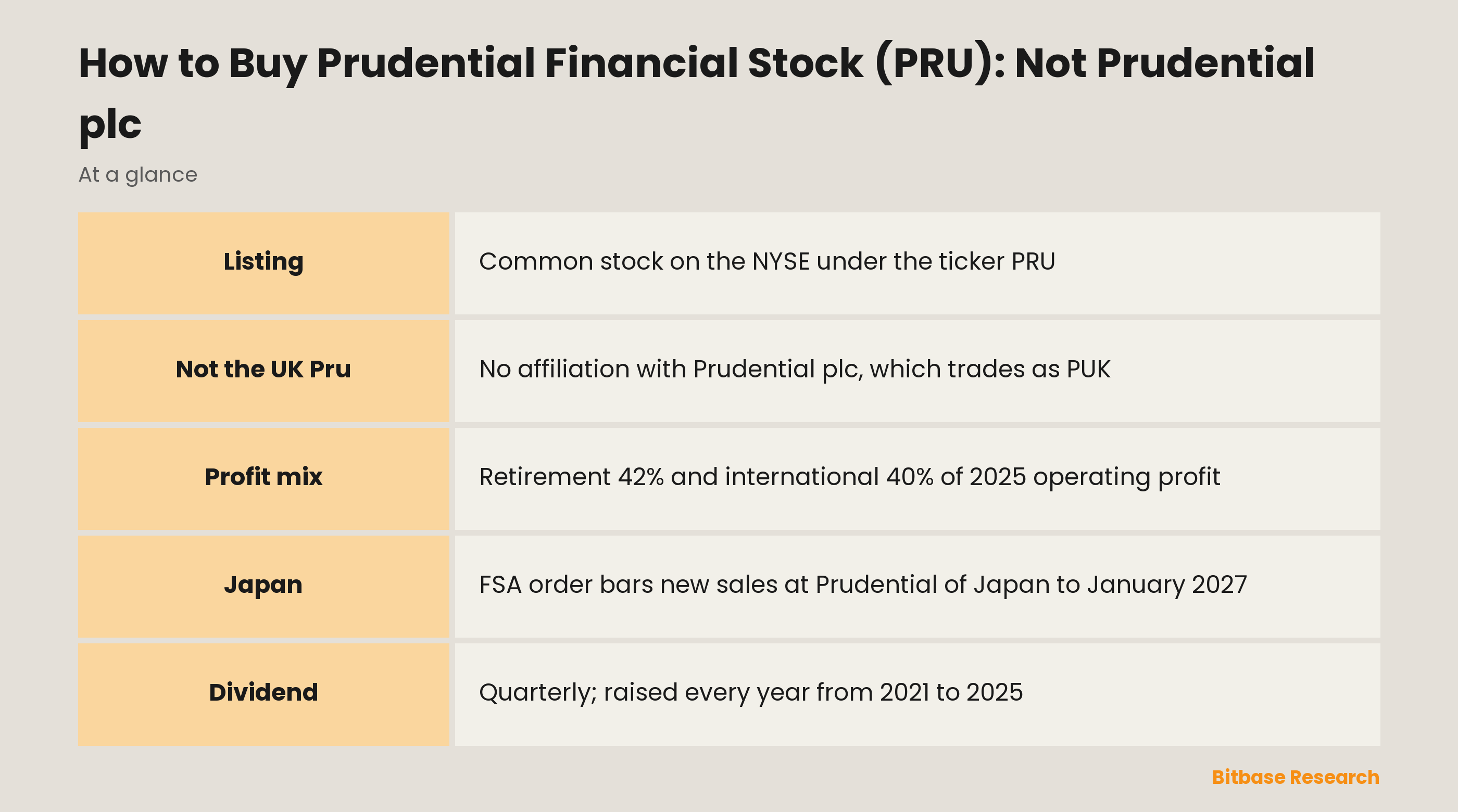
Prudential Financial is listed on the New York Stock Exchange as PRU, and its shares can be bought through any brokerage account with access to US equities. The Newark, New Jersey insurer has no affiliation with the UK's Prudential plc, and in 2025 about 82% of the operating profit of its five businesses came from two of them: US retirement and an international arm centred on Japan. This guide covers what it sells, how to place the order, and why a sales suspension in Japan dominated its 2026.
What Does Prudential Financial Do?
Prudential Financial sells life insurance, annuities and retirement products, and owns PGIM, an investment manager that works for outside clients as well as for the group.
The listed company is younger than the name. Its main US insurer, The Prudential Insurance Company of America, belonged to its policyholders until 18 December 2001, when it converted to a stock company under Prudential Financial. The holding company completed an initial public offering that day, on top of the shares it handed to policyholders. Older participating policies were ring-fenced in a structure called the Closed Block, still reported separately.
In 2025 the group ran five businesses:
PGIM manages bonds, equities, real estate, private credit and multi-asset portfolios. Public fixed income made up about 62% of its assets under management at the end of 2025, and PGIM held about 91% of all assets the group managed.
Retirement Strategies takes over corporate pension obligations through pension risk transfer, in which "we assume all investment and actuarial risk associated with a group of specified participants within a plan in return for a premium typically paid as a lump-sum at inception." It also issues funding agreements and structured settlements, writes longevity reinsurance, including in the United Kingdom, and sells individual annuities such as the FlexGuard range.
Group Insurance sells life, disability and supplemental health cover through employers; most premiums come from employers with over 5,000 benefit-eligible employees. Individual Life sells term, universal and variable policies.
International Businesses operated mainly in Japan, Brazil and Mexico, with joint ventures in Chile, China, India and Indonesia. In Japan it sells through two in-house agent models: Life Planners, who serve affluent customers and numbered 4,283 there at the end of 2025, and Life Consultants, who sell to middle-income households.
The map was redrawn in 2026. From 1 January, guaranteed universal life and traditional variable annuities with living-benefit riders moved into a closed segment, U.S. Legacy Products, and the remaining annuities joined the institutional business in one Retirement segment. In August the company said it intends "to exit emerging markets" and focus on "the United States, Japan, and select markets in Europe." From the third quarter, International Businesses became Japan Businesses.
How Prudential Financial Makes Money
An insurer earns premiums, income on the money it invests before claims are paid, and fees. In 2025 premiums supplied about 51% of revenue and net investment income about 35%.
Revenue is a weak guide to profit, because a large pension deal books its premium up front along with a reserve of almost the same size. In 2025 premiums at the institutional retirement business fell 52%, which the 10-K puts down to "the absence of significant sales that occurred in the prior year, with corresponding offsets in policyholders' benefits," and total revenue fell about 14%. The company judges its businesses on adjusted operating income instead:
| Business (2025 structure) | Share of 2025 adjusted operating income | Where the money comes from |
|---|---|---|
| Retirement Strategies | 42% | Pension risk transfer and annuity premiums, fees, investment income |
| International Businesses | 40% | Life, retirement and health products, mostly in Japan |
| PGIM | 11% | Asset management, performance and transaction fees |
| Group Insurance | 5% | Group life, disability and supplemental health premiums |
| Individual Life | 3% | Premiums, policy charges, investment income |
Shares are calculated from the 10-K segment table as each business's part of the five-business pre-tax total, leaving out the loss posted by Corporate and Other.
PGIM's fees are "typically calculated based upon a percentage of assets under management," so they move with markets and client flows.
PRU Stock at a Glance
| Feature | PRU |
|---|---|
| Exchange | New York Stock Exchange |
| Ticker | PRU |
| Security | Common stock; PRH, PRS and PFH, also on the NYSE, are the company's junior subordinated notes |
| Sector | Life insurance, retirement products and asset management |
| Index membership | S&P 500 |
| Headquarters | Newark, New Jersey |
| Incorporated | New Jersey |
| Listed since | December 2001, when the US insurer demutualized |
| Fiscal year | Calendar year, ending 31 December |
| Payouts | Quarterly cash dividend; buybacks under a yearly authorization |
| SEC identifier | CIK 1137774 |
Share price, market value and yield change all the time, so this guide leaves them out; the Prudential Financial stock page on Bitbase carries the live numbers.
How to Buy Prudential Financial Stock
The common stock is listed directly in New York, with no depositary receipt in between:
1. Pick a broker that reaches the NYSE. Outside the United States, check which legal entity runs the account and who supervises it.
2. Pass the account checks. Non-US individuals generally give the broker IRS Form W-8BEN, which sets the withholding rate on US dividends.
3. Deposit funds. Converting currency adds an exchange spread to the cost.
4. Search PRU and read the result. It should say Prudential Financial, Inc. common stock. PRH, PRS and PFH are notes that make you a creditor, not an owner, and PUK is a different company (see the FAQ).
5. Set the order type. FINRA says brokers "typically enter your order as a market order unless you specify otherwise"; a limit order fills only "at or better than a specified price."
6. Choose the amount. If your broker offers fractional shares, you can invest a set sum; ask how it pays dividends on fractions.
7. Keep the records. Statements establish your cost basis.
Tax abroad. The IRS states that "most types of U.S. source income received by a foreign person are subject to U.S. tax of 30%," and a tax treaty can lower that rate. Your home country may tax the dividend too.
What Moves PRU Stock
The sales suspension in Japan. In January 2026 Prudential of Japan reported the findings of an internal investigation into misconduct involving certain employees. The company voluntarily halted new sales there from 9 February and later extended the halt to 5 November. In October Japan's Financial Services Agency barred Prudential of Japan from soliciting new business through 31 January 2027, stopped new sales through Gibraltar Life's Life Consultant channel over the same period, and required business improvement plans by the end of November 2026. In the third quarter, adjusted operating income from Japan Businesses fell 25% from a year earlier and constant-dollar sales fell 36%, "primarily driven by the Prudential of Japan sales suspension."
Interest rates and credit. Investment income comes largely from bonds and loans. The 10-K notes that some liabilities run "30 years or more"; when rates fall, the company "must invest in lower-yielding instruments," and when they rise fast, customers may surrender policies for better rates elsewhere.
Markets and PGIM. For the third quarter of 2026 the company reported PGIM's third-party net flows at "their highest level in 10 quarters" and retail annuity sales at "their highest quarterly level since 2013."
The yen. Japanese profits are earned in yen and reported in dollars. A "yen hedging strategy" softens the currency effect without removing it.
Selling the edges. On 20 October 2026 the company agreed to sell Prudential of Brazil and Prudential of Mexico to the CNP Assurances group and expects both deals to close in 2027, subject to regulatory approval. It also announced the sale of its South Africa insurance business and completed exits from Indonesia and Kenya.
Where Prudential Financial Can Disappoint Shareholders
Item 1A of the 10-K sorts risks by type. These bear most on a PRU share:
Investments. "Our investment portfolios are subject to the risk of loss due to default or deterioration in credit quality or value," and some holdings are "relatively illiquid."
Insurance assumptions. "Our profitability may decline if mortality experience, morbidity experience or policyholder behavior experience differ significantly from our expectations when we price our products." Annuities and pension deals lose if people live longer than priced; life insurance loses if they do not.
Markets. The filing singles out "material changes in the value of the Japanese yen relative to the U.S. dollar," and warns that hedges "might not perform as intended or expected."
Conduct. The 10-K lists "improper sales practices" among operational risks, and the latest 10-Q adds the Japan misconduct case, "including the duration of the suspension of sales," to its list of uncertainties.
Holding company cash. "The principal sources of funds available to Prudential Financial, the parent holding company, are dividends, returns of capital and loans from subsidiaries," and insurance law limits what those subsidiaries may send up.
Beyond the business, one stock concentrates your money in one company, and each dividend is a board decision, not a promise. The junior subordinated notes also carry a "dividend stopper" that restricts common dividends if their interest goes unpaid.
How to Research PRU Yourself
Every report sits on SEC EDGAR under CIK 1137774: the 10-K, three 10-Qs a year and 8-Ks for events. In 2026 quarterly results came out on 3 February, 5 May, 4 August and 3 November; the filings are also free at investor.prudential.com, where earnings calls are broadcast.
In the 10-K, Item 1 covers the businesses and the naming agreement with Prudential plc, Item 1A the risks, and the MD&A segment results and dividend history. The latest 10-Q follows the Japan orders and restates segments for 2026, so compare against its figures.
For quotes, use the stock page above or Bitbase's list of US stock pages. Two other listed insurers are covered in our MetLife stock guide and Aflac stock guide.
Prudential Financial Stock FAQ
Is Prudential Financial the same company as Prudential plc?
No. The 10-K says that since 2004 Prudential Financial has had an agreement with Prudential plc of the United Kingdom, "with whom we have no affiliation," on use of the names "Prudential" and "Pru." Outside the Americas, including Europe, Africa and most of Asia, the American company pairs its Rock symbol with other names. Prudential plc files with the SEC as a UK issuer and trades on the NYSE as PUK.
Can I buy Prudential Financial stock with crypto?
Not directly. PRU shares are bought in US dollars through a brokerage account, so crypto has to be sold and the money sent to the broker first, and that sale may be taxable where you live. A share also carries dividends and votes in a registered company, which is how a share differs from a crypto asset.
Does Prudential Financial pay a dividend?
Yes, every quarter. The amount declared per share rose in each year from 2021 to 2025, and the board raised the quarterly payment again in February 2026. Check the latest earnings release for the current amount and dates.
What are PRH, PRS and PFH?
They are NYSE listings of Prudential Financial's junior subordinated notes. Holders are lenders who receive interest, not owners. Shareholders should still know them, because if that interest is not paid, dividends on the common stock are restricted.
Is PRU in the S&P 500?
Yes. Prudential Financial was in State Street's daily holdings file for SPY on 6 November 2026; its weight changes with the share price.
Conclusion
Prudential Financial in late 2026 is narrowing itself to fewer, bigger bets: US retirement, PGIM and Japan, with Brazil, Mexico and other emerging-market units being sold. Its earnings now hinge on how long the suspension in Japan lasts and what it costs, on interest rates, and on the timing of large pension deals. The next 10-Q will show Japan on the restated segment basis, and that is the place to start before deciding how much one insurer should weigh in your savings.
Related reading
Other Bitbase articles on this topic:
- How to Buy AIG Stock (AIG): Commercial Insurance After Corebridge
- How to Buy Arch Capital Stock (ACGL): Reinsurance and Mortgages
- How to Buy Cincinnati Financial Stock (CINF): Insurer and Investor
- How to Buy Sun Life Stock (SLF): MFS Funds, US Dental and Asia
Disclaimer: This article is educational content from Bitbase Academy, provided for information only. It explains what a company or fund does and how the instruments referenced here differ from one another; it does not constitute investment, trading, tax, or financial advice, and it is neither a recommendation nor an endorsement of any security, token, or trading strategy. A tokenized stock is issued by a third party and is designed to give economic exposure to an underlying asset: it is not a share, it carries no shareholder rights, and it depends on the issuer's structure, eligibility rules, and redemption terms, which the issuer can change. Perpetual futures are leveraged derivatives that hold no underlying asset and can be liquidated, and trading hours, product availability, and eligibility differ by instrument and by jurisdiction and can change at any time. Written as of November 2026; verify everything yourself through company filings, the issuer's own documentation, and the product pages of the venue you trade on.
References
[1] Prudential Financial Form 10-K for 2025 (SEC EDGAR) www.sec.gov
[2] Prudential Financial 2025 Form 10-K, XBRL cover page (SEC EDGAR) www.sec.gov
[3] Prudential Financial Form 10-Q for the third quarter of 2026 (SEC EDGAR) www.sec.gov
[4] Prudential Financial third-quarter 2026 earnings release, filed with Form 8-K (SEC EDGAR) www.sec.gov
[5] State Street SPDR S&P 500 ETF Trust (SPY): fund page and daily holdings www.ssga.com
[6] FINRA: Order Types www.finra.org
[7] IRS: NRA Withholding www.irs.gov
[8] IRS: About Form W-8 BEN www.irs.gov
[9] Prudential plc filings on SEC EDGAR www.sec.gov





